
The short version
- Melanotan 2 is widely described as unapproved for human use and is sold as an unregulated research chemical in many markets.
- Afamelanotide, the MT1 form with the clearest approval history, is approved only as Scenesse, a sterile fixed-dose implant for erythropoietic protoporphyria (EPP) in some jurisdictions.
- Melanotan 2 is often described as having stronger MC4R activity than MT1, which is why nausea, appetite suppression, and libido side effects are more prominent in user reports.
- A melanotan tan is not UV protection. It doesn’t replace sunscreen.
- Case reports and poison-center reviews have described blood-pressure changes, rare renal events, and mole darkening that can make melanoma surveillance harder.
Where I land before the comparison
If you came looking for a clean ranking, the answer is uncomfortable: neither peptide earns a place in a cosmetic tanning protocol. MT1 has a narrow approved medical niche. MT2 has no approved cosmetic use and no verified dosing path. That’s not a ranking, it’s a safety boundary.
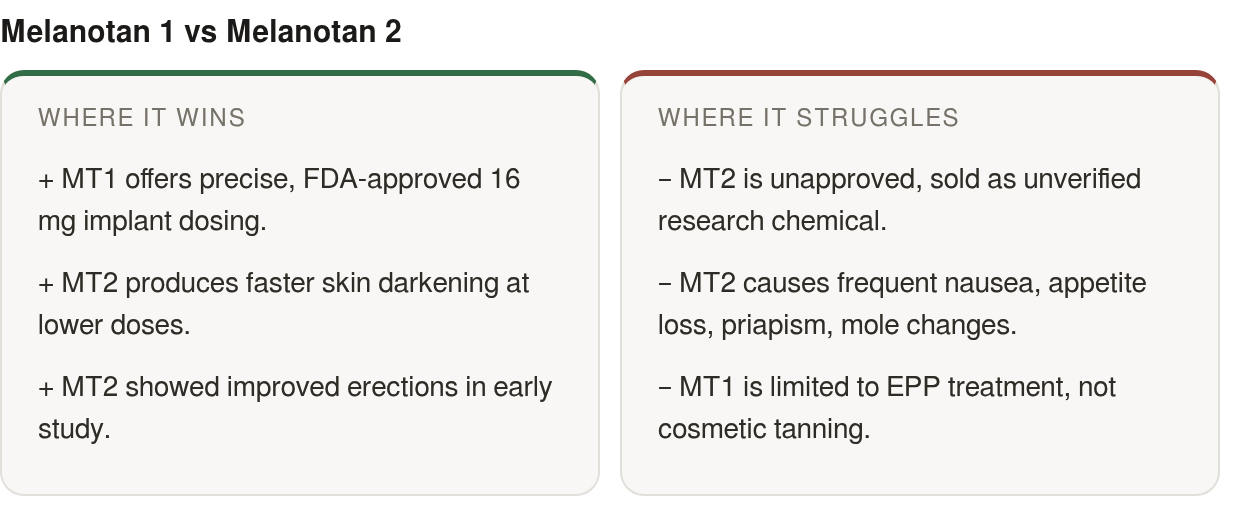

People searching for “beste melanotan” usually want a tan without UV damage. The logic feels clean. The catch is that the product sold for that purpose, Melanotan 2, is not an approved drug in many markets. It is usually an unregulated vial of lyophilized powder. The “research chemical” label doesn’t make it safer; it means the contents are not verified for identity, sterility, or dose.
That doesn’t mean the underlying mechanism is worthless. Afamelanotide has real evidence behind it for EPP. But that evidence doesn’t transfer to an unregulated vial marketed for cosmetic use.
Why people keep searching for the ‘beste melanotan’
The appeal is straightforward: a peptide that stimulates melanin production sounds like an internal alternative to UV. But the data conflict even on the core claim. Some peptide-focused sources cite less sunburn, while mainstream medical references caution that a melanotan tan does not protect skin from UV damage and shouldn’t be treated as sun protection. Even afamelanotide’s approved labeling does not position it as sunscreen.
The search stays popular because people want an aesthetic result with less perceived effort, and access or cost barriers can push people toward unregulated vials instead of a regulated implant. Online popularity is not safety data. A lower visible price does not purchase verified sterility, identity, or dose. In fact, Melanotan 2’s most dramatic darkening is often reported when users combine it with UV exposure, which drives more mole change, not less.
The “personalized dosing protocol” framing also doesn’t survive contact with the product. You can draw a number on a syringe, but you can’t titrate an unknown quantity of an unverified peptide. Precision dosing only exists with the regulated MT1 implant, and that implant is an orphan-disease treatment, not a cosmetic tool.
The clinical differences nobody checks
Melanotan 2 and afamelanotide are not interchangeable. MT2 is often described as having stronger activity at the MC4 receptor, which is why nausea, appetite suppression, and libido changes are more common in user reports than in regulated Scenesse use. Cosmetic MT2 is usually sold as a lyophilized powder that buyers reconstitute at home. Scenesse is a sterile fixed-dose implant placed by a clinician. Those are two different orders of dose control and sterility.
The harms in the literature are not vague. Reported side effects include nausea, facial flushing, and darkening or enlargement of moles that can make melanoma harder to detect or rule out. A tan from Melanotan 2 does not protect skin from the sun. Some poison-center case reviews describe flushing, fast heart rate, and anxiety rather than the aesthetic outcome people are buying.
Home reconstitution also shifts injection hygiene and delivery-chain risk to the buyer. In a regulated implant, dose, sterility, and route are controlled; in an unregulated vial, none of those are verified.
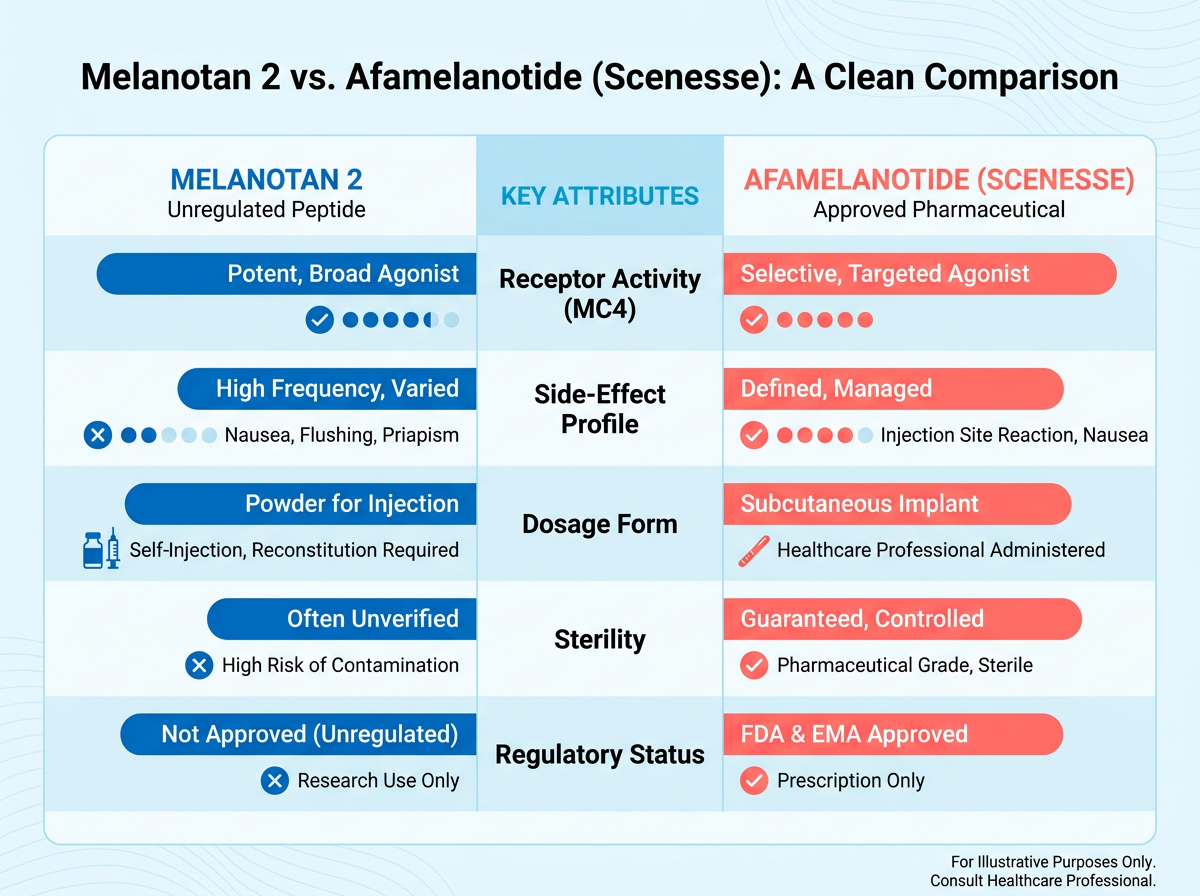
The only member of this family with a legitimate, quantified skin rationale is afamelanotide, used as Scenesse for EPP under specialist care. That’s a prescription therapy for a rare photodermatosis, not a cosmetic tanning shortcut. Clinical trial endpoints measured reductions in painful phototoxic episodes. No comparable endpoint exists for cosmetic MT2.

For a clinic that describes itself as science-backed and data-driven, that distinction matters. If your standard is precision medicine, you don’t start by ranking an unregulated injectable against a regulated implant and calling it a tie.
Where the pros and cons actually land
When someone asks which melanotan is best, the first clarification is that the two compounds are not in the same regulatory class. One has a regulated, fixed-dose form. The other is an unregulated vial with no verified contents.
Before any peptide enters a protocol, I run it through the same precision-medicine gate:
- Verified identity: Is the exact molecule confirmed? If the vial cannot be identity-tested, the protocol stops.
- Dose input: Is the administered dose known and reproducible? A fixed-dose implant passes; a home-reconstituted powder does not.
- Sterility and delivery: Is the route sterile and clinician-controlled? If injection hygiene shifts to the user, that risk is part of the decision.
- Measurable endpoint: For EPP, the endpoint is UV-triggered pain and phototoxic episodes. For cosmetic tanning, there is no comparable endpoint.
- Skin surveillance: Baseline mole mapping and dermatoscopic follow-up are required before any melanocortin exposure.
- Stopping rule: Darkening, new or changing nevi, or systemic symptoms trigger immediate reassessment.
That gate is the ranking. Under it, neither peptide passes for cosmetic use.
Melanotan 1: real dosing control, narrow door
The strongest case for MT1 is dosing precision. The approved form, afamelanotide, comes as a standardized fixed-dose subcutaneous implant on a fixed schedule, so the input dose is known. In controlled EPP studies, the most commonly reported side effects were mild: nausea, fatigue, dizziness, and skin darkening. For people with EPP, the benefit is real; the treatment reduced UV-triggered pain and phototoxic reactions in the studies.
The trade-off is access. The implant is approved for EPP, not cosmetic tanning. Outside that narrow channel, MT1 sold as a research peptide has the same unregulated-vial problems as MT2, just with a milder side-effect profile.
| Attribute | Melanotan 1 | Melanotan 2 |
|---|---|---|
| Approved form | Afamelanotide (Scenesse) for EPP only | No approved cosmetic indication |
| Dosing control | Fixed-dose implant, known schedule | Vial contents unverified |
| Pigment speed | Slower to darken for cosmetic use | Faster, lower cumulative doses |
| Common side effects | Nausea, fatigue, dizziness | Nausea, flushing, erections, appetite loss |
| Key risk | Access limited to EPP patients | Melanoma masking, priapism, renal events |
Melanotan 2: faster pigment, broader receptor noise
MT2’s appeal is speed. It is often described as increasing pigmentation at lower cumulative doses than MT1 because its structure activates additional melanocortin receptors, including MC4R. That broader receptor activity may also create effects some users seek; early research described improved erectile response and increased desire in a subset of volunteers.
The cons outweigh that. Extra MC4R activity brings nausea, flushing, appetite suppression, and priapism risk. The mole changes are more concerning. Published case reports describe rapid mole changes after self-injection plus tanning bed use, including in people with a family history of melanoma. Some reports describe darkening that may fade after stopping, but that does not solve the short-term melanoma-masking problem: a changing mole still needs dermatoscopic review, not a waiting period.
The legal picture varies by jurisdiction, with some countries restricting purchase or supply and others leaving personal possession in a grey area. None of that makes an unregulated vial safe.
Why the ‘beste melanotan’ search misses the point
My clinic doesn’t offer either product for cosmetic tanning. The reason is that precision dosing of MT2 is a fiction. You cannot titrate an unknown quantity of an unverified peptide against someone’s biomarkers and call it personalized medicine. The input dose is the variable you never control.
There’s also a self-defeating logic in the sun-alternative pitch. MT2’s dramatic darkening is most often reported when paired with UV, and the MT2-plus-sunbed combination is exactly what drives rapid mole changes in the case literature. Choosing MT2 to avoid the sun tends to push users toward more UV exposure, not less.
Who these peptides are actually for
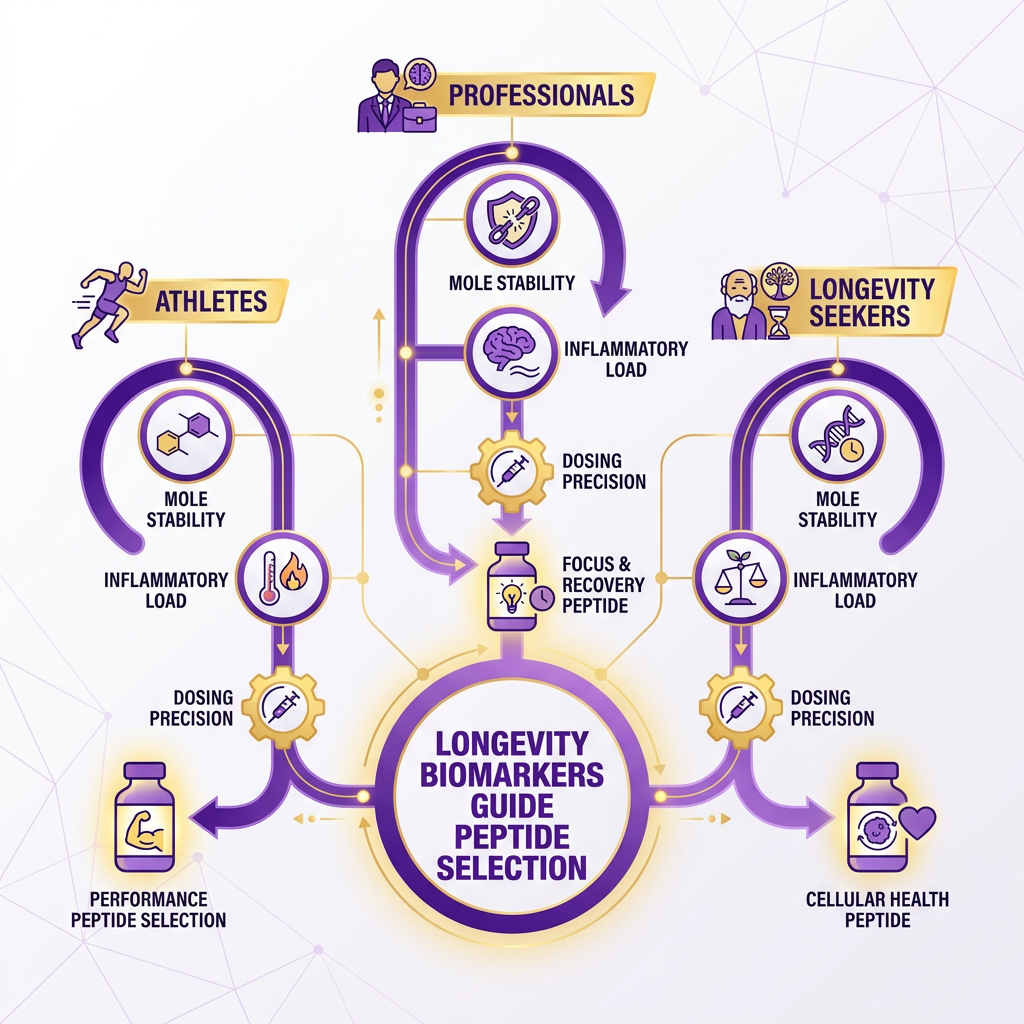
The search for “beste melanotan” usually comes from people who want a deeper tan without UV damage, and they assume the only question is which peptide works faster. I start differently. The biomarkers that matter here are mole stability, inflammatory load, and whether the product can be dosed precisely enough to track any effect. For cosmetic tanning, neither MT1 nor MT2 clears that bar.
The one scenario where Melanotan 1 makes sense
The fixed-dose afamelanotide implant has a real, evidence-backed place in treating EPP. People with EPP experience severe, sometimes disabling pain after brief sun exposure because their skin cannot clear protoporphyrin normally. The implant increases sunlight tolerance and reduces pain, and the standardized fixed-dose implant given on a schedule is the only point where “personalized dosing” is a true statement.
In EPP care, monitoring focuses on protoporphyrin levels, pain reports, and photosensitivity. That is precision medicine with measurable endpoints. Outside that indication, the same compound sold as a research peptide for tanning loses the one thing that makes it defensible: verified dose and sterile delivery.
Why “best melanotan” is the wrong question
Melanotan 2 cannot be precision-dosed at all. The vials people buy online are not verified for anything you’d normally want to know before injecting. You can titrate a number on a syringe, but you have no idea what quantity of active compound you’re actually injecting. Any protocol built on that is not a longevity plan.
The harms in case reports are exactly the ones a biomarker-conscious clinic watches for: new or darkening moles, pigmentation changes that make melanoma surveillance harder, and systemic reactions documented in the clinical literature. Long-term health outcomes for Melanotan 2 remain poorly documented. For an anti-aging audience, that’s the red flag that matters.
Decision factors I actually apply
When someone asks me to compare these options, this is the working table:
| Factor | Melanotan 1 (Afamelanotide) | Melanotan 2 |
|---|---|---|
| Regulatory status | Approved as Scenesse for EPP only | Unapproved for any human cosmetic use |
| Verified dosing | Yes, fixed-dose implant | No, unknown vial contents |
| Ideal user | Someone with diagnosed EPP under specialist care | No legitimate cosmetic use case in my practice |
| Monitoring | Protoporphyrin, pain, photosensitivity in specialist EPP care | Mole stability, inflammatory markers, but no reliable input dose |
My recommendation is blunt: skip the “beste melanotan” search for cosmetic tanning. If you have EPP or a related photodermatosis, talk to a specialist about afamelanotide. Everyone else gets pointed to UV protection, topical tanning options, and skin surveillance that fits a longevity protocol. Often the best peptide for tanning is no peptide at all.
What I’d actually tell someone asking about melanotan
If someone asks me to name the best melanotan, the answer is not a ranking. It’s a refusal. For cosmetic tanning and anti-aging, neither MT1 nor MT2 passes the precision-medicine screen I use for every peptide.
The only compound with a legitimate clinical frame is MT1 in its regulated form, afamelanotide. That carries a regulated fixed-dose implant for EPP in markets where Scenesse is approved. The dose is standardized and the endpoint is measurable: UV-triggered pain and phototoxic reactions. Cosmetic research vials sold as MT1 do not have that control. MT2 is worse; its broader melanocortin receptor binding adds side effects without adding skin protection.
Which melanotan should a longevity protocol accept?
None for cosmetic use. MT1’s photoprotective effect in a regulated clinical setting is real but partial. Reduced sunburn is not the same as no UV damage, and MT1 still does not replace sunscreen as the primary defense against photoaging. For that reason, I would not call any melanotan an anti-aging tanning agent.
| Scenario | My recommendation | Why |
|---|---|---|
| Cosmetic tanning or anti-aging | Neither MT1 nor MT2 | No verified dose, and mole changes can obscure melanoma checks |
| Diagnosed EPP with UV pain | Regulated afamelanotide implant | Standardized dose and measurable clinical endpoint |
| Interest in libido or appetite effects | Discuss PT-141; skip MT2 | MT2’s MC4R activity drives off-target effects |
| Research on MC1R photoprotection | MT1 only | Real but partial photoprotection |
The two recommendations I’m comfortable making
First, if you have diagnosed EPP or a related photodermatosis, the regulated afamelanotide implant is the one scenario where MT1 works as a precision tool. Baseline mole mapping still belongs in that plan. Second, for everyone else searching for a tan, skip both peptides. Use sunscreen as the primary UV defense, and track changes in existing moles with a dermatoscope rather than hoping a peptide gives you a safe glow.
For libido-specific goals, PT-141 is the proper conversation. It does not tan, and that’s fine. We apply the same biomarker-first screen across every peptide protocol we run; the full method is on our protocol blog.
Frequently Asked Questions
Why is Melanotan 2 still sold online if it lacks regulatory approval?
Melanotan 2 is generally sold as an unregulated research chemical, not as a verified medicine. Online availability often reflects marketplace demand rather than safety testing. Controlled human dosing trials for cosmetic tanning are lacking, so much of the safety signal comes from case reports and poison-center reviews rather than controlled trial data.
Does the FDA approval of Melanotan 1 mean it is safe for cosmetic tanning?
Afamelanotide approval covers only Scenesse, a sterile clinician-placed implant for erythropoietic protoporphyria. The safety evidence comes from fixed-dose, specialist-monitored use in that condition. Melanotan 1 sold as a research vial for cosmetic tanning does not carry the same dose control or sterility guarantee.
Can a melanotan-induced tan replace sunscreen?
Skin darkening does not block all UV damage. A melanotan-induced tan should not replace sunscreen, and the approved implant’s manufacturer does not market it as sun protection. UV exposure plus melanotan can also drive mole changes that interfere with routine skin checks.
I already have many moles. What should I ask a dermatologist before considering these peptides?
Request baseline mole mapping and periodic dermatoscope checks. Melanotan use can darken or enlarge existing nevi, which may obscure early melanoma signs. The published case literature includes rapid mole changes after self-injection plus tanning bed use, so surveillance needs to happen before any pigment change, not after.
Is there a separate peptide option for someone only interested in libido effects?
PT-141 is the peptide discussed for libido-specific goals, and it does not cause tanning. The article directs that conversation away from tanning peptides because Melanotan 2’s broader MC4R activity drives appetite suppression and libido changes along with unnecessary risks that a targeted clinical approach avoids.
Free 15-Minute Discovery Call
Ready to take the guesswork out of your health?
Book a free 15-minute call with Monika to talk through your goals, what testing makes sense for you, and the right next step. No pressure, just clarity.
Book Your Free CallFor educational purposes only. Not medical advice.