
Answer:

Key Takeaways
- Melanotan II owns the real-world biohacking market, but Melanotan I (afamelanotide) is the receptor-selective, clinically studied, safer option most people skip right past.
- A single indoor tanning session raises squamous cell carcinoma risk by 58% and basal cell carcinoma risk by 24%.
- Both Melanotan I and II mimic alpha-melanocyte-stimulating hormone, activating the MC1R receptor to push melanin production.
- Afamelanotide’s selective MC1R activation measurably raised eumelanin density in clinical study, producing color while cutting reliance on direct UV.
- Dermatologists dispute the popular forum claim that MT2-boosted melanin works like sunscreen, warning it can compound damage when you add sun on top.
- GHK-Cu is a different animal entirely, a skin-repair compound, not a melanin-stimulating tanning agent.
- The most popular tanning peptide is not the safest one. That gap is exactly why a personalized protocol matters.
Why the tanning peptide everyone uses isn’t the one that works best
Sunless tanning has grown from novelty into a real category, and peptides sit at the center of it. The appeal is obvious: color without baking your skin under UV. But the honest answer to „what’s the best peptide for tanning“ isn’t the one most people reach for.
The uncomfortable part: Melanotan II dominates real-world use in bodybuilding and biohacking circles, while the receptor-selective, clinically studied option is Melanotan I (afamelanotide). That gap is the whole reason clinical guidance beats forum trends.
Why chase a non-UV tan at all?
Because UV carries a steep oncological cost. Traditional UV tanning beds are classified as Group 1 carcinogens, directly damaging cellular DNA and speeding up non-melanoma skin cancers. For anyone optimizing for longevity, deliberately damaging skin to look healthier is a losing trade.
Peptide-induced melanogenesis skips the initial UV-induced DNA damage signal. These synthetic analogs bind directly to melanocortin receptors on melanocytes, kicking off the pigment pathway without prior radiation. Clinical evaluations of afamelanotide show that targeted receptor stimulation shifts the melanin profile toward dark eumelanin, producing a deeper tone through purely biochemical means. That’s the version of „tanning“ that actually lines up with skin health.
Does a peptide tan actually protect your skin?
Sometimes. And this is where the sources genuinely conflict, so we’ll be direct about it.
MT2 users on forums treat their tan as natural sunscreen. Dermatologists push back: pigment produced via synthetic melanocortin stimulation lacks the organized cellular distribution of a natural UV-induced tan, so it fails to shield cell nuclei from radiation. The distinction that matters: true photoprotection is documented for afamelanotide in clinical trials, but it stays unestablished for unregulated MT2 cosmetic tans.
Our take: separate the peptide identity from the evidence quality. Selective MC1R activation (MT1) has real photoprotective data. Broad, non-selective activation (MT2) has case reports of harm, including a 2025 review linking Melanotan II to skin cancer, including malignant melanoma, and a 2020 review connecting it to renal infarction.
Where personalization comes in
Here’s the piece no one connects: your MC1R genotype should shape the protocol. Loss-of-function MC1R variants are themselves a melanoma risk factor, while chronic MC1R activation has not been linked to increased melanoma. Genotyping before dosing is a plausible precision-tanning biomarker.
That’s where our approach diverges from a peptide vial bought online. BiohackNow combines precision medicine with personalized protocols, so any therapy starts with a consultation to assess your health needs rather than treating tan color as the only endpoint.
| Factor | Melanotan I (Afamelanotide) | Melanotan II | GHK-Cu |
|---|---|---|---|
| Primary use | Photoprotective tanning, EPP | Cosmetic tanning | Collagen, wound healing (not tanning) |
| Receptor action | Selective MC1R | Non-selective melanocortin | Not a melanocortin agonist |
| Main risk profile | Low in trials; needs surveillance | Melanoma, priapism, renal infarction | Not pigment-related |
| Unique advantage | Clinically validated photoprotection | Fast, potent color | Skin repair support |
Quick verdict: MT1 wins on evidence and safety. GHK-Cu doesn’t tan skin at all. MT2 is the popular pick and the riskiest. A tailored approach under clinical oversight beats self-prescribing unregulated substances every time.
Peptide Profiles: Ingredients, Purity, and Delivery
Three peptides get lumped under „tanning,“ but they’re chemically different molecules with different receptor targets. Their structure explains why the clinically validated option looks so different from the compound everyone talks about online.
The core split: Melanotan I (afamelanotide) is a linear 13-amino-acid peptide with preferential MC1R activity. Melanotan II is a cyclic 7-amino-acid peptide with broad melanocortin activity. GHK-Cu is a copper-binding tripeptide used for skin repair, not pigmentation. The structural difference between MT1 and MT2 drives their entire safety gap.
How the three compare chemically
Melanotan I: A linear analog that selectively activates MC1R, the receptor governing melanin synthesis. That selectivity is why it carries the cleaner track record for skin health.
Melanotan II: A cyclic, non-selective agonist that binds a wider range of melanocortin receptors. That broad activity explains the off-target effects: appetite suppression, spontaneous erections, and the ability to cross the blood-brain barrier.
GHK-Cu: A copper-binding tripeptide that modulates gene expression for tissue remodeling and extracellular matrix repair, with no pigment-stimulating pathway at all. BiohackNow carries GHK-Cu in its skincare and repair collection.
| Attribute | Melanotan I (MT1) | Melanotan II (MT2) | GHK-Cu |
|---|---|---|---|
| Structure | Linear, 13 amino acids | Cyclic, 7 amino acids | Copper tripeptide |
| Receptor target | Preferential MC1R | Non-selective melanocortin | Copper transport / repair |
| Regulatory status | FDA-approved for EPP | Not approved anywhere | Cosmetic ingredient |
| Common delivery | Biodegradable subcutaneous implant | Injection / nasal spray | Topical |
| Tanning role | Selective, clinically studied | Popular but off-label | None |
What purity and delivery format to look for
Reputable peptide suppliers list high purity as baseline. The catch: tanning injections sold online are unregulated and frequently mislabeled, so that number often means nothing on a black-market vial.
Delivery format matters more than most buyers realize. Melanotan I comes as a biodegradable subcutaneous implant, a controlled clinical format. Melanotan II circulates as unregulated injectables and nasal sprays. DermNet notes MT2 is dosed by injection every second day, with tanning appearing within 5 doses.
On the half-life confusion: sources disagree on which peptide lasts longer. Healthline reports MT1 persists longer in the body, while MT2’s cyclic structure would normally predict better protease resistance. The discrepancy comes from delivery, not chemistry. A slow-release implant behaves nothing like a bolus injection.
Where receptor selectivity fits the evidence
The evidence here is blunt: targeting MC1R specifically avoids stimulating the other melanocortin receptors (MC3R, MC4R, MC5R) that govern systemic functions. That’s the mechanistic hinge separating the two molecules on safety, and why the selective agonist carries a cleaner record without the systemic side effects of the broad-spectrum one.
Individual risk factors matter too. A qualified clinician should evaluate your dermatological history before you introduce any compound that alters melanogenesis. Know your own skin history first.
Skip MT2 entirely if you have a personal or family history of melanoma. The evidence there points in one direction, which makes clinical screening a non-negotiable.
Mechanism of Action: How Each Peptide Triggers Melanin Production
All three peptides share one starting point: the melanocortin-1 receptor (MC1R), a G protein-coupled receptor sitting on your melanocytes. When activated, MC1R fires a cAMP signaling cascade that ramps up eumelanin, the pigment that darkens skin. The difference between the peptides comes down to how selectively each one hits that receptor, and that selectivity separates the safest option from the riskiest.
By mechanism, the best peptide for tanning is the one that activates MC1R and mostly leaves the other melanocortin receptors alone. That’s Melanotan I (afamelanotide), not the more popular Melanotan II.
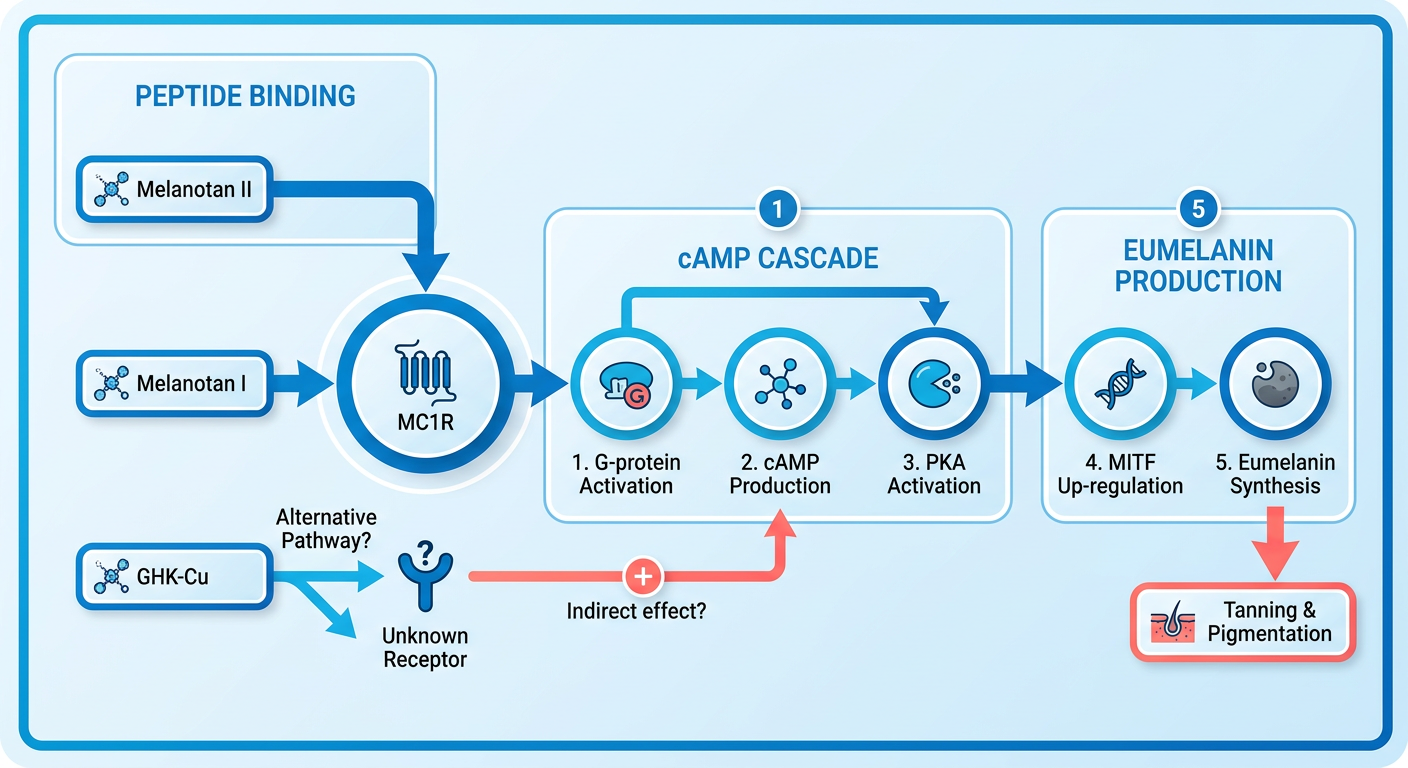
How Melanotan I triggers pigment
A linear 13-amino-acid peptide that preferentially activates MC1R, driving cAMP-mediated eumelanin synthesis with minimal off-target receptor binding.
Clinical data shows afamelanotide, the compound approved for erythropoietic protoporphyria, stimulates the eumelanin that darkens skin. Its more selective receptor activity is what sets it apart from broader-acting MT2.
That selectivity angle is the part most people miss. MT1 doesn’t hit the wide receptor range that MT2 does, which is exactly the kind of targeted mechanism our precision protocols are built around.
Why MT2 is riskier at the same receptor
A cyclic 7-amino-acid peptide that acts as a non-selective agonist, hitting MC1R plus other melanocortin receptors across the brain and body. That broad reach is the source of its side effects.
Because MT2 crosses the blood-brain barrier and binds a wider receptor range, it drives effects MT1 largely avoids: reduced appetite, nausea, spontaneous erections, and in documented cases, priapism and rhabdomyolysis.
Does MC1R activation cause melanoma?
Here the sources genuinely conflict, and the resolution is mechanistic. The intracellular signaling MC1R triggers (cAMP, MITF) is responsible for protective pigmentation. That frames the receptor’s role carefully instead of treating all activation as equivalent.
Against that, MT2 has been reported in the literature in association with melanoma. Our read: the danger tracks with non-selective activity and an unlicensed, largely untested compound, not MC1R activation itself. Dermatologist Dr. Amanda Oakley has stressed the lack of approval and testing for Melanotan II and its potential for serious side effects, melanoma included.
That distinction is the hinge of a precision approach. Reading MC1R function tells you whether someone carries the high-function receptor that responds well to a selective agonist, or a loss-of-function variant that flags underlying melanoma risk before any peptide enters the picture.
| Mechanism | Melanotan I (afamelanotide) | Melanotan II | GHK-Cu |
|---|---|---|---|
| Primary target | MC1R (selective) | Multiple melanocortin receptors | Copper transport, collagen |
| Structure | Linear, 13 amino acids | Cyclic, 7 amino acids | Copper-binding tripeptide |
| Pigment pathway | cAMP-driven eumelanin | cAMP-driven eumelanin | Indirect / skin repair |
| Blood-brain barrier | Limited | Crosses it | No pigment role |
GHK-Cu sits apart. It’s a copper-binding tripeptide that supports collagen synthesis and skin repair, not melanin. We keep it out of the pigment conversation and reserve it for tissue remodeling, where its mechanism actually earns its place.
Dosing Strategies, Administration & Practical Logistics
Dosing is where the safety gap gets concrete. The published protocols differ not just in numbers but in delivery format, and format is what separates the receptor-selective option from the popular injectable one. By evidence, the dosing route matters as much as the dose.
The honest framing before any numbers: Melanotan II has no approved indication and isn’t legally marketed for human use anywhere in the world. So every MT2 „dosing protocol“ online comes from unregulated vendors, not clinical trials. We treat those figures as user-reported convention, not medical guidance.
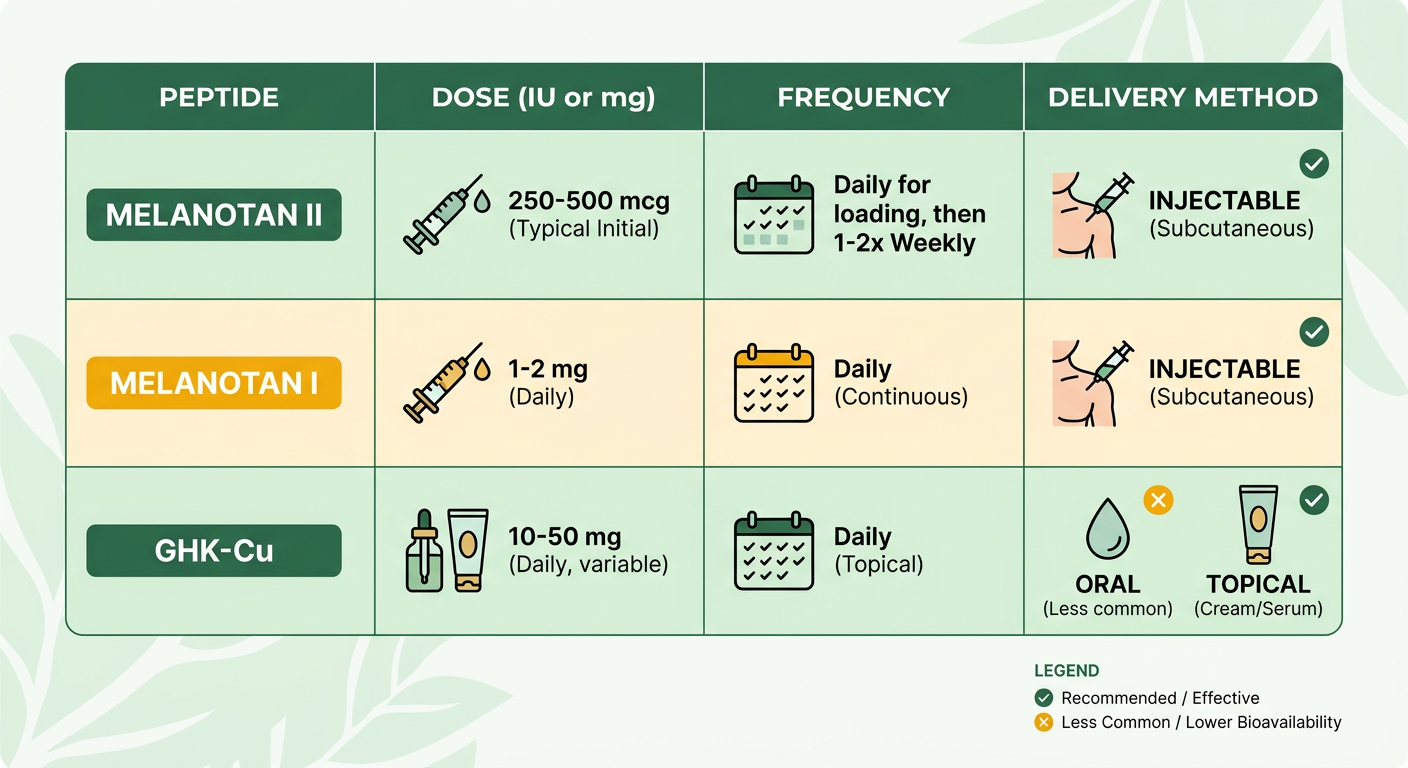
The published dosing regimens
Melanotan I (afamelanotide): The clinically approved form is a subcutaneous biodegradable implant, not a self-injected vial. In EPP trials, MT1 significantly increased pain-free sun exposure, a median of 69.4 hours versus 40.8 for placebo. Vendor-style oral summaries often cite daily dosing, but those figures don’t reflect the approved implant format.
Melanotan II: Sold by unregulated vendors as an injectable. Any „loading“ or daily dosing conventions circulating online come from forums and vendor sheets, not trials. Given the documented systemic risks, we don’t build protocols around it.
GHK-Cu: Used exclusively for its regenerative work on the dermal barrier. Typically applied via topical serums or localized injections to speed healing, not to change skin tone. Pairing it with a selective agonist for barrier support makes sense; using it to tan does not.
| Peptide | Reported use | Route | Regulatory status |
|---|---|---|---|
| Melanotan I | Approved implant; daily doses cited by vendors | Subcutaneous implant | FDA-approved for EPP |
| Melanotan II | Injectable, user-reported conventions only | Injection | Not approved anywhere |
| GHK-Cu | Topical, cosmetic concentrations | Topical | Cosmetic ingredient |
Can you tan with less sun?
Yes, and this is the strongest practical argument for the selective route. In clinical EPP use, MT1 increases melanin in the skin and extends pain-free sun tolerance, and research has reported reductions in sunburn severity with repeated use.
Our take: that points toward pairing a selective agonist with reduced, deliberate UV to lower cumulative damage. But it only holds if the melanin produced is genuinely photoprotective, which dermatology still contests. So the protocol stays conditional. Continued sun avoidance is not optional.
One contradiction worth flagging: sources disagree on half-life. Look at clearance rates and metabolic pathways and it resolves. A slow-release subcutaneous implant gives a steady, prolonged systemic presence; a bolus injection of a cyclic peptide spikes and clears fast. Don’t trust any single „duration“ claim in isolation, since format drives the apparent persistence.
Onboarding and storage
Reconstituted peptides degrade with heat and light. Keep lyophilized product refrigerated, store reconstituted vials cold and shielded from light, and never leave them at room temperature between uses.
Handling these compounds also means strict sterile preparation technique. At BiohackNow, we prioritize clinical safety and structured guidance over self-directed experimentation, so any plan is built on verified health metrics.
Safety Profile & Side‑Effect Landscape
The safety gap between these three peptides is not subtle. Melanotan II carries the heaviest adverse-event load, afamelanotide (Melanotan I) has a documented clinical safety profile, and GHK-Cu sits in a separate category because it doesn’t tan skin. If you want the safest evidence, the receptor-selective option wins on side effects too.
The pattern keeps repeating in the literature: the peptide people reach for most, MT2, is the one racking up the worst case reports. That inversion is exactly why the evidence points toward caution before anyone touches a melanocortin agonist.
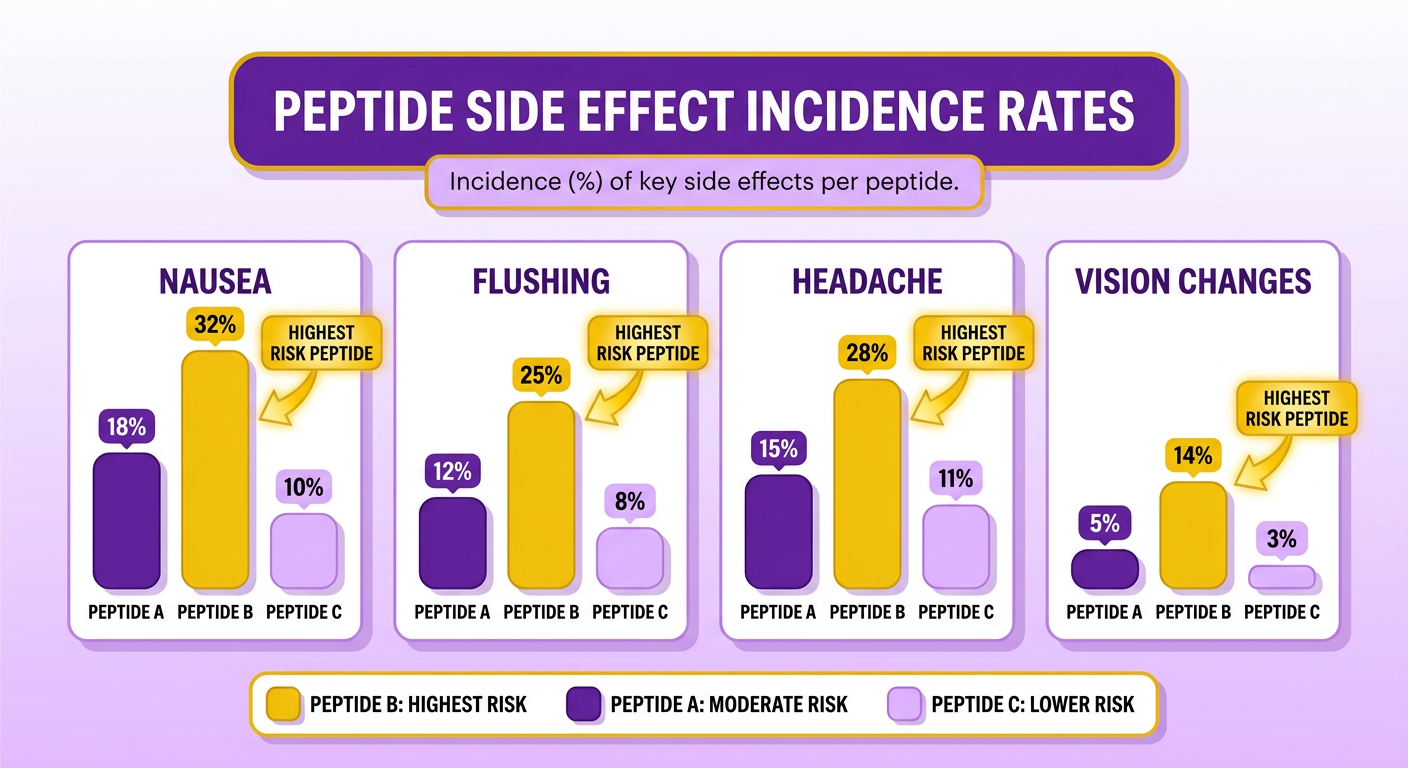
The most common side effects of each
Melanotan II: Frequent complaints are nausea, vomiting, headache, facial flushing, appetite loss, and libido changes. Because MT2 crosses the blood-brain barrier and hits multiple melanocortin receptors, it also triggers spontaneous erections and, in fair-skinned users, darkening of moles.
Interviewed MT2 users, many introduced through the bodybuilding community, universally reported skin darkening, but also flagged darkening of existing moles and increased libido. Some believe synthetic pigmentation shields them from solar radiation; clinical consensus warns this artificial darkening lacks the protective qualities of natural melanin, leaving skin highly vulnerable to UV-induced DNA damage.
Melanotan I (afamelanotide): Because it activates MC1R selectively, its side-effect profile is milder. In EPP use, patients showed increased melanin density without significant melanoma events.
GHK-Cu: Supports wound healing and collagen, not pigment. Its main safety flags are localized allergic reactions and, in theory, copper overload with excessive topical use. Skip it entirely if your goal is color.
How severe do the adverse events get?
MT2’s severe events are the ones that put people in hospital. A 39-year-old man who injected 6 mg, six times a common starting dose, developed tachycardia, muscle tremors, and rhabdomyolysis with elevated creatinine and CPK. That’s muscle breakdown and kidney stress from a cosmetic tan.
The melanoma reports are the real alarm. A 66-year-old developed melanoma in-situ four weeks after starting MT2 from a regulated compounding pharmacy.
| Adverse event | Melanotan II | Melanotan I (afamelanotide) | GHK-Cu |
|---|---|---|---|
| Common | Nausea, flushing, libido shift | Milder nausea, flushing | Local irritation |
| Serious | Priapism, rhabdomyolysis, renal infarction | Not reported at clinical doses | Copper overload (theoretical) |
| Melanoma case reports | Yes | Not in EPP trials | No |
| Regulatory status | Not approved anywhere | FDA-approved for EPP | Cosmetic use |
How MC1R variants change the risk math
Individual genetic profiles dictate how the body responds to melanocortin stimulation. Screening recommendations for fair-skinned patients (Fitzpatrick I-II) emphasize identifying underlying genetic vulnerabilities before introducing any agonist. Regulators including the TGA, and named clinicians, are blunt here: melanotan should only be used under medical supervision, if at all. Our stance is simpler. For most cosmetic tanning, skip injected MT2 entirely. Rather than navigating this alone, get a professional clinical evaluation to explore evidence-based strategies for skin health and photoprotection.
Real‑World Experiences: User Reviews & Clinical Outcomes
What does the real-world evidence actually show? The gap between what users report on forums and what clinical trials measure is the whole story. By outcome data, afamelanotide (Melanotan I) is the standout, yet the peptide dominating user threads is Melanotan II. That inversion is the pattern worth tracking.
The split keeps repeating. Clinical trials measure afamelanotide with instruments. User forums measure MT2 with anecdote. Both matter, but they aren’t the same quality of evidence.

What the review threads actually report
Forum data on MT2 is now large enough to analyze systematically. Qualitative studies have pulled discussion entries from participants across online forums, and separate interview studies have recruited MT2 users, many from platforms like Reddit, spanning a wide range of ages.
The demographic pattern is consistent: many users entered through the bodybuilding community, and common motivations were tanning before vacations or fitness competitions.
Interviewed users routinely reported skin darkening. So onset and efficacy aren’t in dispute. What is in dispute is safety perception. Despite the physical changes, users often carry a false sense of security about UV safety. Clinical evaluations show cosmetic hyperpigmentation doesn’t prevent cellular damage from later sun exposure, meaning self-injected MT2 tans may compound UV damage rather than block it.
How clinical outcomes compare to forum anecdotes
Clinical data tells a cleaner efficacy story for MT1. In controlled research, most subjects receiving MT-1 achieved tanning, and the peptide produced a measurable reduction in sunburn cells at the irradiated site. Subjects needed less sun exposure for equivalent color, and higher doses held the tan longer than controls.
That measured photoprotection is the crux of a genuine contradiction. Dermatology sources argue injected melanin gives no UV protection. The trial data on afamelanotide shows measurable photoprotection.
Our read: the peptide identity resolves it. Afamelanotide’s selective MC1R activity produced measured protection in trials. The dermatology critique targets self-injected MT2, whose cosmetic darkening is not the same molecule or the same evidence quality. Don’t apply MT2 forum anecdote to MT1 clinical outcomes, or the reverse.
What the adverse-event record shows
The published outcomes for MT2 are worse than the cosmetic side effects users trade tips about. Clinical literature tracks atypical nevi changes and rapid dysplastic alterations in moles following MT2 administration. Even from regulated compounding pharmacies, the systemic risk of non-selective receptor overstimulation remains the primary concern.
| Evidence Type | Melanotan II | Melanotan I (afamelanotide) |
|---|---|---|
| Dominant data source | Forums, Reddit, bodybuilding circles | Controlled clinical trials |
| Onset of tanning | Reported by users | Most subjects tanned |
| Documented photoprotection | None (perceived only) | Measurable sunburn-cell reduction |
| Serious events on record | Melanoma, rhabdomyolysis, priapism | Increased melanin, no significant melanoma signal |
| Regulatory status | Not legally marketed anywhere | FDA-approved for EPP |
The reporting gap is itself a data-quality warning. Forum threads skew toward users still actively dosing and satisfied enough to post; people who quit after a bad reaction rarely come back to update the thread, which biases the anecdotal record toward safety. Clinical trials, by contrast, log dropouts and adverse events by protocol, so the afamelanotide record captures negatives forum culture filters out. That structural difference is why a peptide with a documented melanoma case count can still read as „safe“ in community consensus. Treat unmoderated forum sentiment as marketing, not surveillance. Public health agencies worldwide warn against buying and using these unregulated substances, since self-administration bypasses the diagnostic screening that catches problems early.
Frequently Asked Questions
1. Can I use Melanotan II safely if I buy it from a compounding pharmacy instead of an online vendor?
Pharmacy-grade sourcing does not neutralize Melanotan II’s risk. The danger comes from non-selective, superpotent receptor activity itself, which can overstimulate melanocytes and trigger rapid cellular changes. Because the risk is inherent to the molecule’s mechanism rather than product purity or contamination, regulated sourcing offers no meaningful protection against these adverse events.
2. Should I get genetic testing before starting a tanning peptide?
MC1R genotyping is a reasonable precision step before considering any melanocortin peptide. Genetic testing helps identify non-responders or those with high baseline vulnerability to UV damage. By identifying whether you carry a standard, high-functioning receptor or a variant that flags underlying risk, genotyping provides essential data before any dosing begins.
3. Can I combine GHK-Cu with a tanning peptide?
GHK-Cu can be integrated into a broader skincare regimen to support dermal integrity and accelerate tissue repair. However, it has no biochemical pathway to stimulate melanogenesis, meaning it will not alter skin pigmentation or assist in tanning. It should be treated strictly as a skin-repair agent rather than a tanning accelerator.
4. Why do some sources say MT1 lasts longer than MT2 when MT2 is more protease-resistant?
The apparent difference in duration is driven by the physical delivery vehicle rather than the molecular structure alone. Clinically administered Melanotan I utilizes a slow-release subcutaneous implant that alters its pharmacokinetics, providing a steady systemic presence over weeks. In contrast, self-administered MT2 is typically injected as a liquid bolus, leading to rapid absorption and clearance. Therefore, the delivery format dictates the peptide’s actual persistence in the body.
5. If a peptide tan darkens my skin, does that mean I can skip sunscreen?
Artificial pigmentation induced by MT2 does not provide the photoprotective barrier of natural melanin. Because it lacks the structural organization to shield cellular DNA, relying on it without broad-spectrum sunscreen significantly increases your vulnerability to UV radiation. Continued sun avoidance and high-SPF sunscreen remain absolutely necessary.
6. What symptoms indicate a Melanotan II overdose requiring medical attention?
Severe MT2 toxicity manifests as systemic vascular and muscular complications. Key red flags include rapid heart rate, uncontrollable muscle tremors, and severe muscle pain, which can signal rhabdomyolysis (muscle breakdown) and subsequent kidney stress. Prolonged, painful erections (priapism) and acute abdominal or flank pain (indicative of renal infarction) also require immediate emergency medical evaluation.
7. I have a family history of melanoma—which tanning peptide is right for me?
If you have a personal or family history of skin cancer, you should avoid all unregulated melanocortin agonists entirely. These compounds can stimulate atypical melanocyte proliferation, compounding your existing genetic risks. Your priority should be strict UV protection and regular dermatological screenings rather than attempting to alter your skin pigmentation.
Free 15-Minute Discovery Call
Ready to take the guesswork out of your health?
Book a free 15-minute call with Monika to talk through your goals, what testing makes sense for you, and the right next step. No pressure, just clarity.
Book Your Free CallFor educational purposes only. Not medical advice.