
The Short Version
- Afamelanotide is approved by the FDA and EMA for erythropoietic protoporphyria. It is the only clinically backed peptide in this class.
- Melanotan II has no regulatory approval anywhere. The MHRA and the FDA have each issued formal safety warnings against it.
- Published case reports tie Melanotan II to melanoma, priapism, rhabdomyolysis, and renal infarction, plus rapid mole changes that make cancer harder to spot.
- Afamelanotide’s clinical trials have reported longer pain-free sun exposure versus placebo, along with more epidermal melanin and fewer UV-induced thymine-dimer lesions; the exact sunlight-hour figures vary across summaries.
- Melanotan II is described as a nonselective agonist at MC1R, MC3R, MC4R, and MC5R. Afamelanotide is described as a selective MC1R agonist.
What I’d tell you before you buy anything
Ask what the best tanning peptide is for aging skin and the honest answer bends on what you’re actually after. If you just want a bronzed look, nothing on the market is both effective and safe. If you want photoprotection and DNA-damage control inside a longevity plan, afamelanotide (the pharmaceutical form of Melanotan I) is the only member of this class with real clinical backing.
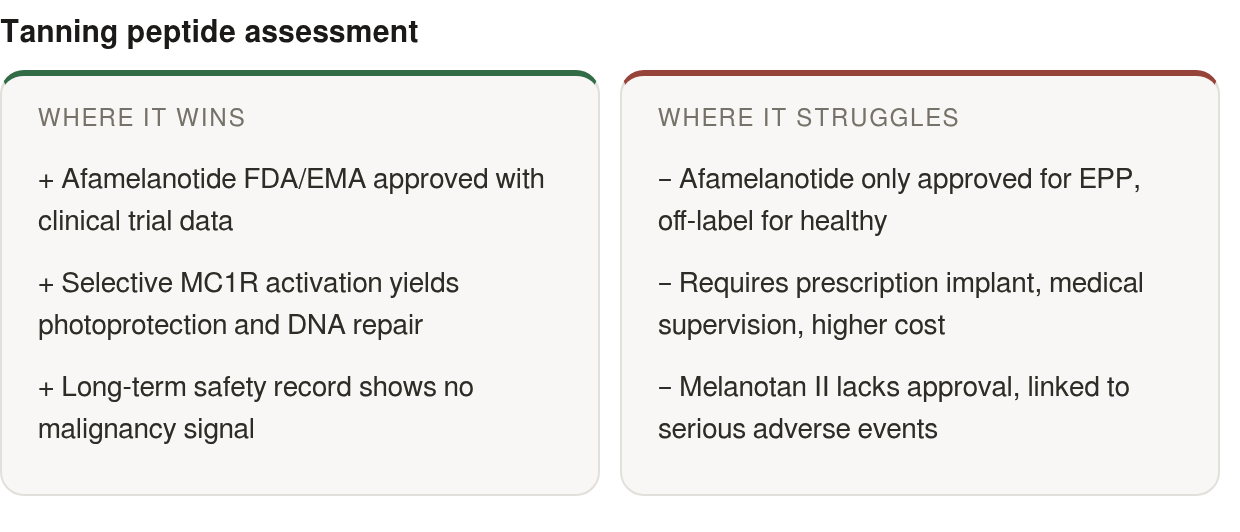
Melanotan II is the one people search for. It also carries the weaker evidence and the worse safety record. Here’s how the options stack up once you add clinical decision-making to the picture.
How Do the Options Compare at a Glance?
| Metric | Melanotan II | Afamelanotide (Scenesse) | Clinical decision criteria for older adults |
|---|---|---|---|
| Mechanism | Nonselective agonist across MC1R, MC3R, MC4R, MC5R | Selective MC1R agonist; drives eumelanin plus DNA repair | A supervised decision should focus on melanocortin selectivity and skin history |
| Regulatory status | No approval anywhere; MHRA and FDA warnings issued | FDA- and EMA-approved for EPP only | Any use for healthy adults is off-label and should be documented as such |
| Typical use | Self-injected, unregulated; gray-market vials of uncertain purity and dose | Prescription subcutaneous implant via licensed prescriber | Should include baseline dermatology screening and a clear off-label rationale |
| Reported efficacy | Visible color reported quickly; no completed efficacy RCT | Trial summaries report longer pain-free sun exposure versus placebo and reduced UV-induced DNA damage | If the goal is cosmetic color alone, the evidence is not strong enough to justify use |
| Safety / monitoring | Low; case reports of melanoma, priapism, rhabdomyolysis, renal infarction | Monitored EPP safety data; pigmentation changes reported | Periodic skin checks and clinical follow-up are necessary, especially with higher mole burden |
Why Isn’t Melanotan II the Answer for Older Adults?
Melanotan II’s speed is its trap. Users report darkening quickly because it hits every melanocortin receptor at once, which is also why users commonly report nausea and that odd stretching-yawning-and-erection complex.
The bigger worry for our readers: the Skin Cancer Foundation has flagged case reports of melanoma and rapid mole changes that make cancer detection harder. A lot of that harm probably traces back to dosing chaos. When gray-market vials hold an uncertain, inconsistent amount of active compound, you’re injecting an unknown quantity of an impure product into yourself.
What Should You Take Away?
The longevity value here was never the tan. It’s the DNA protection.
- Afamelanotide is the only approved peptide in this class. Trial summaries describe fewer UV-induced thymine-dimer lesions and fewer sunburn cells, behaving less like a tanning bed and more like an internal sunscreen with its own repair crew.
- MC1R activation itself may be protective against melanoma. The melanoma signals come from unregulated Melanotan II use, not clean receptor activation. Don’t conflate the two.
- Skip Melanotan II entirely if your goal is healthy aging. The evidence for cosmetic use is absent and the safety data is bad.
- The strongest case for any tanning peptide runs through medical supervision and verified sourcing, which is exactly where self-injection collapses.
Why the tan is the wrong thing to chase
When people ask what the best tanning peptide is, they’re almost always chasing color. For an older adult building a longevity protocol, that’s the wrong starting line. The better question: does stimulating melanin do anything for the skin’s long-term health, or just its shade this month?
The reframe matters because demand for a tan without UV keeps climbing. Sun-avoidance is standard advice now, yet a bronzed look still reads as healthy and youthful to most people. So interest in a tanning peptide sits at the crossroads of two things aging adults care about: looking well, and dodging the UV damage that drives wrinkles, sunspots, and skin cancer risk.
The real payoff is DNA repair, not shade
Afamelanotide’s measurable effects point at photoprotection, not vanity. Some research on melanocortin-1 receptor activation links it to more epidermal melanin and to the skin’s own DNA-repair pathways. So the story is about protective machinery, not the color.
For skin that’s already banked decades of sun, that repair angle is the actual longevity argument. The tan is a side effect of the thing worth having. If your goal is fewer accumulated DNA errors in aging skin, the pigment is a signal that the protective machinery switched on, not the thing you’re buying.
Why aesthetic-focused adults keep circling back
Professionals, athletes, and appearance-conscious adults want the confidence of a natural-looking tan without a tanning bed or a beach session. That’s the honest driver behind most of what we field. The catch: the popular option and the evidence-backed option aren’t the same peptide.
| What drives the demand | What’s really at stake | Where the science actually lands |
|---|---|---|
| A tan without UV | Skin cancer and photoaging fear | Only afamelanotide has clinical photoprotection data |
| Fast visible color | Cosmetic gratification | Melanotan II darkens skin quickly, but on the weakest safety record |
| „Healthy“ appearance | Confidence and self-image | A tan reads as vitality; the health benefit only holds if DNA damage drops |
| Longevity optimization | Reducing cumulative UV harm | DNA-repair upregulation is the defensible rationale, under supervision |
Where peptide tanning fits in a longevity plan
Skip peptide tanning if all you want is a cosmetic bronze. For that goal alone, the evidence in healthy people isn’t there, and the risk-to-benefit math doesn’t work. The case only firms up when the aim is mitigating UV DNA damage as one input among many in an aging-skin strategy.
A pigmentation peptide is not a standalone tanning aid in a serious protocol. It’s a photoprotection tool that has to be weighed against topical UV defense, dermatologic surveillance, and everything else on your plan. We get into how we structure those calls across our longevity work. The next sections put the two peptides head to head on exactly that basis.
Clinical Evidence: Afamelanotide
Judge the best tanning peptide by the standard of actual clinical trials and afamelanotide stands alone. It’s the member of the melanotan class that has cleared formal regulatory approval, for adults with erythropoietic protoporphyria (EPP). Every other option here rests on case reports or user anecdotes.
The evidence we keep coming back to with older clients isn’t the pain-free-sunlight data from EPP. It’s the controlled work on melanocortin-1 receptor activation showing that afamelanotide raises epidermal melanin density and cuts UV-induced DNA damage in the basal epidermis. That’s the mechanism that matters most for skin longevity.
What Does the Key EPP Trial Evidence Show?
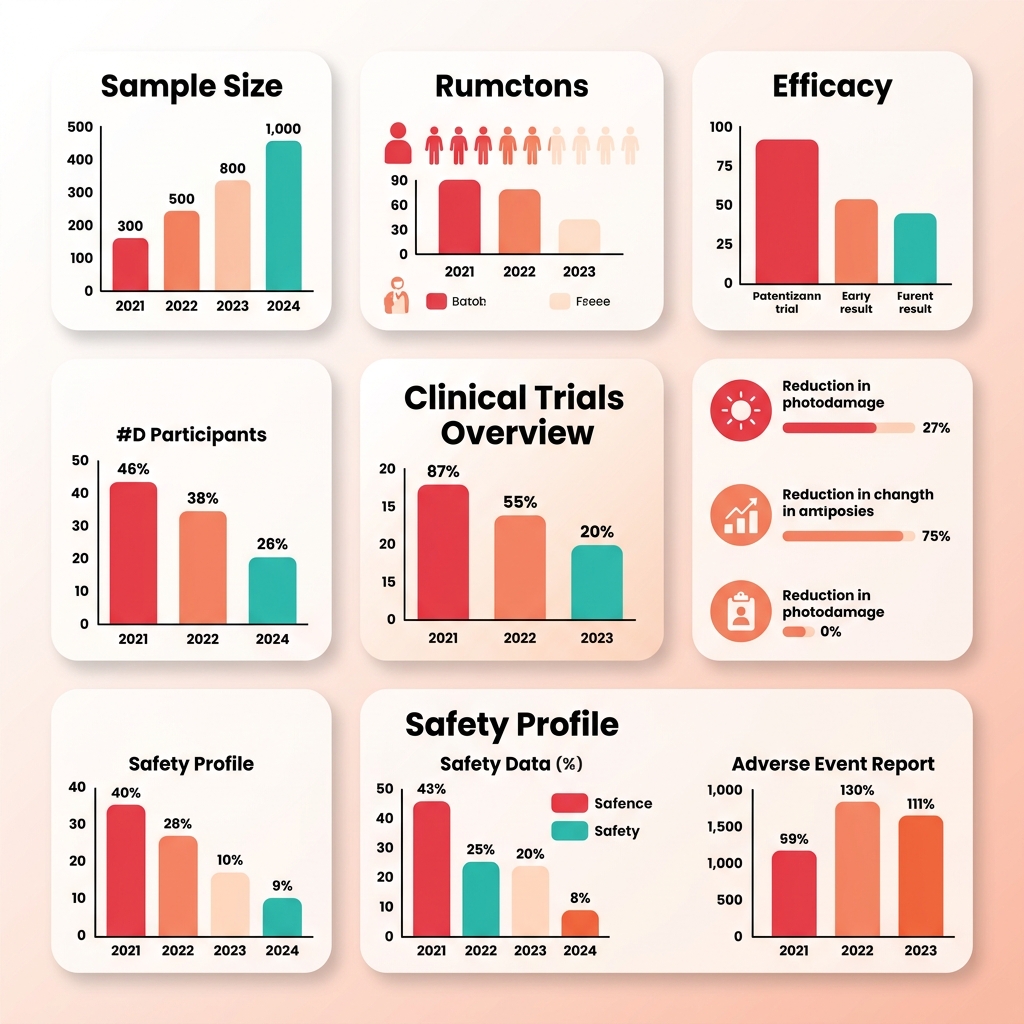
Approval rested on randomized trials in EPP patients. Across those trials, patients on afamelanotide banked more pain-free time in direct sunlight than those on placebo, with fewer phototoxic reactions overall.
The exact hours vary a little across write-ups because of rounding, not because of separate results. They all point the same way, so we describe the effect qualitatively and move on.
One thing worth stating plainly: afamelanotide does nothing to reduce the protoporphyrin buildup or fix the ferrochelatase deficiency behind EPP. Its entire benefit is photoprotective, driven by eumelanin. That mechanism is exactly why it interests us for skin longevity.
How Do the Efficacy and Safety Findings Stack Up?
| Metric | Afamelanotide (Scenesse) |
|---|---|
| Regulatory approval | EPP only |
| Epidermal melanin | Trial summaries report increases via MC1R activation |
| UV DNA damage | Trial summaries report reductions in UV-induced thymine-dimer damage |
| Sunburn cell reduction | Reported in the same trial literature; linked to DNA repair pathways |
| Long-term dataset | Observational follow-up in EPP patients |
| Malignancy signal | No established malignancy signal; pigmentation change reported |
| Cosmetic tanning indication | None anywhere |
That long-term record is genuinely reassuring on tolerability. Observational follow-up in EPP patients has tracked improvements in quality-of-life scores after treatment, though some patients discontinue for reasons including pregnancy and cost.
Does the Evidence Actually Cover Aging Skin?
Here’s the honest caveat: all of this safety and efficacy data comes from a ferrochelatase-deficient patient group. Its safety and effectiveness for tanning in healthy people has never been established. So even the well-evidenced choice is an off-label extrapolation for a healthy older adult. That’s precisely why any serious use belongs inside a supervised protocol with skin surveillance rather than as a self-serve tanning fix.
Stack the melanin, DNA-repair, and sunburn-cell effects together and the aging-skin case is about cumulative UV-damage mitigation, not the color. That’s the prize.
Safety Profiles & Adverse-Event Comparison
The safety gap between these two peptides is wider than the efficacy gap, and it more or less settles the question for anyone thinking long-term. One has monitored follow-up. The other has a stack of published case reports and warnings from multiple health regulators.
Color is easy to get. A clean adverse-event record is not. Here’s how the safety data actually breaks down.
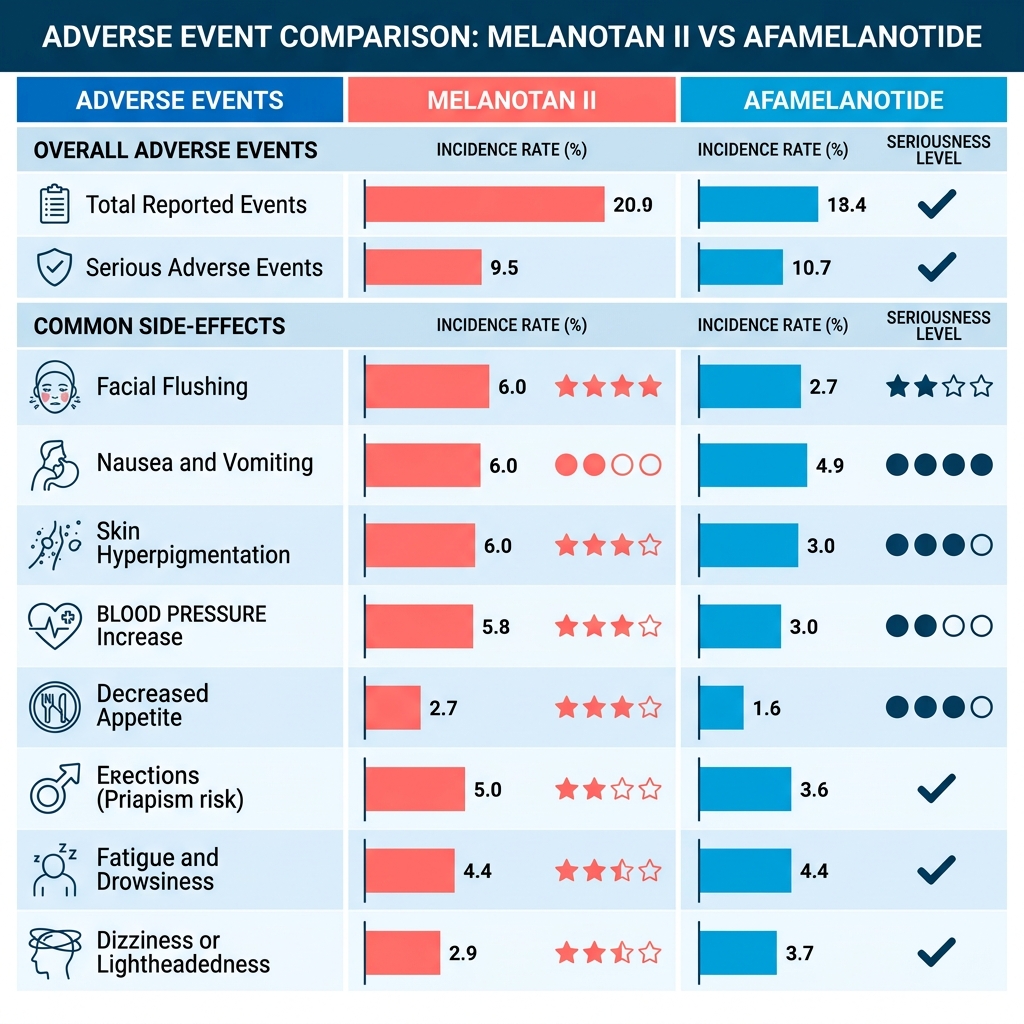
Melanotan II Carries the Ugliest Adverse-Event Record
Reviews of Melanotan II describe nausea and a stretching-and-yawning complex as its common, dose-limiting effects. Unpleasant, but not the real problem.
The real problem is the tail of serious events. Published case reports link Melanotan II to melanoma, eruption of dysplastic moles, priapism requiring surgery, rhabdomyolysis, renal infarction, and posterior reversible encephalopathy syndrome. The Skin Cancer Foundation has flagged rapid changes in moles and pigmented lesions that make skin cancer harder to catch. Their position is blunt.
„The desire for a tan should never outweigh concerns about health and safety.“ – Deborah S. Sarnoff, MD, President of The Skin Cancer Foundation
Two things drive that risk. First, the product is gray-market, so vial contents may not match their labels. You can’t dose safely when you don’t know what’s in the vial. Second, its non-selectivity at MC3R and MC4R may be inseparable from some of its systemic harm. The broad receptor engagement people sometimes market as a „systemic“ longevity bonus is also what may produce the vascular and muscle events. You don’t get the upside without the downside.
Afamelanotide’s Long-Term Data Is Boringly Clean
The contrast is stark. Afamelanotide has been followed through implant use in EPP cohorts. Pigmentation change is the most commonly reported effect, and biopsied lesions in those cohorts have been described as benign in the published follow-up. Long-term MC1R activation hasn’t been tied to a rise in melanoma.
That resolves an apparent contradiction. Case reports tie Melanotan II to melanoma, yet mechanistic review finds clean MC1R activation hasn’t raised melanoma incidence. Both can be true. The melanoma reports are confounded by unregulated dosing, impure product, and sun-seeking behavior. They aren’t a fair test of MC1R activation itself. And no peptide prevents melanoma outright, so skin surveillance stays non-negotiable in higher-risk people.
Supervision Is the Variable That Changes the Risk Math
| Safety dimension | Melanotan II | Afamelanotide | Clinical decision criteria for older adults |
|---|---|---|---|
| Common effects | Nausea and stretching/yawning | Mild, transient pigmentation change | If tolerability issues arise, reassess risk/benefit with a clinician |
| Serious events reported | Melanoma, priapism, rhabdomyolysis, renal infarction, PRES | No established malignancy signal in EPP follow-up | Avoid if history of melanoma, changing moles, or uncontrolled vascular conditions |
| Product quality | Gray-market; label may not match contents | Pharmaceutical-grade | Use only verified pharmaceutical product through a licensed prescriber |
| Monitoring | None | Specialist prescriber | Baseline dermatology exam and periodic skin checks |
A supervised approach should start with a consultation and an in-depth review of your skin history and blood work, then build a plan with ongoing biomarker and lesion tracking. That structure is what a raw vial off a website can never give you.
Legal, Regulatory & Market Status
The regulatory picture answers most of the question before you look at a single trial result. One of these compounds is an approved prescription drug. The other isn’t legally marketed for human use.
That gap is the whole story. When people ask which tanning peptide is worth pursuing, we start with legal status because it dictates everything downstream: purity, dosing accuracy, and whether a clinician is standing between you and the needle.

What Is the Legal Status of Each Peptide?
Afamelanotide, sold as Scenesse, is cleared by the FDA and approved by the EMA for adults with erythropoietic protoporphyria. It reaches patients as a prescription-only subcutaneous implant placed by a licensed prescriber, and there’s no approved cosmetic tanning indication anywhere. Any aesthetic or longevity use is off-label by definition.

Melanotan II sits at the opposite pole. It has no approved indication in any jurisdiction. The UK’s MHRA has issued a public warning against it, and the FDA has sent warning letters to domestic distributors. Multiple health authorities have flagged it.
| Regulatory factor | Melanotan II | Afamelanotide (Scenesse) | Clinical decision criteria for older adults |
|---|---|---|---|
| FDA/EMA status | Unapproved; warning letters issued | FDA- and EMA-approved for EPP | Off-label for cosmetic or longevity use |
| Legal access | Gray-market only | Prescription implant | Access through a licensed prescriber only |
| Product quality | Unregulated; contamination risk | Pharmaceutical grade | Verify prescribing source and product |
| Dermatology screening | None | Specialist prescriber | Baseline skin exam before off-label use |
Why Does the Black Market Make Melanotan II Riskier?
Melanotan II is an unregulated compound sold through gray-market websites, so buyers have no reliable way to know the purity or the true dose in the vial. You’re dosing an unknown quantity of an impure compound.
That matters more than the pharmacology alone. Some of the harms tied to this peptide may reflect dosing chaos and contamination rather than the molecule itself. You can’t separate the compound’s true risk from the sketchy supply chain it travels through.
How Does a Personalized Consultation Change the Picture?
This is where legal status stops being an abstraction. A supervised consultation should start with a health assessment, so decisions are guided by your data rather than guesswork. Clinicians can track core biomarkers and skin changes, and they should say plainly when a peptide is the wrong path.
If you just want a fast bronze and you’re willing to gamble on an unregulated vial, no clinic focused on health and safety will match that price or speed. But for older adults treating pigmentation and UV DNA damage as part of a longevity plan, a medically informed consultation is the version of this that respects both the science and your skin. You can read more about how we structure these protocols on our clinic blog.
Where this is heading, and what to do now
One detail reframes what the best tanning peptide might look like next. The early melanocortin research produced two very different development paths. Afamelanotide came out of the photoprotection arm. Bremelanotide, sold as Vyleesi, was developed for a separate, non-pigment indication. That split tells you where the field is going: toward receptor-selective successors, not the crude parent peptide. So if you’re asking what the best tanning peptide will be, watch the receptor-targeting work, not the next batch of gray-market vials.

Why Does Receptor Selectivity Matter for a Longevity Protocol?
Melanotan II is a nonselective agonist. It hits several melanocortin receptors at once, which may explain why its side effect list runs so long. The nausea, the flushing, the unwanted arousal, and the darkening moles may trace back to a peptide activating receptors it was never meant to touch.
The smarter design goal is a molecule that binds MC1R for pigment and DNA-repair signaling while leaving MC4R and the rest quiet. Afamelanotide already leans that way. Bremelanotide went the other direction on purpose, targeting the desire pathway rather than pigment, which is why it was developed for an entirely unrelated indication.
For an older adult building a skin-longevity plan, that’s the signal worth tracking. The peptides that win here will be judged on how cleanly they isolate the melanocortin-1 pathway, not on how dark they turn you.
How Do the Emerging Directions Compare?
| Direction | What it targets | Where it stands |
|---|---|---|
| Melanotan II | Multiple melanocortin receptors (nonselective) | No approval for human use anywhere |
| Afamelanotide (Scenesse) | MC1R. Pigment and photoprotection | Approved, prescription-only |
| Bremelanotide (Vyleesi) | MC4R. Sexual desire, not pigment | Approved, unrelated indication |
| Clinical decision for older adults | MC1R-focused photoprotection and dermatologic surveillance | Supervised off-label use only; baseline skin exam and monitoring |
The table makes the pattern obvious. One research lineage, split by receptor target, has already produced different regulatory outcomes. That’s the template every serious next-generation candidate will likely follow.
Are Combination Approaches Ready Yet?
You’ll see chatter about stacking a peptide with topical agents or pairing it with UV-free light devices. Be honest with yourself: the controlled evidence for those combinations isn’t published yet. Skip them as a core strategy until real trial data exists. Right now they’re hypotheses, not protocols.
Same caution applies to spray-tan biotech and other non-peptide cosmetic tanning tech. Interesting, but cosmetic color does nothing for the DNA-repair benefit that justifies a peptide in a longevity plan in the first place.
So the move today isn’t chasing an unproven novel compound. It’s staying with approved, receptor-selective science under supervision, then updating as cleaner successors clear regulatory review. That’s how we approach every protocol at BiohackNow. Stay selective, stay supervised, and let the crude peptides age out.
Frequently Asked Questions
1. Is Melanotan I the same thing as afamelanotide?
Afamelanotide is the pharmaceutical, regulated form of Melanotan I, sold as Scenesse. It selectively activates MC1R to drive eumelanin and DNA repair. Melanotan II is a different, nonselective molecule with no approval anywhere, so the two should not be treated as interchangeable.
2. If I already wear sunscreen daily, does a tanning peptide add any protection?
Topical UV defense and afamelanotide work at different points. Sunscreen blocks incoming UV, while afamelanotide’s reported benefit is internal: raising epidermal melanin and supporting DNA-repair pathways. In a longevity plan it’s a supplement to sunscreen and dermatologic surveillance, never a replacement for them.
3. I have several moles and a family history of skin cancer. Should that change how I approach these peptides?
Higher-risk skin makes surveillance non-negotiable. No peptide prevents melanoma outright, and Melanotan II specifically has been tied to rapid mole changes that make cancer detection harder. Skip unregulated vials entirely and pursue any pigmentation approach only under supervision with ongoing skin monitoring.
4. Can afamelanotide be self-injected at home the way Melanotan II is?
Afamelanotide reaches patients as a prescription-only subcutaneous implant placed by a licensed prescriber, not a self-injected vial. That clinician-delivered route is part of what separates it from gray-market Melanotan II, where buyers self-inject an unknown quantity of an impure product.
Free 15-Minute Discovery Call
Ready to take the guesswork out of your health?
Book a free 15-minute call with Monika to talk through your goals, what testing makes sense for you, and the right next step. No pressure, just clarity.
Book Your Free CallFor educational purposes only. Not medical advice.