
Key Takeaways
- CJC-1295 with DAC stays active for 7-8 days and keeps IGF-1 elevated around the clock. That steady elevation raises the risk of daytime fatigue.
- The No-DAC form clears in roughly 30 minutes, so alertness and your natural circadian GH rhythm can recover between doses.
- DAC’s binding domain latches onto albumin and stretches the half-life to about a week, which is why one or two weekly injections do the job.
- No-DAC mimics a natural GH pulse and usually needs one to three daily injections for timing control.
- That 30-minute No-DAC clearance number is a convention, not confirmed human pharmacokinetic data.
- Steady IGF-1 elevation from the DAC version fights your circadian growth hormone rhythm. Short No-DAC peaks do not.
- Which form you use and when you inject it together decide whether CJC-1295 leaves you dragging during the day.
The 30-second version
Short version: CJC-1295 with DAC carries the higher daytime fatigue risk. No-DAC clears fast enough that your alertness recovers between doses. The DAC version sits in your system 7-8 days. No-DAC is gone in about 30 minutes. That one pharmacokinetic gap drives almost everything below, including whether CJC-1295 makes you tired during the day.
Can CJC-1295 make you feel tired? It depends almost entirely on which form you pick and when you dose it. DAC keeps IGF-1 elevated around the clock. Convenient, but it works against your natural circadian GH rhythm. No-DAC lets that rhythm reset between injections.
DAC vs No-DAC: what actually differs
DAC (Drug Affinity Complex): a binding domain that grabs onto albumin and stretches the half-life to about a week. No-DAC: the same GHRH backbone without that domain, so it clears in half an hour and mimics a natural GH pulse.
| Feature | CJC-1295 DAC | CJC-1295 No-DAC |
|---|---|---|
| Half-life | ~7-8 days | ~30 minutes (convention, not confirmed human PK) |
| Injection frequency | 1-2 per week | 1-3 per day |
| IGF-1 pattern | Sustained, around-the-clock elevation | Short peaks that fall between doses |
| Daytime fatigue risk | Higher (constant elevation) | Lower (alertness recovers between doses) |
| Best for | Convenience with clinical monitoring | Timing control to protect daytime alertness |
One honest caveat on that 30-minute figure. It gets repeated everywhere, but a 2024 GH-IGF1 axis review flagged that No-DAC has no established human pharmacokinetic data. Treat the timing as practical convention, not settled science.
Why the convenience comes with a fatigue cost
The property that makes DAC convenient is the same one that raises the fatigue risk. Fewer injections come from the long half-life. And that long half-life is exactly what keeps IGF-1 elevated all day. You cannot have one without the other.
Our read on the pulsatility debate: one pharmacology study showed GH pulses persist even under continuous DAC stimulation. A clinical reality source frames DAC as flattening the pulse. Both can be true. Pulses may survive, but the elevated baseline trough can still nudge your circadian GH rhythm out of sync. That’s the mechanism most likely to leave you dragging by afternoon.
No-DAC sidesteps this by clearing before your next dose. Time it for evening and the GH bump lines up with your natural nighttime release instead of fighting your daytime alertness.
Pricing and product overview
No-DAC single peptide: $79 for 5mg, $119 for 10mg. This is the pick if you want dosing control to protect daytime alertness.
No-DAC / Ipamorelin blend: $149 for a 5mg/5mg vial. Adds a ghrelin-receptor pathway for a stronger evening GH pulse.
Tesamorelin / CJC-1295 No-DAC / Ipamorelin trio: $189. The heaviest stack, aimed at body-composition and metabolic research.
One firm recommendation. If you’re new to this and want the fatigue risk managed, the better-characterized DAC form under clinical supervision beats improvising with No-DAC on your own. The fatigue reports came from unsupervised use, and No-DAC’s missing human PK data means you’re guessing at timing. Supervision, not just the molecule, is what protects your daytime energy.
Feature Comparison
Choosing between these two comes down to balancing your daily schedule against your tolerance for feeling sluggish. One protocol simplifies your routine. The other demands strict daily adherence to keep your energy stable.
Which one is more likely to make you tired
Keeping the long-acting peptide constantly present stops the pituitary from entering its natural refractory period. That constant signaling holds the body in an active growth state, which can paradoxically drain systemic energy reserves over time. A rapid-clearance protocol does the opposite. It lets the endocrine system fall back to its resting baseline between doses, which limits cumulative fatigue.
| Feature | CJC-1295 with DAC | CJC-1295 No-DAC |
|---|---|---|
| Half-life | ~7-8 days | ~30 minutes |
| Injection frequency | 1-2 per week | 1-3 daily |
| IGF-1 pattern | Sustained elevation | Short peaks |
| Daytime fatigue risk | Higher | Lower |
| Human PK data | Limited | None established |
This is why users on a continuous protocol often report a persistent afternoon slump. When the baseline trough of growth hormone stays elevated, the body’s circadian rhythm struggles to shift into its daytime state of high alertness.
The real limitations of each form
The clinical literature on these compounds is thin, so users lean on subjective feedback and biomarker tracking. With no standardized human data, there’s no universal protocol for managing side effects like lethargy. Self-directed experimentation stays unpredictable.
When to skip DAC: if your day demands sharp, uninterrupted focus, such as operating machinery, performing surgery, or managing complex financial transactions, the risk of persistent baseline grogginess makes the long-acting version a poor fit.
When to skip No-DAC: if your life involves frequent travel, irregular sleep, or a general dislike of needles, the multi-dose schedule will probably lead to missed doses and inconsistent results.
Which fits your use case
It comes down to how well each compound’s active window lines up with your life. For steady, long-term research where weekly dosing is preferred, the sustained profile is hard to beat on convenience. For those who want immediate physical and mental readiness during working hours, the rapid-clearance option is far easier to manage.
Our own catalog leans to the No-DAC side of this tradeoff. We stock CJC-1295 No DAC at $79.00–$119.00 in 5mg and 10mg vials, plus blends like CJC-1295 No DAC / Ipamorelin at $149.00 for research and educational use.
CJC-1295 isn’t FDA-approved for anti-aging or performance. Our products are sold for research and educational purposes only. Not to diagnose, treat, cure, or prevent disease.
Performance Comparison
Athletic performance lives on the balance between exertion and recovery. Sustained growth hormone release supports tissue repair, sure. But time it poorly and it can drop you into a state of deep physical relaxation that fights your high-intensity sessions.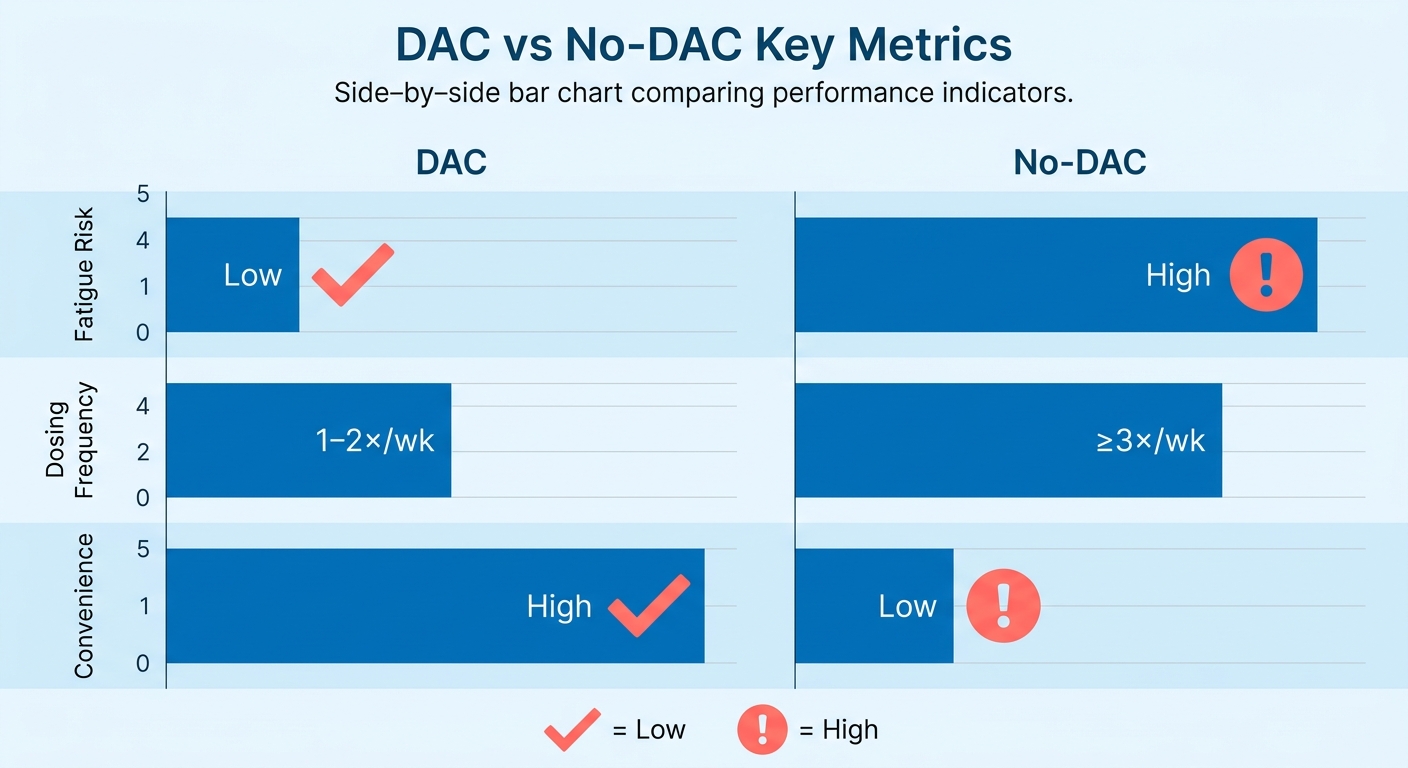
Which form is faster to run, and which preserves alertness
Multiple daily injections mean carrying supplies, keeping things sterile on the go, and timing doses around meals. For erratic schedules, a weekly protocol wins even if it means living with a milder, more persistent level of physical relaxation.
The main driver of daytime tiredness is that elevated baseline trough, not the loss of natural GH pulses. Under constant active signaling, the body stays in a recovery-dominant state, which naturally cuts the drive to exert yourself during waking hours.
How resource usage compares
| Factor | CJC-1295 with DAC | CJC-1295 No-DAC |
|---|---|---|
| Dosing effort | Low (1-2/week) | High (1-3/day) |
| Alertness recovery | Poor (constant elevation) | Good (30-min clearance) |
| PK certainty | Better characterized | Speculative in humans |
| Fatigue risk | Higher | Lower |
Without established PK curves, finding the right window for the rapid-clearance version takes personal experimentation. You track energy after injection to spot when the initial somnolence fades and alertness comes back.
When to skip each one
The financial side differs too. Daily dosing burns through more consumables, bacteriostatic water, syringes, and prep pads, which drives up the cost of a cycle. Frequent vial access also raises contamination risk, which means stricter handling.
For deeper protocol notes, see our BiohackNow Longevity Clinic blog.
Since these compounds aren’t FDA-approved for therapeutic use in healthy individuals, researchers have to weigh these operational demands against their specific experimental goals.
Pros and Cons
The two protocols feel different to run. A continuous-release profile can create a steady, underlying sense of readiness, but also a persistent „heavy“ feeling. An intermittent profile gives you clear windows of energy, but you have to manage the fast swings between active and inactive states.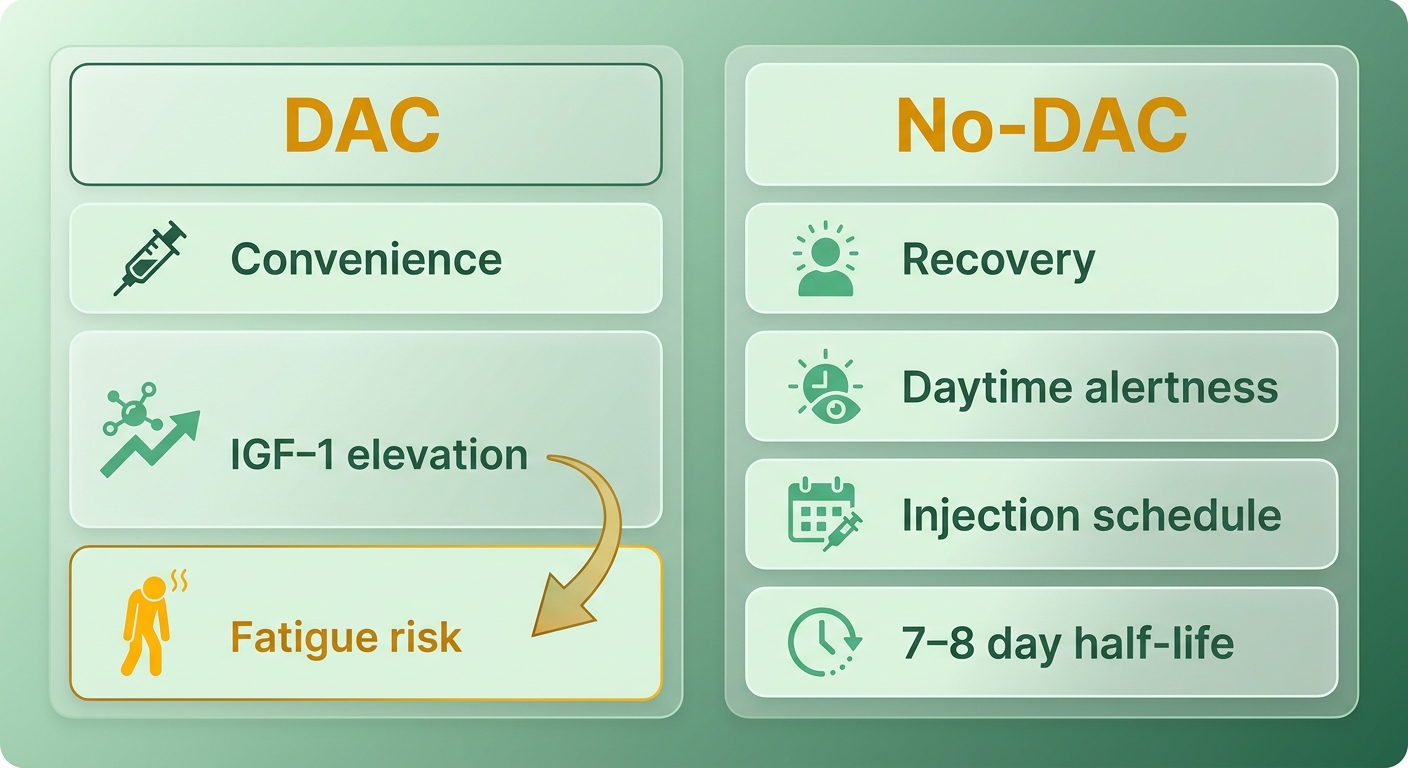
Strengths and weaknesses of each form
A documented clearance rate makes blood work timing easier. On a continuous protocol, the timing of the draw matters less. On a rapid-clearance protocol, testing has to be synced precisely to catch peak levels.
| Aspect | CJC-1295 with DAC | CJC-1295 No-DAC |
|---|---|---|
| Main strength | Fewer injections, documented half-life | Alertness recovers between doses |
| Main weakness | Constant IGF-1 elevation, fatigue risk | Frequent dosing, unconfirmed human PK |
| Circadian impact | Disrupts natural GH rhythm | Allows rhythm to reset |
| Best candidate | Supervised users prioritizing convenience | Users prioritizing daytime sharpness |
Does steady IGF-1 elevation actually cause fatigue?
Sustained GH receptor activation triggers a continuous feedback loop that can suppress other endocrine pathways. When the body is constantly told to prioritize cellular repair and growth, it may pull energy away from immediate cognitive and physical tasks. That’s the afternoon slump some users report.
That constant demand on metabolic resources can also affect sleep architecture. Growth hormone is essential for deep sleep, but excessive levels during waking hours can disrupt the transitions between sleep stages, leaving users unrefreshed despite a full night in bed.
Who should skip which form
Athletic organizations regulate growth hormone secretagogues hard. For competitive athletes, these compounds or their metabolites showing up in a sample can carry severe career consequences. That makes both forms unsuitable, fatigue profile aside.
Sorting through these variables is exactly why professional guidance matters. A structured look at your baseline health can clarify which metabolic pathway to target and how to build the protocol to minimize unwanted side effects.
Use Cases and Ideal Users
Your daily routine decides which protocol works. A predictable, structured schedule absorbs multiple daily tasks easily. An unpredictable lifestyle needs a protocol that asks for minimal daily attention.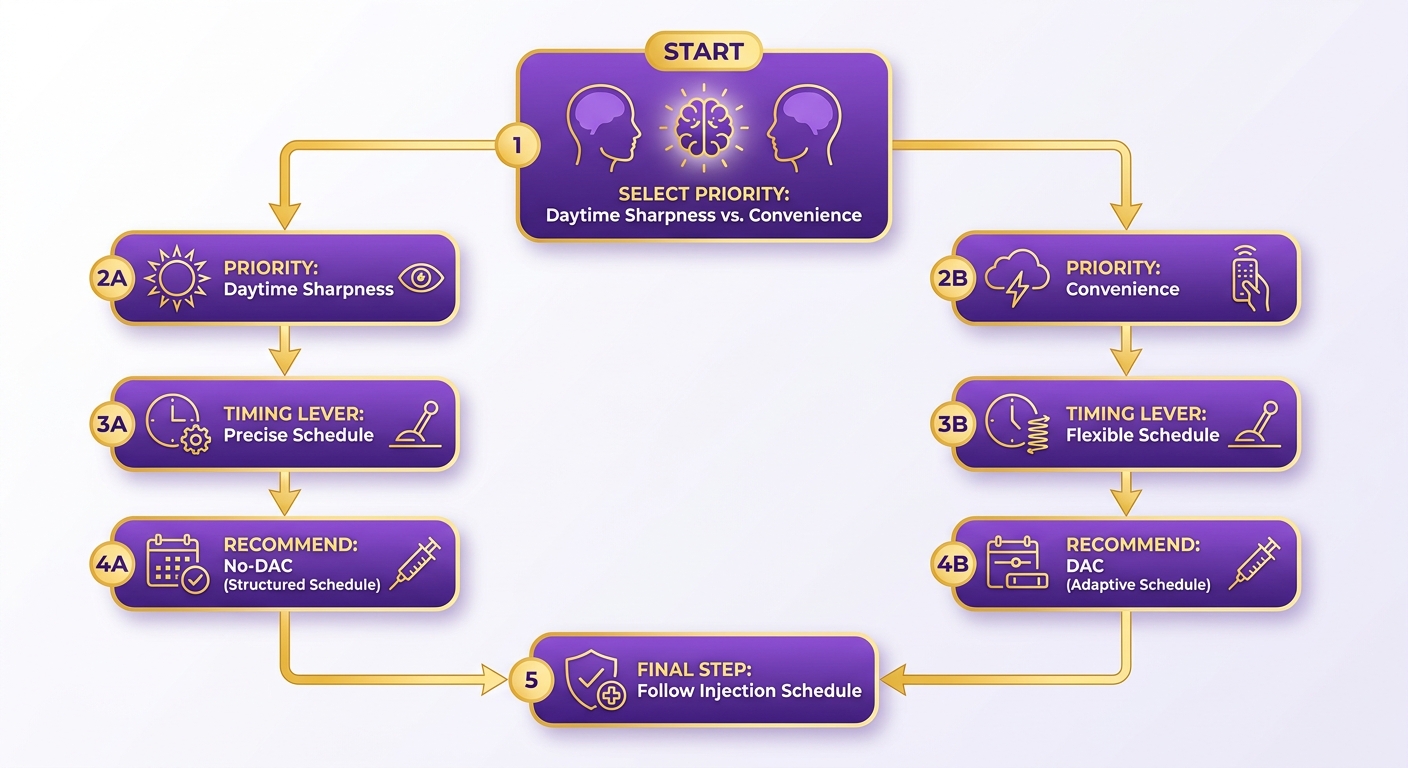
Who should choose No-DAC
For fields that demand sustained mental endurance, software engineering, legal analysis, financial trading, any drop in cognitive performance is costly. A rapid-clearance compound lets these professionals schedule their recovery phases into non-working hours and keep their analytical edge sharp during the day.
The same logic applies to sports requiring fast reaction times and high situational awareness. Clear the active compound before training or competition and you sidestep the physical lethargy that could otherwise blunt performance.
Who should choose DAC (and who shouldn’t)
Frequent travelers, especially those crossing multiple time zones, wrestle with temperature-sensitive compounds. A weekly protocol simplifies the logistics. No cooling case to haul, no injection times to reshuffle against a moving local clock.
But that convenience is a bad trade for anyone already dealing with chronic fatigue, sleep apnea, or other sleep disorders. Adding a continuous GH stimulator to an already compromised recovery system can worsen daytime sleepiness and make normal productivity harder.
Which option fits your profile
Before you commit, run through a few real-world checks that go beyond the pure alertness question:
- Storage and handling. Daily dosers open a vial far more often, so reconstituted product gets used up quickly. Weekly dosers keep the same vial in the fridge longer, which raises the stakes on sterile handling and cold-chain consistency.
- Cost per week. Fewer weekly injections can mean less consumable waste on syringes and alcohol swabs, a small but real budget factor over months.
- Travel logistics. Carrying daily supplies through security and across time zones is harder than packing one weekly dose. If you cross three or more time zones regularly, the weekly option removes a scheduling headache.
- Missed-dose forgiveness. Skip a single daily shot and you lose little. Skip a weekly shot and you leave a noticeable gap in coverage.
One more note on storage stability. Reconstituted peptide degrades over time once mixed, so match your vial size to your planned weekly usage to avoid losing potency.
What I’d actually recommend
The choice between these two pathways is a choice between continuous systemic support and precise timing control. Both offer real advantages for cellular recovery. They just need different management to protect daytime performance.
Which form should you actually choose
If your main goal is peak cognitive and physical performance across the workday, a rapid-clearance protocol is the logical pick. If your life cannot absorb a multi-dose daily schedule, a long-acting formulation is a practical alternative, provided you monitor your systemic response.
Factor in long-term monitoring too. Continuous protocols call for more frequent blood work to keep systemic markers inside safe ranges. Intermittent protocols give you more natural recovery windows.
The safest way to run either form
Before you start anything, establish baseline blood markers, including IGF-1 and growth hormone levels. That data lets you track the compound’s effects objectively and tell normal physiological adaptation apart from excessive systemic fatigue.
| Scenario | Best Choice | Why |
|---|---|---|
| Daytime alertness is critical | No-DAC | Rapid clearance lets energy recover between doses |
| Convenience over everything | DAC | 1-2 injections weekly, no daily clock-watching |
| Under clinical supervision | DAC | Better-characterized PK, monitored trough elevation |
| Want to test timing yourself | No-DAC | Evening dosing aligns GH bump with nighttime rhythm |
| Competing under anti-doping rules | Neither | Both banned as GH secretagogues |
Our bottom line
Managing energy while optimizing recovery is a delicate balance. Once you understand the pharmacokinetic differences between these formulations, you can make decisions that fit both your physical goals and your daily performance demands.
Whichever path you choose, professional oversight remains the most effective tool for managing side effects. A structured clinical consultation can tailor the protocol to your biochemistry, so the pursuit of recovery does not cost you your daily energy.
Frequently Asked Questions
1. Can I switch from DAC to No-DAC if I start feeling tired?
Yes, transitioning is a common strategy for managing persistent fatigue. When making the switch, it is important to allow the long-acting compound to fully clear from your system, which can take several weeks, before starting the daily protocol. That helps you assess the new schedule’s impact on your energy.
2. Does taking CJC-1295 at night reduce the fatigue risk?
This strategy is highly effective for the rapid-clearance version, as it allows the peak growth hormone release to occur during natural sleep hours. For the long-acting version, however, the continuous binding to transport proteins means the compound remains active constantly, making injection timing irrelevant to daytime alertness.
3. Is the fatigue caused by CJC-1295 itself or by how it’s used?
Fatigue is often a product of cumulative systemic exposure rather than the molecule itself. Individual sensitivity to growth hormone secretagogues varies widely, and without precise dosing guidelines, users may inadvertently maintain levels that exceed their body’s capacity to recover, leading to feelings of lethargy.
4. If GH pulses survive under DAC, why does it still cause tiredness?
Even when natural pulsatile release is maintained, a significantly elevated baseline level of growth hormone prevents the endocrine system from returning to a true resting state. This lack of a physiological „reset“ period can overstimulate receptors, leading to systemic fatigue during waking hours.
5. Why does the frequently cited 30-minute clearance figure matter for my dosing plan?
This figure serves as a useful guideline for structuring daily schedules, but because individual metabolic rates vary, the actual clearance time in your body may differ. Treating this number as an approximation helps researchers remain flexible and adjust their dosing intervals based on subjective energy levels.
6. Which BiohackNow No-DAC option fits someone prioritizing daytime alertness?
The single-peptide option offers the most straightforward way to evaluate your response to the compound without confounding variables. For those seeking synergistic effects on growth hormone release, the multi-peptide blend provides an alternative pathway, though it may require more careful timing to manage potential sleepiness.
7. Should beginners choose No-DAC or DAC to manage fatigue risk?
Beginners often benefit from starting with a protocol that has more predictable, documented behavior in clinical literature. Having access to professional guidance during the initial phases of research helps identify early signs of fatigue and adjust the protocol before side effects affect daily productivity.
Free 15-Minute Discovery Call
Ready to take the guesswork out of your health?
Book a free 15-minute call with Monika to talk through your goals, what testing makes sense for you, and the right next step. No pressure, just clarity.
Book Your Free CallFor educational purposes only. Not medical advice.