
Key Takeaways
- The peptide flush from CJC-1295 starts 5 to 30 minutes after you inject and usually fades inside 10 to 60 minutes.
- A real allergic reaction shows up as raised, itchy welts or swelling that keeps building, not a warm, low-grade pink flush.
- The slow-release formula drives flush through both histamine and prostaglandin release, so mild warmth is a drug property, not an immune reaction.
- Hive welts blanch under pressure and each one lasts under 24 hours. Angioedema is deeper, non-itchy swelling around the eyes, lips, or throat.
- New hives hit roughly 1 in 5 people over a lifetime, and urticaria and angioedema often show up together.
- About 99.5% of urticaria episodes resolve without turning severe, which is worth holding onto when you’re watching your own skin.
- Redness, itching, and tenderness right at the needle site usually trace back to technique, not a genuine peptide allergy.
Reading your own skin: hives, swelling, and flush
The first thing you’ll notice after a CJC-1295 injection is redness and warmth spreading out from the site within minutes. That’s the peptide flush. It starts 5 to 30 minutes in and fades in 10 to 60 minutes. An allergic reaction is a different animal: raised, itchy welts, or deeper swelling that keeps building instead of settling down.
Here’s the split that matters when you’re reading your own skin. CJC-1295’s slow-release formula drives flush through both histamine and prostaglandin release, so a warm, pink, low-grade flush is just the drug doing what the drug does. Redness, itching, and tenderness right at the needle site are usually technique, not the peptide turning on you. True hives and swelling are immune-mediated, and that’s when you escalate.
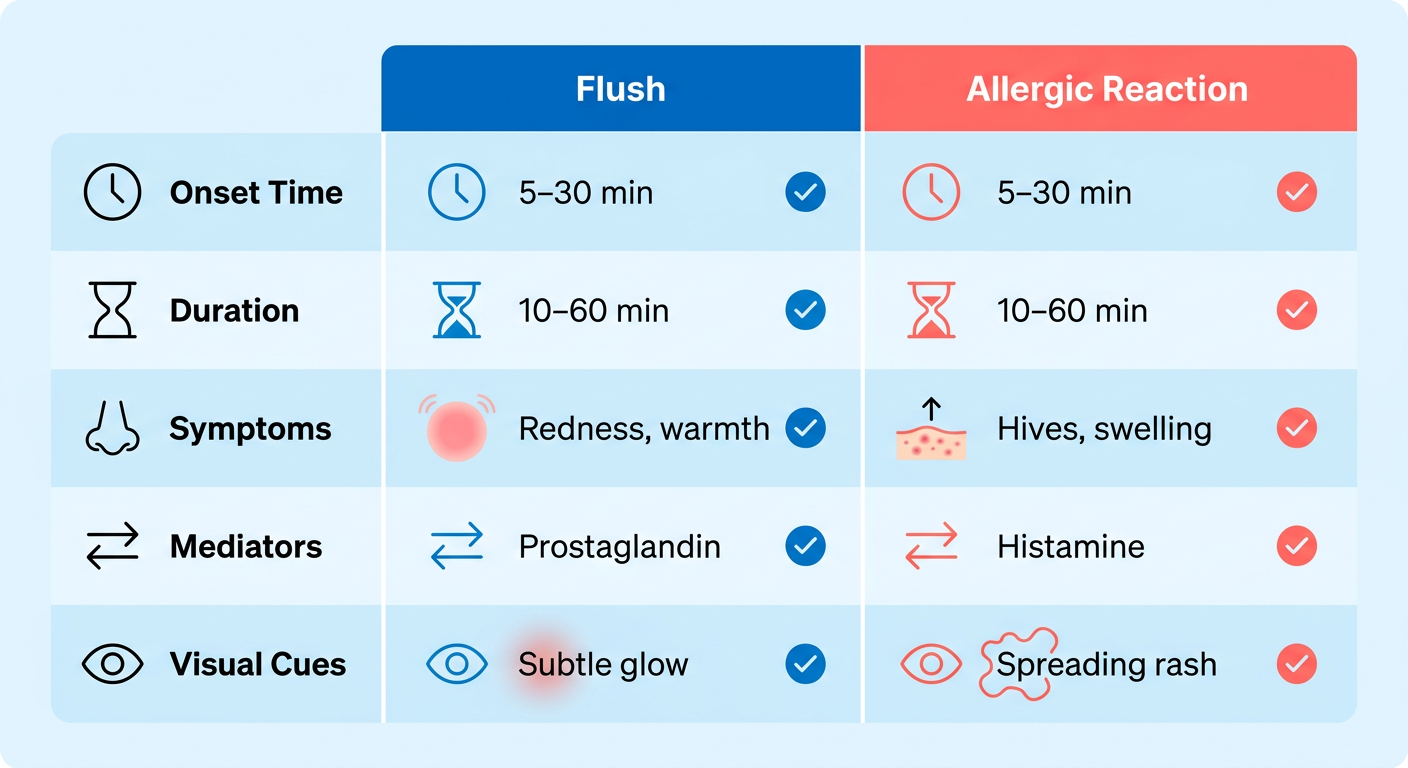
Allergic reaction vs. normal flush: what you’re actually looking at
Hives (urticaria): raised, itchy welts that blanch under pressure, each one lasting under 24 hours. Angioedema: deeper, non-itchy, non-pitting swelling, usually around the eyes, lips, or throat. Flush is flat, warm, and gone within an hour. Welts that stick around and spread are your signal to act.
And watch for swelling actively, don’t wait for it. New hives affect about 1 in 5 people over a lifetime, and urticaria and angioedema often travel together. Our take: if you get post-injection hives, assume swelling is on the table and check your face and throat instead of waiting for it to announce itself.
The reassuring number: 99.5% of urticaria episodes resolve within six weeks, and most are idiopathic rather than a fixed allergy. As allergist Dr. Eric Macy puts it, „allergy is almost never the cause of new episodes of urticaria and angioedema in adults.“ That said, a self-injected research peptide is exactly the uncontrolled, repeated trigger that flips that logic on its head.
Grading severity and knowing when to escalate
Three tiers. Mild: localized hives or flush, no breathing change, no facial swelling. Moderate: widespread hives plus mild swelling. Severe: any wheezing, throat tightness, trouble breathing, or face and throat swelling.
Here’s where the sources genuinely conflict, and it matters for you. Standard clinical guidance says an epinephrine prescription is rarely indicated for isolated idiopathic hives. High-dose non-sedating antihistamines (cetirizine dosed up to 40 mg) handle most acute urticaria. Skip the corticosteroids. A study of over 1.5 million patients linked short-course systemic steroids to higher rates of sepsis and venous thromboembolism, and they don’t actually help hives.
Our position for DIY injectors: you sit in a higher-risk tier than a supervised clinic patient. Uncontrolled trigger, often no allergy history on file. So keeping an epinephrine auto-injector and antihistamines on hand is defensible precaution. Use the epinephrine only for suspected anaphylaxis, not for a patch of hives.
Where tracked protocols come in
We build protocols on tracked biomarkers and personalized review rather than a one-size-fits-all dose, which is the kind of oversight that helps you read a reaction correctly. Because CJC-1295 also flushes through prostaglandins, a warm, low-grade flush can show up even when nothing’s wrong. Don’t misread it as a problem. Log what you see. If welts or swelling appear, that’s a real reaction worth a follow-up conversation, not the flush.
Telling allergy apart from a routine injection reaction

An allergic reaction and a routine injection side effect look alike for the first few minutes, then split sharply. Routine reactions stay local and fade. True allergy spreads, itches, and can pull in the rest of your body. Fastest way to tell them apart: watch two things. Where the symptom is, and whether it’s still growing at the 30-minute mark.
Our working rule. If the redness comes with mild bruising or a small, firm knot under the skin, you’re probably dealing with local tissue trauma from the needle. That kind of thing peaks within a day and fades without spreading. An immune response shows up as raised, migrating welts that expand outward from the site, which means your body is reacting to the peptide itself.
What separates a routine reaction from an allergy
Routine side effect: a symptom confined to the injection site that peaks early and shrinks over hours to a couple of days. Allergic reaction: an itchy, raised rash that spreads beyond the site, keeps building past 30 minutes, or brings breathing changes.
Use this split when you check yourself:
- Location: routine reactions sit at the needle site. Hives appear anywhere.
- Timing: flush resolves fast. Allergic welts persist and multiply.
- Sensation: technique redness feels tender. Allergy itches, intensely.
- Systemic signs: wheezing, throat tightness, or facial swelling never belong to a routine reaction. Call emergency services now.
One nuance most guides skip: what the flush actually feels like. A normal pharmacodynamic flush feels like a sudden wave of dry heat, close to a mild sunburn or a niacin flush, sometimes with a slightly elevated heart rate. That vascular response is benign. An allergic reaction is dominated by intense, localized itching and raised wheals, and it needs a completely different response.
Only hives so far? Still watch for swelling
Yes. Post-injection hives mean you stay alert for deeper tissue involvement. The same inflammatory mediators drive both the superficial and the deep reactions, so a flare on the skin surface can slide into deeper layers. It’s a known pattern, and it calls for active self-monitoring, not passive waiting.
That anatomy changes your monitoring job. Deeper swelling in the subcutaneous tissues can compromise vital structures. For a self-injector, watching has to extend past the skin to the mucous membranes of the mouth and throat the moment any hives show up.
Deep swelling reads as firm, non-pitting, and missing the intense itch of hives. Because it can restrict the airway, any involvement of facial or oral tissue means immediate intervention.
How to respond
Match the response to the tier. For isolated hives with no respiratory symptoms, the goal is to stabilize mast cells and block peripheral receptors. Don’t self-prescribe oral steroids for simple hives. The evidence says they don’t speed recovery and carry unnecessary systemic risk.
Save emergency interventions strictly for signs of systemic compromise, like respiratory distress or cardiovascular instability. Clinical protocols for supervised patients are conservative, but an independent biohacker has to prioritize safety. Keeping emergency countermeasures within reach during self-administration is prudent when you’re working with unprescribed compounds.
First aid in the moment: antihistamines, epinephrine, cooling

The moment you confirm a reaction is underway, your job is to sort severity fast and match the response to it. Isolated hives get antihistamines and cooling. Any sign of airway or blood-pressure involvement gets epinephrine and a 911 call. Those two paths diverge hard, and treating a mild reaction like anaphylaxis wastes time you might need later.
One housekeeping note on your kit. Epinephrine is sensitive to heat and light, so keep it in a stable, dark spot and check the expiration regularly. A degraded auto-injector is no better than not having one.
Antihistamines and doses for acute hives
For acute hives, the goal is to block H1 receptors fast. Second-generation antihistamines do this well, and clinicians often titrate them well past standard over-the-counter doses to get adequate receptor blockade and control the inflammatory cascade.
Cetirizine and its cousins are the workhorses because they control itch without heavy sedation. A first-generation agent at night can help if the itch is wrecking your sleep, but it’s not your daytime driver.
Resist the urge to reach for oral corticosteroids as a quick fix. Major immunology societies advise against routine use for uncomplicated hives because they don’t resolve skin lesions faster than targeted antihistamines. Selective receptor blockers give you a cleaner, safer window.
Why check for swelling even with mild hives
Deep tissue swelling can sneak up because it happens in the lower dermis and subcutaneous layers. Hives appear almost instantly; deeper fluid accumulation can take longer to show. If you see any cutaneous reaction, check your mouth and monitor your breathing on a schedule to catch progression early.
This is where cooling earns its place as an adjunct. Cold packs on hive clusters cut itch and local vasodilation while the antihistamine loads. Wrap the pack, 10 to 15 minutes at a time, never ice directly on skin. Cooling buys comfort. It doesn’t replace the antihistamine, and it does nothing for airway swelling.
When to inject epinephrine and call 911
Use the auto-injector the instant you notice throat tightness, wheezing, difficulty breathing, or facial swelling. Standard adult intramuscular dose is 0.3 mg into the outer thigh. Don’t wait to see if it passes. Anaphylaxis kills through delay.
When EMS arrives, tell them plainly: you injected CJC-1295, a research peptide. State the dose and the time, and say you’ve given epinephrine. That one sentence reframes their workup from mystery rash to drug-triggered anaphylaxis.
And understand that epinephrine’s effects are temporary. It constricts blood vessels and relaxes airway muscles fast, but the half-life is short. That’s why professional evaluation is mandatory even if you feel immediate relief. A second wave of symptoms can hit once the first dose wears off.
Before the needle: screening, prophylaxis, and technique

The best way to manage a reaction is to catch your risk before the needle goes in. Three things: screen your histamine tolerance, decide whether pre-medication makes sense, and clean up your technique so you never mistake an irritation for an immune event.
Our prevention model starts with one filter. If you have an underlying histamine-processing problem, you carry a higher baseline risk of the itchy, welting reactions that mimic true allergy. Screening for that first changes how you read everything that happens after injection.
Screening for histamine risk before you self-inject
Histamine screening: an assessment of whether your body clears dietary and endogenous histamine efficiently, which predicts your likelihood of flush-type and hive-type reactions.
It comes down to the enzymatic pathways that break down amines. People with lower enzyme activity accumulate histamine faster, which lowers their threshold for inflammatory responses. Knowing your baseline there helps you tailor your monitoring.
But metabolic screening only covers one pathway. Synthetic peptides interact with multiple systems at once, so passing a baseline screen doesn’t guarantee you’re clear of all vascular responses. Knowing the difference between metabolic clearance and direct vascular stimulation saves you a lot of unnecessary anxiety during those first doses.
Should you pre-medicate with antihistamines?
Pre-medicating with an oral antihistamine makes sense mainly for the higher-risk tier. If your screen flags a histamine-processing issue, a second-generation oral antihistamine ahead of your dose can blunt the itch-and-welt response.
Skip routine pre-medication if you screened clean and have never reacted. Dosing an antihistamine before every shot you don’t need just masks your ability to read a real reaction early. You want a clear signal, not a muted one.
If you do pre-medicate, timing matters. Oral antihistamines need time to absorb and reach peak plasma levels. Take the blocker well ahead of your injection so the target receptors are occupied before any peptide-induced release kicks in.
Technique that prevents irritation and wrong-depth injection
Good technique strips out the injection-site noise that gets mistaken for allergy. Clean the site with an alcohol wipe and let it dry fully before you inject. Injecting into wet alcohol stings and reddens the skin.
CJC-1295 is a subcutaneous injection. Three workable sites: the abdomen (a couple of inches from the navel), the outer thigh, and the back of the upper arm. Rotate between them so you never hit the same spot twice in a row and stack up local tenderness.
Depth and angle matter because going too deep changes the whole picture. Pinch the skin and inject at a 45-degree angle with a short insulin-gauge needle to stay in the fat layer. Hit muscle and you speed absorption and can amplify the flush, which then looks scarier than the reaction actually is. Nail the technique and you strip away the false alarms, leaving only the real reactions to judge.
For deeper protocol walk-throughs, our clinic blog covers site rotation and screening prep in more detail.
After the shot: what to watch, how long, and what to log

Monitoring after a CJC-1295 injection means checking yourself at fixed intervals, logging what you see, and knowing the threshold that turns watching into acting. The flush window and the allergy window overlap early, so a structured watch is how you tell a passing pharmacodynamic reaction from a real one that needs treatment.
Timing is what makes monitoring reliable. Most immediate hypersensitivity reactions to injectable peptides surface within the first 60 minutes, with the highest-risk block inside the first 15 minutes. That front-loaded risk is why your earliest checks are the tightest, and why a symptom that first appears past the two-hour mark is far more likely to be irritation or a delayed local response than a systemic immune event. Fixed intervals catch the dangerous window without leaving you glued to a clock all day.
The right monitoring intervals
Set a strict observation schedule right after you inject. The first few minutes are for reading immediate vascular changes; the later check-ins tell you whether skin changes are resolving or consolidating into raised, itchy lesions.
At 5 minutes, note redness, warmth, or itch. At 30 minutes, ask the one question that separates flush from allergy: is it fading or still spreading? Fading means pharmacodynamic flush; expect it. Growing welts mean an immune event.
The 2-hour check catches delayed angioedema, especially around the eyes, lips, and throat. A resolved flush needs no further watch. Any welt that outlasts an hour puts you on active swelling surveillance.
What your symptom log should capture
Log onset time, symptom location, severity, and response to treatment for every reaction. That turns a scary moment into data you can act on next time. History is the most important part of any urticaria evaluation, and you’re the only one keeping it.
A workable log is four columns: time of injection, minutes to first symptom, what appeared and where, and what you took plus how fast it settled. Record whether the antihistamines resolved it or whether it kept building despite them. That single detail decides your next dose.
One caveat. Injection-site reactions are easy to confuse with systemic ones. Local reactions stay contained to the puncture area and usually resolve within the same session. A spreading pattern that jumps to untouched skin points toward systemic. Note the boundary of every reaction, because a welt that stays put and one that migrates mean completely different things for your next dose.
When to escalate to a clinician or a blood test
Escalate for any airway or blood-pressure symptom immediately. For repeat hives without airway signs, book a follow-up before your next injection. Serum tryptase can be measured if a severe systemic reaction is suspected, though routine bloodwork isn’t indicated for simple urticaria.
If you keep getting cutaneous reactions, a specialist may recommend in vitro IgE testing or skin patch testing to pin down the exact sensitizing agent. These tools help separate a specific allergy to the peptide sequence from a non-specific reaction to excipients or preservatives in the bacteriostatic water.
Bring your log to the follow-up. A clean record of onset, spread, and treatment response is what lets a clinician adjust your protocol instead of pulling the peptide entirely.
The long game: sourcing, dose tweaks, and lifestyle

Preventing the next reaction is a two-part job: verify what you’re injecting, and cut the immune load your body carries into each shot. Most repeat problems trace to one of these, not to bad luck. If you’ve already had one reaction, this is where you break the cycle instead of rolling the dice again.
Here’s the trap to avoid. Clinical data on ACE-inhibitor angioedema shows an average 10-month gap between a patient’s first swelling episode and the drug being pulled. That delay happens even with a prescribing doctor watching. As a self-injector, you’ve got no one flagging the pattern, so you can blame a bad batch, stress, or dietary histamine across three separate reactions and never suspect the peptide itself. Documentation is your substitute for that missing clinician.
How to verify peptide purity
Peptide purity verification: confirming your vial holds the stated compound at the stated concentration, free of contaminants that can trigger immune reactions. The two gold-standard methods are HPLC (measures purity percentage) and mass spectrometry (confirms the exact molecular identity).
Ask any supplier for a batch-specific certificate of analysis. A generic PDF that never changes across lots tells you nothing. You want HPLC purity above 98% and a mass-spec trace matching CJC-1295’s molecular weight for the exact lot number on your vial.
Contaminants and truncated peptide fragments are the hidden immunogens here. When your welts show up inconsistently, batch variation is often the reason. Testing removes that variable so you can isolate whether the peptide itself is the trigger.
Can dose titration and site rotation cut sensitization?
Start low and climb slowly. A smaller first dose gives your immune system a gentler exposure and lets you read the reaction before you commit to a full protocol dose. If you’ve reacted before, restart at a fraction of your prior dose after a full washout.
Rotate your injection sites on a fixed schedule. Hitting the same spot over and over concentrates local antigen exposure and irritation, which muddies your read on whether a welt is technique or true allergy. Cycle across abdomen quadrants and thighs so no single site gets hammered.
Keep a simple log: dose, site, batch number, and any reaction with its timing. Over three or four injections, a pattern that fingers the peptide gets obvious. That log is the back-end fix for the delay problem we opened with.
The lifestyle factors that lower your risk
Your baseline histamine load matters as much as the injection. A body already fighting inflammation and poor sleep sits closer to the threshold where a mild flush tips into hives.
Three levers do the most work:
- Hydration: supports histamine clearance and takes the edge off flush reactions.
- Sleep: chronic deprivation raises inflammatory tone, which lowers your reaction threshold.
- Anti-inflammatory diet: cutting high-histamine foods around injection days keeps dietary histamine from stacking on top of the peptide’s release.
Skip the fancy protocols if these three basics are broken. Fixing sleep and hydration first often does more than any pre-medication. Pair that groundwork with pre-injection histamine screening and you’ve covered both ends of the risk curve: what you put in, and how your body handles it.
Frequently Asked Questions
1. Can I still use CJC-1295 if I have a known histamine intolerance?
A histamine intolerance raises your baseline risk for flush and hive reactions, but doesn’t automatically rule out CJC-1295. To manage this risk, you can focus on lowering your overall dietary histamine load around your injection days. Avoiding aged cheeses, fermented foods, and alcohol helps reduce the total pool of circulating amines, making any peptide-induced release much easier for your body to process.
2. Why do my hives appear with some vials but not others?
Inconsistent reactions are frequently caused by subtle variations in the manufacturing process of synthetic peptides. During solid-phase peptide synthesis, incomplete chemical reactions can leave behind truncated peptide fragments or residual salts. These manufacturing byproducts, rather than the active compound itself, are often what trigger an unexpected immune response.
3. Is a warm, pink flush after injection a reason to stop using CJC-1295?
A mild, transient flush is a normal physiological response to growth hormone secretagogues. The sudden release of growth hormone causes temporary vasodilation, which manifests as a warm, pink sensation on the skin. This vascular activity is completely harmless and should not be confused with the inflammatory, itchy cascade of a true allergic reaction.
4. Why shouldn’t I just take prednisone to shut down a hive reaction fast?
Oral corticosteroids are broad-spectrum immunosuppressants that take several hours to affect gene transcription, making them too slow for acute relief. Additionally, their systemic side effects—such as rapid blood sugar spikes and fluid retention—outweigh their utility for self-limiting hives, which respond far better to targeted receptor blockers.
5. What should I tell paramedics if I inject epinephrine and call 911?
While waiting for emergency services, focus on preparing your environment for their arrival. Unlock your front door, secure any pets, and place the vial and syringe you used in a visible location. When they arrive, hand them the materials and state the exact time you administered the epinephrine so they can plan your clinical monitoring.
6. If my histamine screen comes back clean, am I safe from all reactions?
A clean histamine screen only indicates that your metabolic pathways are functioning well; it does not rule out other types of immune responses. Your body can still develop a specific IgE-mediated sensitivity to the peptide molecule itself, which operates independently of your baseline histamine clearance capacity.
7. Why does a reaction that appears two hours after injection matter less than one at 15 minutes?
The timing of a reaction is closely tied to the rate of subcutaneous absorption. Because the peptide enters the bloodstream relatively quickly, any systemic, antibody-mediated response will occur almost immediately. A delayed reaction at the injection site is typically a localized, cell-mediated response to the physical trauma of the needle or the volume of the fluid, carrying no risk of systemic escalation.
Free 15-Minute Discovery Call
Ready to take the guesswork out of your health?
Book a free 15-minute call with Monika to talk through your goals, what testing makes sense for you, and the right next step. No pressure, just clarity.
Book Your Free CallFor educational purposes only. Not medical advice.