
Quick Summary
You want to run a CJC-1295 and Ipamorelin cycle and close it cleanly. The side effects that get attention—injection-site redness, water retention—are not necessarily the ones that matter most. Glucose and IGF-1 can shift quietly, and only blood work catches them.
Here is what we track and why each marker earns its place on the exit panel.
| Peptide | Typical dosing | Half-life | Route |
|---|---|---|---|
| CJC-1295 with DAC | Weekly | Longest; DAC extends it | Subcutaneous |
| CJC-1295 without DAC | Daily | Short | Subcutaneous |
| Ipamorelin | Daily, often with CJC | Short | Subcutaneous |
DAC is often described as extending the growth hormone curve. Convenience trades off against a wider monitoring window.
Which Biomarkers Should You Track?
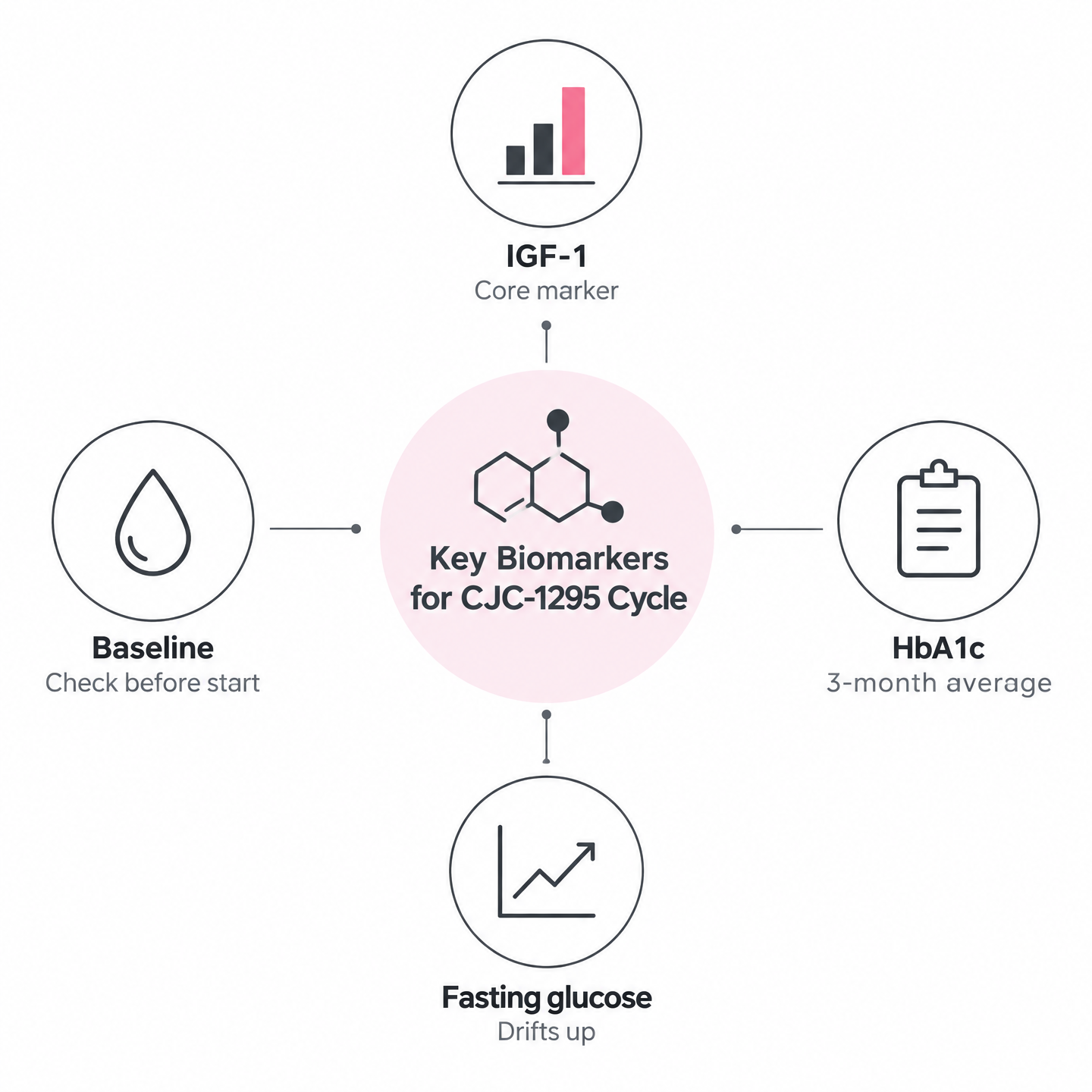
These numbers tell you whether a cycle is safe to continue or safe to close. Glucose markers lead because growth hormone can reduce insulin sensitivity, and some protocols place particular emphasis on the liver.
- IGF-1. Core efficacy and safety marker. CJC-1295 raises growth hormone, which in turn raises IGF-1. You want it elevated into a healthy range, not sky-high—persistently higher circulating IGF-1 has been associated with cancer risk in some research, though the evidence is mixed.
- HbA1c. Your 3-month blood sugar average. Growth hormone secretagogues may nudge this upward in some people.
- Fasting glucose. The marker that can drift up while you feel normal.
- Complete blood count. Baseline health and a reference point for anything unexpected.
- Liver and kidney panels. The liver may be a key site of GH-related insulin-sensitivity changes.
What Side Effects Actually Show Up?
Lead with glucose, not injection-site redness. Growth hormone can reduce insulin sensitivity, and the liver may be affected more than other tissues in some descriptions.
- Impaired glucose metabolism. The one that changes how a cycle is prescribed.
- Fatigue and insomnia. Reported in some clinical trial data.
- Fluid retention and joint discomfort. Mild and usually self-resolving.
- Theoretical tumor-growth concern. Usually discussed in relation to chronic IGF-1 elevation rather than brief cycles.
How Should You Score Your Risk and Time Your Checkpoints?
Risk rises with age, high baseline IGF-1, and poor metabolic health. IGF-1 can rise early in a cycle, so timing your checkpoints matters as much as running them. Test too early and you may chase a number that would have normalized on its own.
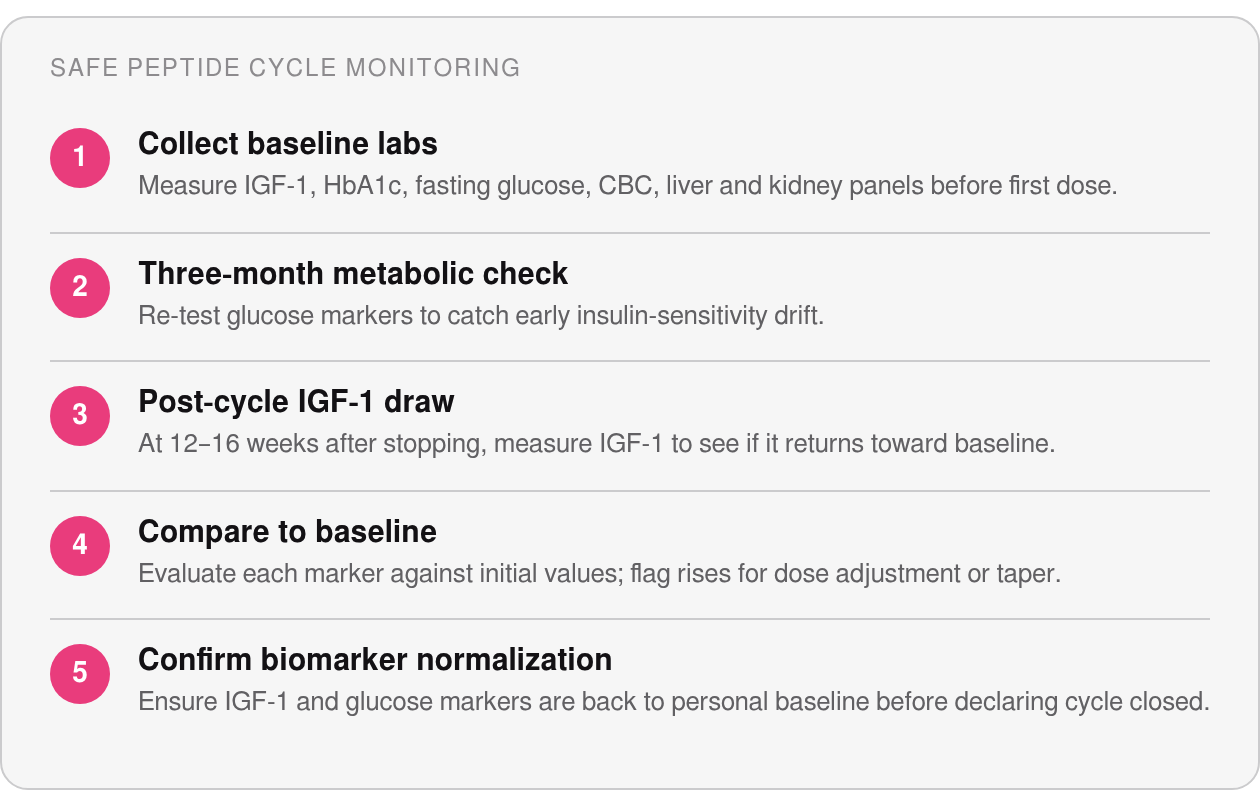
- Baseline. IGF-1, HbA1c, fasting glucose, CBC, liver and kidney panels before the first dose.
- Mid-cycle checkpoint. Recheck glucose markers; this is where metabolic drift may surface.
- Post-cycle after a clear washout period. A delayed IGF-1 draw may be more informative than testing right after the last dose, because early readings can capture a temporary effect rather than recovery.
- Watch HbA1c as a dual signal. Unexpected rises can flag metabolic side effects or, rarely, something that warrants a closer look.
Low risk is a young, metabolically healthy adult with normal baseline IGF-1. High risk is older age, elevated baseline IGF-1, or shaky glucose control.

Quick Answers
- The safest readout compares post-cycle labs against your own baseline, not symptoms.
- Glucose markers deserve priority because metabolic changes can develop without obvious warning signs.
- The DAC version is more convenient, but convenience does not mean a lower monitoring burden.
- HbA1c smooths out day-to-day glucose noise and shows the broader trend.
- IGF-1 interpretation depends heavily on timing. A single poorly timed draw can create false alarm.
- Your starting lab panel is the reference point that makes every later decision more accurate.
Why Glucose and IGF-1 Matter More Than Injection-Site Soreness
Most people running this stack watch for injection site reactions and call it done. That misses the point. The side effects that matter are often the ones you cannot feel: metabolic drift, sustained IGF-1 elevation, and cellular signaling changes that happen silently. Only lab work catches those shifts.
Each category belongs on the exit checklist for a different reason.
Why Does Glucose Monitoring Matter More Than Side Effects You Can Feel?
Growth hormone and insulin pull against each other. Raise one on purpose and you may reduce the body’s response to the other. This is expected physiology, not a rare reaction. A metabolic baseline belongs at the front of the plan.
The practical issue is interpretation. Without pre-cycle glucose data, a later borderline result becomes guesswork: was it already present, diet-related, peptide-related, or part of a broader metabolic pattern? A baseline turns that question into something you can actually evaluate.
- Get glucose markers before your first dose, so later changes have context.
- Look for direction of travel, not just whether one result lands inside a reference range.
When Should You Test IGF-1 After Stopping?
Do not treat the final injection as the finish line for interpretation. CJC-1295 stimulates growth hormone and downstream IGF-1 beyond the moment you stop using it. If you draw during that washout period, the result may describe the tail end of the pharmacologic effect rather than your true recovery point.
The better question is not „did IGF-1 rise?“ It is „did IGF-1 return toward my personal baseline once the cycle had enough time to clear?“ That distinction helps prevent a normal temporary response from being misread as a persistent problem.
- Put the post-cycle IGF-1 draw on the calendar before the cycle starts.
- Read the result against your own earlier number, because age, sex, and baseline physiology change what „high“ means.
What About the Cancer Question?
The cancer concern is mechanistic, not a claim that a short peptide cycle „causes cancer.“ IGF-1 participates in growth signaling, which is why clinicians tend to take persistent elevation seriously. The risk conversation becomes more important when someone already has elevated baseline markers, a concerning history, or poor follow-through with labs.
Brief, monitored use is not the same exposure pattern as years of unexplained elevation. Surveillance can help confirm that the signal settles instead of staying pushed upward.
- Avoid this stack if you have an active or recent cancer diagnosis unless a qualified clinician has specifically evaluated the risk.
- Treat unexplained post-cycle changes as follow-up items, not as something to dismiss because you expected the peptide to move numbers.
Monitoring Biomarkers: IGF‑1, HbA1c, and Cancer‑Risk Indicators
You want to close your cycle on data, not vibes. The lab panel is where many cjc-1295 and ipamorelin side effects show up long before you feel anything. Biomarker tracking sits at the center of how we build and adjust every protocol.
Many people overreact or underreact. A lab value is not useful in isolation. It becomes useful when you know the starting point, the cycle context, the timing of the draw, and whether the trend makes sense for the person in front of you.
IGF-1 Is Only Useful If You Time the Draw
Insulin-like growth factor 1, the downstream hormone growth hormone actually raises, is your primary signal. We read it against age and sex norms, because a healthy younger adult can sit well above an older adult without that automatically meaning something is wrong. As part of our personalized protocols, hormones like IGF-1 are among the core biomarkers we track to guide dosing decisions.
A sensible way to approach it:
- Draw a pre-cycle IGF-1 so the follow-up result has a personal comparator.
- Repeat the marker after the cycle at the planned recovery checkpoint rather than during the immediate washout.
- Flag a result that remains unusually elevated for dose review, a pause, or a more careful clinical discussion.
Why the caution? IGF-1 is thought to promote cell proliferation and may reduce apoptosis. It likely does not start cancer by itself, but persistent elevation can matter in a body where abnormal cells are already present. Short, pulsed use reads differently than chronic elevation, which is exactly why we care that your IGF-1 comes back down.
HbA1c Does Double Duty on This Panel
HbA1c is valuable because it does not depend on what happened at breakfast the morning of the test. It gives a broader view of glucose handling, which makes it harder for a single good fasting number to hide a worsening trend.
Use it as a pattern detector:
- Establish the baseline before the protocol starts.
- Recheck it with the rest of the metabolic panel when the cycle is being evaluated.
- Investigate a rise that does not match your nutrition, training, sleep, or medication changes.
That last point matters because HbA1c is not peptide-specific. It can reflect diet, stress, reduced activity, worsening insulin sensitivity, or something else that deserves attention. The job is not to blame the peptide automatically; the job is to avoid ignoring a real signal.
Cancer Surveillance Is Risk-Scaled, Not Routine
Surveillance should fit the person in front of us, which is the whole point of a personalized protocol. For clients with a personal or family cancer history, age-appropriate screening earns its place in the monitoring plan.
- Keep standard screening current rather than inventing peptide-specific panels.
- Coordinate any added screening with your regular care and existing risk profile.
- Escalate only when the lab pattern, history, or symptoms justify it.
Skip aggressive tumor-marker testing if you are young, low-risk, and your IGF-1 normalizes on schedule. Chasing markers with no pre-test probability buys you anxiety and false positives, not safety. The honest gap: there is no long-term randomized data on this combination in healthy adults, which is precisely why we monitor the way we do. Our full approach lives on the BiohackNow blog.

Managing and Mitigating Side Effects: Protocol Adjustments & Supportive Strategies
You run a cycle to feel sharper, then the exit panel shows a fasting glucose creeping up or an IGF-1 that looks too high. Most of the cjc-1295 and ipamorelin side effects worth worrying about respond to protocol changes, not heroics. We adjust the regimen first and reach for adjuncts second.
The mitigations that matter are the ones that move a biomarker, not the ones that simply make the protocol feel cleaner. We build the exit plan around what the panel will show, then layer in support where the data points.
How Do You Reset IGF-1 With Tapering or a Drug Holiday?
IGF-1 is the marker you close a cycle on, and it does not behave like an on-off switch. Because the long-term safety evidence for this exact combination in healthy adults is limited, the conservative move is to avoid turning a temporary elevation into a continuous one.
- Build a planned drug holiday into the cycle rather than running continuously.
- Taper the dose down over the final phase if your protocol calls for a step-down.
- Use the planned follow-up lab window to confirm where IGF-1 settles before considering another cycle.
This is not about making the protocol complicated. It is about creating a clean stop point where the data can be read without confusion.
What Supports Insulin Sensitivity When HbA1c Climbs?
When glucose markers move, the first step is to confirm the pattern. A single abnormal value can be noise; a consistent shift across markers is more meaningful.
- Retest HbA1c alongside fasting glucose if either baseline shifted during the cycle.
- Tighten carbohydrate timing and training consistency during the protocol.
- Look for mismatches: a lab rise that does not fit your diet, sleep, medication, or activity changes deserves investigation.
Meal timing and training habits can matter even when body weight has not changed, and some protocols focus on liver-related glucose handling. If the numbers keep drifting despite better execution, the protocol needs reassessment rather than another layer of rationalization.
Why Does Sleep Get Worse Instead of Better?
People start these protocols expecting deeper sleep and more energy. Some clinical data report fatigue and insomnia as adverse events, which can catch people off guard because it runs against the common marketing story around GH support.
- Report sleep and energy changes honestly, even if they feel unrelated.
- Keep injection timing consistent and away from bedtime if sleep worsens.
- Recheck the protocol if poor sleep appears alongside glucose drift, water retention, or unusual fatigue.
One reassurance sometimes cited for ipamorelin is that it may be less likely to disturb stress hormones than some other GH secretagogues, but sleep changes should still be evaluated on their own. We fold all of this into each client’s plan on the BiohackNow blog.

Choosing the Right Candidate & Alternatives: Patient Selection, Contra‑indications, and Other GH‑Optimizing Options
Eligibility for growth hormone secretagogues is not about checking a box; it is about deciding whether raising IGF-1 makes sense for your baseline risk profile. At BiohackNow, every protocol is personalized and data-driven, built from your blood work and the core biomarkers we track, from hormones to gut health.
The metabolic and cancer-risk signals matter more than the transient injection-site soreness or overnight puffiness most people focus on. If your baseline risk is already elevated, the question becomes whether the possible benefit justifies adding another growth-signal variable.
Who Should Think Twice About This Protocol?
Some situations call for real caution. Not cautious hedges. Reasons to slow down.
- A personal or family history that raises cancer-risk flags. In that setting, the uncertainty around growth signaling deserves a careful, individualized review.
- Unstable blood sugar. If your baseline glucose control is already shaky, a protocol that can pressure insulin sensitivity may push the wrong direction.
- An unexplained HbA1c creep. If the trend is already moving upward before treatment, the smarter move is to understand why before adding peptides.
One honest note: regulatory status varies, and in some jurisdictions CJC-1295 has been subject to compounding restrictions, so check the current rules and the provider’s compliance before proceeding.

What Are the Better-Studied Alternatives?
Plenty of people who ask about this stack are better served elsewhere. If your goal is sleep, know that the improvement some users chase may not come from GH support unless a true deficiency is present.
- Resistance training and consistent sleep. These support endogenous growth hormone without a drug-interaction profile or a monitoring burden.
- Tesamorelin, a GHRH analog that may have a longer clinical track record for specific indications, if a prescriber judges it appropriate.
- A personalized workup first. At BiohackNow, we start every client with a consultation and in-depth blood work review, then build a protocol tailored to the biomarkers we track, from hormones to toxins and gut health.
The evidence is genuinely thin here, and anyone promising certainty is overstating it. Our philosophy is science-backed, personalized care, which means well-screened candidates and honest expectations. For everyone else, the better-studied path wins.
Frequently Asked Questions
Can I test IGF-1 immediately after my last injection to see if the cycle worked?
No. The immediate post-injection period is not the right moment to judge recovery. Use the delayed post-cycle checkpoint from your monitoring plan so the result reflects where IGF-1 settles, not just the remaining effect of the protocol.
Why does HbA1c matter if my fasting glucose looks normal?
Fasting glucose is a snapshot. HbA1c shows the broader pattern, which makes it useful when day-to-day readings look acceptable but the overall trend is worsening. Reading both together gives a clearer metabolic picture than either one alone.
Should I stop the stack if I feel more tired instead of energized?
Do not simply push through it. Tell your provider, especially if fatigue comes with poor sleep, glucose changes, swelling, or reduced training tolerance. The answer may be timing, dose adjustment, a pause, or a lab recheck.
Does CJC-1295 without DAC carry less cancer risk than the DAC version?
The formulation changes the exposure pattern and dosing rhythm, but the central question is still whether IGF-1 rises appropriately and then returns toward baseline. Shorter pulses do not remove the need for screening and follow-up labs.
What baseline labs do I actually need before starting, beyond just IGF-1?
Use a full baseline panel rather than a single-marker check. IGF-1 tells you about growth-hormone signaling, glucose markers show metabolic tolerance, and basic blood and organ-function labs give context for anything that changes later.
Free 15-Minute Discovery Call
Ready to take the guesswork out of your health?
Book a free 15-minute call with Monika to talk through your goals, what testing makes sense for you, and the right next step. No pressure, just clarity.
Book Your Free CallFor educational purposes only. Not medical advice.