
Key Takeaways
- CJC-1295 DAC is described as a long-acting GHRH analog. The main safety issue is prolonged growth hormone and IGF-1 stimulation, not a brief post-injection spike.
- Serious allergic reactions such as hives, facial swelling, or trouble breathing are rare but high-risk and require emergency care.
- Injection-site pain, flushing, and headache are frequently reported but generally low-risk. Glucose and insulin changes can build over weeks and vary with dose.
- CJC-1295’s status in compounded products has drawn regulatory scrutiny, and growth-hormone-releasing peptides may be prohibited in tested sport. Verify current rules before considering it.
- Prolonged GH-axis activation can worsen blood pressure, glucose control, joint pain, and fluid retention, which may work against the muscle and fat-loss goals users are after.
Quick Summary
The central concern with CJC-1295 DAC is duration. In clinical descriptions, the drug produces measurable growth-hormone and IGF-1 responses well past a single injection. Most reported side effects are mild, but the long exposure window can make even mild risks harder to interpret.

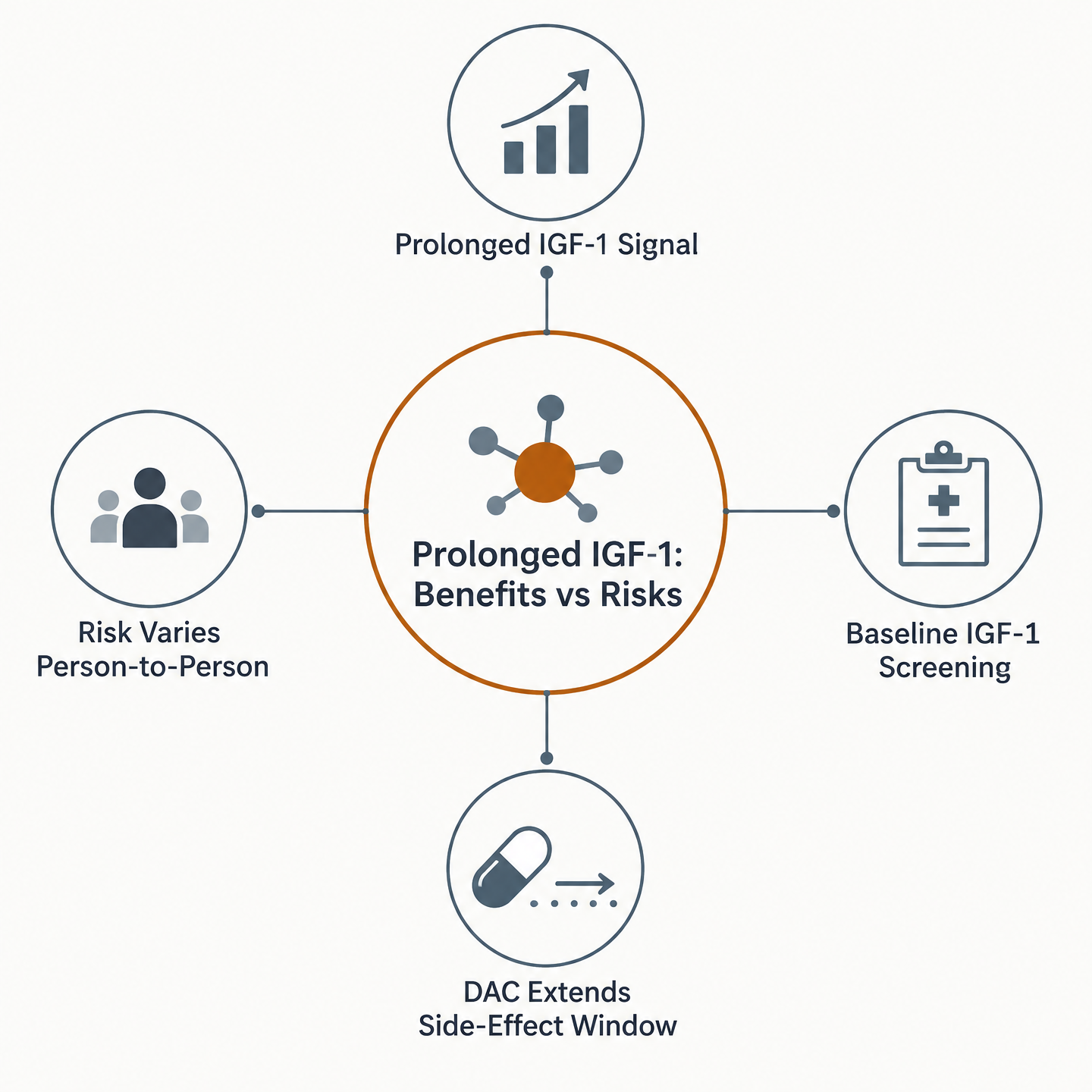
The screening problem is duration. As a long-acting analog of growth hormone-releasing hormone, CJC-1295 is intended to produce prolonged stimulation of growth hormone and IGF-1 secretion. Not a quick spike. A near-continuous growth signal. Anyone with a personal or family predisposition to IGF-1-sensitive tumors faces sustained exposure, not an intermittent one.
The side effects at a glance
| Side Effect | Typical Onset | Severity Range | Reported Frequency | Risk Level | Monitoring / Action |
|---|---|---|---|---|---|
| Injection-site pain, redness | Minutes to hours | Mild | Frequently reported | Low | Rotate sites every injection |
| Flushing / vasodilation | Within an hour | Mild to moderate | Reported | Low-Medium | Monitor flushing; seek help if severe |
| Headache | Hours | Mild | Reported | Low | Hydrate; note frequency |
| Drowsiness, vertigo | Hours | Mild | Reported | Low | Consider dosing before sleep |
| Increased heart rate | Hours to days | Mild to moderate | Reported | Medium | Baseline + follow-up BP/HR |
| Glucose / insulin changes | Weeks | Moderate | Dose-dependent | Medium | Fasting glucose baseline, recheck |
| Allergic reaction: rash, hives, swelling, trouble breathing | Minutes | Severe | Rare | High | Stop immediately, emergency care |
| IGF-1-driven mitogenic risk | Weeks, sustained | Theoretical to serious | Uncertain | High | Baseline IGF-1; screen cancer history |
The table reflects commonly discussed patterns, not a formal safety database. Individual responses can vary.
Who should avoid CJC-1295 DAC
No genetic test gates this therapy. So we treat a baseline IGF-1 level plus personal and family cancer and cardiometabolic history as the working stand-in for the genotype screen an ideal protocol would run. An already-high baseline IGF-1 is a red flag before the first dose.
- Personal or family history of cancer or IGF-1-sensitive tumors. Sustained IGF-1 elevation means prolonged growth signaling, not a short exposure.
- Already-elevated baseline IGF-1. You are adding a growth signal on top of a high starting point.
- Uncontrolled diabetes or insulin resistance. GH stimulation can worsen glucose control.
- Significant cardiovascular disease or uncontrolled hypertension. Prolonged GH-axis activation can increase fluid retention and cardiovascular load.
- Pregnancy or breastfeeding. Not tested in these groups; effects on a developing baby are unknown.
- Anyone under 18. Safety and efficacy in children were never established.
- Prior serious reaction to peptides. This flags possible allergy and immunogenicity risk.
Pre-treatment labs we consider non-negotiable
A conservative pre-treatment review includes fasting glucose, a full IGF-1 level, a lipid panel, and thyroid function. Tell your provider about any steroid or thyroid medication, since both can interact with the growth-hormone axis.
Most reported side effects are mild and self-limiting, but reported common is not the same as harmless. Sustained IGF-1 elevation is the real gatekeeper. Screen your cancer history and baseline IGF-1 first, and skip DAC entirely if either raises a flag.
Why the screening comes before the benefit
Understanding the side effects of CJC 1295 DAC isn’t a box you tick after you’ve decided to start. It’s the decision itself. Peptides have become a visible category in anti-aging, and demand is climbing faster than the evidence under it.
That gap is where avoidable harm shows up. The benefit pitch and the risk profile come from the same mechanism: stronger GH-axis signaling. The catch is that the response isn’t uniform. Two people can use the same product and land in very different biological territory.
Popularity is outpacing the evidence
CJC-1295 has moved from niche forums into everyday longevity talk, but its regulatory and safety footing hasn’t kept up. Before you weigh any benefit, know where the drug actually stands with regulators and sport authorities.
- CJC-1295 has been discussed in regulatory actions involving compounded peptides. Depending on the jurisdiction and current rules, a seller offering compounded CJC-1295 may be operating outside federal guidance.
- Do not assume it is permitted in tested sport. Many sports authorities prohibit growth-hormone-releasing peptides, and a positive test can end a season.
The downsides attack the exact goals you bought in for
Most people reach for CJC-1295 DAC to build muscle, drop fat, or sleep better. The irony is that the drug’s downsides can push straight against those goals. Pushing GH too high doesn’t just add nuisance symptoms. It can reverse the wins you paid for.
- Excessive GH can drive high blood pressure, elevated glucose, joint and muscle pain, and fluid retention. That is the opposite of the lean, recovered body most users are chasing.
- Treat the sleep pitch skeptically. GH-driven sleep benefits are better documented in true GH deficiency, so in otherwise healthy adults the effect may be modest or confounded by lifestyle changes.
- DAC stretches the half-life and the side-effect window at the same time, without the pulsatile rhythm that some clinicians consider important for GH effectiveness.
Where baseline biomarker screening changes the math
This is where a precision approach parts ways with the buy-it-online crowd. Because the harms trace back to sustained IGF-1 exposure, and because that response varies person to person, baseline biomarkers should be measured before anyone injects a single dose. It’s a gate, not an afterthought.
- Establish your IGF-1 baseline before treatment, not after. If your levels already run high, the extended exposure from DAC may compound the risk rather than the benefit.
- Front-load cardiovascular and metabolic screening. GH excess and vasodilation can surface problems a patient never knew they had, which is why baseline cardiac and metabolic checks belong before the first dose.
Skip CJC-1295 DAC if screening flags elevated IGF-1 or hidden cardiac risk. The cost of an abandoned protocol is real, but the cost of learning your risk profile mid-treatment is worse.
What the frequency data actually shows
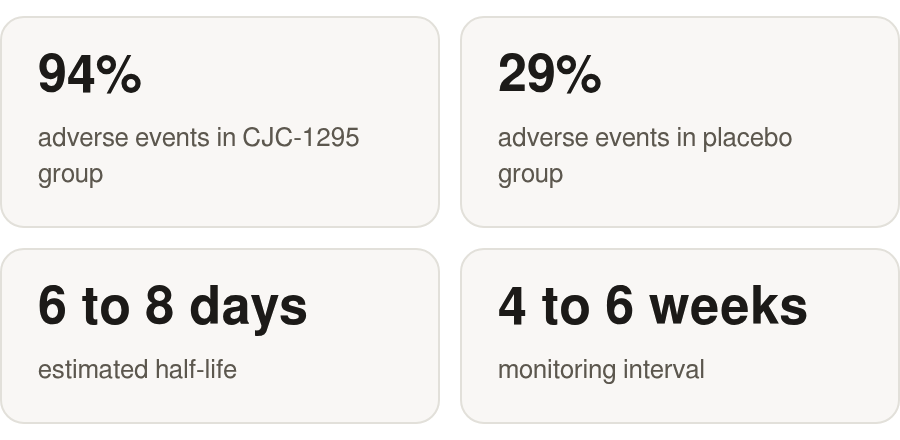
Most reports lump the 1295 DAC into a single reassuring line: mild, well tolerated, nothing serious. Some published dose-escalation accounts tell a messier story. In one study, adverse events were substantially more common in people receiving CJC-1295 than in people receiving placebo, although most reported events were mild.

That gap matters. High frequency and a „well tolerated“ label aren’t contradictions. One describes how often something happens, the other how bad it is. Reading only the severity half is how patients ignore the frequency half.
Injection-site reactions are the most common complaint
Local reactions top the list for a reason: every dose is a subcutaneous shot, usually into the abdomen, thigh, or upper arm. Pain and redness at the site are the events reported most consistently.
- Rotate injection sites with every dose. Reusing the same spot concentrates irritation and makes local pain and redness worse.
- Track redness that spreads or lingers past a day. Persistent local reactions can signal a sensitivity worth flagging before your next injection.
- Treat any whole-body immune reaction as categorically different from soreness at the needle site. Local irritation goes in your symptom log; systemic allergy goes to urgent care.
Systemic reactions track the hormone surge
The whole-body effects come from the drug doing exactly what it’s designed to do. Flushing, headache, drowsiness, vertigo, a faster heart rate, and a bump in body temperature all show up in the reported profile, alongside diarrhea and vasodilatory responses.
Onset is fast for the vascular symptoms. Flushing and headache tend to arrive within hours of an injection, tracking the rise in growth hormone. The metabolic strain builds over a longer horizon.
- Expect flushing and headache in the first hours post-dose. Significant flushing that keeps escalating is a warning sign, not a settling-in effect.
- Watch for joint pain, muscle aches, and fluid retention over weeks. Excessive growth hormone is linked to high blood pressure, diabetes, and these musculoskeletal complaints.
- Tell your provider about any steroids and thyroid medications before starting. These interact with the growth axis and change how you respond.
Why the pre-injection IGF-1 number carries so much weight
The DAC modification is designed to keep this compound active far longer than short-acting analogs, so a single high starting IGF-1 value isn’t a transient spike you can wait out between doses. The extended half-life means an elevated reading can compound instead of clearing.
An already-elevated IGF-1 reading should stop the conversation before the first injection. Age matters too: reference ranges can narrow with age, so a value that looks fine on a generic chart may sit at the top of the band for a 45-year-old.
- Get a baseline IGF-1 drawn first. A high starting value means you are stacking a growth signal on top of one your body already runs hot.
- Confirm the lab reports an age- and sex-matched reference range, not a single population cutoff. A „normal“ flag against the wrong range hides a genuinely high result.
Who should never start, before the drug is even in the room
The clearest contraindications for CJC-1295 DAC aren’t only about the drug. They’re about who you already are before the first injection. A recurring theme in the safety literature: the highest-risk patients often feel perfectly healthy. Their risk is written into their history and, potentially, their genetics.

The practical screening frame is history plus labs. Although researchers have studied variation in IGF-1 and growth-hormone pathway genes, there is no standard genotype-based approval test. That means your cancer pattern, cardiometabolic status, medication list, and starting growth-axis markers carry the weight. Family history is a rough proxy for inherited risk, not an actual genetic test.
The cancer question comes first
Some manufacturer and pharmacy guidance explicitly flags anyone with a history of cancer or increased cancer risk to disclose it before use. That warning exists because IGF-1 is a growth-promoting signal, and DAC creates a near-continuous elevated-IGF-1 environment rather than a brief pulse.
If IGF-1-sensitive tumors like breast or prostate cancer run in your family, prolonged stimulation is exactly the wrong signal to introduce.
- Rule out CJC-1295 DAC if you have a personal history of hormone-sensitive cancer. Sustained IGF-1 elevation is a documented growth driver, not a neutral bystander.
- Flag any strong family history of breast, prostate, or other IGF-1-linked cancers. A concerning family pattern is one practical proxy for genetic risk.
Does existing heart or metabolic disease change the math?
Excessive GH raises the risk of high blood pressure, diabetes, joint pain, and fluid retention. Layer that onto a compromised system and the calculus shifts fast.
Some early clinical reports describe serious cardiac events in people with pre-existing cardiovascular disease. Even when investigators judged those events unrelated to the peptide, the lesson remains: undetected heart disease is precisely the latent risk pre-treatment screening should catch before sustained GH stimulation stresses the system.
- Avoid it with uncontrolled hypertension or known coronary disease. Vasodilatory and fluid-retaining effects add load a compromised heart doesn’t need.
- Reconsider if you have diabetes or impaired glucose tolerance. GH counteracts insulin, and prolonged elevation can worsen glycemic control.
- Disclose pancreas or kidney problems, plus any steroids or thyroid medications. These interact with GH signaling and shift your risk profile.
The groups with no data to lean on
Some groups fall outside the evidence completely. There’s no safety data to work from, so the honest answer is to wait.
- Do not use it while pregnant or breastfeeding. It has not been tested in pregnancy or lactation, and effects on a developing baby are unknown.
- Keep it away from anyone under 18. Safety and efficacy in children were never established.
- Stop immediately after any allergic reaction. Rash, hives, facial swelling, or difficulty breathing warrant urgent medical help, not a second dose.
Monitoring, red flags, and when to stop
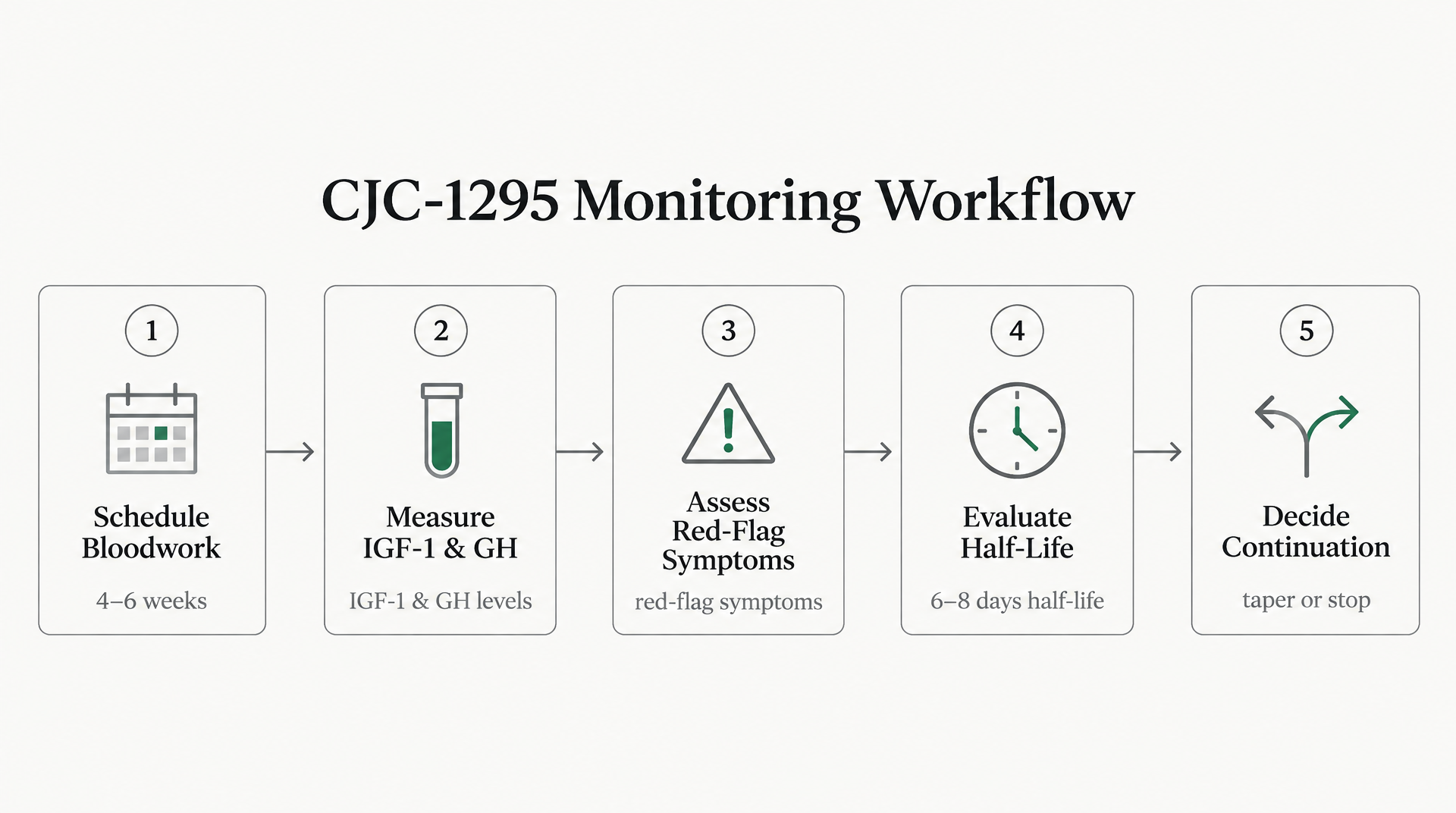
Monitoring is where the genotype-driven logic pays off. Since no genetic test flags who overresponds to the IGF-1 signal, your lab trajectory becomes the proxy you actually have. That’s why tracking CJC 1295 DAC through scheduled bloodwork matters more than watching how you feel.
The pharmacology sets the cadence. The drug is designed to linger, so after repeated dosing the growth signal can accumulate rather than clear between shots. A monitoring calendar should account for that accumulation curve. Some protocols use a retest interval—for example every 4 to 6 weeks—but the right interval depends on the patient.
What to test before and during therapy
Your baseline panel is the reference point every later result gets measured against. Without it, you can’t tell a normal response from an outlier.
- A conservative baseline panel may include IGF-1, growth hormone, fasting glucose, and relevant sex hormones, so a hyper-responsive IGF-1 axis shows up as a trend rather than a surprise.
- Run fasting glucose, HbA1c, and a lipid profile at baseline, because GH stimulation nudges glucose handling and you want the trend, not a single reading.
- Record resting blood pressure and, for higher-risk patients, consider a baseline ECG, since vasodilatory and heart-rate effects are documented with this peptide.
- Recheck IGF-1 and fasting glucose on a schedule matched to the drug’s accumulation pattern—for example every 4 to 6 weeks during treatment.
Some clinicians also track fasting IGFBP-3 where available. The IGF-1 to IGFBP-3 relationship may add nuance when total IGF-1 is still within range but the overall pattern is moving in the wrong direction.
Which red flags mean stop now
Some reactions warrant pausing at the next visit. Others mean stop the injection and get medical help the same day. Manufacturer and pharmacy guidance draws a firm line around acute systemic symptoms.
- Seek immediate care for rash, hives, difficulty breathing, or swelling of the mouth, lips, or tongue, and stop dosing. These signal a serious allergic reaction, and a prior serious reaction is a hard contraindication.
- Stop and reassess after significant flushing following injections, which some pharmacy guidance singles out as urgent rather than cosmetic.
- Flag persistent headache, vertigo, drowsiness, or a sustained rise in heart rate or body temperature, and pause if they don’t settle between doses.
- Pause immediately for unexplained rapid weight gain or blood pressure that stays high across readings, since both point to overshooting the growth and fluid-retention signal.

Continue, taper, or walk away
The decision comes back to trajectory, not one bad day. A single flushing episode that resolves is different from an IGF-1 level climbing past target at every retest.
A practical decision framework looks like this:
- Do not start if you have a personal history of hormone-sensitive cancer, pregnancy or breastfeeding, age under 18, prior serious peptide reaction, uncontrolled hypertension or coronary disease, or uncontrolled diabetes.
- Before starting, obtain baseline IGF-1, fasting glucose, cardiovascular assessment, and medication review. Do not start if baseline IGF-1 is high or high-normal for age and sex unless a specialist has explicitly reviewed the risk.
- During monitoring:
- Mild injection-site symptoms: rotate sites and continue only if manageable.
- Significant flushing, persistent high blood pressure, rapid weight gain, or worsening glucose: pause and reassess.
- Rising IGF-1 above your individual target or baseline ceiling: taper or stop; do not push through.
- Acute allergic symptoms: stop immediately and seek emergency care.
- Where evidence is uncertain: there is no universal IGF-1 cutoff, genetic clearance test, or standard retest interval. Thresholds should be set and updated with a qualified clinician.
If IGF-1 trends above your ceiling or glucose drifts upward, taper the dose rather than pushing through. Because the peptide may linger after the last injection, stopping doesn’t immediately reset the signal, so follow-up labs still matter. For any acute allergic reaction, there is no taper. You stop, and it becomes a permanent contraindication.
Common Questions
How is CJC-1295 DAC different from the version without DAC?
The DAC version is built for extended exposure, while the non-DAC version is used when a shorter signal is desired. That difference changes the safety conversation: with DAC, side effects are less about a single post-injection moment and more about the cumulative load on IGF-1, glucose handling, blood pressure, and fluid balance.
If I have a bad reaction, how quickly does the drug leave my system?
Do not judge this by how you feel the next morning. Symptoms may settle before the underlying growth-axis stimulation has fully declined. If the reaction is mild, your provider may keep checking labs and vitals after dosing stops. If the reaction suggests allergy, the next step is not a lower dose; it is discontinuation and medical evaluation.
My IGF-1 reading came back „normal,“ so am I safe to start?
Not automatically. A lab flag is only useful if it matches your age and sex, and it still has to be interpreted alongside cancer history, glucose control, cardiovascular risk, and current medications. „Normal“ is a starting point for review, not a clearance stamp.
Can I legally buy CJC-1295 DAC for anti-aging use?
Legality is not the only issue. Even if a website is easy to find, that does not mean the product fits within appropriate medical use or that the supply chain is reliable. This is not a peptide to source casually, especially when the main risks depend on screening data most sellers never collect.
Is the sleep improvement people talk about actually real?
Sleep claims should be separated from medical need. If someone has a true growth-hormone deficiency, changing GH signaling may affect sleep architecture. In otherwise healthy adults, better sleep reports are much harder to interpret because expectations, training load, diet, recovery routines, and placebo effects can all move at the same time.
What is the IGF-1 to IGFBP-3 ratio, and why would my provider track it?
IGFBP-3 is one of the binding proteins that helps regulate how much IGF-1 is freely active. Looking at the relationship between the two can give a more nuanced picture than checking IGF-1 in isolation, especially when a patient’s total IGF-1 number has not yet crossed a lab cutoff but the overall pattern is moving in the wrong direction.
I compete in a tested sport. Does that change anything?
Yes. For athletes under testing rules, this is not just a health-risk decision. It becomes an eligibility decision, and medical screening cannot protect you from a rules violation. Talk to your sport’s compliance staff before using any peptide marketed for growth-hormone effects.
This article is for educational purposes only and does not replace individualized medical advice. Talk with a qualified provider before starting, stopping, or changing any peptide protocol.
Free 15-Minute Discovery Call
Ready to take the guesswork out of your health?
Book a free 15-minute call with Monika to talk through your goals, what testing makes sense for you, and the right next step. No pressure, just clarity.
Book Your Free CallFor educational purposes only. Not medical advice.