
Short answers first
- CJC-1295 and Ipamorelin are secretagogues. They ask the pituitary to make more GH, so the body keeps its natural braking system.
- IGF-1 LR3 is a downstream IGF-1 analog that bypasses that brake. According to available reviews, no GHS peptide has FDA approval for muscle growth in healthy people, and IGF-1 LR3 lacks human muscle-gain studies.
- CJC-1295 No DAC lists at $79 for 5mg and $119 for 10mg. IGF-1 LR3 usually costs more per vial.
- Some published analyses of pharmaceutical growth hormone therapy have reported reduced fat mass and increased lean mass; testosterone therapy may not produce the same visceral-fat effect.
The core split: secretagogues versus a direct effector
Strip away the vendor language and the category divides into two camps. CJC-1295 and Ipamorelin work upstream by prompting pituitary GH release inside the body’s normal rhythm. IGF-1 LR3 skips that step and delivers a modified IGF-1 signal directly to tissues, with an extended half-life and no pituitary check on exposure. Regulatory status for research peptides can vary by region and sourcing route, so impurity and compounding risk should be part of the decision.
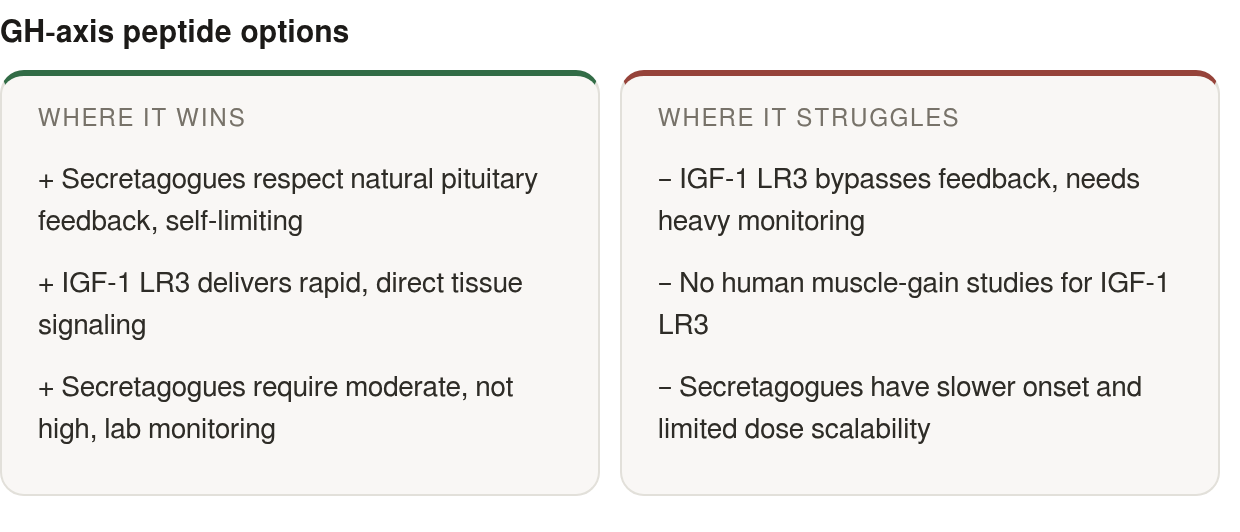
For most people reading this, the secretagogues are the only sane starting point. Not because they are stronger. Because they are more forgiving. IGF-1 LR3 is a monitoring-heavy outlier, not a first move.

The three options at a glance
CJC-1295: A synthetic GHRH analog that increases the size of natural GH pulses. It still has to respect pituitary feedback loops.
Ipamorelin: A selective GH secretagogue receptor agonist that triggers GH release without dragging up cortisol or prolactin.
IGF-1 LR3: An engineered IGF-1 analog with an arginine substitution and an N-terminal extension. It binds receptors directly and avoids normal binding-protein clearance.
| Factor | CJC-1295 | Ipamorelin | IGF-1 LR3 |
|---|---|---|---|
| Pathway | GHRH analog, boosts GH pulse size | GH secretagogue, triggers GH pulse | Direct IGF-1 signal, downstream |
| Feedback control | Intact (self-limiting) | Intact (self-limiting) | Bypasses GH feedback |
| Best-fit goal | Recovery, sleep-driven GH release | Lean-mass and repair support | Aggressive growth (highest risk) |
| Human efficacy data | Thin | Thin | None specific to muscle growth |
| Regulatory note | Not FDA-approved for muscle growth; research use only | Not FDA-approved for muscle growth; research use only | Research-only, no human muscle trials |
| Biomarker to track | Baseline IGF-1, fasting glucose/insulin, lipids, recovery markers | Baseline IGF-1, fasting glucose/insulin, lipids, recovery markers | Baseline IGF-1, fasting glucose/insulin, lipids, recovery markers; more frequent follow-ups |
The evidence gap should matter before the dollar cost
Cell cultures and animal models show anabolic effects. Controlled human trials validating hypertrophy or athletic performance in healthy populations are largely absent from the public evidence base.
IGF-1 LR3 is the compound that worries me most here. Because it bypasses the pituitary-hypothalamic axis, the body does not cap exposure the way it does with secretagogues. Without baseline and follow-up labs, a downstream effector with no brake can drift outside target reference ranges before you notice.
Lifestyle still decides most of the outcome. Progressive resistance training and sufficient nutrition move more than any peptide, and tested athletes have to stay away from this entire class under current WADA rules.
Pricing: the vial is not the expensive part
CJC-1295 No DAC lists at $79 for 5mg and $119 for 10mg. Multi-peptide secretagogue blends sit in a nearby bracket. Recombinant analogs like IGF-1 LR3 often cost more per milligram because of the more complex synthesis work.
The real cost is bloodwork. Establishing baseline hormone levels, metabolic markers, and inflammatory markers, then repeating them, is the larger financial commitment in any GH-axis protocol.
Where each path actually earns its place
This is the section where you match the goal to the compound, not the marketing.
Recovery, sleep, and steady repair belong to the secretagogues. They work through the pituitary, so the body keeps its feedback mechanisms. You get tissue remodeling support without forcing systemic hormone excess.
For hypertrophy and metabolic shifts, the evidence is different. Some published analyses of pharmaceutical growth hormone therapy have reported reduced fat mass and increased lean mass. But that was pharmaceutical recombinant GH, not research peptides. Hone Health’s review puts it plainly:
„There are currently no GHS peptides with FDA approval for promoting muscle growth in healthy populations, so none have been robustly proven to be effective.“
Preclinical promise is not clinical proof. Protocol design has to sit inside your risk tolerance, not outside it.
Where fat loss makes a real GH argument
GH signaling is often described as having lipolytic effects that androgen replacement may not address. Testosterone can support lean tissue, but it does not reliably move deep visceral fat in all patients. For a metabolic plateau or hypogonadal body-composition problem, GH-axis activation may offer a different lipolytic lever than androgen monotherapy.
Outside verified metabolic need, routine use for standard fitness goals has little human evidence. Research-use boundaries stay relevant.
Feedback control decides your monitoring plan
| Factor | CJC-1295 / Ipamorelin | IGF-1 LR3 | BiohackNow protocol |
|---|---|---|---|
| Pathway | Pituitary secretagogue | Downstream hormone | Biomarker-matched to goal |
| Feedback control | Self-limiting | Bypasses regulation | Guided by your tracked biomarkers |
| Best-fit goal | Recovery | Body recomposition | Matched to your personal goals |
| Monitoring need | Moderate | High | Built into every plan |
| Baseline labs | IGF-1, fasting glucose/insulin, lipids, recovery markers | Same panel, with tighter follow-up | Personalized panel |
IGF-1 LR3 is uncoupled. Its structure keeps it from binding IGFBPs, so receptor activation stays on. That is why lab surveillance has to scale up.
Our approach starts with labs, then picks the compound. You can read more about that structure on the BiohackNow blog.

Mechanism comparison: what the labels don’t tell you
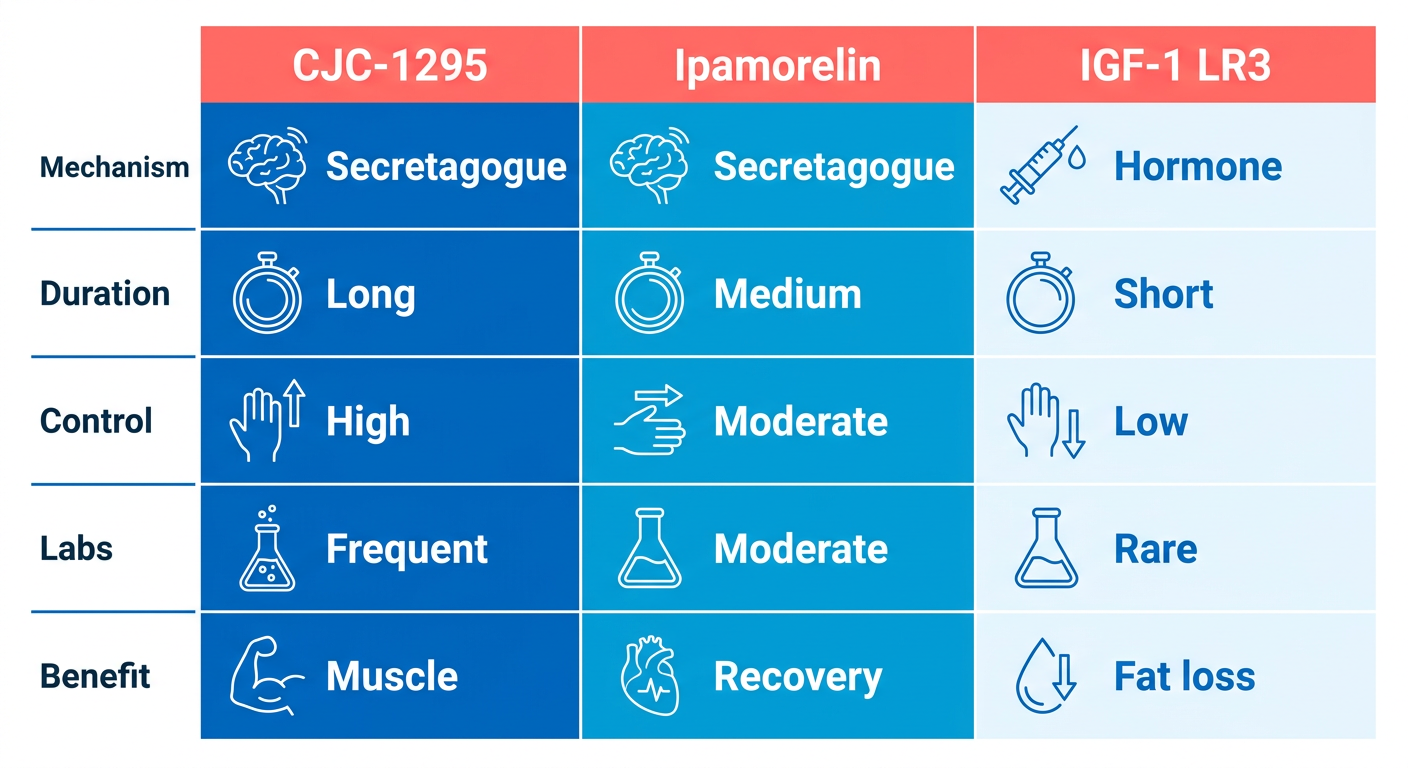
Comparing secretagogues to direct effectors is where most buyer confusion starts. The mechanism determines safety more than the marketing does. What matters on paper is which baseline labs you would need before starting and which follow-up markers would tell you to stop.
Feature-by-feature
| Feature | CJC-1295 | Ipamorelin | IGF-1 LR3 |
|---|---|---|---|
| Mechanism | GHRH analog, prompts pituitary GH release | GH secretagogue, prompts pituitary GH release | Downstream IGF-1 itself, bypasses pituitary |
| Feedback control | Self-limits through natural loop | Self-limits, minimal appetite/cortisol effect | No feedback braking, ignores the loop |
| Half-life | Long-acting | Short pulse | Extended circulating time |
| Human muscle evidence | Thin | Thin | None; preclinical cell/animal only |
| Regulatory status | No approval for muscle growth | No approval for muscle growth | No approval for muscle growth |
| Primary labs | IGF-1, fasting glucose/insulin, lipids, recovery markers | IGF-1, fasting glucose/insulin, lipids, recovery markers | IGF-1, fasting glucose/insulin, lipids, recovery markers with more frequent checks |
Where each one earns its spot
Ipamorelin may fit when baseline IGF-1, fasting glucose, insulin, and lipids are unremarkable and the goal is a selective GH pulse. CJC-1295 may fit when the goal is longer GHRH-receptor tone and follow-up IGF-1 or recovery markers show a response.
IGF-1 LR3 should be reserved for people who can track IGF-1, fasting glucose/insulin, and lipids before and during use. If those markers move outside the pre-set range, the protocol should stop or be re-titrated. Baseline labs are not optional.
Which one wins which job
For recovery and soft-tissue work, secretagogues synced to circadian output make more sense. When metabolic resistance is the issue and androgen-based lipolysis stalls, a direct IGF-1 signal may be more targeted, but also heavier.
The laboratory picture decides. The choice is not a standard stack. It is whether an upstream or downstream agent is defensible for a given patient’s physiology.

Performance comparison: speed, scaling, and the bill your body pays
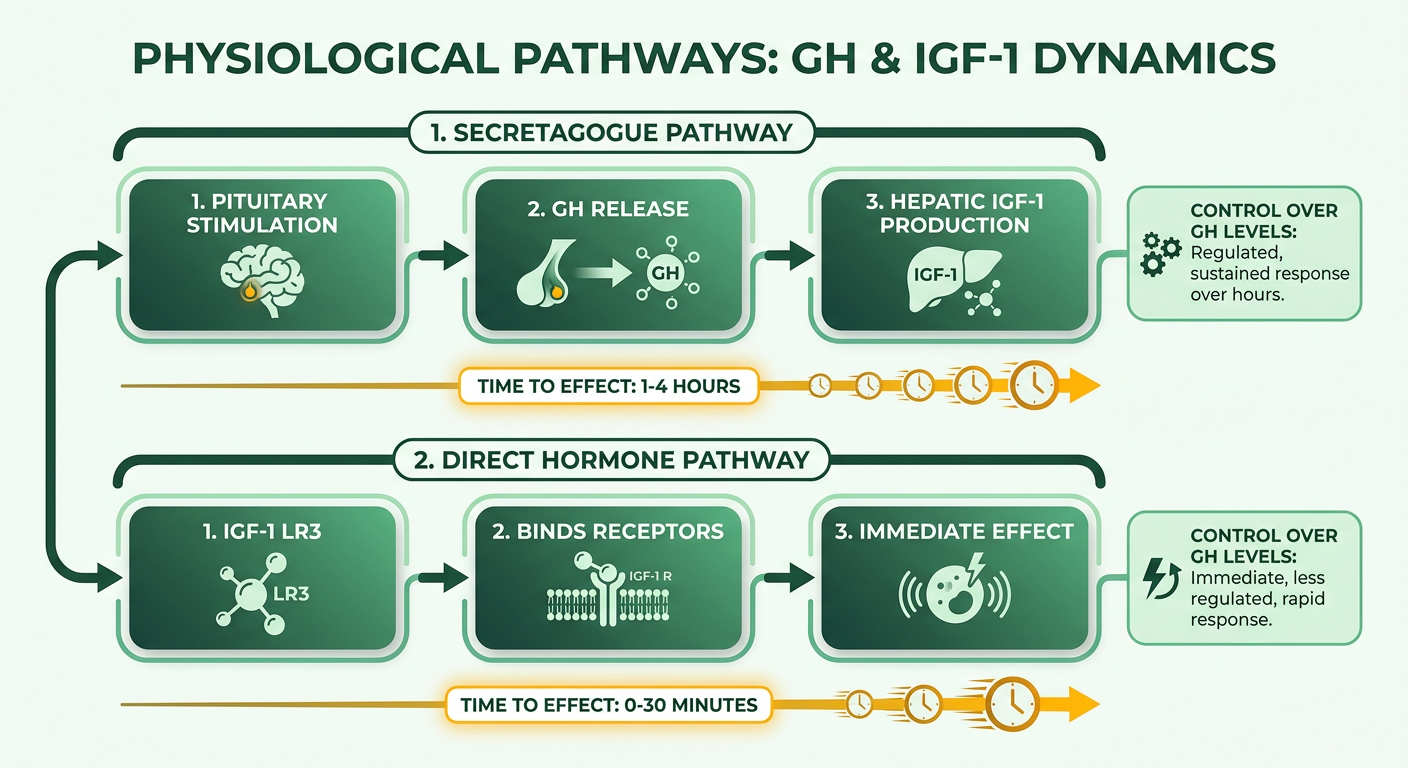
Kinetics are where these three separate fastest. IGF-1 LR3 engages receptors directly, so the delay from pituitary transcription and hepatic synthesis disappears. Secretagogues have to wait for GH to be released and then for IGF-1 to be made in the liver.
That changes onset, dose-response, and systemic cost.
How each compound scales
CJC-1295 and Ipamorelin plateau. Once pituitary receptors saturate, somatostatin steps in and caps output. That protective functional ceiling can show up in serial IGF-1 and glucose labs as a smaller response at higher doses.
IGF-1 LR3 is more linear. No biological gate means the circulating concentration may track the dose more directly. The natural fail-safe is missing, so precise micro-dosing and repeated monitoring are the only real guardrails.
| Performance factor | CJC-1295 + Ipamorelin | IGF-1 LR3 | Our biomarker-guided protocol |
|---|---|---|---|
| Onset | Hours, follows GH pulse | Rapid, direct | Matched to your goal and labs |
| Dose scalability | Self-limiting via feedback | Linear, no ceiling | Titrated to IGF-1 response |
| System cost | Low, works with axis | Higher, ignores feedback | Guided by your personalized lab panel |
| Best fit | Recovery, steady gains | Aggressive muscle phases | Whichever your panel supports |
System cost is a biomarker question, not a dose chart
Direct IGF-1 receptor engagement may shift glucose partitioning. Secretagogues mostly work through endogenous pulses and may preserve insulin sensitivity better.
That means a protocol has to look at fasting insulin, glucose tolerance, and lipid fractions before deciding whether someone has the metabolic overhead for a direct analog.
Pros and cons, with no glossy marketing
Every peptide here is a trade-off between control and speed.
Secretagogues keep control. You give up speed. IGF-1 LR3 gives speed. You give up the brake.
Where secretagogues earn their keep
Administering CJC-1295 or Ipamorelin before sleep makes sense. It reinforces the natural nocturnal GH pulse and does not suppress baseline output. The limit is conversion delay. Hepatic GH-to-IGF-1 production takes time, so adaptations build gradually.
Sourcing purity and shifting regulatory lines are still live concerns. Compounded research peptides may carry impurity and sterility risk depending on the provider.
The IGF-1 LR3 bargain
IGF-1 LR3 is fast. That is its entire argument. When standard metabolic pathways don’t respond, the direct signal is stronger.
The problem is that strength comes from not being cleared like normal IGF-1. Systemic exposure may stay elevated. Human safety data for body recomposition specifically does not exist.
| Factor | Secretagogues | IGF-1 LR3 |
|---|---|---|
| Feedback control | Self-limiting via pituitary | Bypasses feedback |
| Speed of effect | Slower, pulse-driven | Fast, direct |
| Human muscle evidence | Thin | None specific |
| Biomarker to watch most | Cardiovascular + IGF-1 | IGF-1, closely |
| Best-fit goal | Recovery, steady lean gain | Stubborn fat loss when androgens stall |
Who should skip these entirely
If you do not have training and nutrition dialed in, peptides will not fix the gap. If you are a tested athlete, current WADA rules cover the whole GH secretagogue and analog category.
Who these actually fit
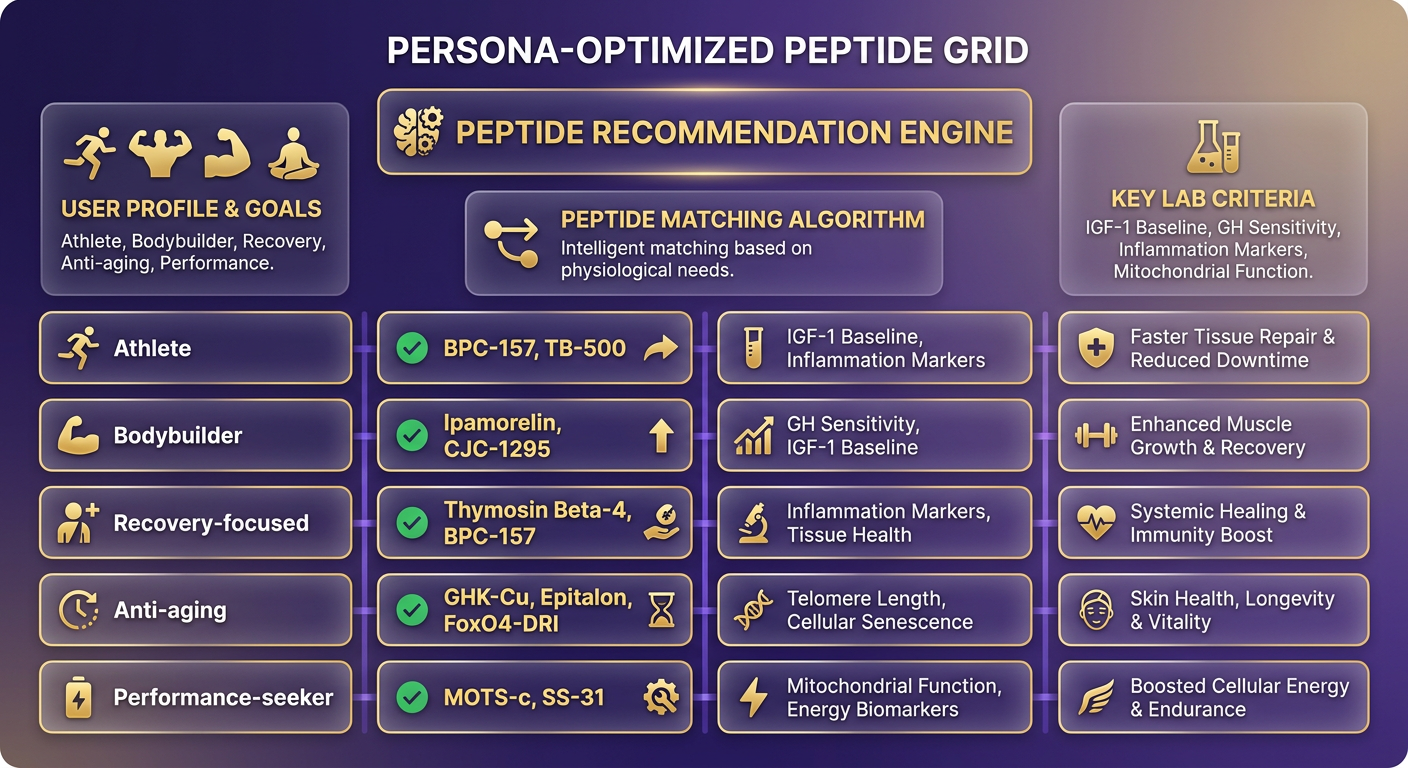
The right compound is a match between your baseline labs and what you are trying to fix.
Recovery-first with tight control
Musculoskeletal recovery with normal baseline IGF-1 matches secretagogues. CJC-1295 plus Ipamorelin supports soft-tissue synthesis and sleep without overwhelming the endocrine axis. Risk-averse users stay inside that natural ceiling.
Where biomarker data beats testosterone alone
When TRT fixes androgens but not visceral fat, GH-pathway activation adds a different mechanism. GH receptor activation may stimulate hormone-sensitive lipase. That can move fat in tissue beds that androgen therapy doesn’t touch.
Lipid subfractions and inflammatory markers tell you whether the effect is real. Pre-existing glucose or lipid abnormalities should be addressed first.
IGF-1 LR3 demands the heaviest monitoring
IGF-1 LR3 is only defensible for experienced users who will do serial labs. Its circulating life means one dose has prolonged effect. That removes margin for error. IGF-1 and glucose markers need close tracking. Stop criteria should be set before starting: if IGF-1, fasting glucose, or lipids move outside the target range, stop and reassess.
| Ideal User | Best Fit | Feedback Control | Monitoring Load |
|---|---|---|---|
| Recovery, normal IGF-1 | CJC-1295 + Ipamorelin | Intact, self-limiting | Moderate |
| Fat loss where TTh stalls | GH-pathway secretagogue | Intact | Moderate–high |
| Experienced, fast response | IGF-1 LR3 | Bypassed | High, frequent IGF-1 checks |
If you will not do regular blood testing, skip this category.
What I’d actually do if I were choosing
If I had normal IGF-1 and wanted recovery, I’d start with CJC-1295 plus Ipamorelin. It is self-limiting and the monitoring load is reasonable.
If fat loss was the only unsolved problem and TRT had already optimized androgens, I’d consider a GH-pathway agent, but only after lipid and inflammatory markers pointed that direction.
IGF-1 LR3 is the last choice, not the first. The speed is real. The missing feedback brake is also real. I’d only think about it with a dense lab schedule and a high tolerance for unknown long-term risk.
| Scenario | Best fit | Why |
|---|---|---|
| Recovery with normal IGF-1 | CJC-1295 + Ipamorelin | Gentle, self-limiting, low overshoot risk |
| Lean-mass goal, intact feedback | CJC-1295 + Ipamorelin | Scales cleanly with the body’s own GH pulse |
| Fat loss where TRT alone stalled | GH-pathway agent | The GH axis may move adiposity where androgens don’t |
| Fast response, high risk tolerance | IGF-1 LR3 | Immediate action, but bypasses feedback control |
| Biomarker-guided protocol design | BiohackNow Longevity Clinic | Labs first, then the compound |
Bloodwork decides the entire question. Secretagogues respect the body’s controls. IGF-1 LR3 does not. If you will not test before and after, don’t use these.
Peptide selection follows labs, not the reverse. The blog covers more of that methodology.
Common Questions
1. Can I stack CJC-1295 and Ipamorelin together, or should I run them separately?
CJC-1295 and Ipamorelin operate through complementary receptors on the pituitary gland. CJC-1295 acts as a GHRH mimetic to sustain signal duration, while Ipamorelin selectively triggers ghrelin-receptor signaling without disturbing ACTH or prolactin. Combining them may generate a synergistic pulse that remains governed by normal somatostatin feedback.
2. Why does IGF-1 LR3 need more frequent bloodwork than the secretagogues?
Unlike endogenous pulses that clear rapidly, IGF-1 LR3 possesses structural modifications that reduce binding-protein affinity, extending its active circulating window. Because the pituitary cannot downregulate this direct downstream compound, regular blood testing is necessary to prevent accumulation beyond target reference ranges.
3. Are these peptides safe to use if I compete in a tested sport?
Athletes competing under standard anti-doping regulations must avoid all three compounds. Current WADA rules generally prohibit growth hormone secretagogues, releasing factors, and modified growth factor analogs. Athletes should check the current prohibited list before considering any use.
4. Is IGF-1 LR3 worth the higher price if I want the fastest results?
While IGF-1 LR3 may provide immediate peripheral receptor binding, the elevated cost per milligram is compounded by the necessity of frequent blood panels. For most individuals, the safety margins and lower diagnostic burden of secretagogues provide a more practical balance of cost and physiological return.
5. Should I avoid these compounds if I have glucose or cancer risk concerns?
Individuals with impaired glucose tolerance or elevated oncological risk should refrain from using direct growth factors. IGF-1 LR3 may directly influence peripheral insulin signaling and cellular proliferation pathways, making it unsuitable for those with underlying metabolic instability or proliferative conditions.
6. If testosterone therapy already builds my muscle, why add a GH-pathway agent?
Androgen therapy may effectively stimulate protein synthesis but may exert less influence over stubborn visceral fat depots. Activating the growth hormone pathway may stimulate hormone-sensitive lipase, supporting lipolysis in patients experiencing metabolic plateaus on TRT alone.
Free 15-Minute Discovery Call
Ready to take the guesswork out of your health?
Book a free 15-minute call with Monika to talk through your goals, what testing makes sense for you, and the right next step. No pressure, just clarity.
Book Your Free CallFor educational purposes only. Not medical advice.