
Key Takeaways
- Side effects of CJC-1295 No DAC and Ipamorelin follow two clocks: fast reactions within an hour, and slow risks that build over weeks.
- The reassuring „no serious adverse reactions“ data came from CJC-1295 with DAC, a different compound with a 5.8 to 8.1 day half-life. Not what you’re dosing.
- The No DAC form is short-acting, and Ipamorelin peaks within roughly an hour, so your monitoring window is narrow and precise.
- Acute-window symptoms: injection-site reactions, nausea, and the FDA’s most-cited concern, immunogenic responses that can escalate to anaphylaxis.
- Cumulative-window risks flagged in the joint research: high blood pressure, fluid retention, and blood-sugar changes that only surface with chronic exposure.
- Catch a symptom inside its onset window, and you can adjust the dose instead of scrapping months of consistency.
- Mapping each symptom to its expected clock is the practical way to tell an acute injection reaction from a slow cumulative risk.
Why timing tells you almost everything
Timing your doses to peak growth hormone release only helps if you also know when problems show up. That is the point of tracking side effects with efficacy. The side effects here split into two clocks: fast-onset reactions in the hour after injection, and slow-building risks that appear over weeks of repeated dosing.
Here is the physiological catch most articles miss. That famous „no serious adverse reactions“ finding came from research on CJC-1295 with DAC, which carries a 5.8 to 8.1 day half-life. That is not the compound you’re injecting. The No DAC form is short-acting, which is exactly why timing matters. Ipamorelin peaks within about an hour, so your monitoring window is tight.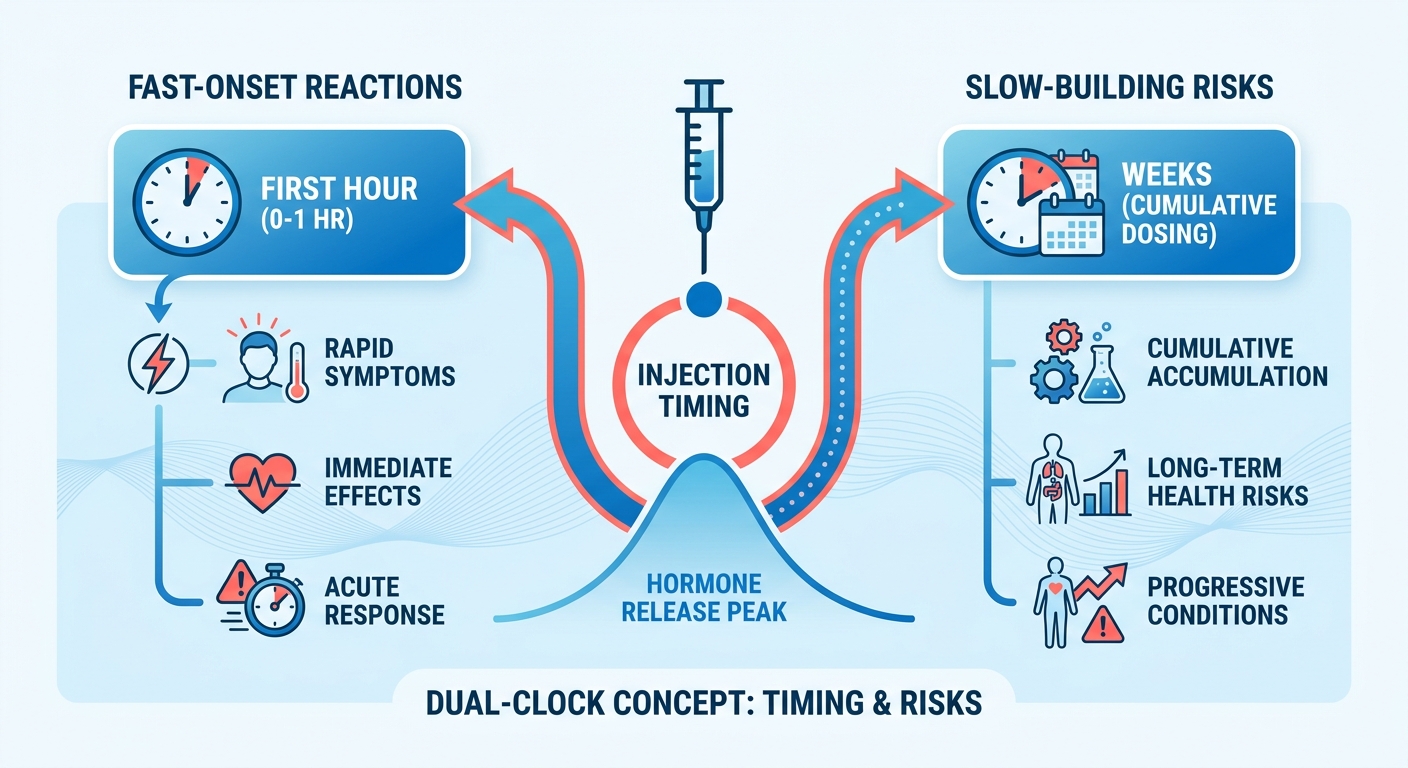
Why symptom timing matters for peptide users
Early detection keeps you on protocol instead of forcing a restart. Catch a symptom in its onset window, and you can adjust the dose rather than abandon the cycle. That protects the months of consistency that drive body-composition and recovery results.
The practical approach: map each symptom to its expected clock. The acute window covers injection-site reactions, nausea, and the FDA’s most-cited concern, immunogenic responses that can escalate to anaphylaxis. The cumulative window covers slower risks. The joint research on this stack flags high blood pressure, fluid retention, and blood-sugar changes that only surface with chronic exposure.
- Log every injection-site reaction, flushing, or nausea within 60 minutes of dosing. These track Ipamorelin’s one-hour peak and flag immunogenic risk fast.
- Watch cumulative markers weekly. Cardiovascular and glucose changes build slowly and will not show up in a single-session check.
Who should skip this stack entirely
Skip CJC-1295 and Ipamorelin if you compete under anti-doping rules. Both are banned growth hormone secretagogues. Skip them too if you’re chasing menopause symptom relief. The evidence there is thin, and proven options like hormone replacement outperform these peptides for that goal.
Be honest about the regulatory picture. The FDA placed CJC-1295 on its list of substances that can’t be used in compounded medications. A recent sports-medicine review put it bluntly: „clinical adoption has outpaced the evidence supporting their safety and efficacy.“ That is why careful monitoring is not optional. It is the only responsible way to run an investigational compound.
How side-effect awareness improves results
It prevents reactive dose cuts that quietly wreck a protocol. Unmanaged nausea or joint discomfort pushes people to slash their dose or quit. Catch the pattern early, and you adjust one variable instead of scrapping the plan.
A client notices mild fluid retention creeping up over two weeks. Checked against the cumulative clock, that pattern points to a small taper, and the cycle continues uninterrupted. Without that early awareness, the same client loses two weeks to a full stop. This is where BiohackNow’s data-driven approach helps. Monika reviews your blood work and biomarkers in depth to build a protocol tailored to you, with guidance at each step.
Our take: the strongest use of careful tracking here is not optimizing GH numbers you cannot feel. It is separating the fast immunogenic red flags from the slow cardiovascular ones, so you know which symptom means „adjust now“ and which means „watch and taper.“ That distinction keeps you safe and consistent.
Reading the clock: normal reactions vs. red flags
Side effects follow a predictable clock. Knowing which window a symptom falls into tells you almost everything about whether to worry. Because the No DAC variant clears fast, acute reactions cluster tightly around the injection window, while systemic changes develop over a longer timeline. Split your monitoring into two windows for exactly this reason: an acute post-injection window and a cumulative-exposure window.
The timing itself is your best diagnostic. A symptom that shows up fast and fades fast is almost always benign. One that appears late, lingers past seven days, or worsens after the 48-hour mark deserves attention.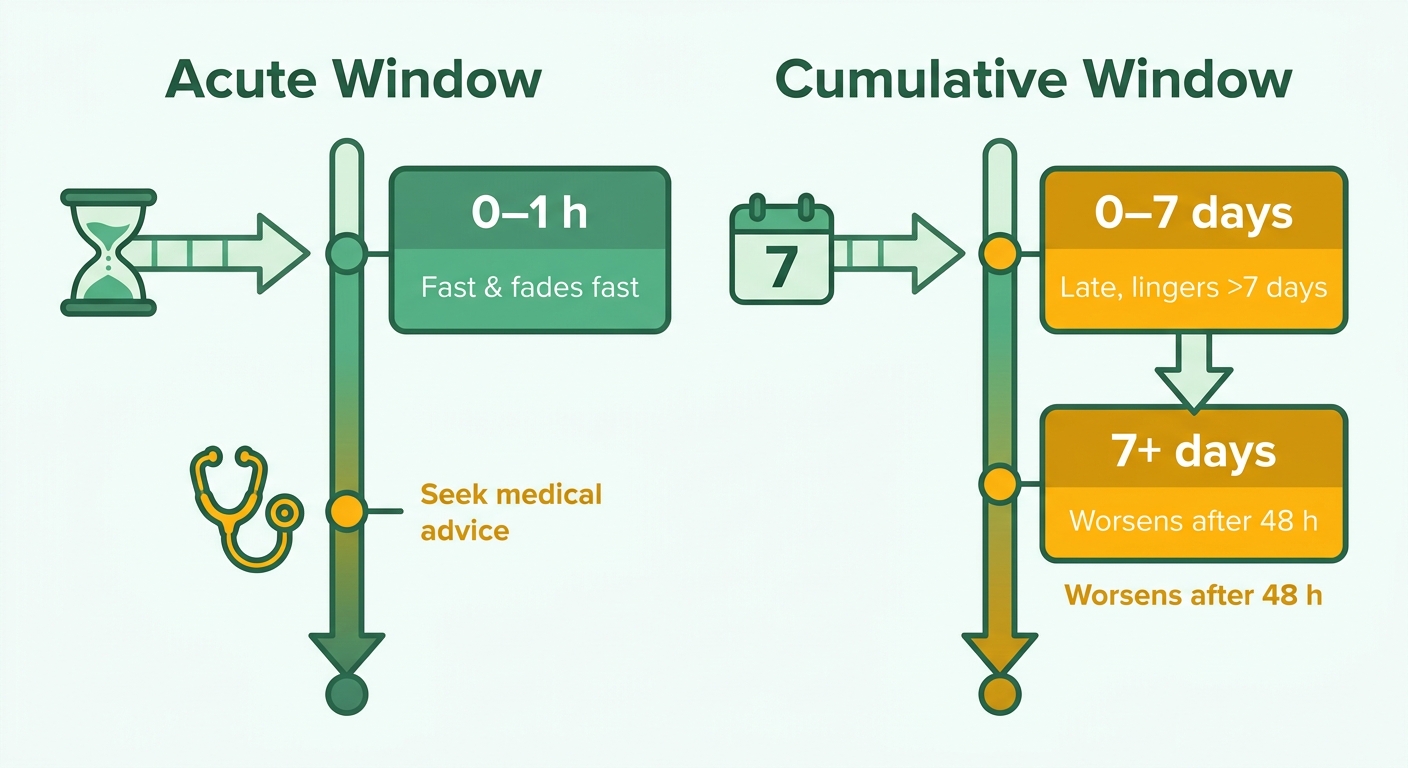
What to expect in the first 72 hours
Most reactions in the first three days are self-limiting and tied to the injection itself, not to hormonal shifts. This window produces the highest volume of reports, and almost none of them need clinical follow-up.
- Injection-site pain or brief dizziness (0-2 hours) is the most common report and clears on its own. Note the time so you can confirm it tracks with your dose, not something unrelated.
- Headache, mild nausea, or transient water retention (2-24 hours) reflects the GH pulse settling. Ipamorelin stimulates GH without touching cortisol, so jitteriness here is usually water balance, not a stress response.
- Increased appetite, mild fatigue, or a subtle blood-pressure dip (24-72 hours) are mid-range and expected. Rising appetite is a sign the GH axis is responding, not a warning.
When a reaction becomes a red flag
A reaction crosses into concerning territory when it breaks the typical self-limiting pattern. Severe immune-mediated responses show up fast; systemic vascular changes need sustained observation. That divergence is why you track both immediate and delayed responses.
- Swelling that lasts more than 48 hours plus redness points toward an allergic or immunogenic response. Try an antihistamine, and if it holds or spreads, contact us before your next dose.
- Prolonged lethargy or skin rashes past day three to seven may signal hormonal imbalance or sensitization. Pause the protocol and reassess rather than push through.
- Any breathing difficulty, throat tightness, or rapid swelling is an emergency, full stop. Anaphylaxis is the one risk you never wait out.
The research gap matters here. Much of the early literature relied on limited, short-term observations in healthy cohorts, which misses the nuances of multi-week protocols. Because real-world use often moves faster than formal longitudinal trials, the cumulative window is where diligent self-monitoring becomes your safety net.
How careful logging sharpens this
The value is clarity. Note the time of each injection and each symptom, and you can line up onset against your dose and judge whether it is mild, moderate, or severe. A mild reaction at hour one is worth a note. A moderate one holding past 48 hours is worth a call.
- Record every injection and symptom with a timestamp so you can tell a normal hour-one reaction from a concerning day-four one.
- Bring your notes to a wellness consultation so we can guide protocol adjustments, including the cycling clinicians recommend to prevent desensitization. Skip the guesswork when the pattern is already in front of you.
Keep in mind these compounds remain investigational. Structured tracking is a tool for personal risk mitigation, not a substitute for established clinical consensus.
Pre-treatment checks, contraindications, and dosing
Before your first injection, you need three things: baseline labs, a contraindication screen, and a low starting dose. Each one closes a specific blind spot before you introduce a GH secretagogue into your system. A clear biological baseline also lets you track how your system responds over time.
A good screen targets the specific pathways these secretagogues affect. Evaluate cardiovascular health and immune history beforehand, and you head off complications before the first dose.
Which baseline labs you actually need
Five markers before you start, each mapped to a specific risk we track across your cycle.
- CBC – Baseline blood counts, so we can catch anything unusual once GH stimulation begins.
- CMP – Kidney and liver function plus electrolytes, which matters because fluid retention is a known cumulative side effect.
- Fasting IGF-1 – Your efficacy and safety anchor. These peptides drive IGF-1 up, and we do not want it climbing past your reference range.
- HbA1c – GH secretagogues nudge blood sugar upward. This flags anyone drifting toward insulin resistance before symptoms appear.
- Thyroid panel – GH and thyroid signaling overlap, so a baseline rules out a masked thyroid issue driving your symptoms.
Who should not start this therapy
Some conditions are hard stops. Others mean we proceed carefully with tighter monitoring.
Absolute contraindications — do not start under any circumstances:
- Active cancer – Elevated IGF-1 can feed tumor growth. Non-negotiable.
- Uncontrolled hypertension – The cardiovascular concerns flagged for this class stack directly on top of existing pressure problems.
- Pregnancy or lactation – No safety data exists. We will not guess with two patients at once.
Relative contraindications — proceed only with closer tracking:
- History of migraines – Headaches sit in the acute post-injection window, so we watch your first dose closely.
- Autoimmune disease – Given the immunogenicity risk, we time doses conservatively and log any flare.
- Severe insomnia – GH pulses affect sleep architecture, so we track sleep data before adjusting.
How to dose and titrate
Start at half your target dose for the first two weeks. This is the single most effective way to keep early side effects minimal while we watch your response.
- Growth-hormone-releasing analog: 100–200 µg subcutaneously, 2–3 times weekly. Titrate up over four weeks only if labs and symptoms stay clean.
- Secretagogue partner: 200–300 µg subcutaneously, 2–3 times weekly, with an optional short loading phase for faster onset.
- Stagger injection times in a combined cycle so the two peptides‘ side-effect windows do not overlap.
Aligning administration times with your circadian rhythm helps the physiological response. It also avoids the pitfalls of generic templates, which ignore your body’s own endocrine patterns. For a deeper look at how these cycles are structured, see our clinic blog.
Monitoring and responding to side effects, short-term and long
Good monitoring rests on a simple structure: track your dosing and symptoms daily, then act on trends before they force a stop. A written log turns vague worry into a clear decision rule. When you can see a symptom climbing across days, you adjust early instead of reacting late.
Sort your observations into immediate post-injection responses and long-term systemic trends. That keeps acute localized reactions from getting confused with gradual, cumulative changes.
What your daily log should include
Your daily log is the raw data everything else depends on. Track four things at the same time each day so trends stay comparable. Rate symptoms on a 0 to 10 scale, since a number you can chart beats a feeling you half-remember.
- Dose and injection site: Record the amount, the site, and whether the spot is red, swollen, or tender. Site reactions that fade within the hour are benign; ones lingering past a day are worth flagging.
- Symptom rating (0-10): Log headache, flushing, water retention, or nausea daily. A rising number over consecutive days is the signal, not any single reading.
- Vitals: Take blood pressure and resting heart rate. Tracking these daily catches gradual upward trends in vascular resistance before they become clinically significant.
Handling mild symptoms at home
Most acute reactions are mild and respond to simple home care. A cold compress brings down injection-site swelling. Extra hydration helps with the water retention that comes with elevated GH signaling. Ginger tea settles the mild nausea some people feel shortly after a dose.
Persistent symptoms deserve attention, not patience. If a mild side effect starts to intensify or will not resolve within a couple of days, that is your cue to reevaluate. When a compound designed for rapid clearance produces lasting discomfort, it usually means the current dose exceeds your tolerance.
- Cold compress for swelling: Apply for 10-15 minutes to a tender injection site.
- Hydration for water retention: Increase fluids on dosing days to ease puffiness.
- Reassess dose at severity ≥5 past 48h: A persistent moderate symptom means back off and review, not push through.
When to escalate to medical care
Some symptoms need professional evaluation, not self-management. Signs of a severe systemic allergic reaction, a sudden dramatic spike in blood pressure, or an intense, atypical headache all warrant prompt attention.
- Signs of anaphylaxis: Throat tightness, hives, or trouble breathing after a dose demands emergency care immediately.
- Persistent high blood pressure: A sustained spike over several readings signals the cardiovascular window, not a one-off.
- Severe or sudden headache: Sharp, non-fading head pain warrants a same-day evaluation.
Long-term follow-up that keeps you safe
Long-term safety profiles for continuous secretagogue use are still being established in the literature, so a consistent follow-up schedule is your most reliable safeguard.
Pull monthly labs: IGF-1, fasting glucose, and liver enzymes. Track the trend lines, not single values. A steady IGF-1 climb or drifting glucose is your early cue to pause and reassess before any structural risk builds. Reviewing these trends keeps your biomarkers within optimal ranges.
- Monthly IGF-1, glucose, liver enzymes: Trends across months catch what any single draw misses.
- Keep follow-up bloodwork on schedule: Set your own reminders so follow-up labs do not slip, which is where most people lose the thread.
Frequently Asked Questions
1. Can I take CJC-1295 No DAC and Ipamorelin at the same injection time?
While many users administer them together, separating the injections can be highly beneficial during the initial weeks. Spacing the doses allows you to isolate your body’s reaction to each specific compound. If a localized flush or mild headache occurs, you will know exactly which peptide triggered it, making protocol adjustments far more straightforward.
2. Why does the „no serious adverse reactions“ claim not apply to the peptides I’m using?
The often-cited safety data originates from studies on the drug variant containing Drug Affinity Complex (DAC), which exhibits vastly different pharmacokinetics and a prolonged active duration. The No DAC version clears the system rapidly, requiring a completely different dosing frequency. Furthermore, those early trials focused on acute, single-dose exposures rather than the multi-week cumulative cycles common today.
3. I have a history of migraines. Can I still use this stack?
A history of migraines requires extreme caution and a conservative approach. Because transient headaches can occur as an acute response to growth hormone pulses, individuals prone to migraines should monitor their initial low-dose administrations very closely. This is considered a manageable risk under supervision, unlike conditions like active malignancies or severe cardiovascular instability, which are absolute barriers to starting.
4. How do I tell a normal injection reaction from a dangerous one?
Normal reactions, such as mild localized redness or a brief flush, typically manifest shortly after administration and resolve completely within a few hours. In contrast, a concerning reaction is characterized by its persistence—such as swelling that worsens over several days—or by systemic symptoms like hives, wheezing, or difficulty breathing, which demand immediate emergency medical intervention.
5. What blood tests should I get before starting this therapy?
A comprehensive pre-treatment panel should evaluate metabolic health, organ function, and baseline hormone levels. Key areas of focus include assessing your resting growth hormone markers, blood glucose stability, and standard kidney and liver filtration rates. This baseline ensures that any subsequent physiological shifts can be measured accurately against your starting state.
6. When should I reduce my dose versus stopping entirely?
A dose reduction is appropriate for moderate, non-emergency side effects—such as persistent mild water retention or mild headaches—that do not resolve after a few days of observation. This adjustment helps find a more tolerable threshold. However, you must stop the protocol immediately and seek urgent medical care if you experience severe systemic symptoms, sudden spikes in blood pressure, or signs of an acute allergic reaction.
7. What should long-term monitoring look like once I’m past the first weeks?
Long-term safety relies on periodic biomarker evaluations to track systemic trends. Rather than focusing on isolated data points, look at how your metabolic markers and hormone levels behave over several months. If you observe a gradual, upward drift in blood sugar or an excessive rise in growth factors, it is a clear indicator to pause the cycle and allow your system to return to baseline.
Free 15-Minute Discovery Call
Ready to take the guesswork out of your health?
Book a free 15-minute call with Monika to talk through your goals, what testing makes sense for you, and the right next step. No pressure, just clarity.
Book Your Free CallFor educational purposes only. Not medical advice.