
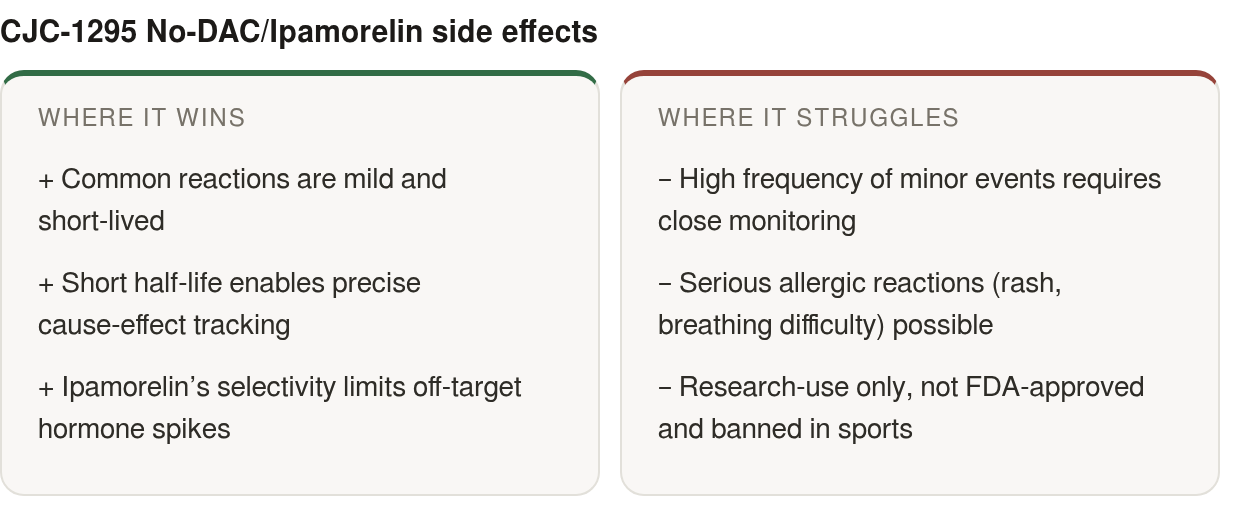
In short: The usual reactions are injection-site pain, redness, headache, flushing, water retention, and dizziness. They are generally described as mild and short-lived. The No-DAC form is short-acting, so effects may appear as brief signals within minutes rather than dragging across days. Rash, difficulty breathing, or facial swelling after an injection is different; that can signal a serious allergic reaction and needs immediate care. Two sourcing notes worth knowing before you buy anything: CJC-1295 appears on the FDA’s list of bulk drug substances that cannot be used in compounded medications, and both peptides are generally banned under sport anti-doping codes. Reconstituted vials are typically kept at 36–46°F and discarded 28 days from first use. Both remain research-use only, not FDA-approved.
What to expect, at a glance
Most reactions in a CJC-1295 no-DAC plus ipamorelin side-effect profile are described as mild and brief: injection-site pain and redness, headache, flushing, water retention, and occasional dizziness. They are often attributed to growth hormone surges and ghrelin-receptor activation. Less common reported reactions include hormonal shifts, joint pain, and blood sugar swings.
The timing is the wrinkle. Because the No-DAC form is short-acting, side effects may arrive as sharp, time-stamped signals rather than a smear across several days. That is why a protocol can be built around data and clinical review rather than self-management.
Common versus rare, side by side
Common effects are the ones to expect and manage. Rare ones warrant a harder look at whether the peptide is actually the cause.
| Attribute | CJC-1295 No-DAC (Mod GRF 1-29) | Ipamorelin |
|---|---|---|
| Common effects | Flushing, headache, injection-site pain/redness | Headache, water retention, dizziness, drowsiness |
| Less common | Increased heart rate, raised body temperature, vertigo | Joint pain, blood sugar fluctuation, hormonal shifts |
| Onset | Minutes after injection (short pulse) | Minutes to hours |
| Half-life | Short (No-DAC form) | Short, pulse-based |
| Route | Subcutaneous or intramuscular | Subcutaneous or intramuscular |
| Status | Research-use only; not FDA-approved for general use | Research-use only; not FDA-approved for general use |
Reactions to CJC-1295 can be frequent, and the peptide is often described as well tolerated because the events tend to be individually mild. Both things can be true at once. A high frequency of minor events is the argument for monitoring, not the argument against the compound.
Dosing, storage, and routes in plain terms
Route: Subcutaneous injection into the abdomen, thigh, or upper arm is commonly used, with intramuscular as an option. Rotate the site every injection to limit local reactions.
The combination is often used subcutaneously five nights a week before sleep, timed to work with natural GH release. Reconstituted vials are typically refrigerated at 36–46°F, never frozen, and discarded 28 days from first use.
- Rotate injection sites every dose so pain and redness don’t stack up in one spot.
- Store reconstituted vials at 36–46°F and discard them 28 days after first use, per standard handling guidance.
- Never double up after a missed dose. Stacking can push GH and IGF-1 higher than a single pulse is meant to.
When a side effect means stop and call
Three signals mean help now, not later. These point to an allergic reaction, not routine GH-axis noise.
- Rash, hives, or itching that spreads after injection, which can signal a systemic allergic response.
- Difficulty breathing, or swelling of the face, mouth, lips, or tongue.
- Significant flushing after injection, which the medication guide flags for immediate medical attention.
One caveat worth stating plainly: diffuse symptoms like fatigue or mood shifts often get pinned on the peptide when thyroid problems, blood sugar imbalances, or other hormonal issues are the real driver. Objective data—core biomarkers plus lab glucose—is what separates a true peptide effect from an unrelated condition. Measure instead of guessing.
Why the side-effect homework actually pays off
Knowing the side-effect picture before you inject is not nervous over-caution. It is what lets a provider catch a problem while it is small. The reactions here are mostly described as mild, but skipping the reading on the rare ones is how a useful protocol quietly turns into a medical complication.
Peptide biohacking has moved from niche forums into mainstream wellness, and the people asking about no-DAC ipamorelin side effects now span very different bodies and goals. That variety is exactly why generic guidance fails. A flushing episode in a lean athlete and water retention in a midlife longevity client are not the same signal, so protocols are best built around the person and the data.
Who reaches for this stack, and why it shifts the risk
Three groups gravitate to CJC-1295 plus ipamorelin, and each brings a different risk baseline worth screening for up front.
- Athletes chasing recovery and body composition. Both peptides are generally banned under sport anti-doping codes, so anyone competing should skip this stack entirely.
- Longevity-focused adults hoping to counter age-related muscle loss and poor sleep. Be honest on the sleep part: the reported gains may be placebo, since growth-hormone sleep research generally shows benefit only in people with a true GH deficiency.
- Aesthetic patients after fat reduction and skin quality. Screen blood sugar history first, because GH pulses may nudge glucose the wrong way.
When the reaction is a product problem, not a peptide effect
Not every bad reaction comes from the peptide. Sometimes it comes from what is in the vial. CJC-1295 appears on the FDA’s list of bulk drug substances that cannot be used in compounded medications, which means anyone selling compounded product may be operating outside federal guidelines. That single fact changes how a red-flag reaction should be read.
- Verify sourcing and product integrity before assuming the dose is wrong. Non-pharmaceutical-grade peptides can carry endotoxin, heavy metals, microbial contamination, or substituted ingredients.
- Log the reaction against the exact batch, not just the protocol. If symptoms cluster around one vial, that points to product quality rather than physiology.
- Treat any sharp, unexpected reaction as a stop-and-check moment, not a push-through-it one.
How monitoring can be structured and adjusted
This is where the No-DAC choice earns its keep. Mod GRF 1-29 is short-acting and produces short GH pulses, so its effects are more time-bound than the DAC version, which may spread effects—and its elevated risk—across days. A clinician-guided protocol can use data review rather than guesswork.
A concrete monitoring setup may include:
- Baseline labs before the first dose: fasting glucose, HbA1c, IGF-1, cortisol, prolactin, and thyroid function, depending on the provider’s protocol.
- Wearable metrics such as resting heart rate, heart-rate variability, skin temperature, and sleep disruption.
- Alert thresholds set relative to each person’s baseline—for example, if resting heart rate trends higher for several nights or fasting glucose moves outside the individual’s usual range, a review can be triggered.
- A review cadence: for example, weekly symptom-log review during the first month, then monthly while stable.
- Stop or pause criteria: any anaphylactic sign, significant flushing, chest pain, severe abdominal pain, fainting, or a sustained glucose or heart-rate trend that does not return toward baseline.
Post-treatment monitoring should continue after injections stop, not end on the last injection day. Markers such as IGF-1 may not return immediately after repeated growth hormone secretagogue dosing; some protocols continue follow-up labs for several weeks after the last dose. For example, if a longer-acting formulation or repeated dosing produced sustained elevations, a provider might choose to recheck labs at or before 28 days.
In practice, a monitoring protocol can pair wearable data with symptom logs so glucose drift, sleep disruption, or an elevated resting heart rate surfaces early. Flagged responses can be routed through a clinician review instead of self-management. Dose adjustments or pauses can be based on tracked trends, not one uncomfortable evening.
Side-effect literacy is not fear. It is the screening that keeps a protocol safe enough to be worth doing. There is more on how structured monitoring can work on the blog.
How the two peptides actually work
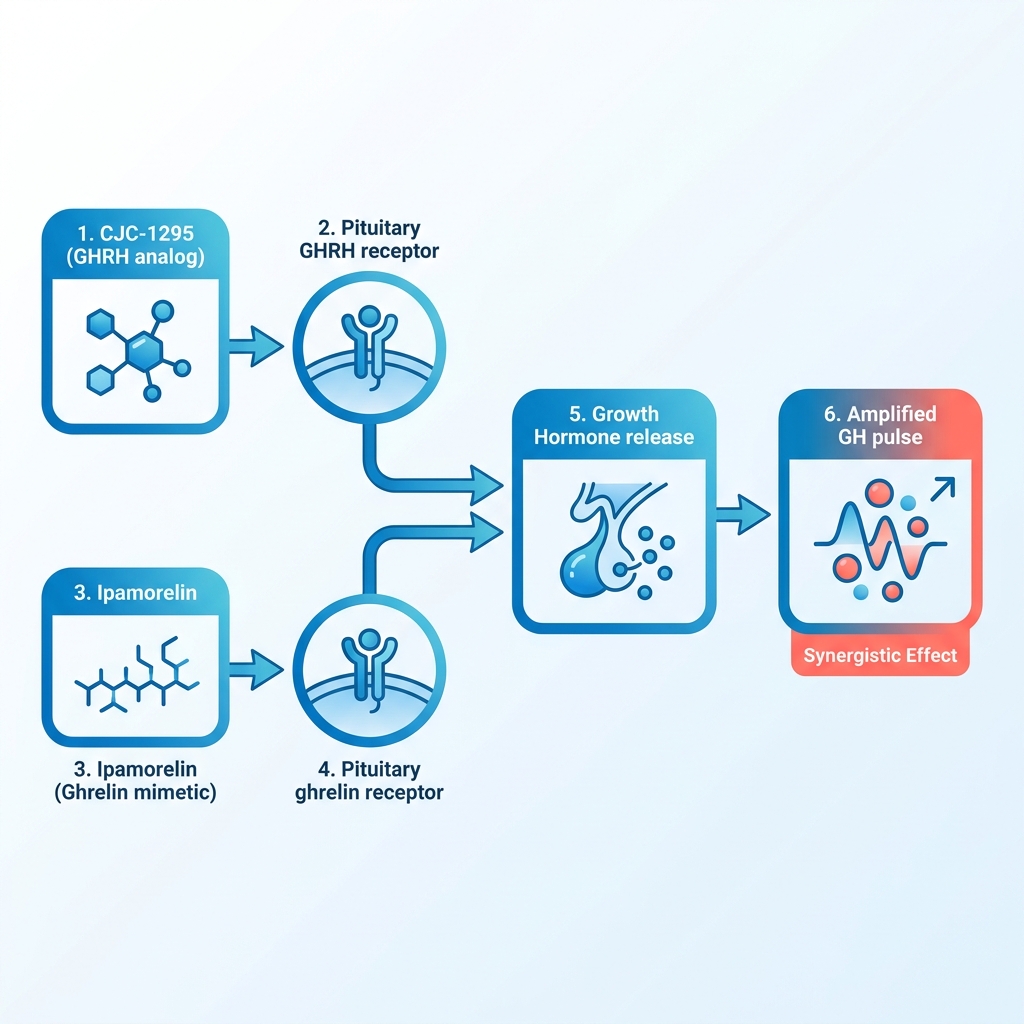
Two peptides, two doors into the same growth hormone axis. CJC-1295 No-DAC is a synthetic GHRH analog that binds receptors on the anterior pituitary and tells it to release growth hormone. Ipamorelin comes at it from a different angle, mimicking ghrelin at its own receptor. Stack them and the intended effect is a larger GH pulse than either produces alone. That amplification is also where many of the reported side effects come from.
As a synthetic GHRH, CJC-1295 stimulates the body’s own growth hormone output, which may raise IGF-1 downstream. Those rising signals are thought to drive the wanted outcomes: protein synthesis, lipolysis, tissue repair. The same surge may drive the unwanted ones: water retention, joint discomfort, vasodilatory flushing. You can’t separate the benefit from the side-effect signal, because they run down the same pathway.
The short half-life is what makes real-time tracking possible
No-DAC (Mod GRF 1-29) is described as short-acting, with a short half-life and short, discrete pulses. That difference is not cosmetic. A quick-clearing peptide turns each reaction into a time-stamped event you can trace to one dose, rather than a smear of symptoms across a week. The narrow active window is the reason a single injection may map to a single response curve.
- Confirm you are using the No-DAC form before starting, since its short action is what allows a flushing episode to be attributed to a specific injection.
- Log dose timing against symptom onset. Fast-clearing pulses give cleaner cause-and-effect windows than a DAC protocol can.
Ipamorelin’s selectivity trims the side-effect menu
Not every GH secretagogue plays nice. Ipamorelin is prized for hitting the ghrelin receptor without meaningfully spiking cortisol or prolactin, the way older GHRPs tend to do. Fewer off-target hormones means fewer confounding symptoms to chase, which is why the remaining signals may be easier to read.
- Establish baseline cortisol, prolactin, glucose, and IGF-1 before the first dose, so any later shift has a reference point instead of a shrug.
- Separate peptide effects from look-alikes. Symptoms blamed on ipamorelin may trace back to thyroid issues or blood sugar imbalances, and lab data can help settle it.
Measurable effects belong on a wearable, not a diary
Several documented reactions are physiological, not just felt. The medication guide lists flushing, increased heart rate, and raised body temperature. Those map directly to metrics a wearable can track, and the glucose effect may show up on continuous monitoring.
Worth naming the tension here. Much of what circulates about CJC-1295 outcomes is still theoretical, and the evidence base for what it actually delivers is thin. What research does suggest is that reactions tend to be mild but can be frequent. High frequency of minor reactions is precisely the case for tracking in real time rather than waiting for a follow-up call.
- Watch heart rate, skin temperature, and glucose trends after injection to catch vasodilatory or metabolic responses objectively.
- Seek medical help immediately for significant flushing, rash, hives, or facial swelling, since those can signal a reaction beyond the expected pulse.
What most people actually feel
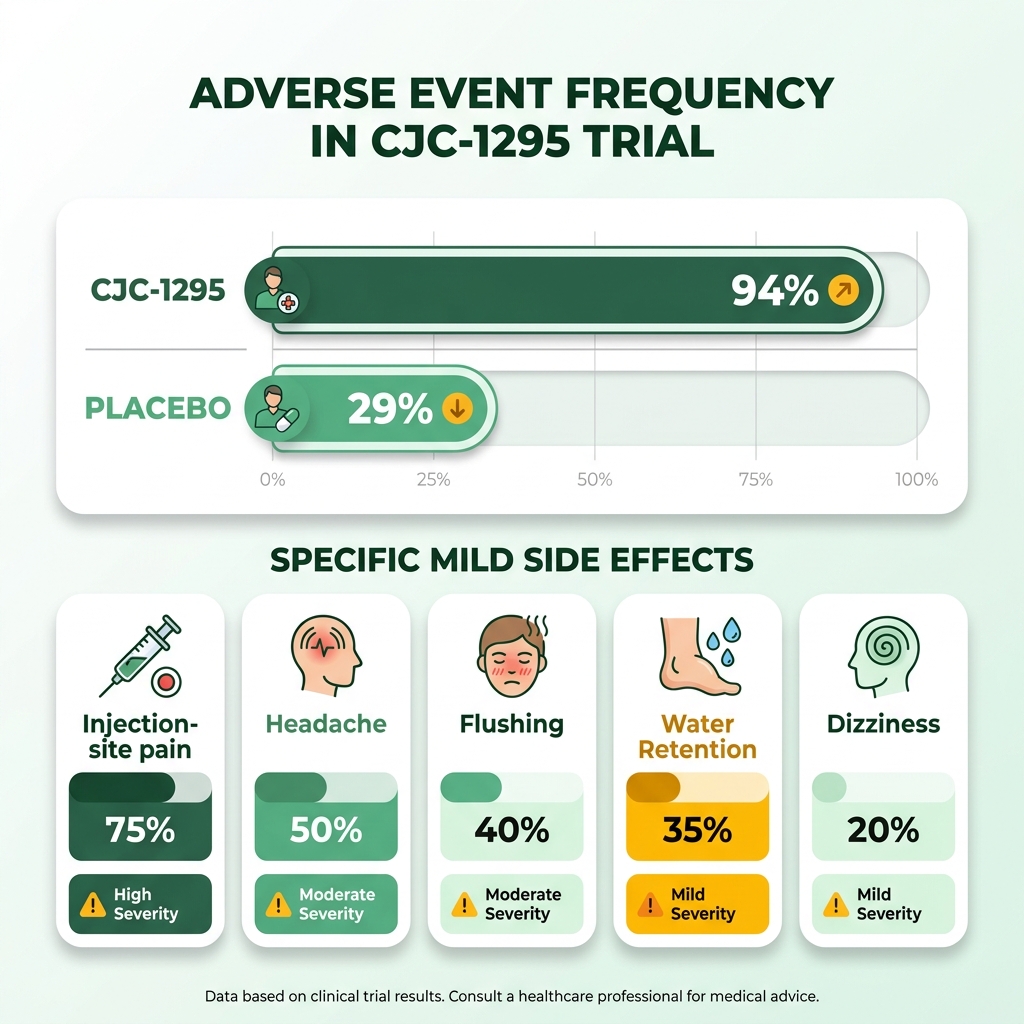
Start with the number that surprises people. In early dose-escalation research on CJC-1295, adverse events were reported in 94% of people who received the peptide, versus 29% on placebo. The same research still described the compound as safe and well tolerated at 30 to 60 micrograms per kilogram. Both can be true: the 94% is frequency; the “well tolerated” is severity. Almost everyone feels something, and that something is usually mild and brief.
That gap is why a clinician-guided protocol helps. Most of what people feel is predictable, physiological, and short. The oversight exists to separate the routine from the rare before it escalates.
Local reactions to expect and rotate around
Injection-site pain and redness top the list, and they are usually traced to the needle rather than the endocrine system. Standard guidance is subcutaneous injection into the abdomen, thigh, or upper arm, often five nights a week before sleep, changing the site every time.
- Rotate sites with each dose to prevent cumulative irritation, bruising, and localized swelling at any one spot.
- Log site reactions by location, so a stubbornly sore area gets skipped next round rather than re-injected.
- Photograph any redness that spreads or hardens. That is the line between normal irritation and something worth reviewing at the next consultation.
The vasodilatory signals worth watching after a dose
Flushing, a warmer body temperature, a faster heart rate, headache, drowsiness, and vertigo are among the common systemic effects. Most are vasodilatory, which means they can show up in things a person can measure, not just feel. Heart rate, skin temperature, and blood pressure can all move with them.
That physiology is why paying attention in the hour after a dose beats a vague recollection the next morning. A brief post-injection shift in heart rate is worth noting so it can be raised at the next consultation.
- Wear a tracker through the first hour post-injection, when vasodilatory flushing and heart-rate changes are most likely to register.
- Flag persistent headache or dizziness that outlasts a single evening, rather than assuming it is just the peptide.
- Treat any significant flushing after a dose as a stop-and-call signal, per the medication guide’s guidance to seek help immediately in that case.
Why the consultation comes first
Not every symptom a person feels is the peptide. Diffuse complaints like fatigue, mood shifts, or sluggishness overlap heavily with thyroid issues, blood sugar imbalances, and other hormonal disorders. Assuming causation without data is how people quit a working protocol for the wrong reason.
A baseline consultation and blood work review can sort that overlap up front. That is also when a provider can review health history and current medications, so the protocol is built around actual biology.
- Disclose thyroid, blood-sugar, and hormonal history so a provider can tell an endocrine symptom from a peptide one.
- List every medication, including steroids and thyroid drugs, before the first injection.
The reactions that mean stop now
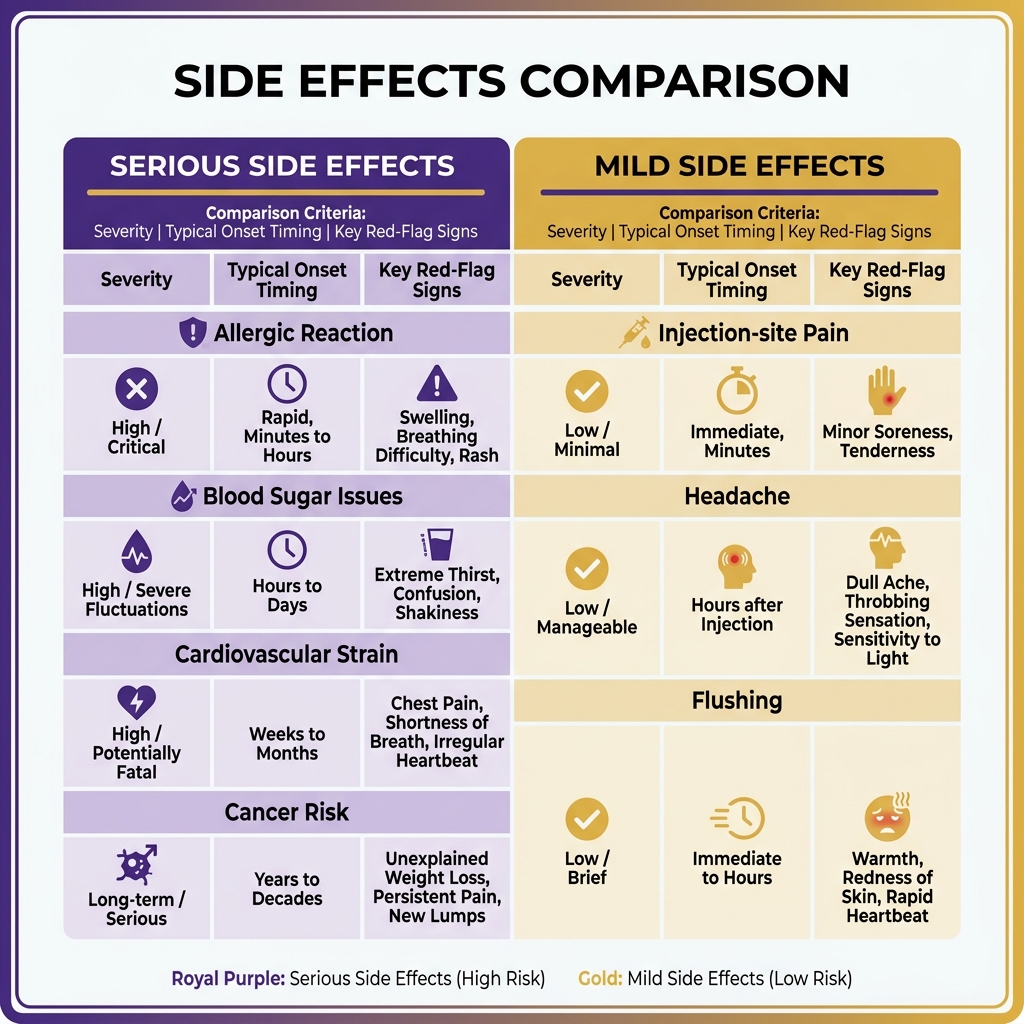
Most reactions clear on their own. A few do not, and telling the two apart fast is the whole job. The serious effects sit at the far edge of the profile: severe allergic reactions, blood sugar and pancreatic trouble, cardiovascular strain, and the theoretical cancer question that comes with chronically nudging the GH/IGF-1 axis upward.
The No-DAC choice may help here too. Without DAC, this GHRH analog has a shorter half-life, so a rare reaction tends to surface close to the dose rather than lingering. The DAC version stays active much longer, potentially spreading that same reaction over a wider window. Short pulses are easier to catch, measure, and act on.
Anaphylaxis is the one that can’t wait
Allergic reactions to peptide formulations are uncommon, but they can escalate on the order of minutes. Watch for the classic warning signs and seek medical help immediately for rash, hives, difficulty breathing, or swelling of the face, mouth, lips, or tongue. Sudden, intense flushing after an injection belongs on that same list.
This is why a pre-start consultation matters. A true hypersensitivity reaction calls for informed care, not guesswork.
- Stop injecting and call emergency services for any throat tightness, difficulty breathing, or swelling of the face, lips, or tongue.
- Treat hives or a spreading rash after a dose as a reason to pause, not push through.
Glucose, heart, and the long-game risks to track with labs
GH elevation touches blood sugar, which is why any history of pancreas or kidney problems is worth flagging before starting. Increased heart rate and raised body temperature are on the documented profile too, and both map cleanly to wearable data. People with an active cancer history or elevated cancer risk should generally skip this stack. The mitogenic GH/IGF-1 signal carries a theoretical oncologic concern.
Same tension as everywhere else. Diffuse symptoms like dizziness or fatigue may not be the peptide at all. They can trace to thyroid issues, blood sugar swings, or other hormonal disorders. Objective data can help settle it.
- Run scheduled fasting glucose and HbA1c labs across the cycle to catch insulin resistance early.
- Watch resting heart rate and skin temperature trends for sustained shifts, not one-off spikes.
- Log persistent dizziness or unexplained rapid weight gain and correlate it against lab and wearable data before blaming the peptide.
- Get chest pain, severe abdominal pain, or fainting evaluated the same day.
And one caution with nothing to do with dosing: product sourced outside GMP standards can carry endotoxins, heavy metals, or mislabeled ingredients, and no monitoring protocol can protect against a contaminated vial.
Drug interactions, hard stops, and where you buy it
The interactions that amplify this stack are not exotic. They are the everyday medications sitting in the cabinet. The medication guide is explicit: tell the prescriber about steroids and thyroid medications before starting, because both act on the same endocrine machinery this combination pushes on.
That overlap is the crux. If someone is also on insulin or an oral diabetes drug, the timing of an evening injection can collide with the dosing schedule and mask an overnight glucose dip. Corticosteroids taken for inflammation add another moving part, since they may blunt the very signals a person is trying to read. Reviewing blood work and tracking core biomarkers can help separate a peptide signal from a medication effect instead of leaving it to guesswork.
The conditions and drugs that rule this stack out
Some situations are hard stops, not fine print. The manufacturer guidance is direct about who should avoid this combination.
- Do not use it if pregnant, planning pregnancy, or breastfeeding. It has not been tested in pregnancy or lactation, and effects on a developing baby are unknown.
- Skip it with a history of cancer or increased cancer risk, since chronically nudging the growth-hormone axis upward is a theoretical concern that warrants real caution.
- Flag any pancreas or kidney problems to a provider first. These organs carry the metabolic load, and impaired function changes the risk math.
- Disclose every steroid, thyroid medication, over-the-counter drug, and herbal supplement. These are the interactions most likely to blur the side-effect picture.
- Rule it out for anyone under 18. Safety and effectiveness in children have not been established.
Why objective data settles the attribution fight
There is a genuine conflict in the evidence. The medication guide treats injection-site reactions, headache, and flushing as clearly peptide-driven. A separate physician-reviewed note argues that symptoms blamed on ipamorelin may actually be thyroid issues, blood sugar imbalance, or an unrelated hormonal disorder.
Both can be right, in different lanes. Acute vasodilatory effects like flushing map to heart rate, skin temperature, and blood pressure, so they are measurable and clearly tied to the dose. Diffuse, slow-building symptoms are the ones that overlap with endocrine conditions. Baseline labs and tracked biomarkers can help resolve that rather than assuming causation either way.
Sourcing and handling are part of safety
Where a person buys matters as much as how they dose. These peptides sit in a prescription and research-chemical gray zone, and mislabeled or contaminated product is a real risk in unregulated channels.
- Source only cGMP-manufactured, third-party-tested vials through a licensed provider. Verifiable purity is the floor, not a bonus.
- Refrigerate between 36°F and 46°F (2°C to 8°C), keep out of direct light, and never freeze. A frozen vial should be discarded.
- Discard any vial 28 days after first use, regardless of remaining volume.
- Start low and let a physician or nurse practitioner titrate up rather than self-escalating. A typical protocol may run subcutaneously five nights a week before sleep.
Get the sourcing, storage, and titration right, and most of the interaction risk is off the table before the first injection.
Common Questions
Can I use CJC-1295 No-DAC and ipamorelin if I have a history of blood sugar problems?
Screen glucose history before starting. GH pulses may nudge blood sugar in the wrong direction, so flag any pancreas or kidney problems to a provider first. Scheduled fasting glucose and HbA1c labs across the cycle can help catch insulin resistance early.
How do I know if fatigue or mood shifts come from the peptide or something else?
Objective data can help settle it. Diffuse symptoms like fatigue, mood shifts, or sluggishness overlap heavily with thyroid issues, blood sugar imbalances, and other hormonal disorders. Lab glucose plus baseline biomarkers can separate a true peptide effect from an unrelated condition, so measure rather than assume causation.
Why do side effects from the No-DAC form appear so quickly?
The No-DAC form is short-acting and fires in short, discrete pulses. That narrow active window turns each reaction into a time-stamped event a person can trace to one dose, rather than symptoms smeared across a week like the longer-acting DAC version.
Can competing athletes use this stack?
Both peptides are generally banned under sport anti-doping codes, so competing athletes should skip this stack entirely. Performance-focused users often reach for it chasing recovery and body composition, but the anti-doping status makes it off-limits regardless of the recovery goals it promises.
What should I do if I miss a dose?
Never double up after a missed dose. Stacking can push GH and IGF-1 higher than a single pulse intends, which may amplify the surge behind water retention, flushing, and joint discomfort. Skip the missed dose and resume the normal schedule at the next injection.
Is buying CJC-1295 legal, and why does sourcing matter for side effects?
CJC-1295 appears on the FDA’s list of bulk drug substances barred from compounded medications, so sellers may operate outside federal guidelines. Non-pharmaceutical-grade peptides can carry endotoxins, heavy metals, or substituted ingredients, meaning a bad reaction may reflect product quality rather than physiology.
Can I use this stack while pregnant or trying to conceive?
Do not use it if pregnant, planning pregnancy, or breastfeeding. It has not been tested in pregnancy or lactation, and effects on a developing baby are unknown. Anyone under 18 should also rule it out, since safety in children is unestablished.
How should a provider decide when to adjust or pause a protocol?
Adjustments should follow tracked trends, not one uncomfortable evening. Wearable data can pair with symptom logs so glucose drift, sleep disruption, or elevated resting heart rate surfaces early. A clinician reviews flagged responses, then adjusts dose or pauses based on the pattern. Monitoring can continue after injections stop, because elevated IGF-1 can persist after repeated dosing—some protocols include follow-up labs for several weeks after the last dose.
Free 15-Minute Discovery Call
Ready to take the guesswork out of your health?
Book a free 15-minute call with Monika to talk through your goals, what testing makes sense for you, and the right next step. No pressure, just clarity.
Book Your Free CallFor educational purposes only. Not medical advice.