
Key Takeaways
- Roughly 1 in 10,000 adults has clinical growth hormone deficiency. Demand for GH-boosting peptides dwarfs that number.
- These therapies pay off most for older adults and athletes chasing recovery, not healthy young people looking for a shortcut.
- CJC-1295 and Ipamorelin are injectables that spike GH 2-10 times above baseline within 30-60 minutes, echoing the body’s own pulses.
- MK-677 is an oral ghrelin mimetic that lifts GH secretion up to 97% and holds IGF-1 elevated for years.
- A 2013 trial found improved muscle strength in men over 50 after six months of growth hormone therapy.
- A 2020 pilot study suggested increased GH circulation helped preserve strength following ACL surgery.
- HGH and IGF-1 build muscle and cut fat mostly in deficient people. If your metabolism is already healthy, they offer little.
Who these peptides actually help
Growth hormone falls with age. That one fact drives most of the demand we see for peptide therapies among older adults chasing longevity. When people line up CJC-1295, Ipamorelin, and MK-677 side by side, they’re really asking one thing: which route keeps them functional longer without wrecking their metabolic health?
Clinical GH deficiency is rare. The market for these compounds is not. It’s driven by athletes, professionals, and people who just want to age better. The work is separating what these compounds do from what the marketing promises.
Who benefits, and who’s wasting money
The clearest gains show up in people already in age-related decline or recovering from acute trauma. For them, raising GH circulation can help preserve lean tissue and speed recovery. Healthy adults with normal baseline levels get far less than the ads imply. If your endocrine system is already running well, stimulating it further does almost nothing for body composition or performance. Younger, metabolically healthy people have little clinical reason to touch these.
What each compound actually delivers
All three raise growth hormone and downstream IGF-1. They get there differently. The CJC-1295 and Ipamorelin injectable combo acts fast, creating short peaks that mirror the body’s own release. MK-677, the oral one, provides a steady, all-day stimulus that keeps levels lifted around the clock.
| Feature | CJC-1295/Ipamorelin | MK-677 |
|---|---|---|
| Route | Subcutaneous injection | Oral pill |
| GH pattern | Pulsatile spikes | Sustained elevation |
| Half-life | 6-8 days (CJC w/ DAC) | ~24 hours |
| Common side effects | Injection reactions, joint pain, nausea | Increased appetite (67%), joint pain (58%) |
| FDA status | Not approved; banned for compounding | Not approved |
Ipamorelin is the selective one in the research. It triggers GH without raising cortisol or prolactin. That matters most for anyone who reacts poorly to hormonal noise, which is why we build every protocol around biomarkers rather than a template.
The longevity trade-off nobody names
Youthful GH secretion is pulsatile. CJC-1295/Ipamorelin preserves that rhythm. MK-677 drives tonic, continuous IGF-1 signaling. For cellular senescence and telomere maintenance, chronic IGF-1 elevation cuts both ways. It could accelerate the very pathways longevity protocols try to keep quiet.
That’s the argument for the injectable combo in an anti-aging context, needles and all.
One caution the peptide crowd skips: mass without function. A 12-month MK-677 study raised fat-free mass by about 1.1 kg with zero strength gain. Peptides alone build metabolically inert tissue. Pair any protocol with resistance training, or you’re just gaining weight that doesn’t do anything for you.
Our approach is to match the goal, not the hype. We start with a consultation and track core biomarkers, from telomere length and hormones to toxins and gut health, so the protocol follows your data. Skip all of it if you compete under anti-doping rules, because these compounds are banned.
CJC-1295 and Ipamorelin: the injectable combo

This pairing hits growth hormone release through two different doors. CJC-1295 mimics growth hormone-releasing hormone (GHRH). Ipamorelin acts as a ghrelin mimetic. Two pathways, one bigger pituitary output. That’s why the combo shows up in every serious comparison of these compounds.
Delivering GH in short bursts, instead of a flat all-day lift, sidesteps the risk of continuous receptor overstimulation. Keep the signal from running nonstop and the pituitary doesn’t get desensitized. For long-term endocrine health, that’s the point.
How the two-pathway mechanism works
CJC-1295 sets the baseline; Ipamorelin fires the sharp pulse. CJC-1295 without DAC works with your natural GH pulses, lining each dose up to the body’s own release windows. Ipamorelin clears in under two hours, so it fires a clean, fast release each time. Timing the two is what separates a well-run protocol from a wasted one.
Ipamorelin’s selectivity is the reason it’s here. Older secretagogues like GHRP-2 or GHRP-6 set off secondary hormonal cascades. Ipamorelin doesn’t, which makes it a cleaner option for people who react to that kind of noise.
What the combo actually delivers
Expect modest lean mass gains, some midsection fat loss, and better recovery. Not a transformation. Studies in older adults show 1 to 3 kg of lean mass over three to six months, and the gains land best paired with resistance training. Athletes on Ipamorelin report faster recovery and less post-exercise soreness.
Keep your expectations about performance in check. The most consistent benefits here show up in sleep architecture and connective-tissue repair, not rapid muscle growth. Strength doesn’t rise with peptides alone. Pair them with progressive overload or you won’t see functional benefit.
Side effects, dosage, and oversight
Watch for irritation at the injection site, mild fluid retention, and transient numbness or tingling in the hands and feet. Because these compounds lack regulatory approval for general use, sourcing and quality control are real hurdles. Managing that takes oversight and regular checks on your metabolic markers.
Published protocols commonly cite 100 to 300 mcg of each peptide, five days per week, timed to natural GH pulses, with conservative starting doses near the 0.2 mg-per-injection range. Many practitioners favor a pre-sleep dose to catch the largest nightly GH pulse. Guidance helps tailor the schedule to your routine and baseline.
MK-677 (Ibutamoren): the oral secretagogue

MK-677, also called Ibutamoren, works orally instead of through a needle. It’s a small-molecule ghrelin mimetic, not a peptide. That distinction matters when you weigh these compounds for long-term use.
The convenience is real. One pill a day. That alone drives a lot of interest, because daily subcutaneous shots wear people down over months. But the mechanism carries a longevity trade-off, which is next.
How MK-677 works
It’s a ghrelin receptor agonist. It stimulates the pituitary to release growth hormone, then lifts IGF-1 downstream. Unlike the injectable combo’s short bursts, it produces sustained elevation that keeps IGF-1 up around the clock rather than in timed pulses.
The persistence is the whole story. One trial held that IGF-1 lift over two years of continuous use. The effect doesn’t fade across long protocols. Ipamorelin, by contrast, clears in under two hours.
Because the ghrelin receptor stays stimulated, IGF-1 never gets the recovery windows you’d see in a natural endocrine cycle. That constant-on state is the thing to weigh if you care about long-term systemic impact.
Benefits and side effects
MK-677 reliably adds lean mass. In healthy older cohorts, participants gained significant fat-free mass over placebo (P < 0.001). A separate 8-week study in young obese volunteers on 25mg daily showed a +6.6 lb lean mass gain. The anabolic signal is real across different groups.
But more tissue volume doesn’t automatically mean better performance. Without the mechanical stimulus of resistance exercise, the new mass sits there, functionally inactive. Training is the part that makes it count.
| Factor | MK-677 (Oral) | CJC-1295 / Ipamorelin (Injectable) |
|---|---|---|
| Dosing burden | One tablet, no needles | Frequent subcutaneous sticks |
| GH pattern | Sustained, tonic | Pulsatile, mimics youthful rhythm |
| Lean mass | +1.1 kg (older adults) | 1-3 kg reported |
| Functional gain | None without training | Depends on protocol |
| Longevity fit | Chronic IGF-1 signaling risk | Preserves pulsatile rhythm |
The side effects are predictable. Beyond the well-documented appetite and joint complaints, users report mild lower-extremity edema and occasional water retention that can bump morning weight up early in a cycle. Fasting glucose can drift upward too, so blood sugar bears watching. For an underweight person trying to eat more, the appetite drive is a feature. For someone managing insulin resistance, it’s a problem.
When to skip MK-677
Skip it if your goal is a tightly controlled, intermittent endocrine signal. The continuous receptor activation doesn’t fit protocols built to minimize chronic growth signaling. It stays a viable option for people who can’t tolerate injections, as long as they commit to rigorous metabolic monitoring and consistent training.
CJC-1295, Ipamorelin, and MK-677 head-to-head
Here’s the comparison that matters for older adults: a cleaner injectable profile versus oral convenience with a heavier metabolic tax. All three raise GH and IGF-1. They split sharply on how, how much, and what it costs your insulin sensitivity over years of use.
The call comes down to whether you want precise control over hormone pulses or the ease of a pill. Each carries its own physiological trade-off, weighed against your own health baseline.
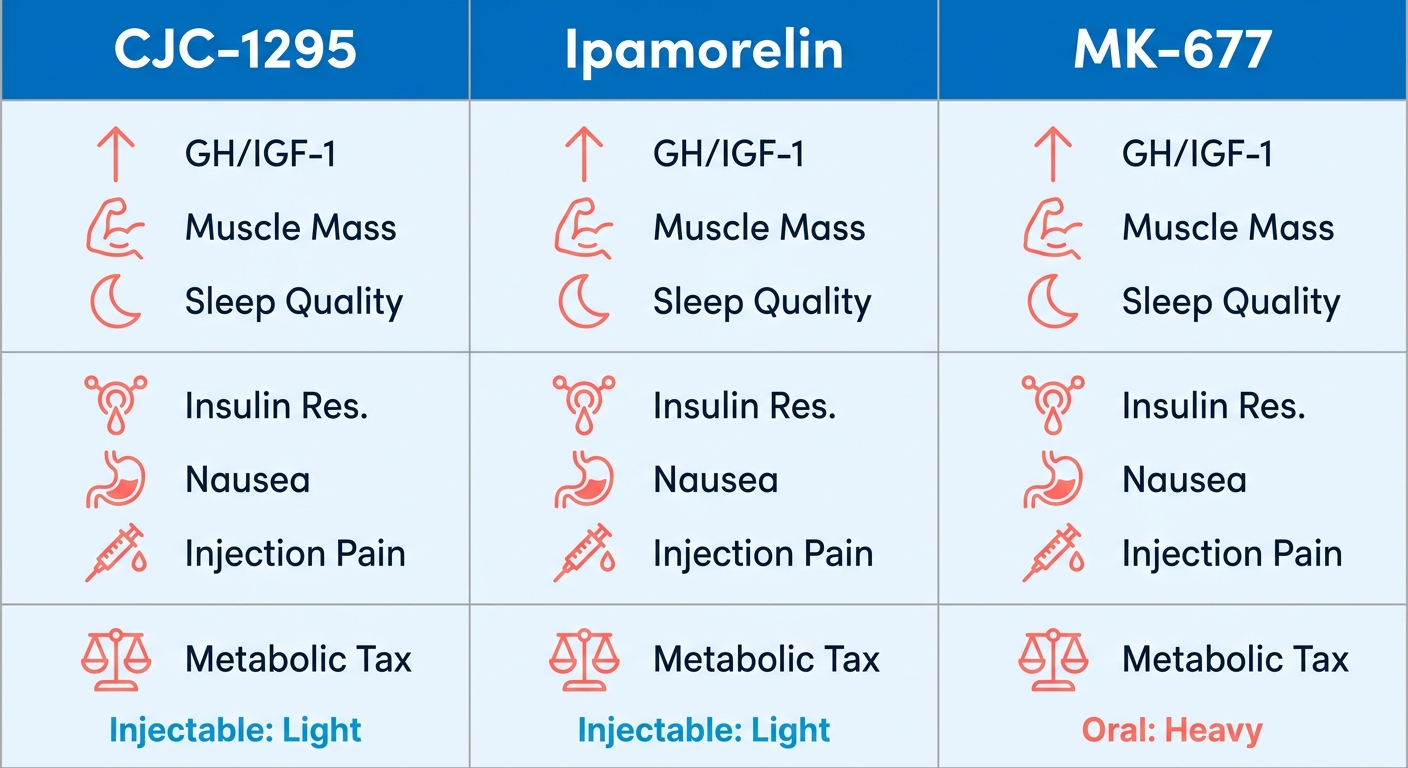
The three buckets that decide it
The main axis is metabolic impact and how often you dose. The injectable route asks for regular subcutaneous prep, but it avoids the continuous receptor occupancy of the oral route, which can nudge long-term glucose tolerance and fluid balance.
For the outcomes you care about, it sorts into three buckets: what each does to body composition, what each does to insulin sensitivity, and how much daily effort each demands. The injectable pathway asks more of you upfront and keeps the metabolic ledger cleaner. MK-677 lowers the effort barrier and raises the long-term glucose question.
Which is safer for metabolic health?
The injectable combo generally runs the more favorable metabolic profile. Because it doesn’t trigger the intense hunger of a direct ghrelin agonist, you’re less likely to eat into an unplanned caloric surplus that complicates glycemic control.
Continuous stimulation can gradually shift insulin sensitivity. Over long stretches, constant signaling may raise the risk of insulin resistance, which makes regular glucose tracking non-negotiable on the oral route.
For anyone with existing metabolic concerns or a borderline HbA1c, the injectable route is the more conservative bet. Less continuous hormonal pressure protects baseline insulin sensitivity.
The mass-without-function trap
There’s a real difference between accumulating lean tissue and improving physical performance. The clinical data is consistent: secretagogues can raise fat-free mass, but that doesn’t translate into measurable strength or better functional mobility on its own.
That gap is the whole game. Metabolically inert mass does nothing for the healthspan you’re after. The only studies reporting real strength gains involved resistance training or GH therapy paired with exercise.
To close the gap, pair any secretagogue protocol with structured resistance work. Loading the musculoskeletal system is what forces the new tissue to adapt and become functional. That’s how inert mass turns into actual capability.
The trade-off, again: the simplicity of a daily pill versus the physiological control of injections. The needles ask more of your discipline. They also give you a more targeted way to manage hormone levels.
Choosing the right option
Picking the right compound means balancing your goals against your tolerance for the route and the metabolic risk. The injectable combo offers cleaner signaling, but daily compliance is the reality that decides whether any protocol works. A plan only helps if you actually follow it for the full duration.
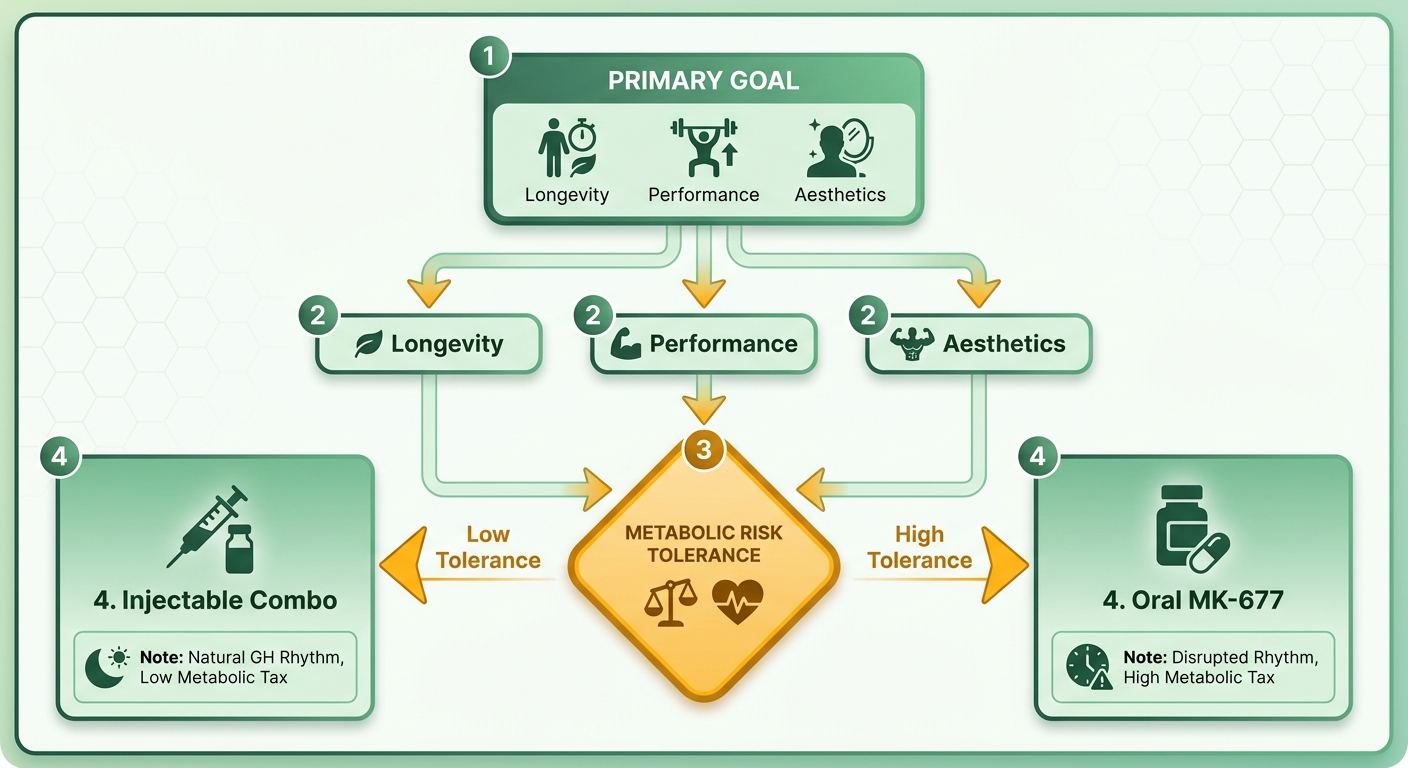
What to weigh before you choose
Start with your goal, your route tolerance, and your glucose baseline. Body recomposition with cleaner metabolic effects points to CJC-1295/Ipamorelin. Raw mass with oral convenience points to MK-677. If your fasting glucose is already borderline, the injectable route is the safer bet.
Think about the functional outcome. Both support tissue growth, but the size and shape of the change differ. The injectable route tends to give steady, gradual body-composition gains over months. The oral route can move scale weight faster, partly from fluid.
Whatever you choose, physical activity is still the main driver of functional longevity. Treat secretagogues as tools that improve how you recover from and adapt to training, not as standalone fixes.
Before you commit, run the checklist:
- Sleep quality and timing. MK-677’s evening dose can deepen slow-wave sleep for some, but the same appetite drive disrupts others. Track how you feel at week two.
- Injection logistics. The combo needs cold storage and reconstitution. If you travel a lot, ask whether that fits your week.
- Budget over 6-12 months. These protocols are a sustained cost, not a one-time buy. Price the full course, not the first vial.
- Bloodwork cadence. Plan for periodic labs. If you won’t commit to monitoring, neither option is a good fit.
Is the „cleaner“ injectable actually safe?
The injectable combo has fewer metabolic and appetite headaches, but it isn’t risk-free. Sourcing, purity, and the absence of long-term regulatory oversight for compounding are real factors that need professional guidance.
We’re direct about this. Skip both if you’re a healthy adult with no deficiency chasing GH-driven muscle gains. The evidence that CJC-1295 delivers what’s commonly promised is thin. The body-composition math changes for people in clear age-related decline, not for someone already at baseline.
How we build a personalized protocol
We start with comprehensive baseline testing to read your current endocrine and metabolic health. That data keeps the protocol tied to your physiology, not the trend of the month.
Pairing clinical oversight with your lifestyle, we help you pick a path that balances what works against what you’ll actually stick with.
If your only priority is oral convenience and mass, MK-677 may fit better. We’ll say so plainly rather than push a shot you don’t want.
Long-term safety and what the research really shows
The blunt truth on long-term safety: none of these three has the decade-long human data older adults actually need. Over a span of years, MK-677 has the longest clean trial record. The injectable combo rests mostly on short studies and theory.
That gap matters for anyone using these for longevity. Regulatory status makes it worse. Without long-term surveillance built into an approval pathway, you’re relying on trial windows that rarely clear a year. If you need a fully regulated product with real post-market monitoring, the data isn’t there yet.
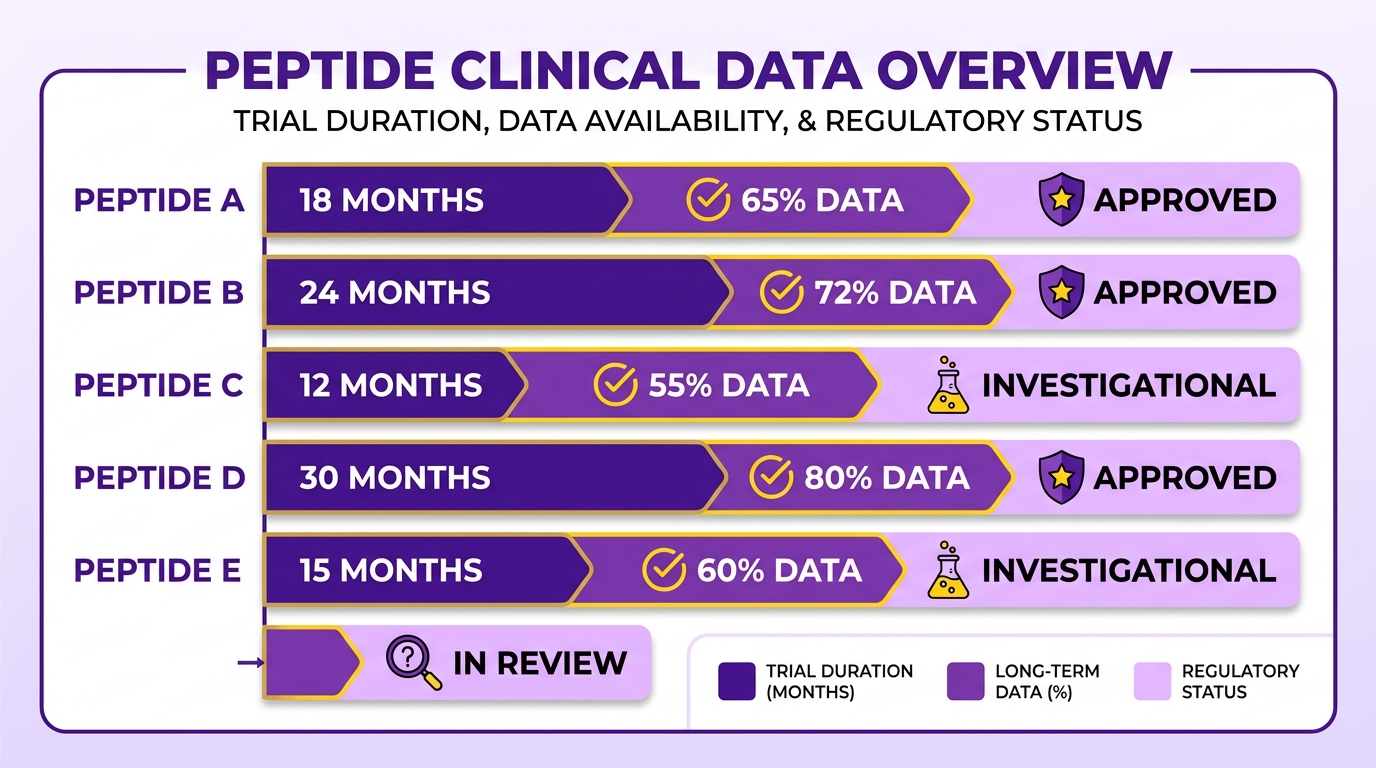
What the research shows for older adults
The strongest long-term evidence favors MK-677. Its year-long trial in healthy older adults stands out because it ran long enough to catch tolerability patterns the injectable studies never reach. Participants sustained secretagogue activity across the full duration without adverse events driving dropout.
The same trial made the harder point clear: bigger physical measurements didn’t equal functional improvement. Participants saw no gains in physical performance or muscle quality. Tissue growth alone isn’t enough for healthy aging.
The injectable side leans on smaller work. Trials show CJC-1295 producing significant lean mass gains, and a small study reported athletes on Ipamorelin recovering faster with less soreness. Long-term safety data is thin. Effects from CJC-1295 can linger up to 28 days after a dose, which is exactly why the sustained-signaling concern won’t go away.
How safe is each one long-term?
Each route has its own safety profile. The subcutaneous options mostly bring localized tissue irritation and transient discomfort. The oral route is more likely to touch systemic fluid balance and metabolic markers over time.
| Safety factor | CJC-1295 + Ipamorelin | MK-677 |
|---|---|---|
| Longest human trial | Short-term only | 12 months, well tolerated |
| Mass gain shown | Yes (lean mass) | Yes (fat-free mass) |
| Strength/function gain | Not established | No (mass only) |
| FDA status | CJC-1295 banned for compounding | Not approved |
| Main long-term concern | Sparse safety data | Sustained IGF-1 signaling |
The consequences of continuous versus intermittent receptor activation are still an open question. Long-term trials confirm secretagogue activity holds over extended periods. Whether uninterrupted signaling behaves the same as a natural cyclic pattern is the part that needs careful thought.
The mass-without-function problem
The theme across the literature holds: hormonal signaling alone can’t replace physical work. To turn cellular changes into functional strength, the body needs the mechanical stimulus of resistance training.
To get anything real out of these compounds, fold them into a broader plan. Active loading is the catalyst that converts hormonal support into actual gains in mobility and strength.
As one review author put it:
„The appeal of these peptides lies in their perceived ‚natural‘ enhancement of performance, yet the risks associated with unregulated use cannot be overlooked.“
Treat secretagogues as supporting players in a wider strategy. Consistent training and metabolic monitoring are what turn them into meaningful, long-term benefit.
Frequently Asked Questions
1. Can I combine MK-677 with the CJC-1295/Ipamorelin injectable stack?
Combining oral and injectable secretagogues is generally unnecessary and increases the risk of adverse effects. Layering these compounds can compound fluid retention and place excessive stress on insulin sensitivity without providing additional therapeutic benefits. It is more effective to select a single pathway that aligns with your specific health goals.
2. Will these peptides show up on a drug test for competitive athletes?
Yes. These substances are classified as prohibited growth hormone secretagogues by major athletic organizations. Modern testing protocols are highly sensitive and can detect these compounds and their metabolites for extended periods after use. Competitive athletes subject to drug testing should strictly avoid them.
3. Do I need to cycle these peptides or can I use them continuously?
Many practitioners recommend structured cycles rather than indefinite use. Incorporating planned breaks helps prevent receptor desensitization and allows your metabolic markers, such as fasting glucose and insulin levels, to return to baseline. Regular laboratory monitoring is essential for determining the optimal duration of a cycle.
4. How should I store and prepare the injectable CJC-1295/Ipamorelin combo?
The injectable combo requires cold storage and reconstitution before use, unlike the shelf-stable MK-677 pill. This creates logistical challenges for frequent travelers, since maintaining refrigeration and sterile mixing on the road is difficult. Factor storage demands into your decision if a consistent weekly injection rhythm won’t fit your lifestyle.
5. Are these peptides safe for someone with pre-diabetes or borderline glucose?
Individuals with compromised glucose tolerance must exercise extreme caution. Certain secretagogues can elevate blood glucose levels and reduce insulin sensitivity. If you have pre-diabetes, a thorough medical evaluation and continuous glycemic monitoring are required before initiating any protocol.
6. How much do these peptide protocols cost over a full course?
Peptide protocols are a sustained cost, not a one-time purchase, so price the full 6-12 month course rather than the first vial. Injectable protocols add expenses for cold storage, syringes, and reconstitution supplies, while MK-677 requires only daily pills. Budget for periodic bloodwork as part of the total commitment.
7. Why do I gain weight but not strength on these compounds?
Weight gain without a corresponding increase in strength is typically due to fluid retention or the accumulation of non-contractile tissue. To convert newly synthesized mass into functional strength, you must apply progressive resistance training. The compound provides the biological environment, but physical training drives the functional adaptation.
Free 15-Minute Discovery Call
Ready to take the guesswork out of your health?
Book a free 15-minute call with Monika to talk through your goals, what testing makes sense for you, and the right next step. No pressure, just clarity.
Book Your Free CallFor educational purposes only. Not medical advice.