
CJC-1295 with DAC vs. without: what changes
You’re weighing CJC-1295 because you want recovery and maybe a leaner, more resilient baseline. Then a forum thread mentions swollen fingers and hand tingling. The real question isn’t only “does CJC 1295 cause water retention?” It’s which version you’re using and how long it stays in circulation.
DAC stands for Drug Affinity Complex. The modification is generally described as binding CJC-1295 to albumin in the bloodstream, which keeps the peptide in circulation longer. CJC-1295 with DAC is often dosed less often and is associated with more sustained growth hormone and IGF-1 signaling. CJC-1295 without DAC, also called Mod GRF 1-29, is described as clearing quickly and producing sharper, pulsatile growth hormone release; it is often used with ipamorelin for a complementary pulse.
Less frequent dosing sounds convenient. But sustained growth hormone elevation does not mirror the body’s usual pattern: native GH secretion is pulsatile, rising during deep sleep and after hard exercise and then falling back. Some researchers have proposed that continuous exposure from the DAC version may blunt canonical GH signaling and shift receptor activity toward inflammatory pathways, but this remains a mechanistic concern rather than a confirmed clinical result. The long-acting DAC form does produce a prolonged rise in GH and IGF-1 after a single dose in some controlled research. The pharmacokinetic pattern may be convenient, but it diverges from pulsatile physiology.
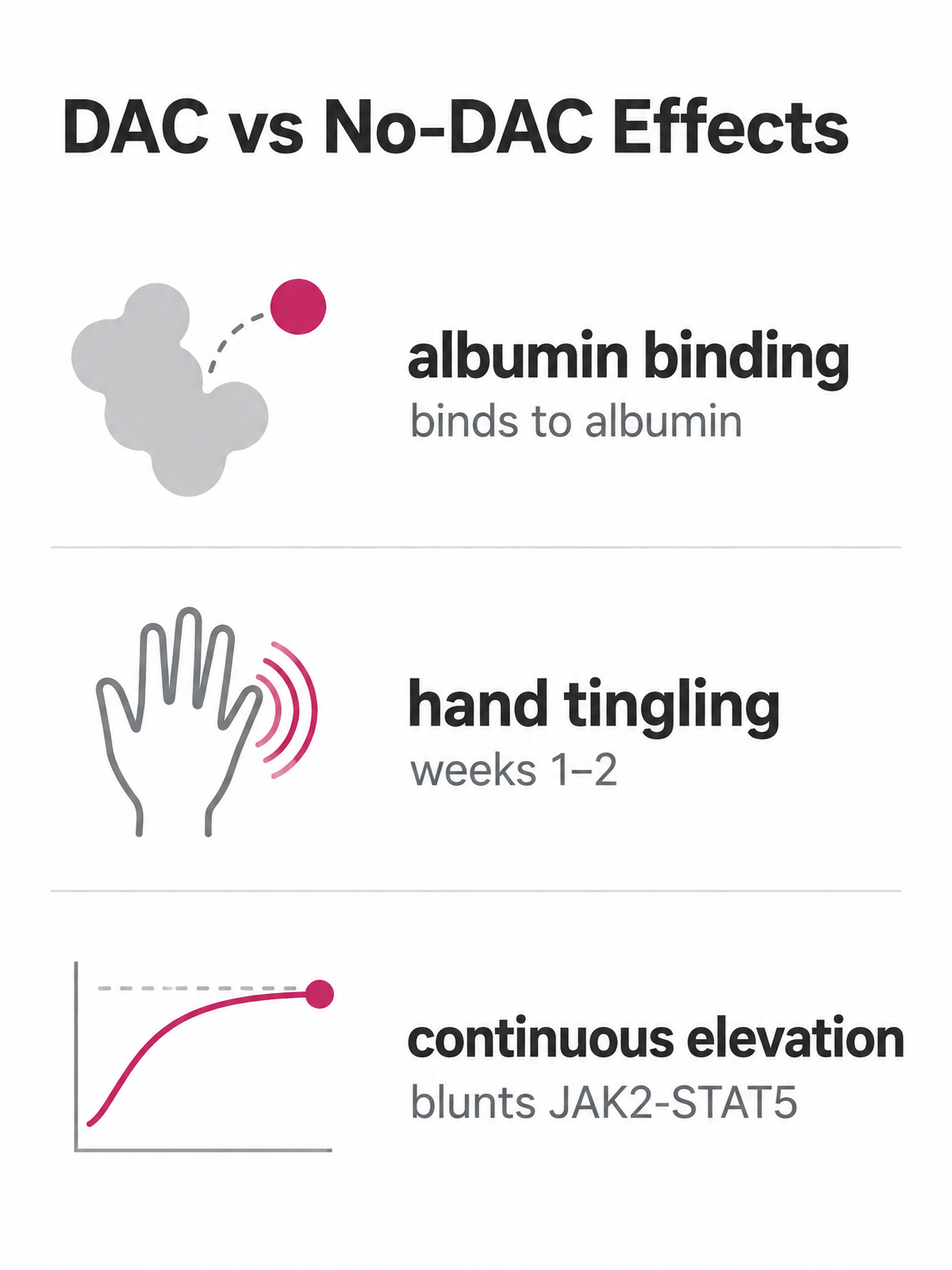
How fluid-related symptoms differ by form
Does CJC-1295 cause water retention? Both versions have been associated with fluid-related symptoms in community reports, but the DAC variant is more often described as producing persistent hand tingling, joint stiffness, and facial flushing. Timing in those reports varies; some users describe symptoms early in a cycle, especially at higher doses. Some providers attribute this to growth-hormone-driven fluid accumulation around the median nerve, but direct controlled evidence for this mechanism is limited.
With no-DAC, tingling is usually described as clustering around injection windows and fading as growth hormone pulses subside. With DAC, the sustained exposure can keep symptoms lingering for days because the peptide stays bound to albumin. Some users frame the tradeoff as convenience versus responsiveness: with DAC, if hand tingling becomes intrusive, the long washout can be a drawback; with no-DAC, a skipped dose or timing adjustment may be felt within hours rather than days.
If you prefer less frequent dosing and can tolerate a stretch of persistent water retention while your body adapts, DAC may fit your schedule. If you want to preserve the body’s natural pulsatile rhythm and make faster adjustments when symptoms appear, no-DAC may be the better match. Pulsatile release more closely mirrors how GH is secreted naturally, which is why some people prefer it over continuous elevation.
Quick answers on CJC-1295 and water retention
CJC-1295 with DAC is commonly described as having a multi-day half-life and is typically used once or twice weekly in some protocols. CJC-1295 without DAC, or Mod GRF 1-29, is described as clearing quickly and is usually used multiple times daily. Both forms can cause fluid-related symptoms. DAC-linked hand tingling, joint stiffness, and facial flushing may persist for days because of sustained GH exposure, while no-DAC symptoms may track the shorter pulse. No schedule-specific water-retention incidence data are available, so your early symptom response becomes the practical guide.
DAC vs. no-DAC: how the two protocols actually compare
Both forms raise GH. The difference is how long the signal stays on. DAC keeps GH elevated for an extended period. No-DAC produces a pulsatile pattern with recovery windows between doses. Because fluid shifts tend to track GH exposure, the steadier DAC signal can keep those shifts active longer than the on-off rhythm of no-DAC.
No schedule-specific fluid-retention incidence data are available. The symptoms people discuss, such as mild hand tingling or morning puffiness, are generally attributed to GH-induced interstitial fluid accumulation rather than measured in controlled trials. Without schedule-specific data, your own early response matters more than any population average.
Standard DAC vs. no-DAC protocols
| Feature | CJC-1295 with DAC | CJC-1295 without DAC (Mod GRF 1-29) |
|---|---|---|
| Half-life pattern | Longer, albumin-bound | Shorter, rapidly cleared |
| Dosing frequency | Less frequent | More frequent |
| Typical pairing | Standalone or optional GHRP | Often paired with ipamorelin |
| GH pattern | Sustained elevation over days | Sharp, pulsatile release |
| Convenience | Fewer injections | Multiple daily injections |
| Fluid retention pattern | No schedule-specific data; sustained GH exposure | No schedule-specific data; pulsatile GH exposure |
DAC is often chosen for convenience. No-DAC is often chosen for pulsatile physiology. Neither has schedule-specific retention data, so your early symptom response is the better guide.
Some controlled research describes substantial DAC-related GH and IGF-1 elevations, but the exact multiples vary by study. For example, a data set might report a 2–10x increase in GH and a 1.5–3x increase in IGF-1; those efficacy figures would not override the concern that sustained exposure may blunt receptor sensitivity over time. The conditional recommendation is: if convenience is your primary goal and you are comfortable tracking a longer washout and side effects stay tolerable, DAC may be acceptable. If you want a shorter signal and faster symptom adjustments, no-DAC is the more conservative default.
Our tailored protocol framework
Since published data can’t tell you which form fits your physiology, we build protocols around measurement. We use functional testing and biomarker tracking (hormones, telomere length, toxin load, gut health) to find where your body is out of balance, then build a personalized plan around your goals. That data-first read tells us whether sustained GH elevation suits your physiology or works against it.
The decision is a three-way tradeoff you can’t optimize all at once: convenience, side-effect burden, and long-term receptor health. Rank those priorities before you pin, not after symptoms force the choice.
What to track before and during a CJC-1295 cycle
Before your first injection, establish a baseline. Record morning body weight at the same time with an empty bladder and minimal clothing. Check your hands and ankles for visible puffiness, and note any existing numbness or tingling. Without that snapshot, you can’t tell whether the peptide caused water retention or yesterday’s sodium did the work.
Daily tracking
Keep a simple log: date, peptide form, dose in micrograms, administration time, morning weight, and evening weight if you want the granular view. Add a yes/no column for hand tingling, ankle swelling, or facial puffiness. Include blood pressure if you already monitor it. Note training load, carbohydrate intake, and sodium intake. All three shift fluid independent of any peptide.
Hand tingling has been described in some growth-hormone research settings and is often attributed to GH-induced fluid accumulation around the median nerve; direct controlled evidence specific to CJC-1295 is limited. That symptom gives you a real-time signal. If tingling appears early and fades, your body may be adapting to elevated GH. If it persists or worsens, your physiology may not tolerate continuous GH signaling, and a pulsatile approach may suit you better even though it requires more frequent dosing.
Some clinicians also suggest that carbohydrate intake around a no-DAC dose may blunt the GH pulse. If you use no-DAC, note whether injections fall close to meals, especially carbohydrate-heavy meals, so the log captures a possible meal-timing effect.
The research excerpts we reviewed don’t provide validated 24-hour weight-gain thresholds, typical peptide-survey ranges, bioelectrical impedance rules, or extracellular-fluid measurements specific to CJC-1295. You’re working from your own data, not a published cutoff. That’s why baseline matters. You become your own control group.
Weekly review
At the end of each week, calculate your average morning weight and identify the highest single-day jump. Score symptom severity as mild, moderate, or intrusive. Note any dose changes and flag anything a clinician should review. IGF-1 labs at baseline and at regular intervals can turn subjective tolerance into objective data. For example, some clinicians schedule follow-up IGF-1 testing every 4–6 weeks; if IGF-1 declines despite consistent administration, that can be treated as a possible receptor-desensitization signal rather than a theoretical concern from a forum thread.
Managing retention: dose tweaks, lifestyle, and when to get help
When hand tingling or morning puffiness appears, the usual reflex is to change something. Drop the dose. Skip a few injections. Add a dietary adjustment. That’s reasonable, but the first variable is which form you’re using and how long a change takes to register. DAC is described as clearing slowly, with a multi-day half-life, so dosing changes won’t produce a noticeable shift for a week or more. No-DAC is described as clearing quickly, so symptoms may track more quickly after an adjustment. If swelling or numbness persists beyond several weeks, the peptide form itself may be the variable to reconsider, not just the micrograms per injection.
Protocol adjustments require supervision
Changing timing, frequency, or peptide selection creates cascading effects that need professional oversight. Community reports describe fluid-related signals anecdotally, not under controlled conditions, so they can’t predict how your specific adjustment will resolve. Meal composition, training intensity, sleep quality, and stress all influence water balance independently of peptide exposure. Isolating cause from effect requires systematic tracking and clinical interpretation. A qualified clinician can order bloodwork at appropriate intervals, compare your symptom timeline against serum markers, and adjust your protocol based on objective data rather than forum pattern-matching.
Switching forms is more than swapping vials. Moving from DAC’s sustained release to no-DAC’s pulsatile pattern changes your injection schedule and the amplitude and duration of serum peaks. That shift may reduce cumulative interstitial-fluid pressure, but it also requires recalculating your total weekly peptide load to maintain an equivalent tissue-repair stimulus. A clinician familiar with secretagogue protocols can map out the transition, account for overlapping clearance windows, and time follow-up labs to confirm the new schedule produces the intended hormonal profile without under- or overshooting your target range.
Symptom-based escalation thresholds
Track new or worsening edema, rapid unexplained weight gain beyond what your log predicts, hand tingling that interferes with grip, shortness of breath, chest discomfort, severe headache, or blood-pressure readings outside your normal range. Any of those warrants a medical conversation rather than a wait-and-see approach. GH-driven fluid shifts may compress the median nerve, the same mechanism sometimes linked to carpal-tunnel symptoms. That is typically reversible when the peptide clears, but ignoring it long enough to cause nerve damage defeats the purpose of a recovery-focused compound.
The early stretch after starting or increasing a dose is when community sources most consistently describe fluid-related signals. If you initiate a protocol or increase your micrograms per injection, keep your daily log current during that window so you can separate peptide effect from unrelated variables. A single high-sodium day or a deload week can shift water weight independent of any secretagogue. The pattern across multiple entries matters more than one morning’s scale reading.
We have not found retention-specific trials comparing sodium-reduction diets, electrolyte-balance protocols, cardio frequency, or sauna use for CJC-1295 users. Those interventions may help general fluid management, but no published evidence isolates their effect on peptide-driven edema. If you try them, log the changes the same way you track dose and timing. That documentation becomes the only data you’ll have if symptoms persist and a clinician needs to reconstruct what changed when. Compression garments, elevation during sleep, and potassium-rich foods show benefit in non-peptide edema, but extrapolating those results to secretagogue protocols remains speculative without direct study populations.
Your next move: choose a form and monitor the first month
So does CJC-1295 cause water retention? Fluid shifts track your GH exposure, not the label on the vial. DAC holds that exposure steady for days. No-DAC lets it rise and fall. That one difference drives most of the decision.
Most side effects, including retention, show up when dosing outpaces your body’s adjustment window. The form you choose matters less than whether you track response, adjust dosing, and leave room to pull back when symptoms appear.
Which form fits your priorities?
You can’t optimize convenience, side-effect burden, and receptor sensitivity all at once. Rank them before you buy.
| Priority | DAC | No-DAC |
|---|---|---|
| Half-life pattern | Longer (albumin-bound) | Shorter |
| GH/IGF-1 exposure | Sustained | Pulsatile |
| Fluid-symptom adjustment | Slower | Faster |
| Best fit | Fewer pins, steady IGF-1 | Shorter signal, quick tweaks |
DAC suits you if fewer injections and steady IGF-1 are the goal. No-DAC suits you if you want a shorter signal and the ability to back off fast when puffiness appears. Neither ranks ahead on retention risk because no incidence data breaks it out by form.
What the regulatory status actually tells you
CJC-1295 is not FDA approved, and the strongest evidence behind it is still limited human research. That status is not an endorsement, and it says nothing about any one supplier’s safety.
Get your baseline numbers and work with a qualified clinician who will track IGF-1 alongside you. That measured, data-first path is how we work at BiohackNow. Measure, don’t guess.
Common Questions
I switched from DAC to no-DAC. How long until the DAC-related water retention clears?
DAC is described as having a multi-day half-life, so a noticeable symptom change after the last dose may take a week or more because the peptide stays bound to albumin. No-DAC is described as clearing quickly, but your timeline follows the slower DAC washout, not the new form’s faster action.
Does stacking no-DAC with ipamorelin raise water retention risk compared with using no-DAC alone?
No schedule-specific study separates fluid retention by this combination. CJC-1295 without DAC is often paired with ipamorelin for complementary GH release, but without schedule-specific data your own symptom tracking remains the only reliable guide.
Is water retention actually a sign the peptide is working?
Water retention signals elevated GH exposure, not a confirmed therapeutic effect. Tingling that fades early may reflect your body adapting to higher GH; persistent or worsening puffiness suggests the dose outpaces your adjustment window. Treat it as a tolerance signal to track, not proof of results.
Can I rely on morning weight alone to judge whether CJC-1295 is causing water retention?
Morning weight alone cannot isolate peptide-driven water retention. Carbohydrate intake, sodium, training load, and a deload week all shift water weight independently of any secretagogue. You need a multi-day pattern and symptom log; a data-first protocol like BiohackNow’s approach uses that baseline to guide adjustments.
If hand tingling starts on CJC-1295, should I stop immediately or adjust the dose?
You can often adjust before stopping, but the form determines speed. No-DAC symptoms are typically described as shifting within hours of a skipped dose; DAC symptoms may take days to clear. Seek medical review if tingling interferes with grip, or if shortness of breath, chest discomfort, or severe headache appears.
Free 15-Minute Discovery Call
Ready to take the guesswork out of your health?
Book a free 15-minute call with Monika to talk through your goals, what testing makes sense for you, and the right next step. No pressure, just clarity.
Book Your Free CallFor educational purposes only. Not medical advice.
