
Key Takeaways
- Over 12 months, tirzepatide averaged -15.3% weight loss versus -8.3% for semaglutide. That’s the dual-receptor advantage on paper.
- Tirzepatide hits both GIP and GLP-1 receptors. Semaglutide works the GLP-1 receptor alone. That second pathway explains the gap in weight and HbA1c.
- In the matched cohort, 81.8% of tirzepatide users hit 5% weight loss, against 66.5% on semaglutide.
- The 10% threshold: 62.1% of tirzepatide patients reached it, versus 37.1% on semaglutide.
- Only 18.1% of semaglutide users lost 15% of body weight. Tirzepatide put 42.3% over that line in the same cohort.
- Both are once-weekly injections that improve insulin and liver markers. Semaglutide also comes as a daily oral pill.
- The numbers come from an 18,386-patient matched cohort drawn from 41,222 adults. Both drugs carry comparable, high GI side effects.
The short version, up front

If you’re an older adult weighing glp-peptides for metabolic health and longevity, here’s the honest read: tirzepatide wins on raw weight loss, but the two are closer than the headline numbers suggest once real-world titration enters the picture. Both are once-weekly injections. Both improve insulin and liver markers. The real question is how aggressively you can climb the dose and what you’re stacking around it.
Here’s the head-to-head, pulled from the cohort and trial data.
Semaglutide vs. tirzepatide, side by side
Tirzepatide is a dual GIP and GLP-1 receptor agonist. Semaglutide works the GLP-1 receptor alone. That extra pathway is why tirzepatide edges ahead on both weight and HbA1c.
| Feature | Semaglutide | Tirzepatide |
|---|---|---|
| Mechanism | GLP-1 receptor agonist | Dual GIP + GLP-1 agonist |
| Mean weight loss (12-mo cohort) | -8.3% | -15.3% |
| Reached 5% loss (cohort) | 66.5% | 81.8% |
| Reached 10% loss (cohort) | 37.1% | 62.1% |
| Reached 15% loss (cohort) | 18.1% | 42.3% |
| Administration | Weekly injection or daily oral | Weekly injection only |
| GI side effects | High, class effect | High, comparable |
In the 18,386-patient matched cohort, tirzepatide users were far more likely to hit the thresholds that actually matter. At 12 months, tirzepatide averaged -15.3% versus -8.3%, and 81.8% of its users cleared at least 5% loss against 66.5% on semaglutide.
Does that gap survive contact with real life?
It shrinks. Randomized trials consistently put tirzepatide ahead, but real-world data, where dosing tends to be less aggressive, narrows the lead.
Why? Titration. In practice, plenty of patients never reach tirzepatide’s top doses, so the peptide is effectively under-dosed and never shows its full hand. Semaglutide protocols, by contrast, more often get titrated to the ceiling.
Our take: for older adults running structured daily routines and IV support, disciplined titration probably matters more than which peptide you pick. A well-titrated semaglutide protocol can beat a badly-titrated tirzepatide one. The molecule is half the equation, at most.
Side effects and cost
GI upset is the main tolerability concern, and here the two are a wash. Head-to-head data found no significant difference in GI adverse events, despite tirzepatide’s greater potency. Absolute rates run high and swing wildly across trials, but that’s a class effect tied to how fast you climb, not a reason to favor one drug.
Both carry boxed warnings for medullary thyroid carcinoma and MEN2. Personal or family history of either? Skip both. Semaglutide offers an oral option; tirzepatide doesn’t, which matters if you dislike needles.
One caveat for this audience, stated plainly: the key studies skew middle-aged, mean ages around 52 and 60. The strongest longevity signal comes from cardiovascular subgroups, not healthy-aging trials. The metabolic case for older adults is strong, but it rests on extrapolation. Know that before you commit.
Why bother with either one
After 60, muscle-sparing fat loss and insulin sensitivity get harder to hold with diet alone. That’s the gap. Semaglutide and tirzepatide both close it, and the choice between them depends less on the headline numbers than on how you plan to run the protocol.

Our starting position: if you want maximum fat loss and can tolerate aggressive titration, tirzepatide has the edge. If you want an oral option, a milder onset, or you’re folding it into a lighter longevity routine, semaglutide holds its own. Both fit the same broader plan of precision genetics, IV nutrient support, and daily habit work.
Which one fits your goal?
The right peptide tracks to your primary target: aggressive weight loss, glucose control, or gentle maintenance. The molecules also behave differently at the receptor. Semaglutide is a single GLP-1 agonist; tirzepatide is a dual agonist hitting GLP-1 and GIP. That second pathway drives its stronger appetite and glucose effects, and it also explains why the GI adjustment period can feel sharper.
For most older adults, though, the deciding factor is titration tolerance, not the molecule. Tirzepatide usually starts at 2.5mg and steps up every four weeks, and each step can bring a fresh wave of nausea. Semaglutide’s slower, lower-dose ramp gives you more room to hold a step when your gut needs it. Your ability to stay on schedule predicts your result far better than the ceiling dose does.
The efficacy gap in real life
Not as wide as the trials suggest. Real-world outcomes trail controlled-trial numbers because many patients never reach the top doses where tirzepatide’s edge is largest. When they can’t climb, the practical gap narrows a lot.
A patient who settles into a tolerable steady dose of semaglutide often beats one who stalls out on tirzepatide at week four. This is exactly where daily tracking and IV-supported recovery earn their keep.
Adherence data backs it up. Roughly a third of patients quit GLP-1 therapy within the first year, most often over side effects during the ramp, not lack of response. The molecule you finish the year on beats the one you quit in month two. That’s why we treat the titration plan as the actual intervention.
When to skip the genetic gatekeeping
Don’t use genetics to rule yourself out. GLP-1 analogs still work in MC4R-deficient models, one of the core monogenic obesity pathways, so „non-responder“ fears are usually overblown. We use genotyping to set dose expectations and pace titration, not to exclude candidates.
That’s the frame: pick the molecule that fits your tolerance, support the titration daily, and use your genetics to calibrate rather than disqualify. More on how we structure that on our blog.
What each peptide asks of you week to week
The feature that matters most for a longevity protocol isn’t the headline weight-loss number. It’s how each drug behaves once you factor in titration, tolerability, and what you’re stacking around it.

The efficacy gap is well documented. The more useful question is what each peptide demands of you week to week. Dosing schedules, formulation options, and how fast your gut lets you climb shape the outcome as much as the mechanism does.
Feature by feature
The one feature where semaglutide wins outright is formulation. It comes as both a weekly injection and a daily oral pill; tirzepatide is injection-only. For anyone who resists needles, that’s a real deciding factor.
| Feature | Semaglutide | Tirzepatide |
|---|---|---|
| Administration | Weekly injection or daily oral | Weekly injection only |
| Dosing steps to max | Fewer titration rungs | More gradual titration ladder |
| Injection frequency | Weekly (or daily oral) | Weekly |
| GI side-effect burden | Comparable | Comparable |
| Storage | Refrigerated | Refrigerated |
The dual pathway shows up in more than the scale. In animal work, tirzepatide shifted the respiratory quotient toward fat oxidation, and its longer titration ladder means dose escalation is slower but often better tolerated at each step. For older adults chasing insulin sensitivity, that gradual ramp is a functional difference, not marketing.
Does the advantage hold up outside the trial?
Not always. It depends on whether you reach the top dose. Trial data shows a meaningful spread favoring tirzepatide, but real-world results narrow because many users never climb to the max, and tolerability governs how fast anyone can titrate.
An under-titrated tirzepatide user surrenders tirzepatide’s whole advantage. This is where daily habit tracking and IV nutrient support earn their place, because GI tolerability sets the speed limit on your dose climb.
On side effects, the two are closer than expected. Head-to-head, there were no significant differences in gastrointestinal adverse events despite tirzepatide’s greater efficacy. GI burden is a class effect and a titration-speed problem, not a tiebreaker.
Where the longevity case gets thin
Be honest about the population gap. Most of the strongest comparative data comes from adults with overweight, obesity, or type 2 diabetes, and the head-to-head cohorts skewed middle-aged, mean ages around 60.
So the longevity argument for healthy older adults rests on extrapolation from cardio-metabolic subgroups, not clean healthy-aging trials. That’s a signal worth acting on, but skip the fantasy that either peptide has proven lifespan extension in fit 70-year-olds. It hasn’t.
How fast, and how far
The headline gap between these two is real, but often overstated. The dose-matched figures above tell only part of the story. In practice, the picture depends heavily on how far each drug gets titrated.
Titration, again. In many real-world settings, patients never reach the top tirzepatide dose while semaglutide users more often hit their ceiling. Tirzepatide is simply under-titrated. For older adults, disciplined titration support moves outcomes more than the choice of peptide.
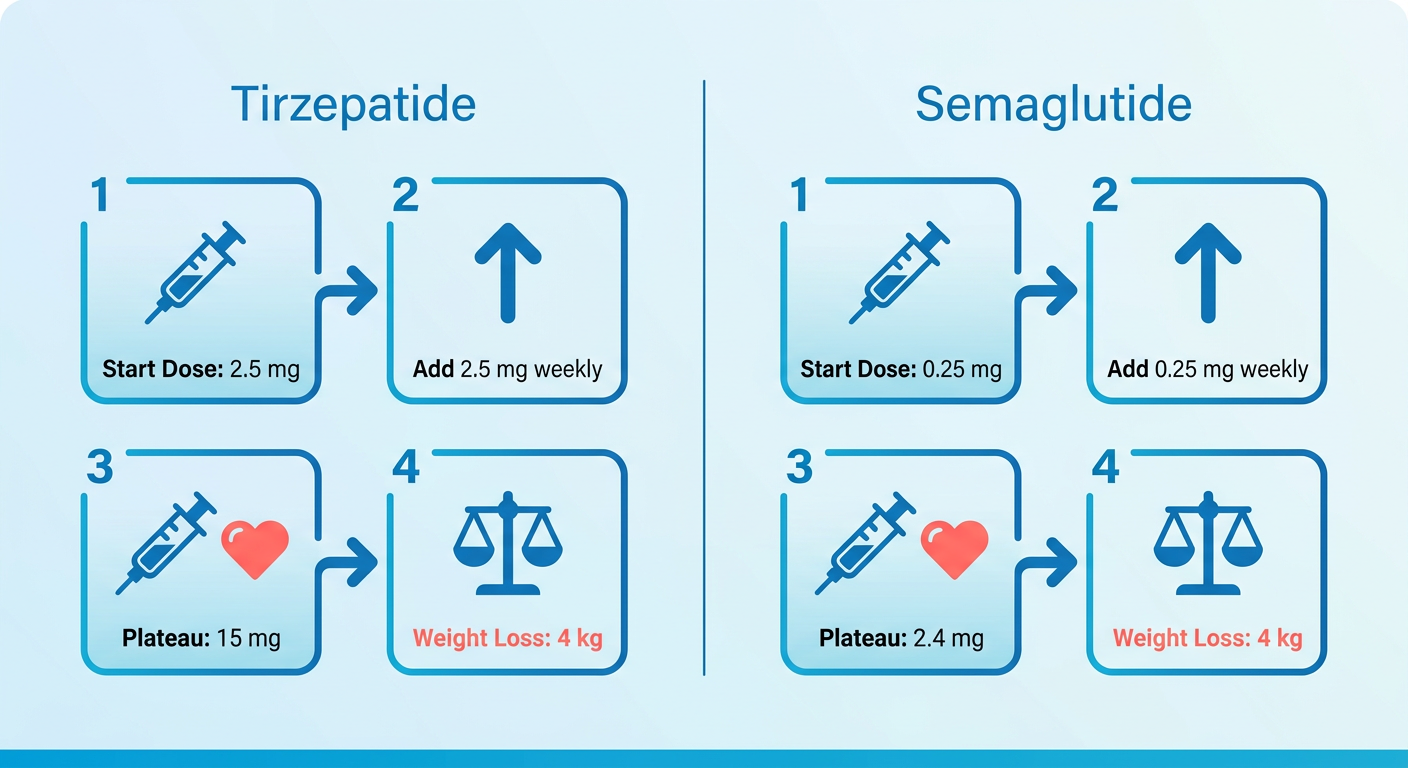
Speed of results
Both peptides show steady, dose-dependent loss over the trial windows studied. Across the comparative data, mean weight loss reached roughly 4.81 kg for semaglutide and 9.7 kg for tirzepatide over follow-up periods averaging about 32.5 weeks. The pattern scales with dose and with how well you tolerate each step up.
Tirzepatide’s dose-response is stark. Its dual-agonist mechanism produced greater mean weight loss than semaglutide, with the advantage widening at higher doses. For an older adult titrating slowly to protect against nausea and muscle loss, that top-dose advantage may never fully materialize. Speed here is a function of tolerance, not just pharmacology.
Which scales better for a longevity protocol?
Semaglutide scales more flexibly for daily routines; tirzepatide scales harder on raw fat loss. Semaglutide comes in weekly injection and oral forms, which suits older adults who want a lower-friction entry or dislike needles. Tirzepatide is injection-only.
| Factor | Semaglutide | Tirzepatide | Our IV + genetics stack |
|---|---|---|---|
| Peak weight loss | ~8-15% | ~15-24% | Adds nutrient support during titration |
| Titration steps | Gentler onset | Steeper curve | Genetics guide the pace |
| Delivery | Injection or oral | Injection only | Weekly IV integration |
| Real-world gap | Narrows at matched doses | Titration discipline closes it |
Tolerability matters for scaling. Head-to-head, the two showed no significant difference in gastrointestinal side effects, even though GI event rates across trials ran anywhere from 32% to 98%. GI burden is a class effect and a titration-speed problem, not a reason to pick one over the other.
At BiohackNow we build both around precision medicine and weekly IV nutrient support. The protocols guide how fast you titrate, and the IV work covers the electrolyte and micronutrient gaps that appetite suppression tends to open up in older bodies.
The honest caveat for older adults
The longevity evidence for over-60s is extrapolated, not direct. The key cohort skewed middle-aged, mean age around 60, with follow-up averaging about 32.5 weeks. Much of the strongest outcome data comes from trials weighted toward metabolic disease, not healthy aging.
That’s a strong cardio-metabolic signal. But if you’re a healthy 68-year-old chasing longevity alone, the population match isn’t perfect. Skip the aggressive top-dose push if fat loss isn’t your primary goal.
Pros and cons
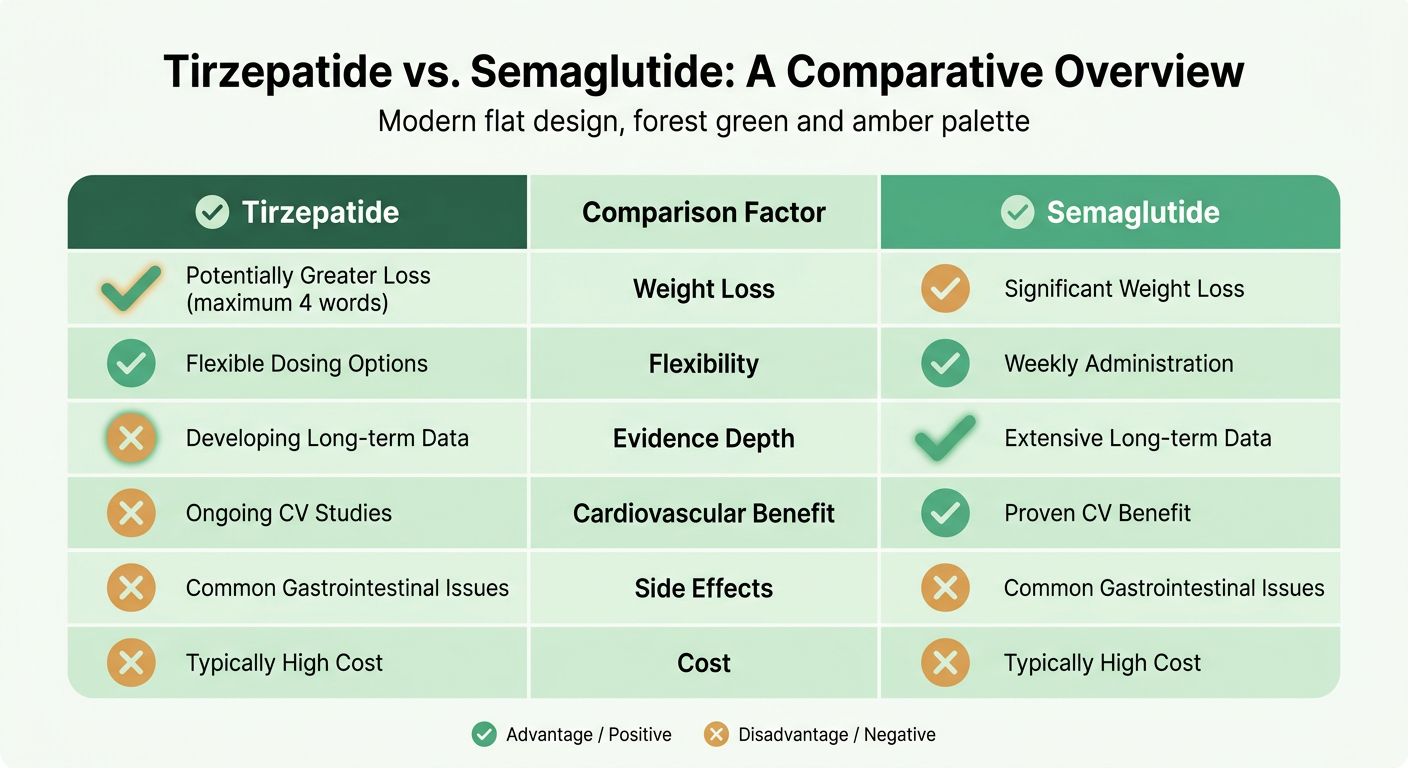
The honest verdict: tirzepatide wins on raw fat loss, semaglutide wins on flexibility and evidence depth, and the mortality case for both rests on extrapolation, not healthy-aging trials. That last point matters more than most reviews admit.
Here’s the trade-off no competitor spells out. The head-to-head data skews middle-aged, mean ages around 60, and the cardiovascular benefit signals emerged in patients with preexisting disease. Strong signal. But if you’re a healthy 70-year-old chasing longevity, you’re borrowing that benefit from a cardio-metabolic subgroup, not from someone in your exact position. We think that’s a reasonable bet given the metabolic upside, but make it with eyes open.
The advantages of each
Tirzepatide’s strength is magnitude. In matched cohorts it consistently outperforms on total fat reduction, and the gap widens the longer patients stay at full dose. That depth matters for older adults, whose weight loss plateaus earlier than younger patients‘. Waist circumference and visceral fat also move faster on tirzepatide, and visceral fat is the compartment most tied to metabolic risk after 60.
Semaglutide’s strength is versatility. Weekly injection or daily oral tablet, so needle-averse patients have a real option. It works in non-diabetic adults, and longer follow-up shows durable weight maintenance when patients stay on therapy. That durability is nothing to dismiss.
The downsides and trade-offs
Both carry the same GI burden and the same boxed warnings. Nausea and digestive upset are class effects tied to titration speed. In the largest head-to-head cohort, GI adverse events showed no significant difference between the two despite tirzepatide’s greater efficacy. So GI tolerability isn’t a real differentiator. Both also carry boxed warnings for medullary thyroid carcinoma and MEN2.
The bigger catch is real-world titration. Tirzepatide’s advantage in controlled settings narrows when patients don’t reach therapeutic doses. Its ceiling is higher, but it demands more commitment to climb through multiple dose steps. Semaglutide’s simpler ramp, and its oral form, make it easier to optimize in practice.
Our take: for older adults on structured routines and IV nutrient support, disciplined titration moves outcomes more than the peptide you start with. That’s where the daily protocol earns its keep.
| Factor | Tirzepatide | Semaglutide |
|---|---|---|
| Visceral fat reduction | Faster, larger shift | Steady, slower |
| Plateau timing | Later onset | Earlier onset |
| Administration | Weekly injection only | Injection or oral pill |
| GI tolerability | Class effect, comparable | Class effect, comparable |
| Real-world optimization | Requires disciplined titration | Simpler dose escalation |
When should you skip the aggressive route? If you can’t commit to slow, monitored titration, don’t chase tirzepatide’s ceiling. You’ll collect the side effects without the payoff. For a lighter longevity stack, semaglutide’s oral form and milder onset fit better. We build the titration schedule and nutrient support around whichever you choose.
Who each peptide is actually for
The right peptide depends on who you are and what you’re building around it. For older adults, we sort candidates into three profiles: the aggressive fat-loss case, the flexibility-first case, and the metabolic-maintenance case. Each one changes which glp-peptide earns the slot.
Here’s the filter we run before anyone starts. If you have preexisting cardiovascular disease, the cardio-metabolic signal is strongest for you. GLP-1 research points to meaningful metabolic benefits in that subgroup, which is why we weigh cardiovascular history heavily. That’s where the case for treatment is clearest.

Who should choose tirzepatide
Tirzepatide fits the older adult chasing maximum fat loss who can tolerate steady titration. Its dual-receptor action drives appetite suppression and slowed gastric emptying that compound over months. Carrying significant visceral fat and want the steepest curve? This is your peptide.
The dose-response is real, and it rewards patience. Higher maintenance doses consistently separate from lower ones on fat loss, so early plateaus usually mean an incomplete titration rather than a ceiling. This profile only works if you commit to the full ladder. Under-titrated tirzepatide gives back most of its edge.
There’s a metabolic bonus for insulin-resistant older adults. In genetic obesity models, tirzepatide shifted the respiratory quotient toward fat oxidation and improved insulin and liver markers. If your bloodwork shows early metabolic drift, that mechanism matters.
Who should choose semaglutide
Semaglutide fits older adults who want flexibility, a milder onset, or an oral route. The oral form suits needle-averse users. It still delivers meaningful weight loss on its own, well beyond what lifestyle changes typically manage alone.
It also has a deep evidence base for weight management. For a lighter longevity routine, semaglutide holds its own without demanding the aggressive dose climb tirzepatide rewards.
Which profile are you?
| Profile | Best Fit | Why |
|---|---|---|
| Maximum fat loss, tolerates titration | Tirzepatide | Steepest fat-loss curve; strong dose-response |
| Flexibility / oral option / mild onset | Semaglutide | Oral form; milder onset; deep evidence base |
| Existing cardiovascular disease | Either | Cardio-metabolic benefits weigh in this subgroup |
| Precision-guided titration + IV support | Our protocol | Titration discipline drives outcomes more than drug choice |
We win one category outright: the older adult who wants disciplined titration support wrapped around genetics and IV nutrient work. Much of the real-world efficacy gap comes down to how far patients actually titrate. When they fall short of full dosing, the advantage of one peptide over the other narrows. That’s the whole thesis. Getting titration right moves the needle more than picking a peptide.
Skip both if you’re healthy and hunting pure longevity insurance. The head-to-head cohorts skew middle-aged, 52 and 60. A fit 70-year-old with clean bloodwork is borrowing benefit from a cardio-metabolic subgroup, not a healthy-aging trial. The metabolic upside can still justify it, but make that call with clear eyes.
What I’d actually recommend
After all the head-to-head data, the bottom line for older adults: tirzepatide wins the raw fat-loss race, but which glp-peptide you run matters less than how you run it. The dual-agonist edge is real. It just isn’t the whole story once titration, tolerability, and your surrounding routine come in.
The caveat we keep returning to: the strongest cardiovascular benefit signals came from patients who already had heart disease. A healthy older adult chasing longevity is extrapolating from a cardio-metabolic subgroup, not a healthy-aging trial. We think that’s a reasonable bet given the metabolic upside. Make it knowing that’s the bet.
Which peptide should you choose?
Choose tirzepatide for maximum fat loss; choose semaglutide for flexibility and evidence depth. The efficacy gap you actually see depends on reaching an effective dose, so the choice hinges less on the molecule and more on whether you can sustain the ramp.
That titration gap is the whole game. When tirzepatide is under-titrated, its paper advantage shrinks fast. For older adults on structured IV nutrient support and daily tracking, disciplined titration beats the drug choice itself.
| Scenario | Best Choice | Why |
|---|---|---|
| Maximum fat loss, can titrate | Tirzepatide | Larger efficacy ceiling when fully dosed |
| Wants oral option or milder onset | Semaglutide | Available as tablet; deeper evidence base |
| Preexisting cardiovascular disease | Either | Strongest metabolic signal in this subgroup |
| Precision-managed longevity protocol | BiohackNow protocol | Biomarker tracking + IV support + titration coaching around either peptide |
Side effects and tolerability
Gastrointestinal side effects are a class effect, not a tiebreaker. Head-to-head, the two peptides showed comparable GI adverse events. Nausea and digestive issues track with how fast you titrate, not with which molecule you pick.
That’s freeing for the decision. You don’t have to trade tolerability for results. You have to titrate at the right speed. We tie dose escalation to your biomarkers and how your body actually responds, not to a fixed calendar.
Our final take
We build the protocol around the peptide, not the other way around. The biomarkers we track, from hormones to gut health, guide how we manage each protocol. Non-invasive IV therapy keeps micronutrients and hydration steady while appetite drops. Daily routines protect muscle, which matters far more after 60 than the headline weight number.
Pick tirzepatide if you want the strongest fat-loss lever and can commit to steady titration. Pick semaglutide if you want an oral route, a gentler ramp, or a lighter stack. Either way, the outcome lives in the execution.
Skip both entirely if your goal is a quick cosmetic drop with no intention of long-term support. These peptides reward sustained, monitored use. They punish start-stop dabbling.
Frequently Asked Questions
1. Can I switch from semaglutide to tirzepatide if my weight loss stalls?
Switching is worth discussing with your provider, but the article suggests a stall often reflects incomplete titration rather than a molecule ceiling. Before changing peptides, confirm you’ve reached an effective, tolerable dose. A well-titrated semaglutide protocol can outperform a poorly-titrated tirzepatide one, so titration discipline usually matters more than switching.
2. Is the daily oral form of semaglutide as effective as the injection?
The article confirms semaglutide comes in both weekly injection and daily oral forms, giving needle-averse users a real option, while tirzepatide is injection-only. It doesn’t compare oral versus injectable efficacy directly, so treat the oral pill as a flexibility advantage rather than a proven efficacy equivalent.
3. Should I avoid these peptides if I have a thyroid condition?
Both semaglutide and tirzepatide carry boxed warnings for medullary thyroid carcinoma and MEN2. The article advises skipping both peptides entirely if you have a personal or family history of these conditions. This is a hard exclusion, unlike genetic profiling, which is used to calibrate dosing rather than disqualify candidates.
4. Does my genetics determine whether these peptides will work for me?
Genetics shouldn’t rule you out. GLP-1 analogs still work in MC4R-deficient models, one core monogenic obesity pathway, so „non-responder“ fears are usually overstated. BiohackNow uses genotyping to set dose expectations and pace titration, not to exclude candidates, calibrating your protocol rather than disqualifying you from treatment.
5. Why do so many people quit GLP-1 therapy in the first year?
Roughly a third of patients discontinue within the first year, most often over side effects during the ramp rather than lack of response. GI upset tied to titration speed drives most quitting. This is why the article frames disciplined titration support, not the peptide choice, as the real intervention.
6. If I’m a healthy 70-year-old, do these peptides extend lifespan?
No lifespan extension has been proven in fit older adults. The key cohorts skewed middle-aged, around 52 and 60, and the strongest signals came from cardiovascular subgroups with preexisting disease. A healthy 70-year-old is borrowing benefit from a cardio-metabolic subgroup, so the longevity case rests on extrapolation, not direct evidence.
7. How much muscle-supporting nutrient support do I need during titration?
Appetite suppression tends to open electrolyte and micronutrient gaps in older bodies, which is why BiohackNow pairs protocols with weekly IV nutrient support. The article doesn’t specify exact nutrient amounts, but frames IV integration as covering deficits that emerge as you titrate and reduce food intake.
Free 15-Minute Discovery Call
Ready to take the guesswork out of your health?
Book a free 15-minute call with Monika to talk through your goals, what testing makes sense for you, and the right next step. No pressure, just clarity.
Book Your Free CallFor educational purposes only. Not medical advice.