
The Short Version
- The Wolverine Stack pairs BPC-157 and TB-500. Dosing schedules are often discussed in broad ranges, but there is no single agreed protocol.
- Some providers suggest daily schedules for acute recovery goals and weekly or split-weekly schedules for long-term maintenance.
- BPC-157 and TB-500 are often described as having different persistence after injection. That reported difference is usually the basis for spacing TB-500 doses further apart, but human pharmacokinetic data are limited.
- Fewer injections may mean slower use of product and lower monthly cost, but actual spend depends on concentration, vial size, source, and protocol design.
- Both peptides are commonly described as prohibited under WADA rules. No dosing schedule changes that eligibility concern.
The Fast Answer: Daily vs Weekly
How often to take the Wolverine Stack really comes down to two camps. A daily microdose schedule, and a spread-out weekly rhythm. Same two peptides in both, BPC-157 and TB-500, but they are often described as loading your system differently.
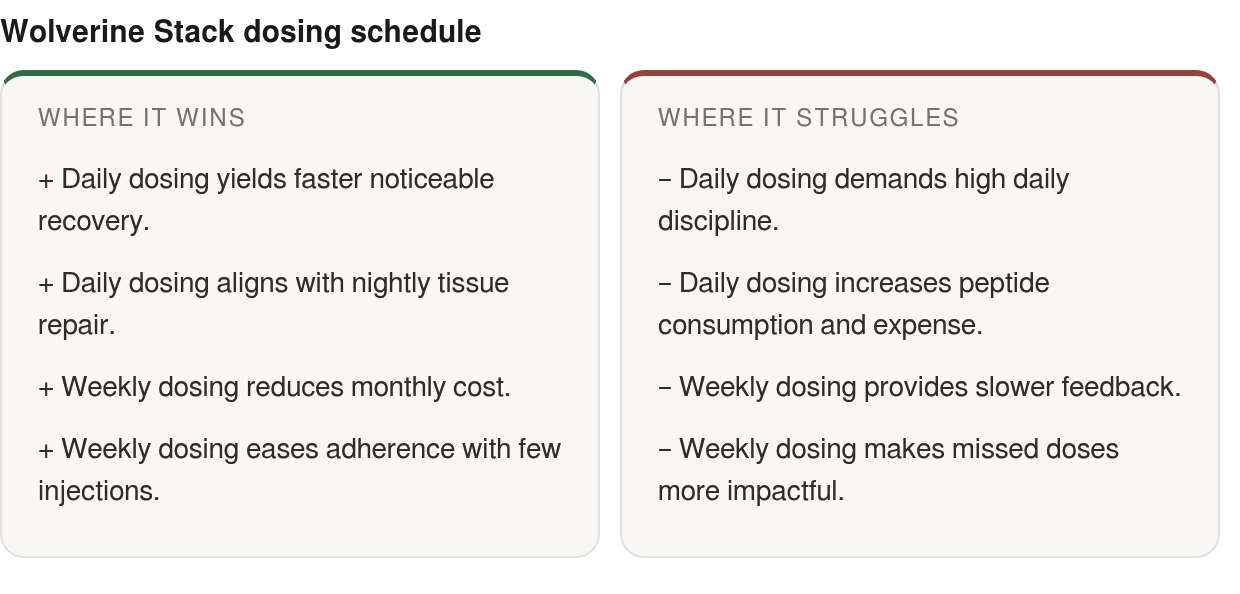

Match the schedule to the job. Time-sensitive repair may lean daily. Long-game resilience may lean weekly. If you’re rehabbing a fresh tendon issue or working inside a post-procedure window, the higher-frequency plan may earn its friction. If you’re running the stack as maintenance across a year, the weekly rhythm might be the one you’ll actually keep. Neither cadence is better in the abstract. They may solve different problems.
One decision tree stops early, though. If your sport follows anti-doping rules that prohibit these peptides, this stack is off the table before dosing even enters the conversation.
What actually separates daily from weekly
Daily dosing often uses smaller, repeated administrations, sometimes timed to the evening. Weekly dosing often uses fewer touchpoints and leans on the reported longer tissue residence of TB-500 to space doses out.
| Factor | Daily Protocol | Weekly Protocol |
|---|---|---|
| Injection frequency | Every day, often 1x | 1–2x per week |
| Timing fit | Tight, often dose-timed near nightly recovery | Looser, fewer anchor points |
| Best for | Acute injury, short recovery sprints | Maintenance, longevity, tendon work |
| Peptide consumed | May be higher over a month | May be lower over a month |
| Cost trend | May be higher monthly spend | May be more economical |
| Adherence burden | Demands daily discipline | Easier to sustain |
The split is often described as coming from how the two compounds are said to behave. One is thought to reward frequent reinforcement. The other is thought to allow more room between shots. That is why the same stack can be arranged as a short-term rehab tool or a lower-friction maintenance plan, according to some provider protocols.
Which schedule fits which client
For acute recovery, the tighter rhythm may be more useful. A new tendon issue, a muscle strain, or a time-sensitive post-procedure window may reward consistency over convenience.
For longevity and maintenance, spreading out may be easier to sustain, easier to budget, and less likely to become another daily task you eventually resent. A missed dose still counts. The overall routine just asks less of you.
What it costs to run
Weekly protocols may cost less overall, because fewer administrations can mean slower vial use. Daily protocols may consume more product and sit higher on the ledger. That may be the trade you accept for a faster acute response.
Fixed totals are hard to pin down, because concentration, vial size, source, and protocol design all move the number. A more reliable rule is that frequency may drive cost. If budget matters and your goal is maintenance rather than acute repair, the lower-frequency route may win.
Why the Schedule Question Even Matters
Start with a plain question: what are you actually trying to fix? The schedule should follow the goal, not the reverse. We see people default to daily because more feels better, then wonder why their maintenance protocol turned into a chore they dread.
The real choice comes down to three things. Your repair window, your circadian pattern, and how much of your day you’re willing to spend managing injections. Get those right and consistency may take care of itself.
Matching dose frequency to the goal
Acute problems may want a tighter cadence. A new connective-tissue injury or a post-surgical stretch may benefit from repeated exposure while the tissue is actively rebuilding. That’s the short-term play, and it may have an expiration date.
Longevity clients are running a different race. Used as ongoing support, the stack may work better on a weekly or split-weekly rhythm that stays light enough to repeat over months. You’re not forcing a dramatic response in a few days. You’re keeping recovery inputs organized across a long horizon.
There’s a practical limit worth naming. If you have no active injury and no clear performance target, aggressive daily dosing may not add much benefit once the repair demand drops.
The selection factors people skip
Your chronotype may be the quiet variable most people ignore. Regular sleep may make timing easier. Chaotic nights may make the theoretical edge of perfect evening timing harder to actually capture.
Compliance is the other honest factor. Daily protocols demand discipline. If you’ll skip doses on busy weeks, a structured weekly plan you actually follow may beat a daily plan you abandon by week three.
| Selection Factor | Daily Dosing | Weekly / Split-Weekly | BiohackNow Protocol |
|---|---|---|---|
| Best use case | Acute injury, short heal window | Longevity maintenance | Personalized wellness protocols |
| Timing fit | Often paired with nightly recovery | Broader recovery cadence | Guided scheduling |
| Compliance load | High (every day) | Lower (few days/week) | Guided scheduling |
| Ideal client | Rehab-focused | Prevention-focused | Data-driven optimizers |
When a guided protocol pulls ahead
Self-managed dosing may work fine if you already track your sleep, labs, and recovery. Plenty of people do. The gap may show up when you want the cadence matched to your own biology instead of copied from a generic template.
That’s the case we’d claim outright: precision-medicine clients may want the schedule built around their own data. Our team can review blood work and core biomarkers to help shape the protocol, so the „how often“ question isn’t answered by guesswork. Our longevity blog breaks down how we structure these plans if you want the deeper version.
For everyone else, the call stays clean. Higher-touch plan when there’s something specific to repair. Lower-touch plan when the goal is maintenance.
How the Peptides Actually Behave
Here’s the two schedules side by side on the features a longevity client cares about: how the peptides are described as moving through your system, how they may line up with recovery timing, and what each one costs you in daily effort.
Feature by feature
Most people answer the frequency question by feel. We’d rather answer it by the reported mechanics. The two compounds are often described as behaving differently after a shot, and that gap is what makes the scheduling debate real instead of arbitrary.
Daily microdosing may aim for steadier short-interval coverage. Weekly or split-weekly use may accept a more pronounced peak-and-taper pattern in exchange for fewer administrations. That trade may shape everything downstream: adherence, timing flexibility, and how well the plan holds across a long maintenance cycle.
| Feature | Daily Microdosing | Weekly / Split-Weekly |
|---|---|---|
| Dose spacing | Frequent, smaller administrations | Fewer, larger administrations |
| Timing fit | Easier to time near nightly recovery | Anchored to fewer recovery windows |
| Injection burden | 7+ per week | 1–3 per week |
| Best fit | Acute injury, short healing window | Maintenance, longevity protocols |
| Adherence risk | Fatigue from frequency | Missed dose may have bigger impact |
Circadian sync is where weekly earns its keep
Your body is often described as doing a large share of tissue repair during sleep, especially when the recovery routine is consistent. Daily dosing may let you place a shot near that window night after night. Precise, but demanding.
Weekly dosing may play a longer game. You can pick your higher-quality recovery nights instead of forcing the same routine through travel, poor sleep, or a wrecked schedule. For anyone tracking sleep and readiness, that flexibility may be worth something.
For precision-medicine clients, this is where the data may pay off. A weekly plan might be anchored to your best recovery pattern rather than dropped on a random day. The possible win isn’t just fewer injections. It is better timing with less friction.
Where each one falls short
Daily protocols may fail on adherence. Seven-plus injections a week can wear people down, and a maintenance plan you quit does nothing for you.
Weekly protocols have the opposite weak spot. Miss a dose and the gap may show more, because the whole schedule was built around fewer touchpoints. The convenience is real. It doesn’t cancel the need for consistency.
Our read
The deciding feature is fit. A demanding plan may work beautifully for a short rehab sprint, then turn into a burden when you stretch it across months. A lighter plan may be ideal for maintenance and still feel too slow when you’re staring at a fresh injury.
There’s no single right cadence. At BiohackNow we aim to build personalized protocols around your goals, guided by the information you share and reviewed one-on-one. If you want a peptide plan mapped to your own needs, a free consultation is the place to start.
Speed vs Staying Power
Performance, in peptide terms, often comes down to one question. How fast do you feel the change, and can that pace hold over months? Speed and staying power may pull in opposite directions, and that tension is the whole reason this decision exists.

Daily dosing may tend to front-load the experience. Weekly dosing may get judged by whether the routine can continue without wearing you down. For a longevity client, that second thing may matter more than the buzz of early feedback.
Daily is faster, weekly lasts
A daily rhythm may keep the stack present with fewer breaks between shots. People may choose it when they want quicker feedback and can tolerate the higher routine burden.
Weekly and split-weekly dosing may trade early intensity for a smoother long-term experience. For maintenance spread across a year, that trade may pay off. A longevity protocol may not be chasing a fast spike. It may be steady support you can hold without burning out on injections.
Scaling over months, not days
This is where the two really diverge. Scalability isn’t about dose size. It’s about whether you can keep the routine going.
Daily injections may scale badly over long horizons. High frequency can get tedious, and adherence may quietly slip. Weekly dosing may scale more cleanly because it asks less of you. Fewer touchpoints, less injection-site fatigue, easier to keep going week after week. A schedule you can actually sustain may beat an intensive one you drop after a month.
| Factor | Daily Dosing | Weekly / Split-Weekly | Our Personalized Protocol |
|---|---|---|---|
| Time to noticeable effect | Faster | Slower, steadier | Matched to goal |
| Injections per week | High | Low | Tailored to you |
| Adherence over 6+ months | Harder to sustain | Easier to sustain | Structured for maintenance |
| Data-guided tuning | Generic template | Generic template | Built on your biomarkers |
| Best for | Acute injury windows | Longevity maintenance | Client-specific tuning |
The resource that matters most isn’t peptide volume. It’s attention. Daily protocols may spend a lot of it. Weekly protocols may spend less, which is exactly why they may hold up across the long maintenance windows longevity clients care about.
Our approach is to build the cadence around your health data and goals rather than hand you a fixed number. Some clients do better on a split rhythm. Others can keep it simpler. One honest limit, though: if you’re rehabbing a fresh, serious injury, don’t reach for the slow weekly rhythm. That window may reward intensity, and stretching doses out may delay the payoff.
What You Gain and What It Costs
Every dosing schedule may buy you something and charge you something else. Daily and weekly rhythms each solve one problem well and hand you a different headache in return.
Below is where each one may shine, where it may flop, and the trade you might be signing up for as a longevity client trying to keep the protocol tied to recovery instead of random effort.
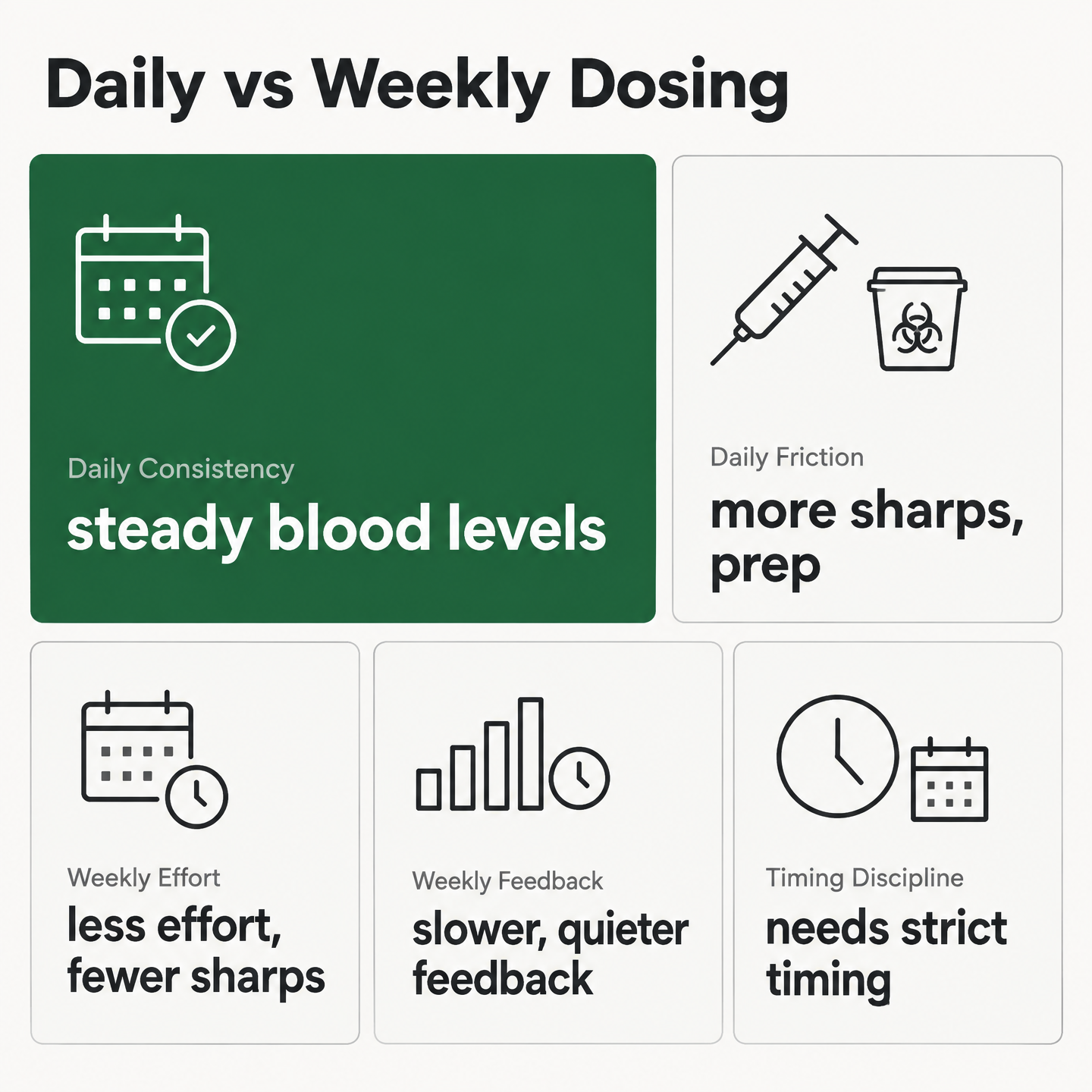
Daily wins consistency, taxes your routine
The upside of a daily rhythm may be control. You may cut the risk of wide troughs between shots, which may help when a tissue issue is active and the timeline is short.
The cost is friction. Daily injections mean more sharps, more prep, more tracking, and more chances to miss a night when life gets busy. The burden may compound. What feels easy for a week can feel intrusive after several.
Daily dosing may also put more pressure on injection-site rotation, since frequent sticks in the same spot can irritate tissue. Something to plan for, not ignore.
Weekly fits maintenance, slows the feedback
Weekly and split-weekly schedules may cut administrative drag. That’s the pro: less effort, fewer sharps, a protocol that may fit around work, travel, and training.
The con may be patience. Spread-out dosing may give slower, quieter feedback. You may not feel a sharp early shift the way some daily users report. For someone chasing an acute fix, that lag can feel like nothing’s happening.
Weekly dosing may also demand better planning. Fewer anchor points may mean sloppy timing stands out more. Put the dose on a day you can repeat, not on whatever day happens to be convenient.
| Factor | Daily Dosing | Weekly / Split-Weekly | Our Approach at BiohackNow |
|---|---|---|---|
| Best for | Acute injury windows | Longevity maintenance | Personalized protocols |
| Effort | High (nightly) | Low (1–2x/week) | Matched to your goal |
| Feedback speed | Faster | Slower, cumulative | Tracked against your markers |
| Routine fit | Demands consistent timing | Easier around real life | Tailored to your goal |
| Dose spacing | Daily administrations | Weekly or split-weekly administrations | Screened per client |
At BiohackNow we aim to build every protocol around your data and goals, tracking core biomarkers to help guide the cadence instead of defaulting to a fixed schedule. That’s the judgment piece a fixed calendar may not give you. Weekly rhythms may give each site more recovery time, but they raise the stakes on clean handling, correct reconstitution, and dependable cold storage. We aim to match the tempo to your goals and your handling habits, then adjust as your markers move.
Who Each Schedule Is Actually For
Picking the right rhythm gets easier once you match it to a real person with a real goal. The frequency question isn’t answered in the abstract. It’s answered by looking at who you are, what you’re repairing, and how much structure your routine can carry.
A few clear profiles keep showing up. Each may land on daily or weekly for a specific reason, and the reason usually ties back to urgency, adherence, and recovery timing.
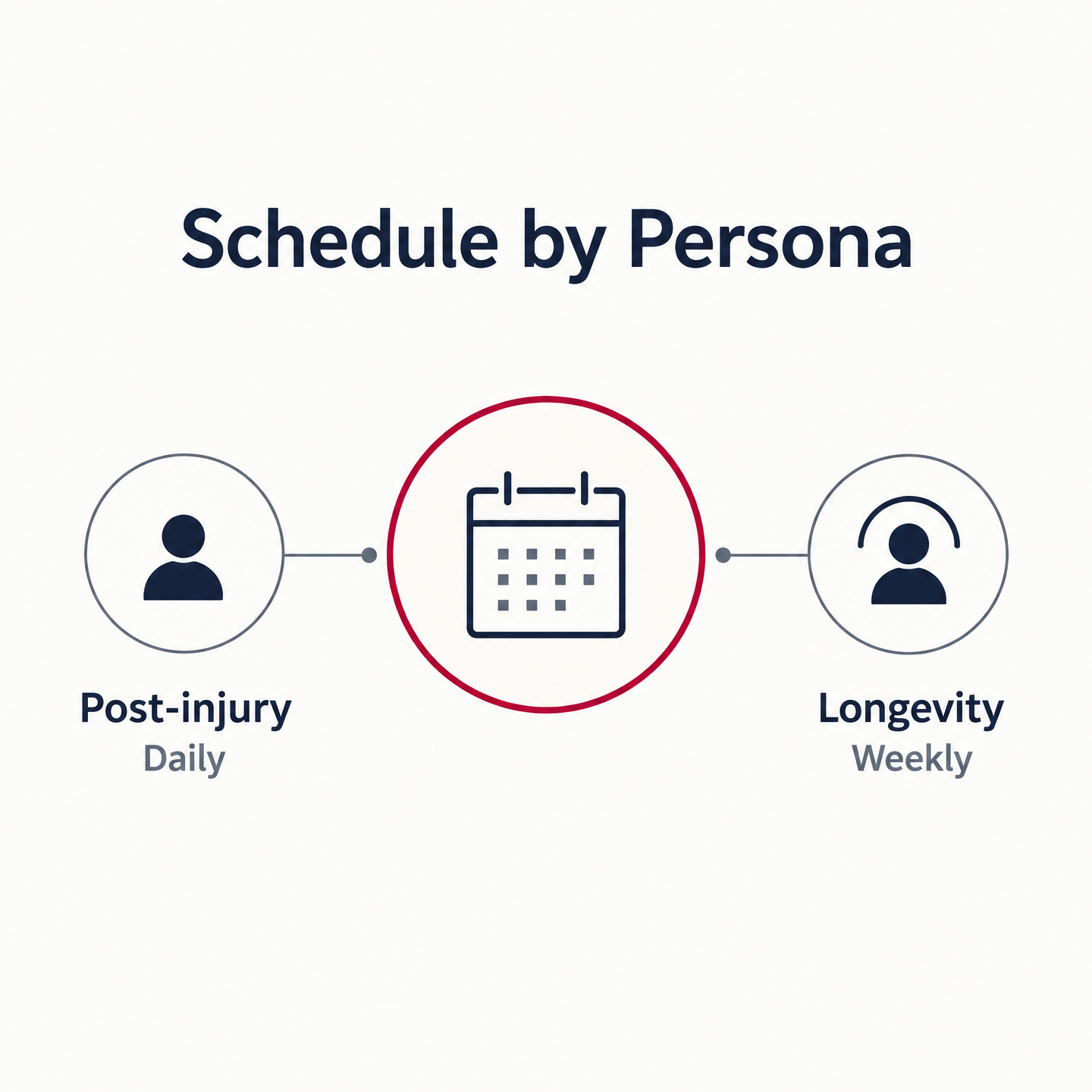
The acute injury belongs to daily
Inside a short healing window, daily may win. A new soft-tissue strain, a post-surgical stretch, or a flared-up joint may benefit from steady support while the tissue is actively rebuilding.
This may be a weeks-long commitment, not a lifestyle. Once the acute demand calms, most people may step down rather than live on a high-frequency plan forever. If your goal is general maintenance, daily may not be necessary. You may spend more effort and more sharps than the payoff justifies.
The longevity client runs on a weekly clock
Weekly and split-weekly rhythms may fit people who aren’t chasing a fast fix. The professional or athlete managing accumulated wear, trying to keep tissue quality holding over years. The point may not be to feel busy every night. It is to design a rhythm you can actually keep.
Sustainability may be the whole game here. People focused on longevity may tend to prefer fewer administrations because the schedule respects real life. Room for travel, recovery days, and adjustments without the protocol turning into a second job.
There’s a real trap worth naming. Somewhere along the way, biohacking can quietly turn into shopping. It gets easy to drift from doing the things that move the needle to just adding more, because adding more feels sophisticated. Running daily doses for a maintenance goal may be exactly that mistake.
| User Profile | Primary Goal | Better Rhythm | Why |
|---|---|---|---|
| Post-injury / post-surgical | Fast tissue repair | Daily (evening) | May support steady levels during active healing |
| Longevity maintenance | Preserve tissue over years | Weekly / split-weekly | May align with overnight recovery, low friction |
| High-frequency traveler | Consistency without daily admin | Split-weekly | Fewer injection days, portable |
| BiohackNow consultation client | Personalized wellness protocol | Weekly, individually reviewed | Schedule set through a consultation, not a generic calendar |
We lean toward that last row for people playing the long game. Personalized, biomarker-guided protocols may be set through a consultation, not the same calendar handed to everyone.

The decision comes down to three honest questions. How urgent is the repair? How much daily admin can you tolerate? And does your goal call for a burst or a slow, steady hold? Answer those and the schedule may pick itself.
The Bottom Line on Wolverine Stack Frequency
So where does this leave you? The answer isn’t a single number. It is a match between your repair goal and the clock your body may already run. Daily for the sprint, weekly for the long game.
One idea keeps surfacing with our precision-medicine clients: a schedule built around your biology may beat one that just feels productive. If you’re matching cadence to real recovery demand, you’re already ahead of the person injecting on autopilot.
Which one should you actually pick
Pick daily when the clock is against you. A fresh injury, a tight rehab window, a deadline to get back to training. You may want a more consistent short-term input, and you may trade routine friction for speed.
Pick weekly or split-weekly when you’re playing for years. Maintenance, joint longevity, general resilience, all of it may reward a spread-out rhythm. Fewer injections and less daily overhead may make the protocol easier to repeat, month after month.
The two rhythms at a glance
| Decision Factor | Daily Dosing | Weekly / Split-Weekly |
|---|---|---|
| Best goal | Acute injury, short rehab window | Longevity, joint maintenance |
| Speed to felt results | Faster | Slower, steadier |
| Timing | Nightly, tightly timed | Spread across fewer dosing days |
| Routine effort | High | Low |
| Staying power | May fade if you stop | May hold between doses |
Read the table as a fork, not a scoreboard. Neither column wins outright. The winner is whichever row matches the question you walked in with.
Where our protocol fits
We aim to build peptide programs around each client’s data. For longevity clients who want a weekly or split-weekly rhythm, our team can tailor the protocol to your biomarkers instead of handing you a generic frequency and wishing you luck. That may be data-driven, personalized maintenance for people optimizing over the long haul.
If you’re managing a sharp, acute injury on your own tight timeline, a straightforward daily protocol may serve you fine without any of that structure. We’d rather say so than upsell a program you don’t need.
One last practical note before you commit. Whatever tempo you choose, the fundamentals may still decide your results: proper reconstitution, cold storage between doses, and rotating injection sites so no single spot takes the repeated load. A great schedule may lose its edge fast if the handling is sloppy, and those basics may matter more the longer the program runs.
The rest is matching tempo to biology. Get it right and the protocol has a reason to exist. Get it wrong and you’re just paying for the wrong schedule.
Frequently Asked Questions
Can I start on a daily schedule and switch to weekly once my injury heals?
Yes. Many people may use the more intensive cadence during the active repair phase, then reduce frequency once the issue has stabilized. The key is not to treat the initial schedule as permanent just because it helped early on.
What actually happens if I miss a weekly dose?
You lose the rhythm the plan was built around. If that happens once, get back on schedule rather than doubling up impulsively. If it happens often, the protocol may be too fragile for your actual routine.
Why does BPC-157 need daily dosing while TB-500 works twice weekly?
They are often described as not persisting in the body the same way. The scheduling difference may come from that reported mismatch: one is usually managed with closer spacing, while the other is often allowed more room between administrations. Human pharmacokinetic data are limited.
Does injection-site rotation matter more on a daily schedule?
Yes. Higher-frequency injections may make poor site rotation show up sooner as soreness, irritation, or repeated stress in the same area. A weekly schedule may lower that pressure, but sterile technique and proper storage still matter.
Is a daily schedule always better since it delivers peptide more often?
No. More frequent administration may be useful when the repair demand is urgent, but it may become unnecessary overhead during maintenance. The better schedule is the one that fits the goal, not the one with the most injections.
How does my sleep pattern change which schedule works for me?
Consistent sleep may make timing easier. If your nights are unpredictable, it may help to build the protocol around the recovery windows you can realistically protect rather than assuming every evening is equally useful.
Is either schedule safe if I compete under anti-doping rules?
No. If you compete under rules that prohibit these compounds, changing the frequency does not solve the problem. Eligibility comes before protocol design.
How does BiohackNow decide which cadence fits me instead of using a fixed number?
BiohackNow may start with your goals, health data, recovery pattern, and biomarkers. From there, the cadence can be individualized and adjusted over time instead of being copied from a generic dosing calendar.
Free 15-Minute Discovery Call
Ready to take the guesswork out of your health?
Book a free 15-minute call with Monika to talk through your goals, what testing makes sense for you, and the right next step. No pressure, just clarity.
Book Your Free CallFor educational purposes only. Not medical advice.