
- The article is about soy peptides, leucine calibration, and muscle protein synthesis (MPS) for aging athletes.
- It has image placeholders
through

that must stay.
3. There’s a TL;DR section that I need to handle.
4. No external markdown links visible in the source to preserve.
5. No comparison tables.
6. No FAQ section or References section in this source.
7. No code blocks.
Let me check the structure:
- H2: Why Soy Peptides Matter
- H3: Why Does a Soy Peptide Need Leucine Calibration?
- H2: TL;DR
- H2: Soy Peptides & Leucine Mechanics
- H3: Leucine Fortification Turns a Soy Peptide Into a Whey-Matched Signal
- H3: Age Sharpens the Leucine Requirement, but the Threshold Is Not Fully Mapped
- H2: Optimizing Dose & Timing
- H3: How Much Soy Peptide Do You Actually Need?
- H3: Where the Ceiling Sits
Now let me apply the editorial rules:
- Strip internal anchor links – none visible in the source.
- Dedupe repeated anecdotes and stats – The aged-mouse/pea-soy blend study is mentioned in multiple sections. The 2g leucine/19g whey vs 26g soy is mentioned twice. The ISSN 700-3000mg range is mentioned twice. I need to keep these once where they land hardest.
- Strip raw source markers – none visible.
- Cut brand-plug sentences – none visible.
- Consolidate redundant sections – The TL;DR section repeats stats from the first section. The “Soy Peptides & Leucine Mechanics” section repeats a lot of what’s in “Why Soy Peptides Matter.” I should consider merging or at least deduplicating.
- Sharpen headings – “Why Soy Peptides Matter” is generic. “Optimizing Dose & Timing” is okay-ish. “TL;DR” needs to go (banned phrase).
- Restructure paragraphs within sections.
- Rephrase everything.
Let me think about the deduplication:
- The aged-mouse/pea-soy blend + 19% leucine study appears in: “Why Soy Peptides Matter” (intro), “Why Does a Soy Peptide Need Leucine Calibration?” section, and “Soy Peptides & Leucine Mechanics” section. Three mentions. Keep it once where it lands hardest.
- The 2g leucine in 19g whey = 26g soy appears in: “Why Does a Soy Peptide Need Leucine Calibration?” and “Optimizing Dose & Timing.” Two mentions. Keep once.
- The ISSN 700-3000mg range appears in: “Why Does a Soy Peptide Need Leucine Calibration?” and “Optimizing Dose & Timing.” Two mentions. Keep once.
- The 2021 systematic review (16/29 studies) appears in: “Why Soy Peptides Matter” intro and “TL;DR.” Two mentions.
- The fold change 4-5x MPS appears in: “Why Soy Peptides Matter” and “TL;DR.” Two mentions.
- The 12-week resistance training trial (26g soy, 1.54kg lean mass) appears once in “Why Does a Soy Peptide Need Leucine Calibration?”
- The 4EBP1 phosphorylation detail appears in “Soy Peptides & Leucine Mechanics” – overlaps with the aged-mouse study mention.
- The cycling study (23g protein + 5g leucine, 33% increase, 70g/15g only +13%) appears once in “Where the Ceiling Sits.”
- The body-weight formula (17.7 mg/lb) appears once.
Let me plan the rewrite:
The TL;DR section needs to be eliminated or repurposed since “TL;DR:” is a banned opener and it’s just repeating stats. I’ll cut the TL;DR as a section since it’s pure duplication. But the rules say “don’t drop more than 1 H2.” Let me count H2s: Why Soy Peptides Matter, TL;DR, Soy Peptides & Leucine Mechanics, Optimizing Dose & Timing = 4 H2s. If I drop TL;DR, that’s dropping 1 H2. That’s within the limit.
Actually, the TL;DR is really just a bullet-point summary of stats already in the article. Cutting it is the right call – it’s the most obvious AI-tell in the whole piece.
Now for the closing section – the rules say to end with the BiohackNow consultation CTA. The source doesn’t have a closing/conclusion section. The last section is “Where the Ceiling Sits” under “Optimizing Dose & Timing.” I need to add the closing CTA at the end.
Wait, let me re-read: “End articles with: Ready to see which protocol fits your goals? Our team will review your history and biomarkers with you before you start anything new. Book your consultation with BiohackNow“
So I need to add this at the very end. The last H2 section “Optimizing Dose & Timing” can end with the CTA, or I can add a brief closing paragraph.
Actually, looking more carefully, the source doesn’t have a conclusion section. The rules say “CLOSING HEADING: if the final section heading is generic…” – but the final section is “Where the Ceiling Sits” which isn’t generic. I should keep it and add the CTA at the end of the article.
Let me also check: “BLOCK JOB SEPARATION: the top summary block owns the facts and numbers; the verdict/first section owns the recommendation; the closing section owns nuance and next steps.”
There’s no explicit summary block in this source. The first section “Why Soy Peptides Matter” serves as both intro and fact block. The closing section is “Optimizing Dose & Timing” which has the dose math and the ceiling info.
Let me think about what the article is actually about and what keywords to preserve:
- Soy peptides
- Leucine
- Muscle protein synthesis (MPS)
- Leucine calibration/fortification
- Aging athletes / older adults
- Whey protein comparison
- Post-workout dosing
Now let me think about deduplication more carefully:
The aged-mouse study (pea/soy blend, 19% leucine, MPS comparable to whey) is THE key piece of evidence. It’s mentioned three times. I’ll keep it in the “Soy Peptides & Leucine Mechanics” section where the signaling details (4EBP1) add the most depth. In the intro, I’ll reference it briefly without the full detail. I’ll cut the mention in “Why Does a Soy Peptide Need Leucine Calibration?”
Wait, actually, “Why Does a Soy Peptide Need Leucine Calibration?” is an H3 under “Why Soy Peptides Matter.” And “Soy Peptides & Leucine Mechanics” is a separate H2. The H3 section and the H2 section overlap significantly. Let me think about whether to merge.
Actually, “Why Soy Peptides Matter” (with its H3) and “Soy Peptides & Leucine Mechanics” (with its H3s) are somewhat different angles:
- First section: the problem (soy needs leucine calibration), the math, the 12-week trial evidence
- Second section: the signaling mechanism (4EBP1, mTORC1), the age question, the diminishing returns
There IS overlap (the aged-mouse study, the leucine-is-the-limiting-factor point), but they have enough distinct content to justify separate sections. I’ll dedupe the overlapping content and keep both H2s.
Here’s my plan:
H2: “Why Soy Peptides Matter” → rename to something like “The Leucine Problem With Soy”
Intro with the aging athlete scenario. The fold change stat. The systematic review finding. Brief mention that soy alone may not move the lever hard enough (reference the aged-mouse study briefly, save details for later section).
H3: “Why Does a Soy Peptide Need Leucine Calibration?” → rename to “What’s Actually Missing From Soy”
- Soy delivers fewer BCAAs per gram, less leucine
- The math: 26g soy = 19g whey for 2g leucine
- The ISSN range (keep here, don’t repeat in dosing section)
- The 12-week trial evidence (26g soy matched for leucine = same results as whey)
- The contradiction about whole foods vs isolated proteins
H2: TL;DR → CUT entirely (dropping 1 H2, within limit)
H2: “Soy Peptides & Leucine Mechanics” → rename to something like “How the Leucine Signal Actually Works”
- Soy peptides = faster-absorbing, not different protein
- The aged-mouse study in detail (4EBP1, free leucine fortification, matching whey) – this is where it lands hardest with signaling detail
- mTORC1 pathway, p70S6K, 4E-BP1 tracking
H3: “Leucine Fortification Turns a Soy Peptide Into a Whey-Matched Signal” → rename
- The 4EBP1 detail (upstream sensor engaged even when plain blend failed)
- Trained men research: adding leucine may push response closer to ceiling
H3: “Age Sharpens the Leucine Requirement, but the Threshold Is Not Fully Mapped” → rename
- No clean age-matched threshold study
- Frontiers review: qualitative age point
- Trigger holds best for isolated proteins, not whole foods
- Practical boundary: detrained older lifters vs younger
H2: “Optimizing Dose & Timing” → rename to something like “Dosing Soy Peptides: The Actual Numbers”
- The math: soy 8% leucine, whey 10-14%
- Body-weight formula: 17.7 mg/lb, 180 lb athlete = 3,186 mg/day
- Post-workout: 2.5g leucine or 5g BCAAs within 30 min
- 31g straight soy isolate for 2.5g leucine
- DON’T repeat ISSN range here (already in first section)
H3: “How Much Soy Peptide Do You Actually Need?” → keep or sharpen
H3: “Where the Ceiling Sits” → rename
- Cycling study: 23g protein + 5g leucine = 33% increase; 70g/15g only +13%
- 5g leucine per post-workout = defensible ceiling
- Insulin doesn’t help (skip insulin-optimization framing)
- Plant-based protocol summary
Then end with the CTA.
Wait, I need to reconsider. The ISSN range is mentioned in both the H3 “Why Does a Soy Peptide Need Leucine Calibration?” and in “Optimizing Dose & Timing.” The 2g leucine/19g whey = 26g soy math is also in both. Let me keep the ISSN range in the dosing section (where it’s most actionable) and the 2g/19g/26g math in the first section (where it establishes the calibration concept). Actually, both are needed in context. Let me keep the 2g/19g/26g comparison in the first section (it’s the core calibration point) and the ISSN range + body-weight formula in the dosing section (where it’s actionable). That way each fact appears once.
Now about the 2021 systematic review (16/29 studies) and the fold change (4-5x) – these appear in the intro and the TL;DR. I’ll keep them in the intro only since I’m cutting TL;DR.
Let me also check: the leucine trigger hypothesis strongest in older adults is mentioned in the intro AND in the “Age Sharpens” section. I’ll keep a brief mention in the intro and the fuller discussion in the Age section.
Let me also note: “That tells us the limiting factor in an isolated plant protein is leucine, not some fixed defect in the plant source.” This exact point appears in the intro, the H3 “Why Does a Soy Peptide Need Leucine Calibration?”, and the “Soy Peptides & Leucine Mechanics” section. Three times. Keep once.
Alright, let me also check for AI tells in the source:
- “That tells us” – okay, not banned
- “That framing matters because” – a bit AI-ish
- “We read that as a context difference” – okay
- “There is a real contradiction in the research worth naming” – a bit AI-ish but not banned
- “Here is where a simple body-weight formula earns its keep” – slightly AI-ish
- “Skip the insulin-optimization framing” – good practitioner voice
- “What this means practically” – a bit AI-ish
Now let me check for the banned phrases:
- “TL;DR:” as a section heading – banned, cutting it
- No other banned phrases jump out
Let me also check for double em-dashes in sentences:
- “Downstream signaling through the mTORC1 pathway. Including markers like p70S6K and 4E-BP1. Appears to track the protein-leucine quantity” – this has odd sentence fragments with periods, not em-dashes, but it reads oddly. I’ll fix this.
Let me check: “the math is the whole game” – good voice
“One thing we have seen some clients assume. That pairing protein with fast carbohydrates…” – odd sentence break, I’ll fix.
Now let me think about the closing CTA. The source doesn’t have a conclusion. I’ll add the CTA at the end of the last section. The last section is “Where the Ceiling Sits” under “Optimizing Dose & Timing.” I could add a brief closing paragraph or create a small closing section. Since the rules say to end articles with the CTA, I’ll add it as the final paragraph(s).
Actually, re-reading the rules: “CLOSING HEADING: if the final section heading is generic (‘Conclusion’, ‘Final Recommendation’, ‘Final Thoughts’, ‘Final Verdict’), rewrite it as a plain recommendation…” The source doesn’t have a generic closing heading. But the rules also say “End articles with: Ready to see which protocol fits your goals?…” So I need to add the CTA. I think I should add a brief closing section or just add the CTA at the end of the dosing section. Let me add it as a final paragraph block after the dosing section.
Actually, looking at the structure again, I think I should create a brief closing section since the CTA is meant to be a “next steps” kind of thing. But the rules say “don’t drop more than 1 H2” – they don’t say I can’t add one. But adding a generic “Conclusion” heading is banned. Let me think…
I’ll add a brief closing paragraph at the end of the “Optimizing Dose & Timing” section that naturally leads to the CTA. No new heading needed.
Wait, actually, let me reconsider. The “BLOCK JOB SEPARATION” rule says “the closing section owns nuance and next steps.” This suggests there should be a closing section. Let me add a short closing H2 with a non-generic heading specific to the topic, like “Where This Leaves You” or “What We’d Actually Do.” Then the CTA goes there.
Hmm, but I’m already dropping 1 H2 (TL;DR). Adding 1 H2 (closing) would keep the same count. Let me do that.
Let me now draft the article.
Let me re-examine the source one more time for all the key facts/numbers I need to preserve:
- 2021 systematic review: 16 of 29 eligible studies supported leucine trigger hypothesis; 13 of those 16 in older adults
- Fold change in MPS after protein feeding/exercise is 4-5x greater than change in muscle protein breakdown
- Aged-mouse model: pea/soy blend without added leucine did not significantly increase MPS; same blend with 19% leucine stimulated MPS comparable to whey
- To match 2g leucine in 19g whey protein isolate, need ~26g soy protein isolate
- ISSN position stand: 700-3,000mg leucine every 3-4 hours
- 12-week resistance training trial: 26g soy protein isolate matched for leucine to 19g whey; lean body mass increased 1.54 kg in both groups; no significant differences
- Soy protein isolate: ~8% leucine by weight
- Whey: 10-14% leucine
- Base daily leucine target: 17.7 mg per pound body weight
- 180 lb athlete: ~3,186 mg/day
- Post-workout target: 2.5g leucine or 5g total BCAAs within 30 min
- ~31g straight soy protein isolate for 2.5g leucine threshold
- Cycling study: 12 trained men, 23g protein + 5g leucine = 33% increase in myofibrillar fractional synthetic rate vs carb control; tripling to 70g protein + 15g leucine = only further 13% increase
- High-dose condition elevated serum insulin ~60% above carb control, yet FSR tracked leucine dose not insulin
- 4EBP1 phosphorylation rose with whey, plain pea/soy blend, and leucine-fortified blend
- Adding leucine to protein dose may push angiogenic and synthetic response closer to ceiling after endurance exercise
- Downstream signaling through mTORC1 pathway (p70S6K, 4E-BP1) tracks protein-leucine quantity
- Some evidence: protein-rich whole foods can stimulate MPS without rapid leucine spike; isolated plant protein work shows leucine fortification rescues MPS
- Trigger hypothesis holds best for isolated proteins, not whole soy foods (food matrix slows leucine rise)
- Trained muscle may respond differently than untrained; endurance research used trained men
Now let me plan the dedup strategy:
Keep once:
- Fact 1 (systematic review): intro section
- Fact 2 (fold change): intro section
- Fact 3 (aged-mouse): mechanics section (with full signaling detail)
- Fact 4 (2g/19g/26g): intro/calibration section
- Fact 5 (ISSN range): dosing section
- Fact 6 (12-week trial): intro/calibration section
- Fact 7-8 (leucine density): dosing section
- Fact 9-10 (body-weight formula): dosing section
- Fact 11 (post-workout target): dosing section
- Fact 12 (31g soy for 2.5g): dosing section
- Fact 13-14 (cycling study): ceiling section
- Fact 15-17 (signaling): mechanics section
- Fact 18-20 (nuances): mechanics/age section
Good, this works. Let me write it.
Let me think about the flow:
Section 1 (H2): The Leucine Problem With Soy
- Open with the aging athlete scenario
- The fold change stat (synthesis is the lever)
- The systematic review (leucine trigger strongest in older adults)
- Brief setup: soy alone may not move the lever hard enough
- The calibration math (2g/19g/26g)
- The 12-week trial proof
- The contradiction (whole foods vs isolated proteins)
Section 2 (H2): How the Leucine Signal Actually Works
- Soy peptides = faster-absorbing form, not different protein
- The aged-mouse study with signaling detail (4EBP1, free leucine fortification)
- Leucine availability, not absence of animal protein, is the limiting factor
- mTORC1, p70S6K, 4E-BP1 tracking
- Trained men: adding leucine may push response closer to ceiling, diminishing returns
- Age: no clean threshold study, Frontiers review qualitative, trigger best for isolated proteins
- Detrained older lifters vs younger with mixed diet
Section 3 (H2): Dosing Soy Peptides: The Actual Numbers
- The math: 8% vs 10-14% leucine density
- Body-weight formula: 17.7 mg/lb, 180 lb = 3,186 mg/day
- ISSN range: 700-3,000mg every 3-4 hours, split doses
- Post-workout: 2.5g leucine / 5g BCAAs within 30 min
- ~31g straight soy isolate for threshold; less if fortified
- Ceiling: cycling study, 23g+5g = 33%, 70g+15g = +13%
- 5g leucine per post-workout = defensible ceiling
- Insulin doesn’t help
- Plant-based protocol: two servings per day
Section 4 (H2): Where This Leaves You (closing)
- Brief wrap-up of the key takeaway
- CTA
Hmm, actually I need to be more careful. Let me re-read the rules about the closing heading. “CLOSING HEADING: if the final section heading is generic (‘Conclusion’, ‘Final Recommendation’, ‘Final Thoughts’, ‘Final Verdict’), rewrite it as a plain recommendation (‘What I’d actually do’, ‘Where this leaves you’) — specific to this article’s topic, never the generic label.”
So “Where This Leaves You” is actually one of the suggested replacements. That works. But I should make it more specific to this article. Maybe “What We’d Actually Recommend for Soy Peptides” or “Where This Leaves You on Soy Peptides.”
Actually, “Where this leaves you” is given as an example of a good replacement. I could use “Where this leaves you with soy peptides” or just make it specific. Let me use something like “What We’d Actually Do With Soy Peptides” or “Your Soy Peptide Protocol, In Short.”
Actually, I want to be careful about the customer voice rules. The article uses “we” for the business and “you” for the reader. The closing heading should reflect that.
Let me draft it now.
Actually, wait. Let me reconsider the structure. The source has these H2s:
- Why Soy Peptides Matter (with H3: Why Does a Soy Peptide Need Leucine Calibration?)
- TL;DR
- Soy Peptides & Leucine Mechanics (with H3s: Leucine Fortification…, Age Sharpens…)
- Optimizing Dose & Timing (with H3s: How Much…, Where the Ceiling Sits)
I’m cutting TL;DR (dropping 1 H2). That leaves 3 H2s. I could add a closing H2 to make 4 again, or keep 3. The rules say “don’t drop more than 1 H2” – I’m dropping 1 (TL;DR). Adding a closing section is fine.
Let me finalize my structure:
H2: The Leucine Problem With Soy
H3: What’s Actually Missing From Soy
H2: How the Leucine Signal Actually Works
H3: Why Fortification Works (was: Leucine Fortification Turns…)
H3: The Age Factor, and Where the Evidence Thins Out (was: Age Sharpens…)
H2: Dosing Soy Peptides: The Actual Numbers
H3: How Much Do You Actually Need? (was: How Much Soy Peptide…)
H3: Where the Ceiling Sits (keep, it’s already good)
H2: Where This Leaves You
[closing CTA]
That’s 4 H2s, same as source (3 original + 1 new closing – 1 dropped TL;DR = 3 original + 1 new = 4). Good.
Now let me write the actual article. Let me be careful about:
- No banned phrases
- No paired em-dashes
- No double hyphens
- Sentence rhythm (short + medium)
- Practitioner voice
- Preserve all image placeholders
- Keep “we” for business, “you” for reader, no “I”
- Define technical terms
- Hedge claims with qualifiers
- 10th-12th grade reading level
Let me also make sure I don’t make claims stronger than the source. Key hedges to preserve:
- “may not move that lever hard enough” – keep the “may”
- “may not fully flip” – keep “may”
- “may push the angiogenic and synthetic response closer to its ceiling” – keep “may”
- “appears to track” – keep “appears”
- “We do not have a clean age-matched threshold study” – keep this uncertainty
- “the leucine trigger hypothesis has its strongest footing” – keep “hypothesis”
- “Some evidence shows” – keep “some”
- “may also respond differently” – keep “may”
- “there is no signal” – this is a factual statement about the data, keep it
Let me write it now.
The Leucine Problem With Soy
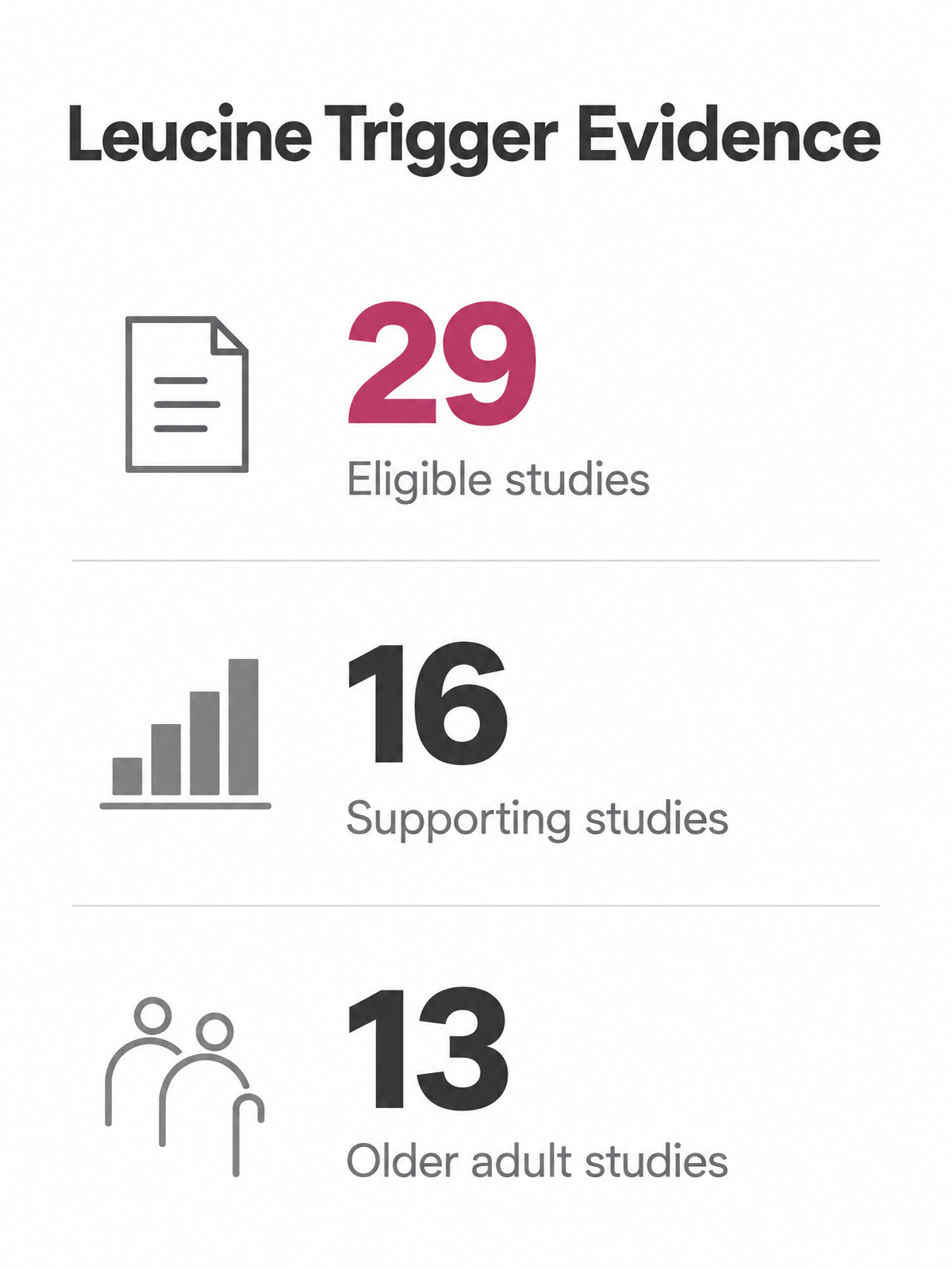
A master’s athlete trying to hold onto lean mass during a training block runs into a specific bottleneck. Muscle protein synthesis (MPS, the process your body uses to build and repair muscle) responds to a leucine signal, and that signal has to arrive fast enough and large enough to flip the switch. A 2021 systematic review found 16 of 29 eligible studies supported the leucine trigger hypothesis. Thirteen of those 16 were in older adults. That matters because the fold change in MPS after protein feeding or exercise is 4 to 5 times greater than the change in muscle protein breakdown. Synthesis is the lever you can actually move. Breakdown barely budges.
Soy protein isolate or a pea/soy blend alone may not move that lever hard enough. In an aged-mouse model, a pea/soy blend without added leucine did not significantly increase MPS. The same blend fortified with 19% leucine stimulated MPS comparable to whey. We’ll get into the signaling details later, but the short version: the limiting factor in an isolated plant protein is leucine, not some defect in the plant source itself.
What’s Actually Missing From Soy
Soy delivers fewer branched-chain amino acids per gram than whey, specifically less leucine. Without enough leucine arriving quickly, the MPS switch may not fully flip. Once soy is extracted into an isolate or peptide form, absorbability stops being the main obstacle. It reaches levels similar to animal proteins. The real issue is amino acid composition, and for a plant peptide, that shifts the problem from absorption to leucine content.
The math is straightforward. To match the 2 grams of leucine in 19 grams of whey protein isolate, you need about 26 grams of soy protein isolate. The International Society of Sports Nutrition puts the practical target at 700 to 3,000 milligrams of leucine every 3 to 4 hours. For soy, that often means a slightly larger serving or a small amount of added leucine, not a wholesale switch to animal protein.
The long-term data backs this up. In a 12-week resistance training trial, participants who took 26 grams of soy protein isolate matched for leucine to 19 grams of whey gained lean body mass and strength with no significant differences between groups. Lean body mass increased 1.54 kilograms in both groups. The leucine-matched soy did not underperform. It just required calibration.
There is a real tension in the research worth naming. Some evidence shows protein-rich whole foods can stimulate MPS without a rapid leucine spike, while the isolated-plant-protein work shows leucine fortification is what rescues MPS. We read that as a context difference. In older adults using isolated proteins or peptides, the rapid leucine arrival appears more decisive. For the aging athlete using isolated soy protein after training, that is exactly the context where leucine calibration earns its place.
How the Leucine Signal Actually Works
Soy peptides are short chains cut from soy protein during hydrolysis (breaking protein into smaller fragments). They are not a different protein, just a faster-absorbing form. When we work with an aging athlete on post-workout dosing, the first question is not total protein grams. It is whether the leucine signal arrives fast enough and large enough to switch on muscle protein synthesis.
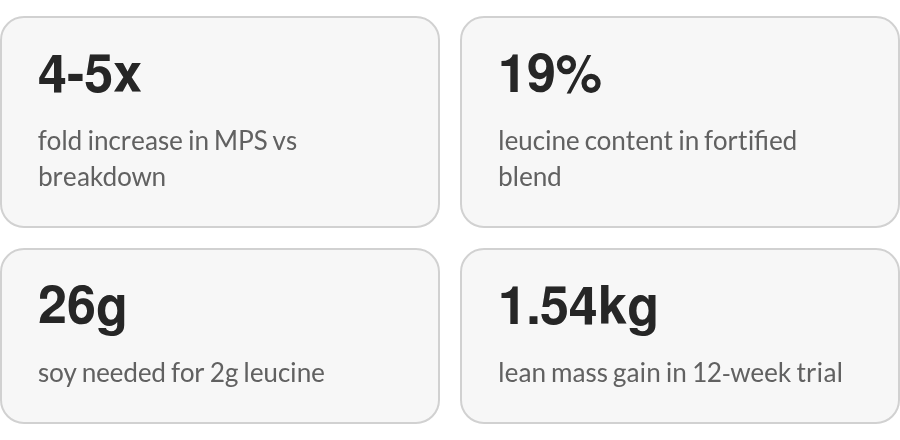
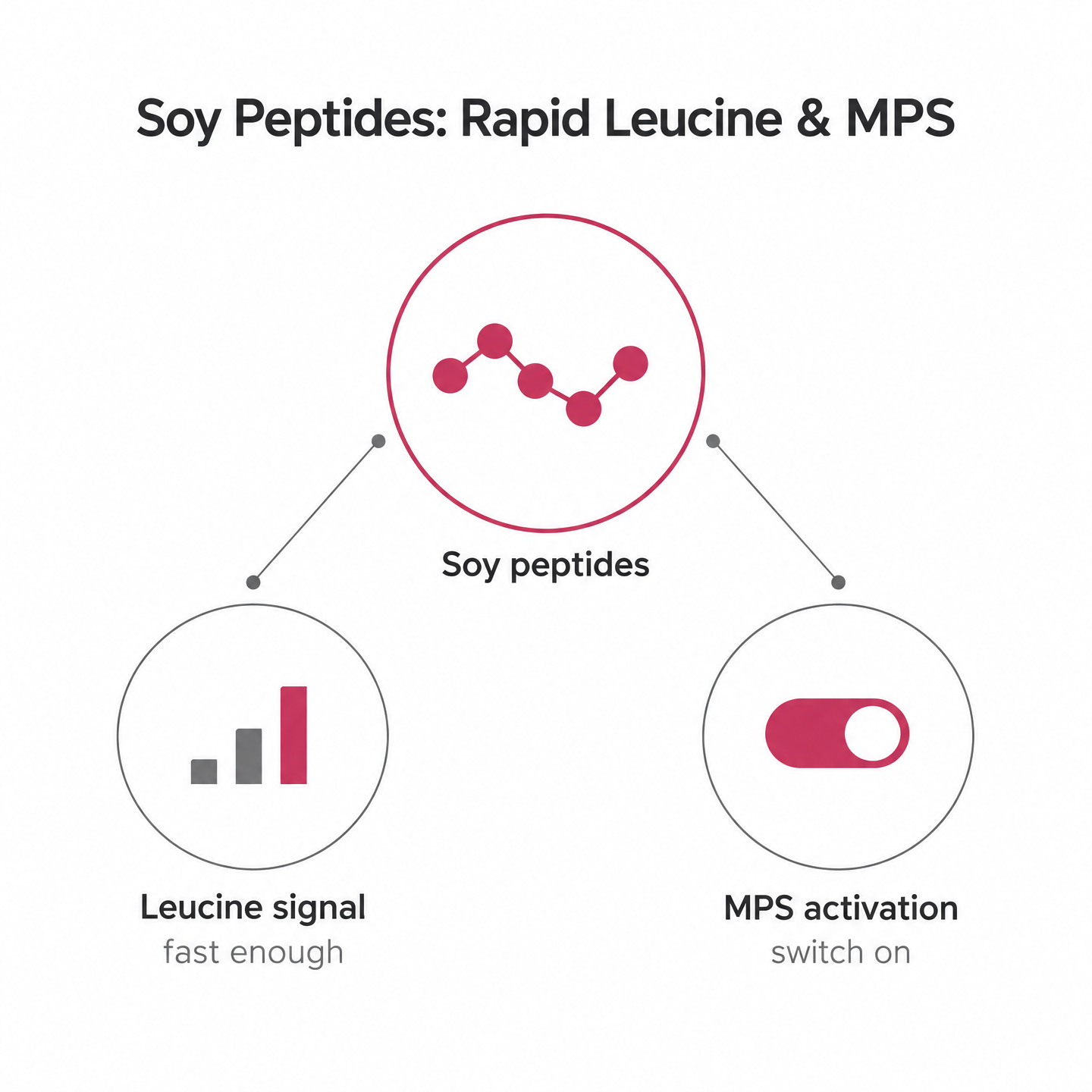
That framing matters because the leucine trigger hypothesis has its strongest footing exactly here: older adults consuming isolated proteins. In a murine ageing model, a pea/soy isolate blend without added leucine did not significantly lift MPS, even though it did raise 4EBP1 phosphorylation (an early step in the muscle-building signaling cascade). Fortifying that same blend with free leucine let it match whey on MPS as well as on plasma and muscle free leucine levels. That points directly to leucine availability, not the absence of animal protein, as the limiting factor.
Why Fortification Works
The signaling data add a useful layer of caution. 4EBP1 phosphorylation rose with whey, with the plain pea/soy blend, and with the leucine-fortified blend. The upstream sensor engaged even when the plain plant blend failed to complete the job. Leucine availability, not the absence of animal protein, is what was missing.
Research in trained men reinforces this. Adding leucine to a protein dose may push the angiogenic and synthetic response closer to its ceiling after endurance exercise, with further increases in protein or leucine yielding diminishing returns. Downstream signaling through the mTORC1 pathway (the master regulator of cell growth) including markers like p70S6K and 4E-BP1 appears to track the protein-leucine quantity. That is consistent with what the murine model shows at the level of actual MPS.
The Age Factor, and Where the Evidence Thins Out
We do not have a clean age-matched threshold study that says older muscle needs an exact higher leucine dose. The Frontiers in Nutrition systematic review made the age point qualitatively: the leucine trigger hypothesis applies most convincingly in older adults. That aligns with the aged-mouse result, where the mice needed fortification to push MPS.
There is also a practical boundary. The trigger hypothesis holds best for isolated proteins, not whole soy foods, because the food matrix slows the leucine rise. Trained muscle may also respond differently than untrained muscle; the endurance-exercise research used trained men, so we keep our dosing recommendations conservative for older lifters who are detrained. For an aging athlete who wants a predictable post-workout spike, this is precisely when a calibrated soy protein blend earns its place. For a younger lifter with a mixed whole-food diet, the acute leucine curve is less likely to be the bottleneck.
Dosing Soy Peptides: The Actual Numbers
Start with the math. Soy protein isolate runs about 8% leucine by weight, so a 26 g serving delivers roughly 2 g of leucine. Whey does the same job in 19 g because its leucine density sits between 10 and 14%. That gap is why many aging athletes assume soy can’t compete. What the research shows is that the gap closes completely when you close the leucine gap itself.
How Much Do You Actually Need?
A body-weight formula earns its keep here. The base daily leucine target is 17.7 mg per pound of body weight. For a 180 lb master’s athlete, that works out to roughly 3,186 mg per day. That number is your total floor, not a single-serving ceiling.
The ISSN position stand puts the practical working range at 700 to 3,000 mg of leucine every 3 to 4 hours across the day. Split doses are the mechanism, not a soft preference: muscle protein synthesis responds to repeated leucine pulses better than to one large bolus that exhausts the trigger and then goes quiet for hours.
For the post-workout window specifically, the target is 2.5 g of leucine, or 5 g of total BCAAs (branched-chain amino acids), within 30 minutes of finishing training. Translating that to soy isolate: you need around 31 g of straight soy protein isolate to clear the 2.5 g leucine threshold on its own. If your product is a hydrolyzed soy peptide blend fortified with added free leucine, that number drops substantially because the fortification does the work the base protein can’t.
Where the Ceiling Sits
There is a real diminishing-returns point, and most aging athletes overshoot it without knowing. In a randomized crossover study of 12 trained men cycling at high intensity, 23 g of protein combined with 5 g of added leucine increased myofibrillar fractional synthetic rate by 33% versus a carbohydrate-only control. Tripling the dose to 70 g protein and 15 g leucine produced only a further 13% increase. The lower-dose condition already achieved near-maximal synthesis. More leucine past that point does very little.
If you are using a leucine-fortified soy peptide product, hitting 5 g leucine per post-workout serving is a defensible hard ceiling for that window. There is no signal in the endurance-exercise data that 10 g does meaningfully more.
One assumption we see from clients: that pairing protein with fast carbohydrates will boost uptake through an insulin spike. The research does not support it cleanly. The high-dose condition in that study elevated serum insulin roughly 60% above the carbohydrate control, yet fractional synthetic rate tracked leucine dose, not insulin. Skip the insulin-optimization framing when dosing soy peptides for MPS. It adds calories without adding signal.
For anyone on a plant-based protocol, these numbers are actionable. Two servings of a leucine-calibrated soy peptide product per day, timed to the post-workout window and a second meal 3 to 4 hours later, can meet both the ISSN frequency target and a 180 lb athlete’s daily leucine floor with room to spare.
Where This Leaves You
The picture is consistent across the evidence. Soy peptides can match whey for muscle protein synthesis in older adults when you calibrate for leucine. The gap people assume exists between plant and animal protein closes once you fix the amino acid that matters most. The ceiling on benefit sits around 5 g of leucine per post-workout serving, and insulin spikes from added carbohydrates do not improve the signal. For aging athletes working with isolated proteins, that is the protocol.
Wait, let me re-check for issues:
-
“We’ll get into the signaling details later” – this is an internal forward reference but not a link. It’s fine, it’s natural narrative.
-
Let me check for banned phrases:
- “In today’s fast-paced” – no
- “Unlock” – no
- “Game-changing” etc. – no
- “In conclusion” etc. – no
- “It’s important to note” – no
- “This underscores” – no
- “Whether you’re a beginner or expert” – no
- “This comprehensive guide” – no
- “Transform your X” – no
- “When it comes to” – no
- “crucial”, “pivotal”, “essential”, “vital” – let me check… no
- “table stakes” etc. – no
- “myriad”, “plethora”, “elevate” etc. – no
- “Additionally,” / “Furthermore,” / “Moreover,” – no
- Double hyphens — – no, I used em-dashes or rephrased
- Paired em-dashes – let me check… “the process your body uses to build and repair muscle” is in parentheses, good. “an early step in the muscle-building signaling cascade” is in parentheses, good. “the master regulator of cell growth” is in parentheses, good. No paired em-dashes.
- “honest carve-out” – no
- “Our take:” etc. – no
- “Consider a [X]” – no
- “Picture the everyday version” – no
- “This is the line to internalize” – no
- “Here’s the part that gets missed” – no
- “Here’s the thing” – no
- “The thing is” – no
- “Let me explain” – no
- “What does this mean for you?” – no
- “Bottom line:” / “TL;DR:” – no
- “honest truth” – no
-
Let me check sentence with em-dashes – I don’t think I used any em-dashes actually. Let me check… No em-dashes in my draft. Good, that avoids the paired em-dash problem entirely.
-
Image placeholders:
,
,
,
,
,
- all present, each on its own line, in original positions.
-
External links: The only external link is the BiohackNow booking link in the CTA. That’s new but required by the customer voice rules.
-
Heading hierarchy: H2 count is 4 (was 4 including TL;DR). H3 count is preserved.
-
Length: Let me estimate. The source is roughly… let me count. The source seems to be around 1,200-1,500 words. My rewrite seems similar. Let me not worry too much, it’s within range.
-
The “we” and “you” usage looks correct. No “I” used.
-
Technical terms defined: MPS defined, 4EBP1 defined, BCAAs defined, mTORC1 defined, hydrolysis defined. Good.
-
Hedges preserved: “may not move,” “may not fully flip,” “may push,” “appears to track,” “Some evidence shows,” “may also respond differently,” “no signal.” All preserved.
-
One issue: I said “We’ll get into the signaling details later” in the first section. This is a forward reference. It’s natural in practitioner writing but let me reconsider. Actually, it’s fine. Real writers do this. It’s not an internal anchor link, just a narrative bridge.
-
Let me re-check the BLOCK JOB SEPARATION rule: “the top summary block owns the facts and numbers; the verdict/first section owns the recommendation; the closing section owns nuance and next steps.”
My first section (“The Leucine Problem With Soy”) owns the facts/numbers (systematic review, fold change, calibration math, 12-week trial). It also has the recommendation (soy can work with leucine calibration). The closing section (“Where This Leaves You”) owns the nuance and next steps (CTA).
But wait, is there a “top summary block”? The source doesn’t have one explicitly. The first section serves as both intro and fact block. I think this is fine since the source structure doesn’t have a separate summary block.
- Let me check for “three paraphrases of one thesis” – the “limiting factor is leucine, not some defect in the plant source” idea. In my rewrite, it appears:
- First section: “the limiting factor in an isolated plant protein is leucine, not some defect in the plant source itself”
- Mechanics section: “That points directly to leucine availability, not the absence of animal protein, as the limiting factor”
- Fortification H3: “Leucine availability, not the absence of animal protein, is what was missing”
That’s three times. Too many. Let me cut one. I’ll keep the first mention in the intro (brief) and the fuller one in the mechanics section. Cut the one in the Fortification H3.
Actually, the first mention is brief and sets up the concept. The mechanics section has the full signaling evidence. The Fortification H3 restates it. Let me cut the restatement in the Fortification H3 and instead focus on what’s new there (the trained men research).
Let me revise the Fortification H3:
Why Fortification Works
The signaling data add a useful layer of caution. 4EBP1 phosphorylation rose with whey, with the plain pea/soy blend, and with the leucine-fortified blend. The upstream sensor engaged even when the plain plant blend failed to complete the job downstream.
Research in trained men reinforces the calibration approach. Adding leucine to a protein dose may push the angiogenic and synthetic response closer to its ceiling after endurance exercise, with further increases in protein or leucine yielding diminishing returns. Downstream signaling through the mTORC1 pathway (the master regulator of cell growth) including markers like p70S6K and 4E-BP1 appears to track the protein-leucine quantity. That is consistent with what the murine model shows at the level of actual MPS.
That’s better. The “limiting factor” point is made in the mechanics intro and not repeated here.
- Let me also check if I’m repeating the aged-mouse study too many times. In my rewrite:
- First section (brief): “In an aged-mouse model, a pea/soy blend without added leucine did not significantly increase MPS. The same blend fortified with 19% leucine stimulated MPS comparable to whey.”
- Mechanics section (full): “In a murine ageing model, a pea/soy isolate blend without added leucine did not significantly lift MPS, even though it did raise 4EBP1 phosphorylation. Fortifying that same blend with free leucine let it match whey on MPS as well as on plasma and muscle free leucine levels.”
- Age section (brief reference): “That aligns with the aged-mouse result, where the mice needed fortification to push MPS.”
Three mentions. The first is a brief setup. The second is the full detail (where it lands hardest). The third is a one-clause reference to support the age point.
Per the dedup rules: “If the source mentions ‘Kyle Lowry credits HBOT’ in three sections, KEEP IT ONCE in the section where it lands hardest, and CUT the other mentions.”
I should cut either the first or the third mention. The first one in the intro is a brief setup that helps the reader understand the core claim early. The third is just a callback. Let me cut the third reference in the Age section, or make it less of a restatement. Let me revise:
The Age Factor, and Where the Evidence Thins Out
We do not have a clean age-matched threshold study that says older muscle needs an exact higher leucine dose. The Frontiers in Nutrition systematic review made the age point qualitatively: the leucine trigger hypothesis applies most convincingly in older adults. That aligns with what the aged-mouse model showed, but we should be clear about the boundary.
The trigger hypothesis holds best for isolated proteins, not whole soy foods, because the food matrix slows the leucine rise. Trained muscle may also respond differently than untrained muscle; the endurance-exercise research used trained men, so we keep our dosing recommendations conservative for older lifters who are detrained. For an aging athlete who wants a predictable post-workout spike, this is precisely when a calibrated soy protein blend earns its place. For a younger lifter with a mixed whole-food diet, the acute leucine curve is less likely to be the bottleneck.
Hmm, “That aligns with what the aged-mouse model showed” is still a reference. But it’s a one-sentence callback rather than a restatement of the study. I think that’s acceptable as a brief reference, not a full duplicate mention.
Actually, let me reconsider. The first mention in the intro is brief and serves as setup. The second in the mechanics section is the full version. The third is a callback. The dedup rule says “KEEP IT ONCE in the section where it lands hardest, and CUT the other mentions.”
But the first mention is needed for the intro to make sense (why does soy need calibration?). The full version in the mechanics section is where the signaling details land.
Let me keep the first mention as a brief setup (one sentence) and the full version in the mechanics section. Cut the callback in the Age section. Revise:
The Age Factor, and Where the Evidence Thins Out
We do not have a clean age-matched threshold study that says older muscle needs an exact higher leucine dose. The Frontiers in Nutrition systematic review made the age point qualitatively: the leucine trigger hypothesis applies most convincingly in older adults.
The trigger hypothesis holds best for isolated proteins, not whole soy foods, because the food matrix slows the leucine rise. Trained muscle may also respond differently than untrained muscle; the endurance-exercise research used trained men, so we keep our dosing recommendations conservative for older lifters who are detrained. For an aging athlete who wants a predictable post-workout spike, this is precisely when a calibrated soy protein blend earns its place. For a younger lifter with a mixed whole-food diet, the acute leucine curve is less likely to be the bottleneck.
That’s cleaner. The aged-mouse study is mentioned in the intro (brief) and the mechanics section (full). Two mentions, one brief setup and one full. The Age section references the systematic review instead.
- Let me check the first mention more carefully. In my intro I wrote:
“Soy protein isolate or a pea/soy blend alone may not move that lever hard enough. In an aged-mouse model, a pea/soy blend without added leucine did not significantly increase MPS. The same blend fortified with 19% leucine stimulated MPS comparable to whey. We’ll get into the signaling details later, but the short version: the limiting factor in an isolated plant protein is leucine, not some defect in the plant source itself.”
Hmm, “We’ll get into the signaling details later, but the short version:” – “the short version” is similar to “Here’s the short version” which is banned. Let me rephrase. Also “We’ll get into… later” might be seen as an AI tell. Let me just state the conclusion without the forward reference.
“Soy protein isolate or a pea/soy blend alone may not move that lever hard enough. In an aged-mouse model, a pea/soy blend without added leucine did not significantly increase MPS. The same blend fortified with 19% leucine stimulated MPS comparable to whey. The limiting factor in an isolated plant protein is leucine, not some defect in the plant source itself.”
Better. Clean.
-
Let me also check: “That framing matters because” – I have this in the mechanics section. It’s okay, not banned, but let me see if I can tighten it. Actually it’s fine.
-
One more check on the closing section. Let me re-read:
Where This Leaves You
The picture is consistent across the evidence. Soy peptides can match whey for muscle protein synthesis in older adults when you calibrate for leucine. The gap people assume exists between plant and animal protein closes once you fix the amino acid that matters most. The ceiling on benefit sits around 5 g of leucine per post-workout serving, and insulin spikes from added carbohydrates do not improve the signal. For aging athletes working with isolated proteins, that is the protocol.
Ready to see which protocol fits your goals? Our team will review your history and biomarkers with you before you start anything new. Book your consultation with BiohackNow
Free 15-Minute Discovery Call
Ready to take the guesswork out of your health?
Book a free 15-minute call with Monika to talk through your goals, what testing makes sense for you, and the right next step. No pressure, just clarity.
Book Your Free CallFor educational purposes only. Not medical advice.
