
Key Takeaways
- Early Phase 1 research reported tanning in some subjects and fewer sunburn cells at irradiated sites, but the findings come from small supervised studies and are not a home-use dosing model.
- According to FDA labeling, afamelanotide (Scenesse) is approved for a rare sun-sensitivity disorder, not for cosmetic tanning, anti-aging, or performance use.
- Some recent reviews distinguish chronic MC1R activation from loss-of-function MC1R variant risk, while reported melanotan-linked melanomas remain a real-world safety concern.
- Published case reports of melanomas in melanotan users often involve fair-skinned, sun-seeking people who self-injected unregulated products, particularly non-selective MT2.
Why MT1 deserves more caution than the forums give it
Melanotan-1 can produce a real pigmentary effect. That is precisely why it earns a careful eye rather than a shrug. Early human data showed genuine biologic activity with mostly minor acute complaints. What the hype skips is the part that actually governs your decision: no version is approved for anti-aging, cosmetic tanning, or performance. Before you work out how to use MT1, you have to separate the studied molecule from the way most people meet it online.
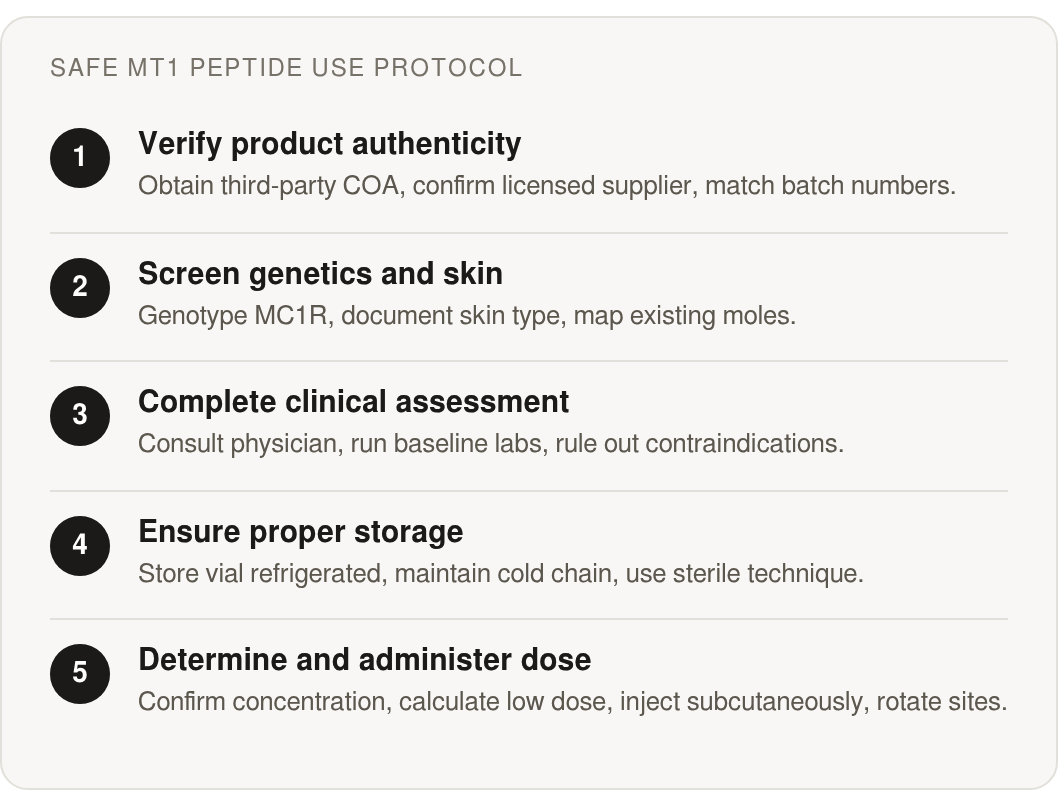

The legally approved form is a clinician-placed implant for a narrowly defined condition. It is not a consumer vial for aesthetics or longevity. That single fact reshapes any responsible approach, and it is why a supervised protocol should start with consultation, baseline blood work, and a personalized plan instead of a dosing chart lifted from a message board.
The evidence is real. The supply chain is the weak point.
The peptide itself is not the biggest danger. The vial is. Gray-market products can contain undisclosed compounds and vary widely in purity, which is why verifying peptide safety and asking for a certificate of analysis matters. Unlicensed labs also cannot guarantee sterility, and multi-dose vials may not stay stable over time.
So verified sourcing, licensed oversight, and a third-party certificate of analysis come ahead of any injection technique. In a supervised clinical setting, protocols may be guided by physicians, nurse practitioners, or paramedics. If you cannot verify all three, skip MT1.
Why a genetic screen goes first, not last
The sources look contradictory until you separate receptor biology from real-world use. Controlled discussion of MC1R activation points one way. Case reports involving unregulated melanotan point another.
Both can be true at once. A genetic screen helps flag people whose baseline melanoma risk is already higher and whose pigment response may be weaker. Pair that result with wearable UV-exposure data and you personalize the decision instead of guessing at it.
Building a pre-treatment checklist that covers all three fronts
A solid checklist spans three areas: regulatory, clinical, and logistical. That means confirming sourcing and legality, screening genetics and skin history, and planning storage and sterile handling before any protocol is selected. A supervised protocol starts with a consultation and blood work to assess individual health needs, with each step guided by data rather than a fixed template.
| Checklist Item | Recommended Action | Time/Frequency | Difficulty | Clinical Note |
|---|---|---|---|---|
| Verify source + COA | Confirm third-party purity testing | Before purchase | Medium | Non-negotiable first gate |
| MC1R genotyping | Screen for loss-of-function variants | Once, pre-treatment | Low | Flags risk and non-response |
| Baseline skin exam | Document all nevi | Once, then per dermatology | Low | Reference for future change |
| Cold-chain storage | Refrigerate; label away from kids | Ongoing | Medium | α-MSH is fragile |
| UV/wearable tracking | Log sun exposure | Daily | Low | Personalizes dosing |
- Confirm accredited sourcing and a valid certificate of analysis before buying anything.
- Complete MC1R genotyping to screen for melanoma-risk variants and predicted response.
- Book a baseline dermatologic exam and photograph existing moles.
Top safety priorities, in order: verify the product, screen your genetics, and never treat pigment as protection from ultraviolet exposure.
What the law actually says about melanotan-1
The legal picture is simpler than the marketing makes it sound, and it shapes the whole approach from step one. Regulatory approval for melanotan-1 is narrow, prescription-based, and tied to a specific medical indication. It is not a cosmetic or athletic license.
So when you research how to use MT1 for anti-aging or performance, you are looking at a product with no approved consumer pathway. That fact sits at the top of the checklist because it dictates sourcing and oversight before any genetic panel or wearable readout matters.
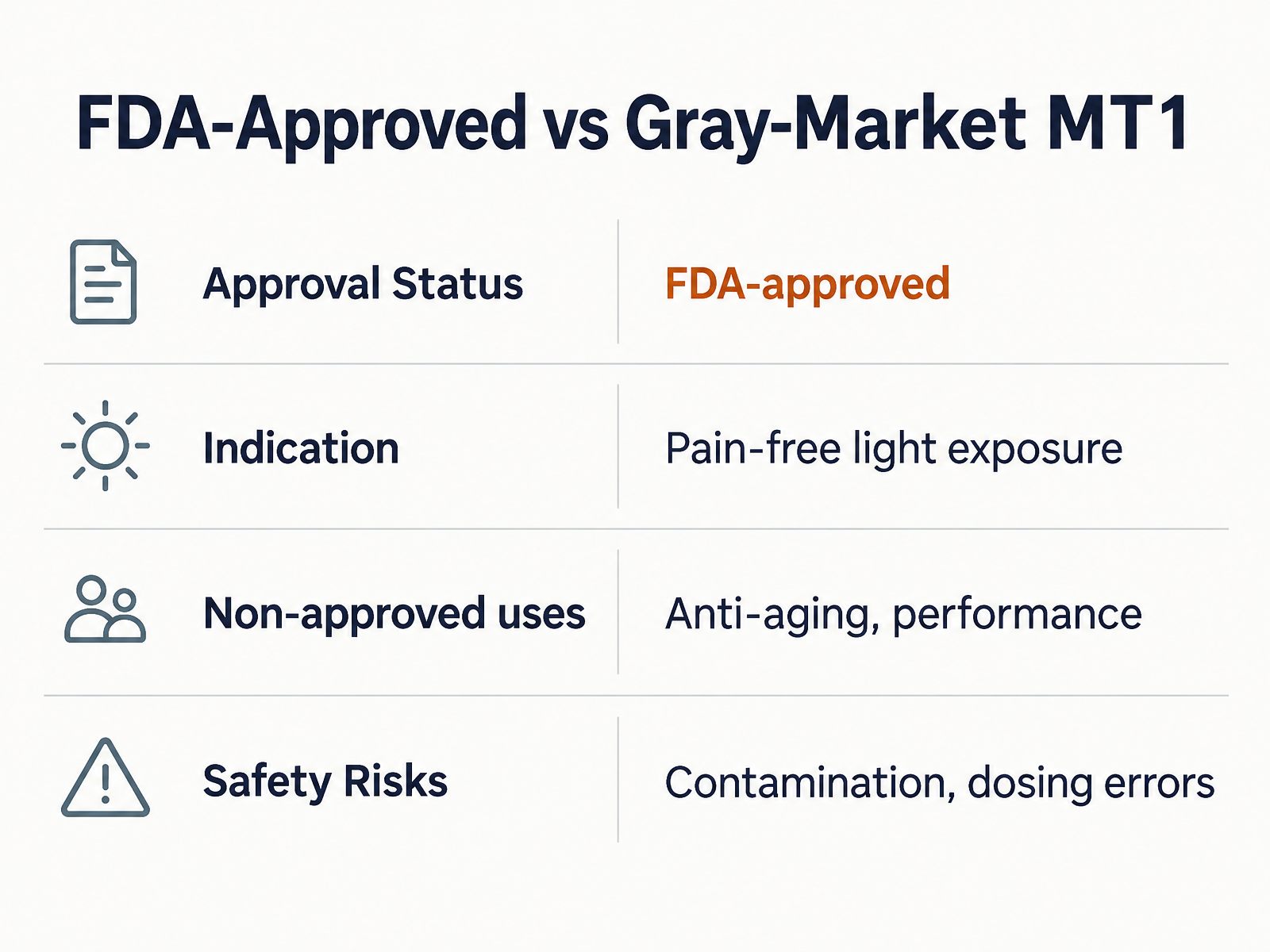
The approved molecule and the gray-market vial are not the same thing
Regulators draw a hard line between the pharmaceutical-grade compound studied under monitoring and the unregulated powder sold online. Irish health authorities call the injectable version illegal, untested, and unregulated, and warn that α-MSH is fragile enough to demand a manufacturing environment unlicensed labs cannot guarantee.
That gap shows up in the product itself. Regulatory warnings describe risks of contamination and dosing errors with unapproved peptides, and their contents and safety data are often largely unknown. You cannot personalize a dose against a vial whose contents you do not actually know.
- Confirm the product is pharmaceutical-grade with a batch-specific certificate of analysis, since label claims mean nothing without third-party verification.
- Verify licensed clinical oversight before any injection, because self-administered gray-market peptides carry documented contamination and dosing risks.
Every major jurisdiction says no to the unregulated version
Melanotan-II, the non-selective cousin often sold alongside MT1, has no approved indication for human use and is not legally marketed for cosmetic tanning. Multiple national health organizations have issued safety warnings against unregulated melanotan products.
This is where genetic screening earns its slot. The same test that can flag elevated pigment-related risk can also help predict whether an MC1R-focused approach is likely to work at all. It belongs before dosing, not after.
- Screen MC1R genotype and skin phenotype up front, especially in people with fair skin or a strong sun-seeking history.
- Skip MT1 entirely if you compete under anti-doping rules, since melanocortin agonists may sit outside approved use and testing frameworks.
Unregulated status makes documentation part of the protocol
These products sit outside any approved consumer pathway. That regulatory reality is exactly why sourcing and verification belong in your protocol from the start.
For you, documentation is not optional paperwork. Sourcing records, prescriber sign-off, and lab verification protect you and keep your protocol grounded in verified supply.
- Keep a written provenance trail for every vial, so your protocol rests on verified sourcing rather than unregulated research-use-only supply.

Proving what’s actually in the vial
Working out how to use MT1 safely never really starts with a dose. It starts with the vial in your hand, and whether you can prove what is inside it. Some verification guides and regulatory warnings note that research-grade peptide products sold online may miss purity benchmarks or contain unlisted contaminants. So before we talk milligrams, we talk provenance.
The practical divide is between accountable clinical supply and anonymous product access. Same molecule name, very different risk profile. The variable is not just the peptide. It is who made it, who tested it, who prescribed it, and who stays responsible if something goes wrong.
What purity standard should MT1 actually meet?
Purity is your first hard filter, and it should be confirmed by independent testing rather than taken on trust. Gray-market melanotan products have been reported to have inconsistent purity, which means a labeled vial may deliver less active peptide than expected alongside unknown byproducts.
- Confirm verified purity on the Certificate of Analysis before anything else. Without documented purity, dosing math based on genetic or wearable data becomes meaningless.
- Check for a heavy metals panel run under USP General Chapter <232>. This is what helps catch heavy-metal contamination sometimes seen in unregulated product.
- Verify endotoxin testing under USP General Chapter <85>. Injecting an endotoxin-contaminated peptide is a risk factor for a systemic reaction, no matter how pure the active ingredient reads.
How do you vet the supplier behind the vial?
Compounded does not mean counterfeit. A properly licensed compounding pharmacy operating under state board oversight can be a more accountable clinical source. An anonymous overseas vendor stamping “not for research use” on the box is not, and that label gives you zero legal or biological protection.
Verification guides describe a three-part legitimacy test that a source should satisfy all at once: accredited sourcing, licensed clinical oversight, and independent third-party documentation. Miss one, and the other two cannot cover for it.
- Require a COA from a laboratory independent of the seller. A vendor testing its own product is not verification.
- Confirm a licensed provider is prescribing and monitoring. A prescription’s real value is putting you inside a relationship with someone legally accountable, not the paper itself.
- Match the batch number on the vial to the batch number on the COA. Mismatched or missing batch IDs mean the certificate proves nothing about your specific vial.
The counterfeit red flags worth walking away from
Price is the loudest signal. When a vial costs a fraction of the clinic rate with no prescription and no documentation, you are not finding a bargain. You are accepting the exact risk regulators keep flagging.
- Walk away from any product with packaging inconsistencies, no lot number, or a price far below verified sources.
- Treat the absence of a COA as a hard stop, not a minor gap.
One detail buyers routinely overlook: how the peptide arrived. Lyophilized peptides are temperature-sensitive, and a vial shipped without cold-chain handling can degrade in transit even when the paperwork checks out. Ask whether the product moved under refrigeration, and inspect the powder itself. A properly freeze-dried peptide sits as an intact cake or fine uniform powder. A shrunken, discolored, or partially melted plug points to heat exposure or a failed lyophilization run, and no COA can vouch for what happened after the vial left the lab.

The screen that gray-market sellers skip
Knowing how to use MT1 responsibly starts long before a vial is opened. It starts with a screen most gray-market sellers skip entirely. A data-driven, personalized approach means baseline testing and clinical review come first, not as extras, because they answer two questions at once: is this safe for you, and will it even work?
That framing matters. A responsible pre-treatment screen can identify both risk and likely non-response before anyone considers MT1 for aesthetic or performance goals.
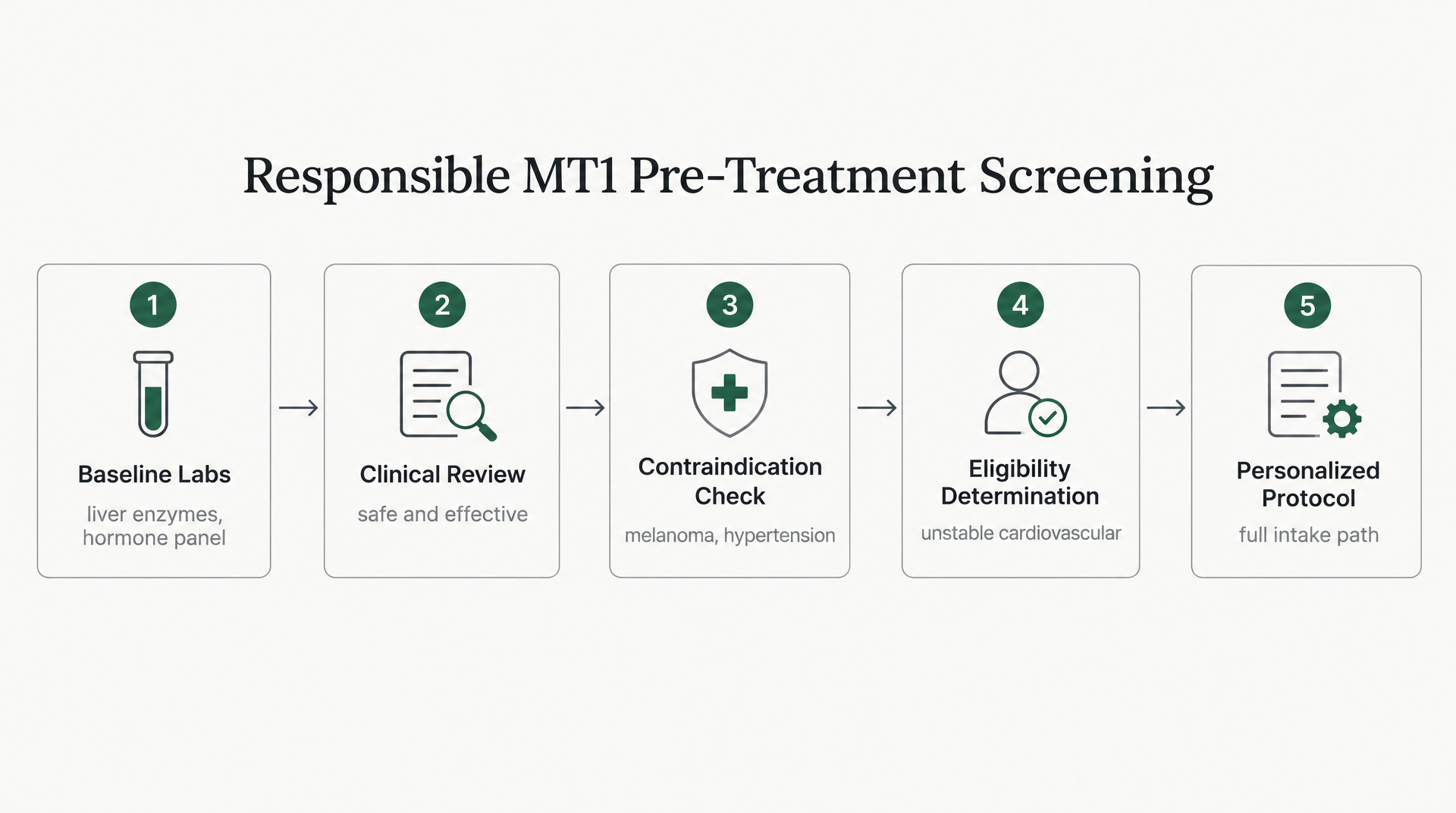
The MC1R variants we watch for
Loss-of-function MC1R variants—such as those sometimes reported as D84E, R142H, R151C, R160W, and D294H—are among the genetic findings that may change both the safety conversation and the odds of a useful pigmentary response.
- Run MC1R variant genotyping before any dosing decision, since carrier status can alter the risk-benefit calculation.
- Document Fitzpatrick skin type and sun-seeking history, because behavior and phenotype shape real-world risk.
- Complete a baseline dermatologic exam mapping existing moles, so future pigmentation changes can be told apart from a suspicious lesion.
The clinical point is straightforward: receptor targeting, skin phenotype, product quality, and UV behavior all need to be evaluated together. Looking at only one of them gives a false sense of precision.
The contraindications we screen every time
A prescription does not make a compound safe. Its value is putting you inside a clinical relationship with someone accountable for the calls below.
- Exclude active or prior melanoma and uncontrolled hypertension as contraindications, because melanocortin effects can involve both pigment and vascular tone.
- Review antihypertensives and hormonal therapies for interaction risk, and flag any history of priapism. An erection lasting over four hours is a medical emergency that can cause permanent damage.
- Log every current medication and supplement using a structured intake questionnaire, so nothing gets missed in conversation.
Skip MT1 entirely if you have a melanoma history or an unstable cardiovascular picture. The evidence does not support treating through those risks for a cosmetic endpoint.
Baseline labs and wearable data set your starting line
Objective baselines let us personalize rather than copy a generic protocol. Wearables extend that picture between visits.
- Consider baseline liver enzymes and a hormone panel before initiation, because these can help establish an accountable starting point for peptide therapy.
- Capture resting heart rate and blood pressure trends from your wearable, giving a cardiovascular reference to watch against MT1’s vascular effects.
- Confirm cold-chain handling: store reconstituted MT1 refrigerated, away from direct light, since improper storage can degrade peptide potency and may trigger reactions from breakdown products.
One limit stays in place regardless of labs or wearables: pigment change is not a substitute for UV protection or regular skin checks. If you are under supervision, your clinical team should walk through the full intake path during consultation.
Dosing when the published numbers don’t agree
The hardest part of figuring out MT1 is not finding a number. It is realizing the published numbers do not describe the same product. Early Phase 1 tanning research described subcutaneous dosing in supervised volunteers, but those were small studies using pharmaceutical-grade material and close monitoring. Afamelanotide, an approved melanocortin agonist, is a clinician-administered product, not something you titrate at home. Gray-market vials, by contrast, are unregulated multi-dose containers of unknown concentration. Those forms are not interchangeable, and no titration plan works until you know which one is in your hand.
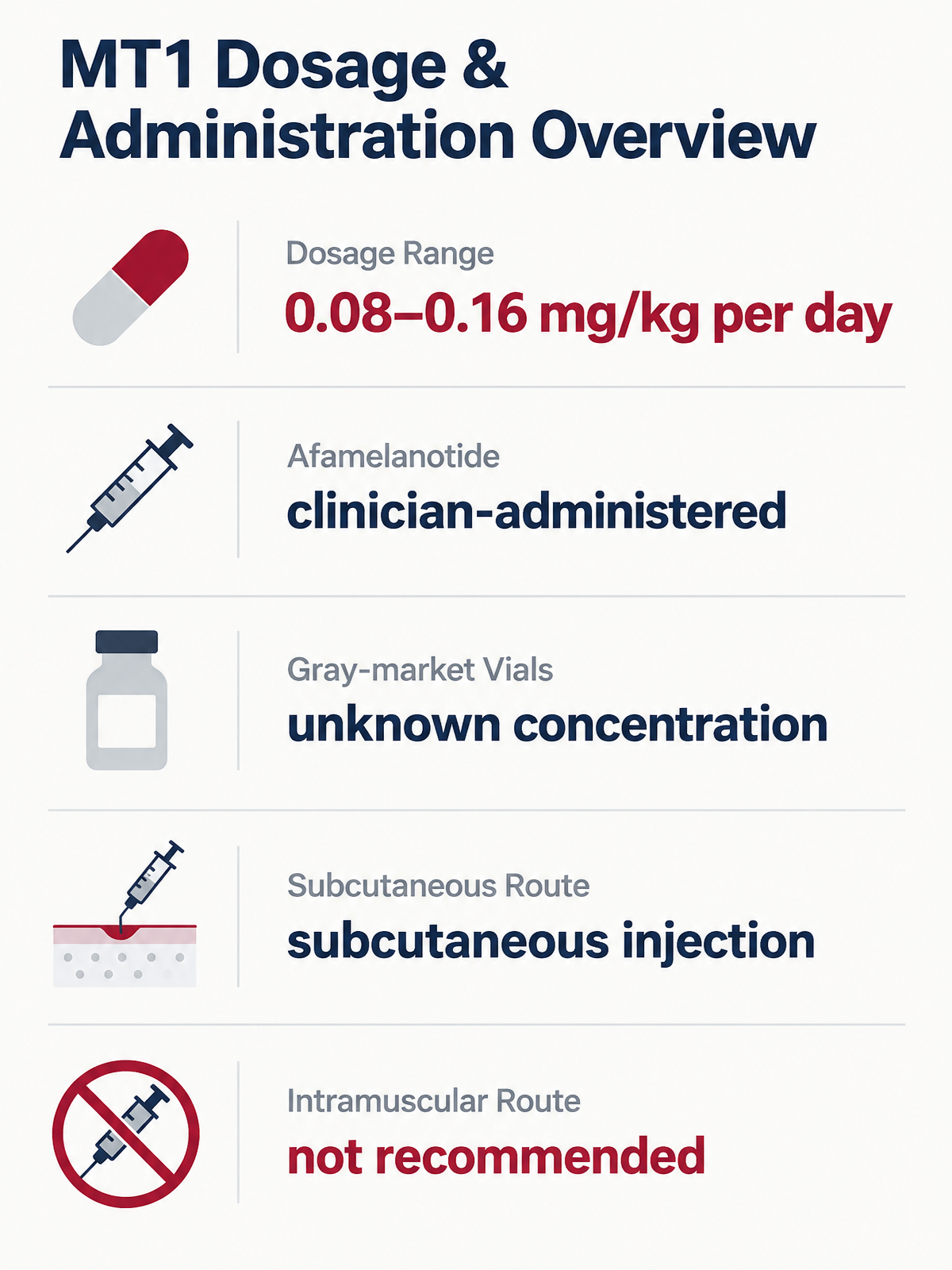
So the first checkpoint is declaration, not calculation. Write down the exact form, concentration, and total peptide mass before you touch a syringe. Everything else on the checklist is built on that one answer.
How do you set a starting dose when the numbers disagree?
Weight-based dosing from the early research gives a ceiling, not a target. Those subjects were injected under supervision with pharmaceutical-grade peptide and monitored closely in a dermatology clinic. That is a research environment, not a home protocol.
- Confirm the product form and stated concentration in writing before dosing, since a weight-based number means nothing without a verified mg/mL.
- Start well below published research ranges and hold, because escalation in the studies was designed to observe response under supervision, not to define a casual starting point.
- Treat any dose above what is needed for a mild pigment response as unnecessary risk. The controlled safety record does not transfer automatically to unsupervised use.
Subcutaneous or intramuscular? Which route, and why
The published early human research described subcutaneous administration, so that is the route with the most data behind it.
- Choose subcutaneous injection if you and your clinician decide to proceed, rotating between abdomen and thigh sites to keep absorption consistent.
- Rotate sites every dose and log each one, because repeated injection into the same spot changes how the peptide absorbs and irritates tissue.
- Keep injection volume small and split larger volumes across sites rather than forcing one bolus, which reduces local reactions.
We do not recommend intramuscular administration here. There is little published support for it with MT1, and case reports have described serious complications such as compartment syndrome after self-injection of unregulated peptides. The variable driving that harm is provenance and technique, not necessarily the molecule alone.
What belongs on your titration safety checklist
A multi-dose vial is a stability problem the published early studies did not face. Once reconstituted, a vial gets punctured repeatedly across an extended use window, and sterility can degrade over time.
- Set a discard date based on pharmacy or compounder guidance, not guesswork, and treat sterility decay as a stop, not a suggestion.
- Watch for nausea and facial flushing as expected early signals, and pause on anything beyond that.
- Keep using sunscreen regardless of pigment change. Early trial findings about acute UV-cellular response are not blanket photoprotection, and a tan from this peptide does not replace SPF.
What to watch after the syringe is empty
Learning how to use MT1 responsibly does not end when the syringe is empty. It arguably matters more afterward. The peptide keeps signaling melanocytes for days, so what you log in the first few days tells you whether to continue, adjust, or stop.

This is where the pre-treatment data pays off. If your genetic panel and wearable baseline are already on file, every symptom you record after a dose has something to compare against. That is why monitoring gets built into the protocol from day one, rather than bolted on after something goes wrong.
What to track after each dose
The most frequently reported effects are mild and predictable. According to WebMD, nausea, vomiting, headache, reduced appetite, and facial flushing are common adverse effects, while uneven darkening, new or enlarging moles, and dark nail lines—called melanonychia—may show up over longer use. The early published trial pattern is broadly consistent with those acute effects.
Flushing and nausea tend to show up soon after a subcutaneous dose. Pigment and mole changes are the slow signals worth watching across weeks.
- Log every dose with a timestamp, injection site, and any symptom within the first few hours. A dated diary or a notes app turns vague recall into a pattern you can act on.
- Photograph existing moles at baseline and at follow-up intervals recommended by your dermatologist. Because melanotropic peptides drive pigmentation and new or enlarging moles are a known concern over longer use, consistent photos are your early-warning system for changes you might otherwise miss.
- Use your wearable to flag resting heart rate spikes or sleep disruption after dosing. A sudden shift is data, not noise.
When do you pause or stop MT1?
Some reactions mean stop now, not “wait and see.” A painful erection lasting more than four hours is a medical emergency; WebMD warns it can cause permanent damage without prompt care. That single symptom overrides any protocol.
- Pause dosing if a new mole appears or an existing one changes shape, color, or size. Get it examined before the next dose.
- Stop and seek urgent care for any erection past four hours. This is not optional monitoring.
- Discontinue if nausea or headache stays severe or will not settle between doses. Persistent effects usually mean the dose is wrong for you.
How to prepare for a serious reaction
Anaphylaxis is rare but fast. WebMD’s serious-reaction list includes wheezing or breathing trouble, swelling of the face, lips, tongue, or throat, hives, racing heart, and dizziness or fainting. Any of these means stop the peptide and call emergency services immediately.
Preparation is simple and cheap. Get it in place before your first injection.
- Have emergency numbers and your nearest ER accessible before dosing. Never inject alone the first few times.
- Keep a written record of your exact product, concentration, and dose to hand to responders. It saves critical minutes.
- Schedule dermatologic follow-up at intervals your dermatologist recommends based on baseline nevi and pigment response.
One final guardrail remains: keep sunscreen and skin checks in the plan regardless of pigment response.
FAQ
Is a melanotan tan a safe replacement for sunscreen?
No. A melanotan-related pigment change should be treated as a biologic response, not as a license to skip SPF, protective clothing, shade, or dermatology follow-up. If MT1 is part of a supervised protocol, UV protection still stays in the plan.
What’s the difference between MT1 and MT2, and why does it matter for safety?
MT1 is more MC1R-preferential, while MT2 is non-selective. That matters because receptor selectivity, product source, and user behavior all affect risk. In practice, the biggest safety gap is often not the name on the vial but whether the product is regulated, tested, prescribed, and monitored.
I have high blood pressure. Can I still use MT1?
Uncontrolled hypertension is a hard stop in a responsible MT1 screen. If blood pressure is a concern, the next step is clinical review of your cardiovascular history, medications, wearable trends, and current control before any protocol is considered.
What warning signs after injection mean I should seek emergency care immediately?
Seek urgent help for a prolonged painful erection, breathing trouble, facial or throat swelling, hives, racing heart, severe dizziness, or fainting. Keep your product name, concentration, and dose written down so emergency clinicians know exactly what you used.
Free 15-Minute Discovery Call
Ready to take the guesswork out of your health?
Book a free 15-minute call with Monika to talk through your goals, what testing makes sense for you, and the right next step. No pressure, just clarity.
Book Your Free CallFor educational purposes only. Not medical advice.