
Quick Comparison Summary
You want to line up IGF-1 LR3 against CJC-1295 with Ipamorelin before you commit to anything. The fastest way to see the split is to ask where each one is proposed to act on the growth hormone pathway, and how you would actually track results. One is usually described as working downstream. The other upstream. That difference may drive dosing cadence and which biomarkers are most useful to follow.
CJC-1295 paired with Ipamorelin is commonly described as encouraging the pituitary to release growth hormone in pulses, with downstream IGF-1 production. IGF-1 LR3 is often described as an IGF-1 analog that may act more directly at tissue receptors. So the practical choice is usually framed as loading the IGF-1 pool directly, or asking your body to build it.
The mechanism split sets your monitoring cadence
Both paths are often discussed as affecting the GH/IGF-1 system, but they may demand different feedback loops. CJC-1295 is typically described as a long-acting GHRH analog, while Ipamorelin is typically described as a ghrelin-receptor agonist. Because they are proposed to act through different receptors, some providers see them as complementary for raising GH pulses. However, the clinical evidence base is limited.
IGF-1 LR3 is the outlier in this framing. It is often described as an IGF-1 analog with reduced binding-protein interaction and more direct tissue-receptor activity, but those distinctions can be harder to confirm in routine labs.
| Feature | CJC-1295 + Ipamorelin | IGF-1 LR3 |
|---|---|---|
| Primary target | GHRH + ghrelin receptors (proposed) | IGF-1 receptor (proposed) |
| Where it acts | Upstream (pituitary) | Downstream (tissue) |
| Main effect | May stimulate endogenous GH pulses | May provide direct tissue-level IGF signaling |
| Ipamorelin selectivity | Reported lower activity at cortisol, prolactin, appetite-related pathways | N/A |
| Best-fit biomarker | IGF-1 trend, timing of GH-related pulses | Tissue-related IGF signaling, glucose trends |
| Monitoring rhythm | Slower, pulse-averaged | Faster, dose-linked |
Why total serum IGF-1 alone misleads you
Total serum IGF-1 alone can mislead you. Circulating IGF-1 is influenced by IGF-binding proteins, which can affect how much is available to tissues and how long it remains measurable. A single blood draw may not reveal bioavailable IGF-1, and this matters for both approaches.
So the tidy “direct receptor action” story for IGF-1 LR3 holds only in principle. IGF-1 LR3 is often described as modified to reduce binding-protein interaction, but it still operates in a system shaped by IGFBP dynamics. That is exactly why we track a panel of core biomarkers, from hormones to gut health, through periodic labs instead of reading everything off one value.
For the GH-secretagogue path, the signal you care about is the delayed, protein-buffered IGF-1 rise. That means slower, pulse-averaged tracking. For IGF-1 LR3, the injected molecule may perturb the very pool you are measuring, so faster, dose-linked surrogate readings may carry more weight.
Cost tracks the loop, not the label
Cost may follow monitoring intensity, not just the vial. A GH-secretagogue protocol is often run over a longer period with fewer measurement demands. IGF-1 LR3 may require tighter feedback, which can raise the real cost of running it well.
Skip IGF-1 LR3 if you want a hands-off routine. Reach for the CJC-1295 and Ipamorelin stack when you prefer nudging your own physiology. In tested sport, both options may be prohibited under current anti-doping rules, so competing athletes should verify status with their governing body before considering either. For deeper protocol notes, see our blog.
Key Takeaways
- The practical decision is not which peptide sounds more powerful. It is whether you want to influence the GH/IGF-1 pathway before or after your own GH release.
- Lab interpretation may shift depending on where each peptide is proposed to act, so the same blood marker can mean different things under different protocols.
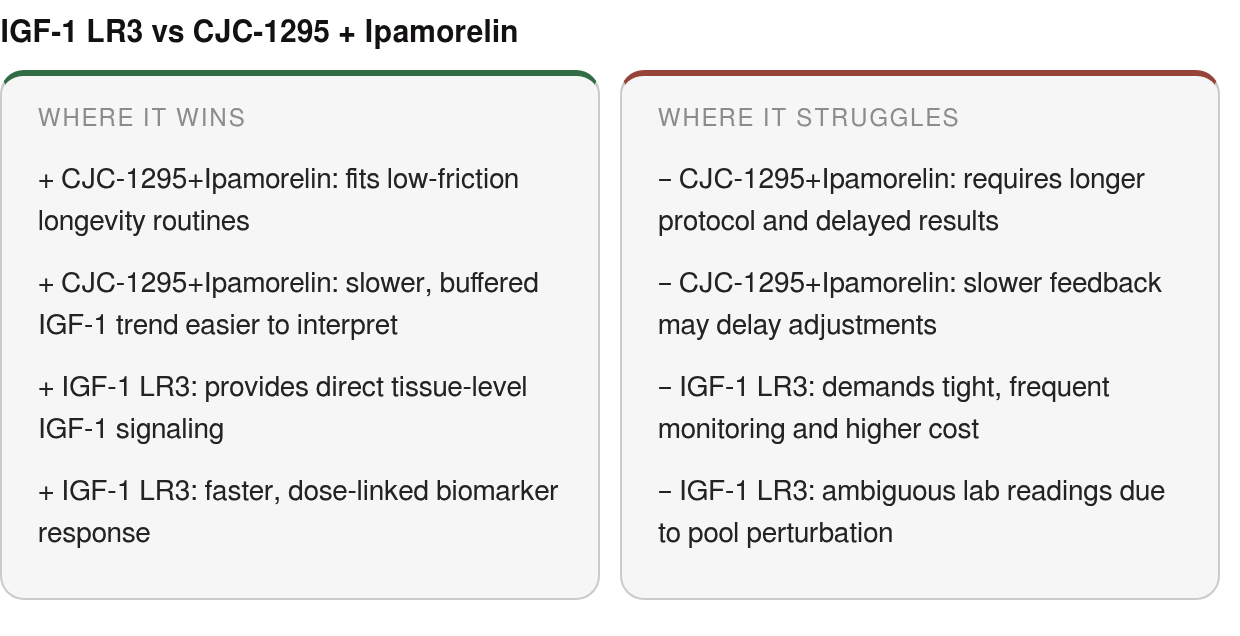
- CJC-1295 with Ipamorelin is generally easier to fit into a lower-friction longevity or recovery plan for many users.
- IGF-1 LR3 is often described as a more direct option, and it may ask for a more disciplined tracking setup.
- The most useful protocol is the one you can monitor consistently, adjust responsibly, and align with your actual goal.
Start with the goal, not the molecule
Most people arrive at this decision with an outcome in mind, not a molecule. You want faster recovery between training blocks, better body composition, or a longevity protocol that tracks against your own data. The peptide is just the tool. Choosing between IGF-1 LR3 and CJC-1295 with Ipamorelin starts with matching that tool to what you are trying to change and how tightly you plan to measure it.

These two are not interchangeable in real life. The right call usually comes down to how much feedback you can realistically gather, how comfortable you are interpreting it, and whether your plan can be adjusted before small issues turn into large ones.
What are you trying to optimize?
Think about the outcome first. If you want a gentler approach that works with your existing hormonal rhythm, the CJC-1295 and Ipamorelin combination often fits. It is usually the cleaner match for people chasing recovery, sleep, and body-composition support without jumping straight to the most direct tool on the shelf.
IGF-1 LR3 serves a different need. It appeals to people after a more targeted tissue response who already understand the protocol may be less forgiving. The closer you get to direct signaling, the more your tracking habits matter.
Why does monitoring drive the choice?
Monitoring is the selection factor most guides underplay. A lab result is only useful if it reflects something you can interpret and act on. With either option, a single number pulled out of context can push you toward the wrong conclusion.
That is why we build titration around periodic labs and the core biomarkers we track, from hormones to gut health, read alongside your goals and personal data. The question is not whether a peptide changes a marker. It is whether that marker gives you a reliable steering signal for the protocol you are running.
For example, a secretagogue plan may pair a scheduled lab review every few weeks with a running log of sleep, resting heart rate, HRV, and recovery perception, with a rule to pause if recovery markers trend outside your baseline for a sustained period. An IGF-1 LR3 plan could use the same lab panel but place more weight on glucose and post-dose timing, with a lower threshold for adjustment if glucose moves outside your baseline. These are examples of monitoring logic, not universal protocols.
Which option fits your situation?
| Selection factor | CJC-1295 + Ipamorelin | IGF-1 LR3 | Our monitored protocol |
|---|---|---|---|
| Site of action | Pituitary (upstream) | Tissue receptors (downstream) | Matched to your goal |
| Signal you track | Buffered, time-delayed IGF-1 | Directly perturbed IGF-1 pool | Biomarker + lab loop |
| Best suited for | Physiologic GH support | Targeted tissue response | Data-guided dosing |
For most people, the honest starting question is not which peptide is stronger. It is which signal you can actually follow week to week. You can see how we frame that loop on our clinic blog.
How the two protocols compare day to day
Here are the two protocols side by side on the features that change your routine: how long each stays active, what you can measure, and how much monitoring effort it demands. This is where the IGF-1 LR3 versus CJC-1295 Ipamorelin question stops being about mechanism and starts being about logistics.

Duration is the first fork. A longer-acting secretagogue component changes your planning, while a shorter pulse changes your timing. Depending on the CJC-1295 formulation, duration may differ. IGF-1 LR3 gets evaluated differently because it is not waiting on pituitary output in the same proposed model. In practice, that puts the calendar, the lab schedule, and your tolerance for adjustment on equal footing with the molecular description.
How do the two protocols compare feature by feature?
| Feature | CJC-1295 + Ipamorelin | IGF-1 LR3 | BiohackNow monitored protocol |
|---|---|---|---|
| Site of action | Upstream (pituitary GH release) | Downstream (tissue IGF-1 receptors) | Either, matched to your biomarkers |
| Effective duration | Depends on formulation; may include longer-acting and shorter-acting components | Often described as extended tissue exposure | Titrated to your biomarker and lab response |
| Endogenous vs. Exogenous | May stimulate your own GH and IGF-1 | Often described as bypassing GH release | Chosen by goal + data |
| Selectivity | Ipamorelin: reported lower cortisol/prolactin/appetite effect | Often described as direct receptor binding | Reviewed per side-effect profile |
| Monitoring difficulty | Delayed, buffered IGF-1 signal | Injected molecule may perturb the pool you measure | Periodic labs across core biomarkers |
The selectivity line carries more than it looks. On the secretagogue route, tolerability often decides whether someone stays consistent long enough to judge the protocol at all. On the direct route, the issue is not just effect size. It is whether you can separate useful response from measurement noise.
Why does monitoring cadence differ between them?
The two paths may ask for different sampling schedules because they are proposed to change your biology at different points in the chain.
With the secretagogue combo, timing the draw is the whole challenge. A poorly timed test can create false confidence or false concern, so consistency beats chasing a dramatic reading. The trend tells you more than the snapshot.
IGF-1 LR3 flips the problem. The reading may get harder to interpret because the intervention and the measured pool are tightly linked. That is precisely why periodic lab work across the core biomarkers we track earns its place in titration. It fills the gap any single draw leaves open.
Where does each one win?
Pick CJC-1295 plus Ipamorelin when you want a protocol that lines up with recovery habits, sleep routines, and gradual biomarker movement. Choose IGF-1 LR3 when your goal calls for a more direct route and you have the monitoring discipline to justify it.
A monitored protocol may tie dose adjustments to your data rather than a fixed chart, and you can read more on how we structure that on our clinic blog.
Who each protocol actually fits
Start with the goal, not the molecule. People who get value from this comparison usually fall into three camps: athletes chasing recovery, professionals running a longevity protocol, and body-composition seekers who want visible, measurable change. Choosing between IGF-1 LR3 and CJC-1295 Ipamorelin comes down to how you train, how tightly you plan to monitor, and how much of your own pituitary output you want to keep in the loop.
The practical split is simple without being simplistic. If you want a plan that slots into an already disciplined wellness routine, the secretagogue path is usually easier to manage for many people. If you are chasing a narrower outcome and already track training, nutrition, sleep, and labs closely, the direct analog may be more relevant.
Who benefits most from CJC-1295 with Ipamorelin?
This pairing suits people who want a physiologic approach. It is often a strong fit for longevity-minded users, recovery-focused clients, and anyone easing into peptides who does not want the most aggressive monitoring burden from day one.
Wearable trends matter here. Resting heart rate, HRV, sleep depth, training readiness, and recovery perception can help show whether the protocol is moving in the right direction between lab checkpoints. Those signals do not replace blood work, but they make the protocol easier to read in daily life.
The caveat is patience. Because you are watching a downstream response rather than a direct push, the best decisions come from repeated measurements and consistent habits, not one dramatic result.
When does IGF-1 LR3 make more sense?
IGF-1 LR3 may appeal to advanced users targeting a more specific tissue response who accept a tighter feedback loop and a daily commitment. If your goal is a targeted body-composition change and you already log training and nutrition closely, the direct route may match that discipline.
The trade-off is consistency. This protocol asks more from you, because irregular timing, missed entries, or loose nutrition tracking make the feedback harder to trust. Without a reliable data routine already in place, the direct route can create more confusion than clarity.
It also demands comfort with ambiguity. You may see shifts in subjective recovery, glucose stability, or training output before the lab picture feels clean, which is why the plan needs defined decision points before you start.
How do the options line up by ideal user?
| Ideal user | CJC-1295 + Ipamorelin | IGF-1 LR3 | BiohackNow monitored protocol |
|---|---|---|---|
| Longevity, first-timer | Strong fit | Overkill | Strong fit |
| Advanced body-comp | Good | Strong fit | Biomarker-guided protocol |
| Wants light monitoring | Workable | Poor fit | Not the entry point |
| Data-driven optimizer | Good | Good | Best fit |
Where we see the most consistent results is the data-driven optimizer. We tie dosing to trackable health signals, so titration reflects your measured data rather than one snapshot. If you want the reasoning behind that cadence, a wellness consultation walks through the biomarker logic for your specific goals.
The bottom line on IGF-1 LR3 versus CJC-1295 Ipamorelin
By now the choice should feel less like picking the stronger molecule and more like picking the one you can actually track. The peptide that pairs cleanly with your wearable data and your labs is the one that earns its place in your protocol.

After doing this work with health-conscious clients, our read is that for most longevity or recovery protocols, the secretagogue path is easier to manage well. It gives you a cleaner relationship between habits, recovery data, and lab movement. That does not make it automatically better. It makes it more practical for the majority of people starting from a wellness framework.
Which protocol should you actually choose?
Match the tool to your goal and your appetite for tracking. The table below is our practical summary, built from what each option is proposed to do and how it fits a wearable-guided approach.
| Scenario | Better fit | Why |
|---|---|---|
| Longevity protocol with heavy wearable tracking | CJC-1295 + Ipamorelin | Proposed to work upstream, so your labs may read your own response |
| Recovery support between training blocks | CJC-1295 + Ipamorelin | Fits better with recovery and sleep-pattern tracking |
| Direct tissue-level approach, experienced users | IGF-1 LR3 | Often described as bypassing pituitary GH release and may require tighter oversight |
| Personalized protocol built from your biomarkers | BiohackNow Longevity Clinic protocol | We design your peptide plan around your labs and track, not a fixed template |
The clinic-managed option is listed separately because it is the only row where dosing is built around your own labs and data rather than a fixed product comparison. That is the core of how we run it.
When should you skip both?
Be clear about the exceptions. If you fall under anti-doping rules, do not assume either option is permitted. Verify current status with your governing body before making any decision. This is not a timing problem or a clever-cycle problem. It is a rule-set problem.
There is also a health line worth respecting. IGF-1 signaling is involved in cell growth and proliferation, so if you have a personal or family history of active cancer, the direct analog may raise additional questions. Clear it with your physician before you touch either path, and treat any unexplained lab drift as a reason to pause rather than push.
And a fair word on the wider trend. Stacking peptides without a measurement plan is just consumerism in a lab coat. The monitoring is what turns a purchase into a protocol.
Let your data set the order
Your data decides the sequence, not a slogan. Let your own IGF-1 trend, glucose stability, and recovery markers tell you when a lower-friction approach has given what it can, before you consider anything heavier. That order respects your physiology first and keeps every dose accountable to a number you can read.
Whichever way you lean, the winning move is the same. Pick the peptide you can measure, then let the data drive the dose. You can read more of how we think about this on our blog.
FAQ
Can I stack IGF-1 LR3 together with CJC-1295 and Ipamorelin at the same time?
Treat stacking as a separate clinical decision, not an automatic upgrade. A combined plan only makes sense if each compound has a defined role, a measurement target, and a stopping rule. Without that, adding more peptides usually makes the data harder to interpret.
Why does the timing of a blood draw matter so much for the CJC-1295 and Ipamorelin path?
Because the protocol depends on a changing hormonal signal rather than a flat, constant level. Testing needs to be consistent enough that you can compare one result with the next. Otherwise, the lab may reflect timing more than physiology.
Should I avoid these peptides if I have a family history of cancer?
This is a physician-level decision. IGF-1 signaling is involved in cell growth and proliferation, so any relevant personal or family cancer history should be reviewed with a physician before considering either protocol. Do not use a peptide protocol to work around that uncertainty. Get medical clearance first and pause if your biomarkers move in a concerning direction.
What makes Ipamorelin different from other GH secretagogues?
Ipamorelin is often described as a more selective ghrelin-receptor agonist, meaning some providers use it when they want a narrower secretagogue effect. In this comparison, it may support the upstream route without turning the protocol into a broader endocrine push.
Why does CJC-1295 stay active longer when Ipamorelin clears faster?
They play different roles in the pairing. Depending on formulation, one component may support a more sustained background signal, while the other contributes a shorter secretagogue pulse. That difference is why the combination is usually discussed as a rhythm-based protocol rather than a single-effect injection.
If cost tracks with monitoring rather than the vial, what actually makes IGF-1 LR3 more expensive to run?
The expense comes from the oversight required to use it responsibly. More frequent interpretation, tighter timing, and a lower tolerance for guesswork can all add cost beyond the product itself.
I compete in a tested sport but only in the off-season. Is there a safe window to use these?
No. If you are subject to testing rules, the safest answer is to avoid both unless and until you have verified current status with your governing body. Competitive status changes the decision before dosing, timing, or monitoring even enter the conversation.
Free 15-Minute Discovery Call
Ready to take the guesswork out of your health?
Book a free 15-minute call with Monika to talk through your goals, what testing makes sense for you, and the right next step. No pressure, just clarity.
Book Your Free CallFor educational purposes only. Not medical advice.