
Key Takeaways
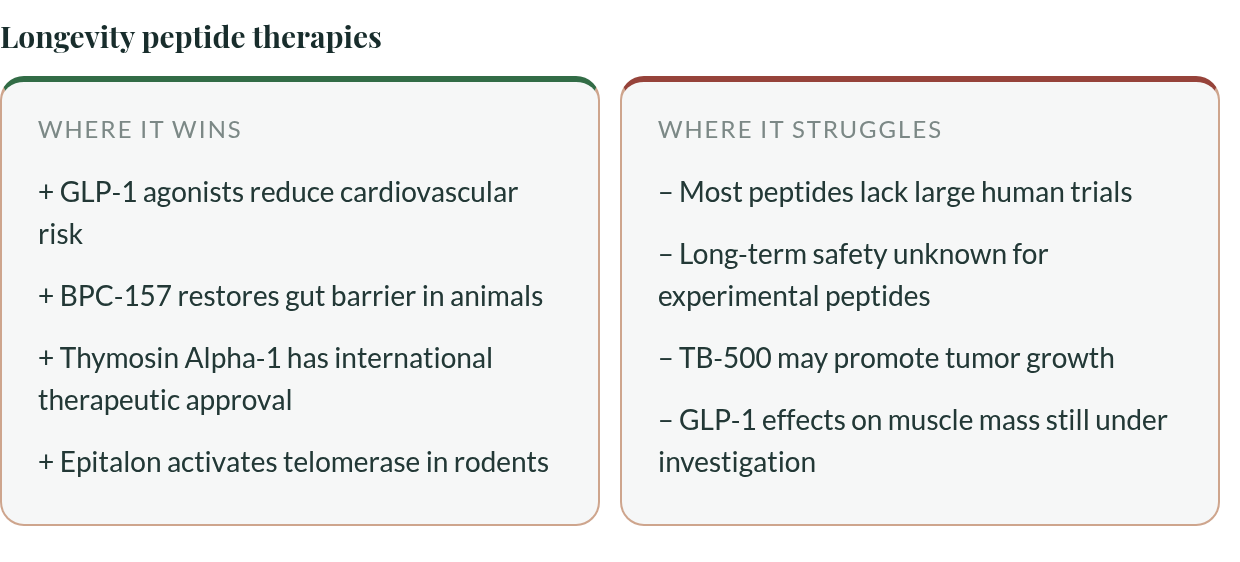
- GLP-1 agonists such as semaglutide and tirzepatide have cardiovascular outcomes data from large, multi-year clinical trials.
- Many marketed longevity peptides remain experimental despite prices of $500–600 per dose.
- BPC-157 has shown gut-barrier restoration in animal models, while human research remains limited to small, short-term studies.
- Thymosin Alpha-1 has regulatory approval in multiple countries for selected immune-support uses but remains unapproved in the United States.
- Animal research suggests lower growth hormone and IGF-1 activity may relate to longer lifespans, challenging the premise behind growth-hormone-enhancing peptides.
- TB-500 has tissue-repair findings from laboratory and animal work, alongside concerns about stimulating tumor growth in regenerative settings.
- Epitalon research includes telomerase activation and lifespan extension in rodents, but human dosing, safety, and durability remain unresolved.
Quick Summary
Longevity peptides fall into distinct evidence tiers: metabolic therapies supported by substantial human research, tissue-repair candidates backed mainly by preclinical models, and experimental compounds with little clinical validation. Confusing those categories can turn a reasonable health goal into an expensive and poorly monitored experiment.
| Peptide | Biological Target or Proposed Role | Evidence Type | Relevant Observed Effect | Regulatory Status | Key Limitation |
|---|---|---|---|---|---|
| Semaglutide (Ozempic, Wegovy) | GLP-1 receptor agonist for metabolic and cardiovascular health | Phase 3 RCTs in large patient populations | Cardiovascular risk reduction and weight loss documented in regulatory filings | FDA-approved for type 2 diabetes, obesity, and cardiovascular risk reduction | Long-term effects on muscle mass and neuroprotection still under investigation |
| Tirzepatide (Mounjaro, Zepbound) | Dual GLP-1/GIP agonist for enhanced metabolic control | Phase 3 RCTs | Weight loss outcomes documented in comparative trials | FDA-approved for type 2 diabetes and obesity | Same muscle-mass monitoring considerations as semaglutide |
| BPC-157 | Gut epithelial repair and anti-inflammatory signaling | Preclinical animal models; limited human pilot data | Tissue repair and gut-barrier restoration in animals; short-term tolerability in small human studies | Not FDA-approved; compounding availability varies by state | No large-scale human trials; sourcing quality varies widely; long-term safety unknown |
| TB-500 (Thymosin Beta-4 fragment) | Tissue regeneration and wound healing | Primarily animal research; limited early human data | Tissue repair observed in laboratory and animal studies | Not FDA-approved | No large-scale human clinical trials; potential tumor-promotion concern in regenerative contexts |
| Thymosin Alpha-1 (Tα1) | Immune enhancement through T-cell maturation and diversity | RCTs in viral hepatitis and cancer adjunct therapy | International use for immune support during chemotherapy or as a vaccine booster | Not FDA-approved in the U.S.; approved internationally | U.S. regulatory status; immunosenescence benefits need longer-term validation |
| Epitalon | Telomerase activation and cellular aging | Decades of preclinical work; limited human safety data | Lifespan extension observed in aged rodents in some studies | Not FDA-approved | Human evidence is early; long-term safety and efficacy unproven |
The Metabolic Tier Has the Strongest Clinical Support
GLP-1 agonists operate through well-mapped receptor pathways. Their dosing, adverse effects, and clinical outcomes have been examined in regulatory filings and controlled trials. That makes them materially different from compounds whose rationale rests on cell culture, animal models, or anecdotes.
BPC-157 and TB-500 occupy a less established category. BPC-157 has produced signals involving gut-barrier restoration, while TB-500 has been investigated for wound and tissue repair. Those findings may justify further research, but they do not establish clinical effectiveness. Short-term tolerability findings are not proof that a compound improves the condition it is intended to treat.
Most Anti-Aging Claims Remain Experimental
Thymosin Alpha-1 has a longer clinical history than many compounds sold in longevity clinics, particularly in international hepatitis and cancer-support settings. That history does not automatically establish a benefit for healthy aging. Epitalon presents a different problem: its proposed telomerase and lifespan effects come largely from older preclinical research, leaving human dosing and long-term outcomes uncertain.
For foundational longevity work, the distinction between an approved treatment and an experimental anti-aging intervention matters more than the appeal of a mechanistic story.
The Evidence Problem Everyone Ignores
We see a widening gap between peptide marketing and the evidence behind the claims. Commercial visibility is not the same as clinical validation. Approved peptide medicines can lend an unearned sense of credibility to unapproved longevity products. When a compound enters a protocol before researchers have established its benefits and risks in humans, market momentum has moved ahead of science.
Three evidence tiers, not one monolith
The field is easier to evaluate when divided into three broad tiers. Tier 1 contains FDA-approved molecules such as semaglutide, which have passed extensive clinical evaluation for defined indications. Tier 2 includes compounds approved in some countries but not in the United States—these may have meaningful research histories without equivalent U.S. authorization or comprehensive long-term data. Tier 3 consists mainly of experimental peptides supported by animal studies, laboratory findings, and anecdotal reports.
Many products promoted for longevity sit in the latter two tiers, even when their cost suggests a level of confidence associated with established medicines. A price of $500–600 per dose reflects what a market will charge, not what the evidence has demonstrated; it can also reflect marketing spend rather than clinical-trial investment.
Animal research also complicates the idea that more growth signaling necessarily means slower aging. In several longevity models, lower growth hormone and IGF-1 activity may be associated with longer life. A peptide used for a narrowly defined recovery or body-composition objective should not be presented as a general lifespan intervention.
Where the hype outpaces the data
Regulatory status helps identify how much scrutiny a compound has received, but it does not answer every safety question. Some products remain the subject of regulatory concern because of impurities, immune reactions, adverse events, or uncertain manufacturing practices. Compounded products from accredited pharmacies with documented testing are not equivalent to research chemicals purchased online.
The body’s natural production of molecules such as insulin and GLP-1 makes supplementation sound intuitive. Yet a marketed peptide may differ in structure, dose, delivery, and pharmacology from the body’s endogenous version. A compelling explanation of how a compound might work is not evidence that it improves long-term human outcomes.
A peptide that improves intestinal-barrier measures in rodents may eventually prove useful in people with age-related inflammation. Human immune complexity, dosing differences, and prolonged exposure can change that result. Controlled clinical research must resolve those uncertainties before the claim becomes medical guidance.
Core Peptide Classes for Performance & Aging
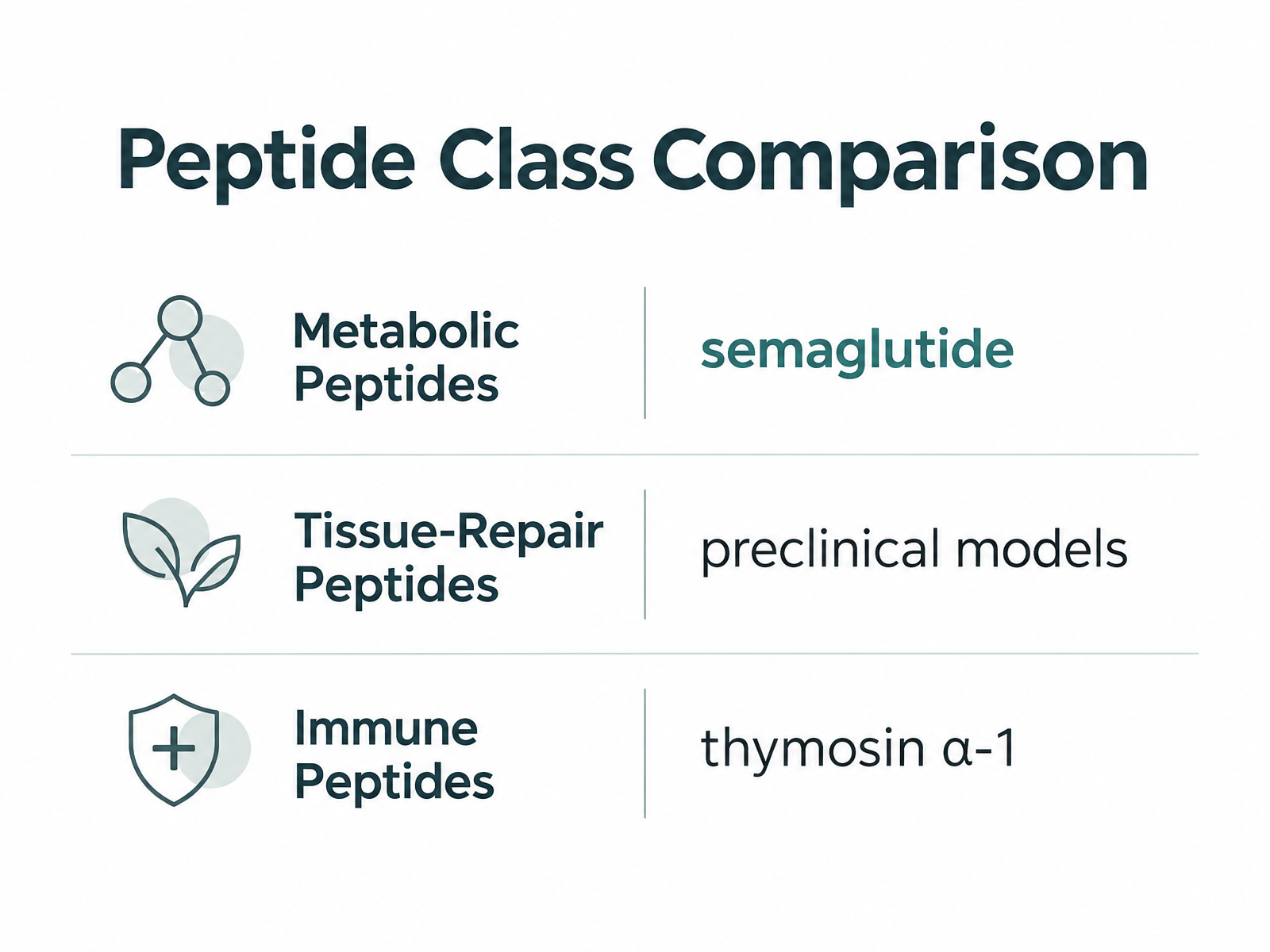
Peptide therapies address aging through several proposed mechanisms. Metabolic agents influence insulin regulation and appetite. Tissue-repair compounds are built on laboratory and animal findings with limited early human work. Immune peptides occupy an intermediate position when they have international therapeutic use but uncertain evidence for longevity outcomes.
Metabolic regulators: GLP-1 receptor agonists
Semaglutide acts through satiety and insulin-regulation pathways rather than by stimulating growth-hormone production. We consider it for individuals who meet appropriate therapeutic criteria. Its strongest rationale is metabolic management; possible cardiovascular advantages belong to defined patient populations rather than to a blanket anti-aging claim.
Someone seeking endurance gains or generalized longevity without metabolic disease should not assume that a GLP-1 agonist is the right tool. Strong evidence for one indication does not transfer automatically to every performance or aging objective. Muscle mass, nutritional intake, and the reason for treatment also require attention when weight loss is part of the plan.
Tissue repair and recovery: the preclinical zone
Most tissue-repair peptides have not been tested in the type of controlled human research needed to establish treatment protocols. Animal models suggest anti-inflammatory or regenerative activity, but those models cannot settle questions about human dosing, functional recovery, or long-term exposure.
These compounds sometimes appear in plans for persistent soft-tissue problems after conventional treatment has stalled. That choice represents individualized clinical judgment in an evidence-poor setting, not an established standard of care. A plausible repair mechanism does not demonstrate an athletic-performance benefit.
Immune and cellular aging: thymosin α-1’s uncertain position
Thymosin α-1 has international use in chronic viral hepatitis and as an immune-support intervention during selected cancer treatments. Its effects on T-cell maturation make it relevant to discussions of immunosenescence, but improved immune markers do not equal longer life or better function in otherwise healthy adults.
We view it as a compound with a substantial research and treatment history in certain settings, not as a validated longevity drug. FOXO4-DRI belongs even further toward the experimental end of the spectrum because it lacks a human evidence base.
Book your consultation with BiohackNow
Designing a Personalized Peptide Protocol
We begin with the health objective rather than with a favored peptide. A documented metabolic disorder, a defined tissue injury, and a broad desire to slow aging are different clinical situations. Approved uses come with established monitoring and outcome measures; experimental longevity plans generally do not.
The stacking problem. Many users assemble protocols from online forums, combine compounds that have never been studied together, and pursue outcomes such as telomere extension or mitochondrial biogenesis without validated human markers. Existing research cannot responsibly supply do-it-yourself dosing, titration, or stacking rules for unapproved compounds. If you are considering more than one experimental peptide, start with a single agent so any benefit or adverse effect can be attributed correctly.
The Evidence Gaps That Prevent Protocol Publication
The same evidence gaps affect growth-hormone secretagogues, tissue-repair peptides, and mitochondrial modulators. Many anabolic and regenerative compounds remain research chemicals available online, creating concerns about contamination, mislabeling, and inconsistent concentration. Without controlled trials, there is no dependable basis for selecting dose ranges, washout periods, or combinations.
Clinician-Supervised Decisions Replace Published Regimens
A qualified clinician reviews medical history, current laboratory findings, contraindications, and the quality of the available evidence before discussing an intervention. That conversation should include regulatory status and the possibility that a compound’s proposed benefit has never been demonstrated in people.
Informed consent is particularly important when long-term safety data are absent. Anecdotal routines do not show how a protocol should change when symptoms, laboratory findings, or treatment goals shift. The decision belongs to you and your clinician, not to a generalized dosing chart or forum post.
Safety, Regulation, and Choosing a Qualified Provider
The regulatory environment for longevity peptides is complicated, so each compound should be assessed according to its own evidence and authorization. GLP-1 receptor agonists such as semaglutide are FDA-approved for specific metabolic indications and have formal dosing and safety-monitoring frameworks. A product marketed for longevity may not have undergone comparable evaluation.
Thymalfasin, a synthetic form of thymosin alpha-1, is approved in multiple countries for selected medical uses outside the United States. Epitalon has a long history of animal research, but its clinical evidence remains limited. Regulatory discussion about compounding is separate from approval of a treatment’s safety and effectiveness for a particular use.
BPC-157, TB-500, and CJC-1295 illustrate the experimental end of the market. Some early human work has examined tolerability, but controlled evidence of effectiveness is lacking. Product quality can also vary because many anti-aging peptide products do not receive the manufacturing oversight applied to approved medicines. Purchasing a compound without a validated human dosing schedule means accepting substantial uncertainty.
Peptide safety depends on product quality and third-party verification
Plant-derived peptide products are used in some performance and recovery products. They are generally hydrolysates, meaning that enzymes process the original protein, and the final peptide profile depends on the production method and manufacturing controls.
Independent testing can assess whether a batch meets stated purity standards or contains contaminants such as heavy metals or microbial loads. A manufacturer’s certificate of analysis is not the same as verification by an accredited outside laboratory. Ask for batch-specific testing that includes amino acid profiling, heavy-metal screening, and microbial analysis before using any peptide product.
Preclinical longevity research also raises a separate biological concern: stimulating regeneration is not automatically beneficial. Growth-hormone and IGF-1 pathways may have different implications at different ages and doses, and indiscriminate cellular stimulation could affect both healthy and abnormal tissue. Endogenous antimicrobial peptides such as LL-37 are tightly regulated; altering related pathways may influence inflammation or autoimmunity. Most experimental compounds have not been adequately evaluated at prolonged or above-physiological exposure levels.
What clinician oversight actually requires
Medical supervision should be specific to the indication, compound, and patient baseline. For FDA-approved peptides, we may use baseline testing, dose adjustment, follow-up visits, and surveillance for recognized adverse effects. GLP-1 therapy requires attention to gastrointestinal tolerance, pancreatic symptoms, and thyroid history. Tesamorelin, which is approved for HIV-associated lipodystrophy, calls for IGF-1 and glucose monitoring.
The framework is less certain for experimental compounds because the evidence does not define reliable safety endpoints. Clinicians may use laboratory work such as inflammatory markers, metabolic panels, or emerging longevity measures, but these are exploratory rather than validated proof that a treatment is working. A closely supervised n-of-1 trial can document individual response and identify warning signs; self-directed dosing without follow-up cannot provide the same safeguards.
When evaluating a provider, look for licensed prescribing authority in your state, clear disclosure of each compound’s regulatory status, a prescription tied to documented health needs, appropriate sterile compounding, and product characterization supported by independent testing. A provider who cannot explain the evidence level or provide batch information should not receive your trust. Natural and bioidentical labels do not guarantee safety; peptides remain pharmacologically active, and injection bypasses the digestive barriers that affect oral products.
The industry’s commercial incentives can also distort priorities. Multivitamins have a longer safety history and lower cost. Balanced nutrition, regular exercise, adequate sleep, and social connection remain the most dependable foundation for longevity because their benefits do not depend on an unvalidated peptide claim.
Tracking Results & What Happens Next
Monitoring should follow the original goal. A person using a GLP-1 agonist for metabolic health may track weight, waist circumference, fasting glucose, and HbA1c. Someone exploring a growth-hormone secretagogue for body composition may discuss IGF-1, lean mass measured by DEXA, and sleep quality with a clinician. For an immune-focused intervention such as thymosin alpha-1, inflammatory measures and infection patterns may provide context, though neither establishes a lifespan benefit.
What to review with your clinician
Bring a concise update to each visit: the initial goal, perceived changes, objective outcomes where available, adverse effects, and any concerns about sourcing or administration. This information helps determine whether continued use is justified, whether the plan needs revision, or whether stopping is more appropriate.
Do not assume that a commercial biomarker panel can validate an experimental peptide. Research has not established dependable peptide-specific panels for most metabolic, tissue-repair, or immune-aging claims. Retesting intervals and performance trackers are likewise not standardized for these compounds, and detailed published case protocols showing successful dose changes remain scarce.
If perceived benefits fade, adverse effects outweigh improvements, or follow-up findings fail to support the original objective, reassessment is warranted. A protocol should be responsive to evidence rather than maintained for its own sake.

Still Wondering?
1. Should I take growth hormone peptides if I want to live longer?
Probably not. Longevity research does not support the assumption that increasing growth-hormone signaling extends life. Such peptides may have a role in a defined therapeutic situation, including documented muscle wasting or recovery needs, but that is different from using them for lifespan extension. If you are metabolically healthy, the rationale is especially weak.
2. How do I know if a compounded peptide is actually safe to inject?
Ask for batch-specific independent testing from an accredited laboratory. The report should address identity or amino acid profile, heavy metals, and microbial contamination. A manufacturer’s own certificate can be useful, but it does not replace outside verification. If the provider cannot document a batch’s composition and sterility controls, the product’s quality is unknown.
3. Can I combine BPC-157 with a GLP-1 agonist in the same protocol?
There is no validated combination protocol or established interaction-monitoring framework for those compounds. The GLP-1 agent has clinical guidance for its approved uses, whereas BPC-157 remains in an early evidence tier.
4. If thymosin alpha-1 is approved in other countries, why isn’t it approved in the U.S.?
Each country evaluates evidence, indications, manufacturing, and risk through its own regulatory process. International use for hepatitis or cancer-adjunct care does not establish approval for healthy-aging treatment in the United States. It also does not show that the compound improves the outcomes typically promised by longevity programs.
5. What should I actually monitor if my doctor prescribes an experimental peptide?
Your clinician may select metabolic panels, inflammatory measures such as hsCRP or IL-6, compound-specific targets where available, and symptom or adverse-event tracking. These tests are often exploratory because most experimental peptides lack validated endpoints. The clinician should explain why each test is being ordered and how the results will influence continuation, adjustment, or discontinuation.
Ready to see which protocol fits your goals? Our team will review your history and biomarkers with you before you start anything new. Book your consultation with BiohackNow
Free 15-Minute Discovery Call
Ready to take the guesswork out of your health?
Book a free 15-minute call with Monika to talk through your goals, what testing makes sense for you, and the right next step. No pressure, just clarity.
Book Your Free CallFor educational purposes only. Not medical advice.
