
In short: CJC-1295 with DAC has a half-life of 5.8 to 8.1 days. Without DAC, it lasts about 30 minutes, and sermorelin lasts 11 to 12 minutes. In healthy adults aged 21 to 61, a single CJC-1295 injection raised growth hormone for at least 6 days and IGF-I for 9 to 11 days. With repeated doses, IGF-I stayed above baseline for up to 28 days in the original human trials. Phase 1 research tested 30 and 60 µg/kg.
Why deep sleep is where growth hormone support starts
You’re 38. You train five mornings a week, you eat well, and your lifts have stalled. The session from two days ago is still sitting in your legs. Plenty of people who ask us about peptide therapy in Miami Beach describe something close to this. It isn’t a lab value. It’s a sense that recovery has quietly slipped.
Sleep is a sensible place to look first. In adults, the most reliable pulse of growth hormone (GH) arrives shortly after you fall asleep, during the first stretch of slow-wave sleep, the deepest non-REM stages. Much of sleep-related GH release is tied to those stages, and the size of the pulse tracks how much deep sleep you actually get.
The decline starts in your thirties, not your seventies
GH secretion and slow-wave sleep both tend to drop well before old age, and research suggests the two declines overlap during midlife. That overlap is interesting. Some age-related GH loss may come from losing deep sleep, not from a pituitary that simply wears out.
We won’t claim this explains your stalled recovery or your waistline. The physiology links GH to sleep. It doesn’t prove those downstream outcomes.
Why we test before we talk protocols
GHRH (growth hormone–releasing hormone) is the signal your hypothalamus sends to tell the pituitary to release GH. CJC-1295 is a modified version of it. In Phase 1 trials in healthy adults, injected CJC-1295 produced sustained, dose-dependent rises in GH and IGF-1. But the DAC and non-DAC forms last very different lengths of time, and that may change how each one relates to your natural nighttime pulse. More GH doesn’t automatically mean better sleep.
So our recommendation is to start with a consultation and functional testing (measuring your biomarkers and history instead of guessing) before any protocol is on the table. Our licensed medical providers handle lab review and prescriptions when your care calls for them. We won’t offer wearable-guided nightly dose adjustments, because nothing validates them. Responses may also vary by sex and age, and trial participants most often reported injection-site reactions. Both are good reasons for an individual review before you start.
How CJC-1295 and GHRH work together (and where the evidence stops)
Native GHRH has a built-in limitation: it works briefly. CJC-1295 was designed to get around that. It’s a long-acting GHRH analog, meaning a lab-made version of the hormone. Like the natural signal, it tells your pituitary to release GH. The signal just lasts far longer.
When people ask about these peptides for sleep and recovery, the real question is usually timing. The research on each molecule was done separately, so it helps to take them one at a time.
What each one actually does overnight
In the original human trials, the DAC (drug affinity complex) version of CJC-1295 behaved like a slow drip, not a pulse. One injection kept GH elevated for days and kept IGF-I elevated for more than a week. IGF-I is the growth factor your liver makes in response to GH, and it’s the marker most clinicians watch.
Synthetic GHRH works differently. Because its action is short, the effect depends on when it’s given. Sleep research suggests GH release is closely tied to deep sleep, so the timing of a short-acting dose relative to sleep onset may shape the result. With GHRH, the hour of the dose counts.
Does combining them recreate a natural pulse?
We found no study comparing CJC-1295 alone with CJC-1295 plus GHRH. Claims that the pairing produces a “more physiologic” surge have no data behind them.
Blood sampling one week after CJC-1295 found that GH pulse frequency and size did not change. Trough GH, the baseline between pulses, rose instead. That shows pulses were preserved. It doesn’t show they were restored, and it says nothing about tissue health.
The practical limit follows from that. A peptide active for days can’t be lined up with your first deep-sleep cycle the way a short GHRH dose can. Injecting CJC-1295 with DAC at bedtime won’t make it act like a nighttime pulse. And the available safety data covers CJC-1295 on its own, not a combination.
Building a sleep-optimized protocol on what was actually measured
Wanting a protocol that lines up with your deepest sleep is a reasonable goal. The research simply measured less than most online protocols imply, so that’s where we begin.
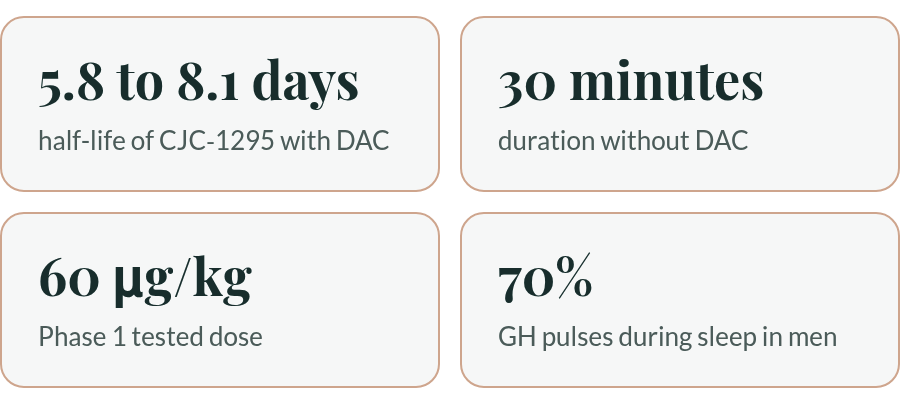
For CJC-1295 with DAC, the human dose data comes down to two numbers: 30 and 60 micrograms per kilogram. Phase 1 investigators described both as safe and relatively well tolerated in healthy adults. Those are research doses, not a prescription for you. We found no reliable clinical range for non-DAC CJC-1295, and none for GHRH used as sleep support. In the overnight study, going from 60 to 90 µg/kg made no significant difference. More was not better.
Early-night timing has support. A bedtime clock doesn’t.
The timing evidence comes from native GHRH, not CJC-1295. In young men, repeated intravenous GHRH during the first few hours of the night increased slow-wave sleep and GH secretion. In the early morning, the approach produced no major changes on sleep EEG. That body of work also found sleep-impairing effects in women, so women shouldn’t assume GHRH will deepen their sleep.
What this shows is that the early-night window matters physiologically. It doesn’t validate a “30 or 60 minutes before bed” injection rule, and a compound active for days wouldn’t follow that clock anyway. Wearable sleep scores were never part of these studies either, so they aren’t a validated way to steer dosing.
Repeat dosing shows persistence, not a cycle
Volunteers who got two or three weekly or biweekly doses kept mean IGF-I above baseline for weeks afterward. That tells you the effect lingers. It doesn’t support the “on for weeks, off for weeks” cycling you’ll see on forums. If your plan needs changes along the way, that’s a call for a licensed provider looking at your labs, not a fixed calendar.
The measured outcomes are narrow:
- CJC-1295 raised GH and IGF-I.
- Early-night GHRH increased slow-wave sleep and GH.
Nobody studied the two together, so the research can’t tell you whether a combined protocol improves recovery, body composition, or sleep architecture. That’s why we build plans around your history in consultation rather than from a template.
Safety, monitoring, and side effects
Marketing copy tends to skip this part: CJC-1295 has a short, narrow clinical record. The core human data come from two randomized, placebo-controlled, double-blind, ascending-dose trials lasting 28 and 49 days, run in healthy adults at two investigational sites. Reported events included injection-site reactions, headache, diarrhea, and systemic vasodilatory responses, the flushing-type effects that come from widened blood vessels.
Those trials were built to measure how a long-acting analog behaves in the body. That’s a pharmacology question. A few weeks in healthy volunteers can’t tell you much about long-term use, and if you’re weighing peptide therapy in Miami Beach for sleep and recovery, you deserve the whole picture, not just the encouraging half.
Why your health history comes first
The published research doesn’t establish how CJC-1295 behaves in people with chronic conditions, including heart disease. If you have known or suspected heart disease, the record is too thin for us to call it reassuring. Our licensed medical providers handle lab review, hormone support, and prescription questions, so your care stays with the right expert at each step.
Lab numbers guide the conversation, not a formula
Our approach is simple: measure, don’t guess. Lab work, including hormone markers, helps show where your body may be out of balance and gives a personalized protocol something real to build on. Early research suggests CJC-1295 may influence IGF-1 pathways, but the published work is limited, and one lab value is one input among many.
That limit applies to timing too. Because the DAC version produces sustained GHRH activity over several days, it doesn’t create a sharp deep-sleep pulse. The shorter-acting no-DAC version is the one more often discussed for natural GH pulsatility and sleep-related release. Your baseline data help us talk through which approach, if any, fits your goals.
Sleep habits come first, then the peptide
Start a growth hormone protocol while going to bed at 1 a.m. some nights and 10 p.m. on others, and you’ve put the cart before the horse. Sleep is the foundation the protocol sits on. It isn’t a bonus the peptide amplifies. Steady your sleep window before you change anything else.
The physiology explains why. In men, about 70% of GH pulses during sleep coincide with slow-wave sleep (non-REM stages III and IV), and the amount of GH released tracks how much deep sleep happens at the same time. Less deep sleep leaves a smaller window for any GHRH signal to work with.
A peptide can’t stand in for lost deep sleep
GHRH acts upstream of a process that depends on deep sleep actually happening. In young men, early-night GHRH increased slow-wave sleep, increased GH, and lowered cortisol. None of that shows a peptide rescuing a night that was cut short or broken up. Your habits set the conditions the peptide works within.
One review raises the stakes. Its authors argue that age-related GH decline may be largely a sleep problem, with the fading sleep-onset pulse playing a major role that pituitary aging alone doesn’t explain. If they’re right, protecting your deep sleep is the first intervention, not the fallback.
GHRH’s sleep effect depends on who you are
The sleep-deepening response comes mainly from young men. In women, GHRH raised ACTH and cortisol and impaired sleep. In older adults, it increased lighter stage 2 sleep and had a weak sleep-promoting effect. If you’re a woman hoping GHRH will deepen your sleep, the current evidence doesn’t back that expectation.
Wearables have a narrow but useful role:
- Use a tracker to keep your bedtime consistent.
- Don’t use its data to change your dose on your own. Dosing belongs in a consultation, where your history, labs, and goals get reviewed together before anything in your protocol shifts.
FAQ
1. Can I use CJC-1295 if I have a heart condition?
This is not a situation for self-directed peptide use. The available studies do not answer how the compound behaves in people with cardiovascular disease, and flushing-type reactions were reported in research participants. A clinician needs to review your medical history, current treatment, and biomarkers before discussing whether any hormone-support approach is appropriate. At BiohackNow, our licensed providers handle those prescription decisions.
2. Will GHRH-based peptides deepen sleep for women and older adults?
The response is not uniform across groups. Research in young men produced the clearest sleep-related findings, while the results in women and older adults moved in different directions. That makes sex, age, baseline sleep, and the reason for treatment important parts of the discussion rather than minor dosing details.
3. Is CJC-1295 without DAC a better fit for sleep than the DAC version?
The two forms differ mainly in duration. A shorter-acting product is easier to discuss in relation to an individual sleep period, while the DAC form creates a longer exposure that cannot be matched to one particular sleep cycle. Neither has established sleep benefits, so the choice cannot be made from timing alone.
4. Does taking a higher dose of CJC-1295 produce better results?
The dose-response findings do not support assuming that more produces more benefit. The research measured hormone responses rather than recovery, body composition, or sleep quality. A larger dose therefore cannot be treated as evidence of a better real-world outcome.
Ready to see which protocol fits your goals? Our team will review your history and biomarkers before you start anything new. Book your consultation with BiohackNow
Free 15-Minute Discovery Call
Ready to take the guesswork out of your health?
Book a free 15-minute call with Monika to talk through your goals, what testing makes sense for you, and the right next step. No pressure, just clarity.
Book Your Free CallFor educational purposes only. Not medical advice.
