
Key Takeaways
- Lab and tissue reviews link GHK-Cu to higher production of collagen, elastin, and glycosaminoglycans (the moisture-holding molecules in skin’s support matrix), plus better activity in dermal fibroblasts, the cells that build skin structure.
- The most-cited copper-peptide skin reviews were written by authors affiliated with a commercial skin-care company. Independent large human trials remain scarce.
- The key follicle study tested AHK-Cu, a related analog, on human follicles in culture. GHK-Cu hair research relied on young mice.
- Gene-expression data show GHK influences multiple biochemical pathways and suppresses NFκB, a molecule thought to accelerate age-related disease. So far, that’s only in preclinical models.
- GHK-Cu is a three-amino-acid peptide found naturally in human plasma. It has appeared in skin and hair products since its discovery in 1973.
Where the GHK-Cu Evidence Actually Stands
You want firmer skin, thicker hair, or a slower aging curve. Someone has pitched GHK-Cu as the answer to all three. The research doesn’t back those goals equally, and before you commit to peptide therapy in Miami Beach or anywhere else, it helps to know how close each claim gets to an actual person using an actual product.
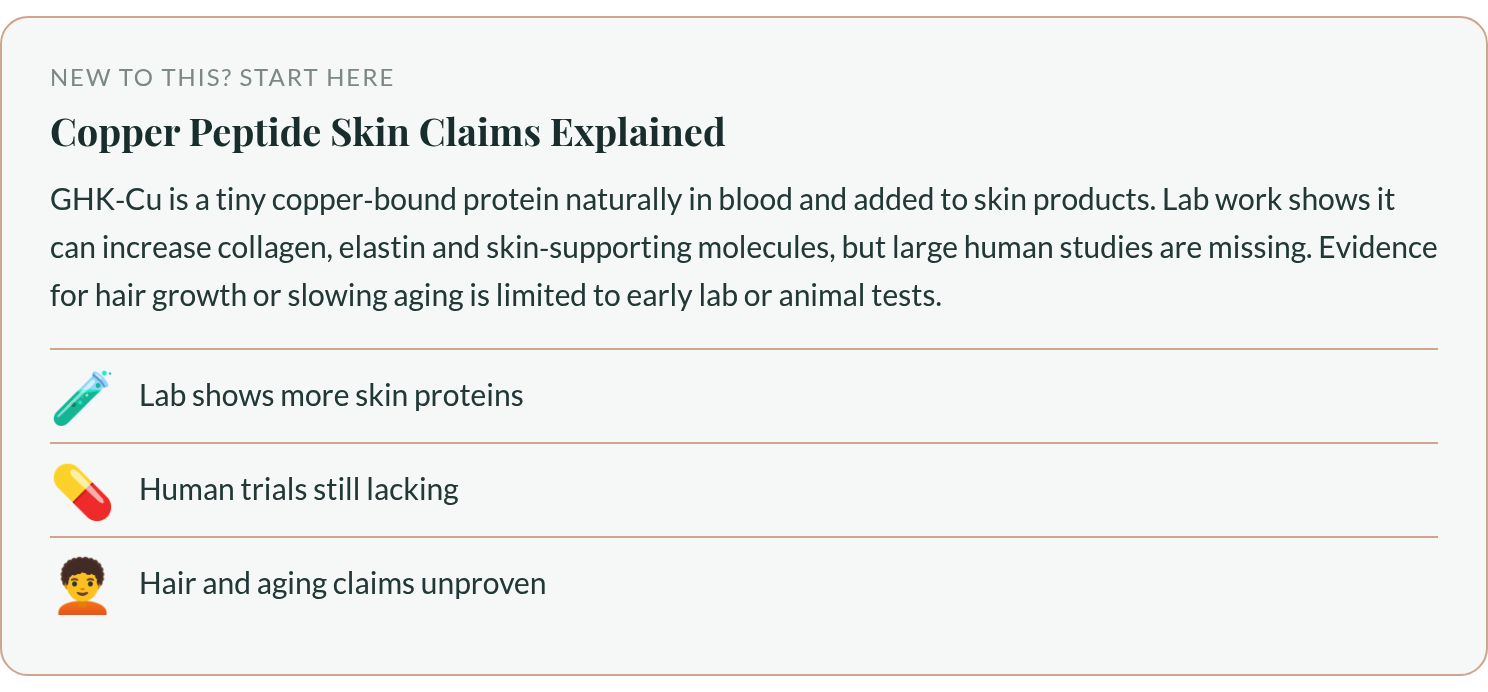
That’s how we sorted the copper-peptide findings below. Skin sits closest to real-world use. Hair and systemic aging sit a long way out.
| Peptide | Target | Studied Route or Model | Reported Study Duration | Key Outcome | Evidence Tier |
|---|---|---|---|---|---|
| GHK-Cu | Skin repair | Review of lab and tissue studies | Not stated in the sources we reviewed | Increased collagen, elastin, and glycosaminoglycan synthesis; supported dermal fibroblast function | Early, mostly preclinical |
| GHK-Cu | Skin and hair products | Topical cosmetic use | Not stated in the sources we reviewed | Widely used in skin and hair products since its discovery in 1973 | Commercial use, not trial evidence |
| Tripeptide-copper complex | Hair growth | In vitro human hair study | Lab culture only | Effects on human hair growth studied in the lab; detailed outcomes not covered in the sources we reviewed | Laboratory only |
| GHK | Tissue repair | Skin, lung connective tissue, bone, liver, and stomach lining | Not applicable | Improved tissue repair reported across these tissues | Preclinical |
| GHK | Systemic aging | Gene-expression and cell studies | Not applicable | Regulates multiple biochemical pathways; suppresses molecules such as NFκB that are thought to accelerate the diseases of aging | Preclinical |
Look at the far-right column. Not one row reads “established in human trials.” The skin findings are consistent enough to justify interest, but much of that work traces back to industry-affiliated authors, which is a reason for caution rather than dismissal.
So should you try it?
For aging skin, topical GHK-Cu is a reasonable thing to discuss with a clinician. For anything else, slow down.
- Skin: The most defensible use case when texture and fine wrinkles are the goal.
- Hair: Don’t build a hair-loss plan around GHK-Cu alone. No study has shown an isolated GHK-Cu benefit on human hair.
- Injectable or individualized protocols: These need their own clinical and regulatory review. A result from a topical product doesn’t carry over to an injection just because the molecule’s name matches.
One more point that trips people up. GHK occurs naturally in plasma and may be released from tissue after injury. That makes for a nice biological story, but it doesn’t hand anyone a dosing target. There’s no validated biomarker (a measurable lab value that tracks a biological process) for tailoring a GHK-Cu regimen.
What the Studies Show on Efficacy and Safety
Expecting dramatic before-and-after photos? The most-cited copper-peptide skin research doesn’t offer them. What it describes is cellular activity. GHK-Cu is a tripeptide, meaning a chain of just three amino acids, and its copper-bound form has become a familiar ingredient in cosmetic formulas. Reviews tie it to collagen, elastin, and glycosaminoglycan synthesis, and to support for the fibroblasts that maintain skin’s structural framework.
Most of that work involves topical exposure and lab models. So if someone has recommended injectable GHK-Cu for your wrinkles, ask a simple question: did the cited research study injections? Usually it didn’t.
Two limitations carry real weight. Several influential reviews came from authors connected to a skin-care company. And independent, large-scale human trials are hard to find. The amount of online enthusiasm has outrun the clinical evidence by a wide margin.
Is there real hair data for GHK-Cu?
Not much. The best-known follicle experiment tested AHK-Cu, a related analog, on human follicles in a dish. It did not test GHK-Cu in people. The separate GHK-Cu hair work used young mice. Those models can raise a good biological question. They can’t tell you whether a serum or an injection will thicken hair on your scalp.
Hair products containing the ingredient also tend to include several other actives, which makes it hard to say what GHK-Cu itself contributed. If someone presents that follicle study as proof of a human scalp result, they’re stretching the source.
What do we know about safety?
Published reviews describe several of GHK’s biological actions as favorable. Favorable mechanisms are not the same thing as long-term safety data for cosmetic use. Human tolerability studies have been small and short, so questions about extended use remain open.
That gap is why our protocols start with a full consultation and lab review. When we use compounded peptides, they come from licensed U.S. compounding pharmacies, with Certificates of Analysis verifying purity and potency.
The mechanism story is further along than the clinical one. Gene-expression findings suggest GHK touches multiple biochemical pathways, which may help explain its broad repair-related activity in the lab. They don’t predict what you’ll see in the mirror.
GHK and GHK-Cu also aren’t interchangeable labels. Your provider should name the exact molecule and formulation being discussed. Fibroblast and follicle findings make a case for more research. They don’t guarantee your response.
Building a Personalized GHK-Cu Protocol in Miami Beach
A useful plan reflects your skin, your scalp, your medical history, and your goals. A generic stack copied from a forum does not. Before we suggest any peptide protocol, our clinical team reviews your recent blood work, health history, and priorities with you.
The research can inform that conversation. It can’t write the prescription. There’s no established lab target showing that a measured GHK level should set the amount or frequency you use.
What can a personalized plan reasonably draw on?
Two things: the published findings and your clinical picture. Skin studies give a rationale for exploring GHK-Cu when repair or texture is the concern. The hair literature argues for restraint. For injectables, the research we reviewed set no standard for frequency, concentration, or cycle length.
Your current products and medications matter too. Decades on store shelves is not head-to-head clinical proof, and it tells us nothing about how the ingredient behaves alongside supplements, hormones, or other peptides.
Get the formulation in writing. Studies and product labels may refer to the copper-bound complex, the unbound peptide, or a loose “copper peptide” category. Those aren’t the same thing, and they shouldn’t be swapped casually.
What shouldn’t you expect from a GHK-Cu protocol?
A validated combination strategy, for one. No study we found tested GHK-Cu alongside supplements, hormones, or other peptides in a way that points to a preferred stack. That’s why we track progress and biomarker updates rather than layering several new interventions at once. Change five things together and you can’t tell which one helped, or which one caused the rash.
Be skeptical of special skin prep or scalp routines said to “boost uptake.” We found no documentation for those promises. We also found no Florida-specific regulatory or insurance guidance on peptide administration, so if someone cites a definitive local rule, ask to see it.
For more on how we evaluate early-stage research, our blog covers related topics.
The Bottom Line on Choosing a GHK-Cu Provider
How a provider talks about the follicle research tells you a lot. That study used AHK-Cu on cultured follicles, not GHK-Cu in a treated patient, and its reported effect on cell death didn’t reach statistical significance at the cell-count level. A careful clinician will volunteer both details. A less careful one will hand you the study as proof.
Run through this checklist before booking peptide therapy in Miami Beach. That includes booking with us.
What to ask a peptide therapy provider in Miami Beach
- Who the clinicians are. Ask who prescribes and who answers your questions once treatment starts.
- Evidence that matches your goal. Skin, hair, and systemic-aging claims rest on very different research. Ask which source supports the specific outcome you’re being promised.
- A documented route and product. Get the route (topical or injectable) and the exact formulation in writing. Request the Certificate of Analysis (COA), the lab document verifying purity and potency. Findings from one preparation don’t automatically apply to every serum or compounded product.
- A follow-up and adverse-event plan. Know who to contact about a reaction and when your next review happens.
Walk away from any program promising to “restore youthful GHK levels.” The research doesn’t show such a target exists, let alone that hitting it delivers a predictable anti-aging result.
What happens after your first consultation?
A good first visit covers your medical history, goals, current products and medications, and relevant risks. It should also define how success gets measured. At BiohackNow, the consultation ($275) includes a review of your labs, history, and goals with our clinical team. From there, a sensible sequence looks like this:
- Agree on one documented route and product.
- Record baseline measures that fit the goal, such as photos, wrinkle depth, or hair density.
- Talk through the limits of the evidence, including what hasn’t been studied.
- Set a review schedule and decide how progress and biomarker updates will be handled.
- Adjust or stop based on response and tolerability.
Short studies may offer some reassurance for the weeks they observed. They can’t speak to years of use. That’s why the monitoring plan is part of the treatment, not an afterthought.
Frequently Asked Questions
Are GHK and GHK-Cu the same thing?
No. GHK is the unbound tripeptide, while GHK-Cu refers to the copper-associated form. The latter is the version most often discussed in connection with skin regeneration. Because the molecules and formulations may behave differently, the label should identify which one a provider intends to use.
Can GHK-Cu be combined with other peptides, hormones, or supplements?
There is no established combination protocol in the research reviewed for this article. A proposed stack should therefore be treated as an individualized clinical decision rather than a validated formula. Ask the provider what each component is intended to do, how interactions will be watched, and what would lead to simplifying or stopping the plan.
Can a blood test show whether I need GHK-Cu or how much to take?
No validated test currently answers that question. Routine laboratory work may help assess general health and treatment suitability, but it does not identify a personal GHK-Cu requirement or prescribe an amount. Be wary of services that use an unvalidated measurement to create a precise-sounding regimen.
Does the topical skin research apply to injectable GHK-Cu?
Not automatically. Delivery route, formulation, and tissue exposure can change how a product behaves. Much of the skin evidence concerns topical preparations or laboratory settings, so an injection requires its own justification. Ask for the proposed route, formulation, supporting evidence, and Certificate of Analysis rather than assuming that one type of product represents another.
Ready to see which protocol fits your goals? Our team will review your history and biomarkers with you before you start anything new. Book your consultation with BiohackNow
Free 15-Minute Discovery Call
Ready to take the guesswork out of your health?
Book a free 15-minute call with Monika to talk through your goals, what testing makes sense for you, and the right next step. No pressure, just clarity.
Book Your Free CallFor educational purposes only. Not medical advice.
