
TL;DR
- CJC-1295 amplifies growth-hormone release through the same pathway that generates both its intended effects and its side effects.
- The practical safety question isn’t whether you feel fine after dose one—it’s whether symptoms repeat, worsen, or cluster across doses.
- Sourcing, storage, and pre-treatment screening matter because most CJC-1295 preparations exist outside FDA-approved channels.
- The DAC formulation extends hormone activity for days, so effects accumulate—follow-up needs to match that timeline.
Related Video
Watch: Real Dr Explains CJC-1295 + Ipamorelin – The CLASSIC Peptide Stack by This Is Not Covered – Dr. Ashley Froese
What You’re Actually Starting
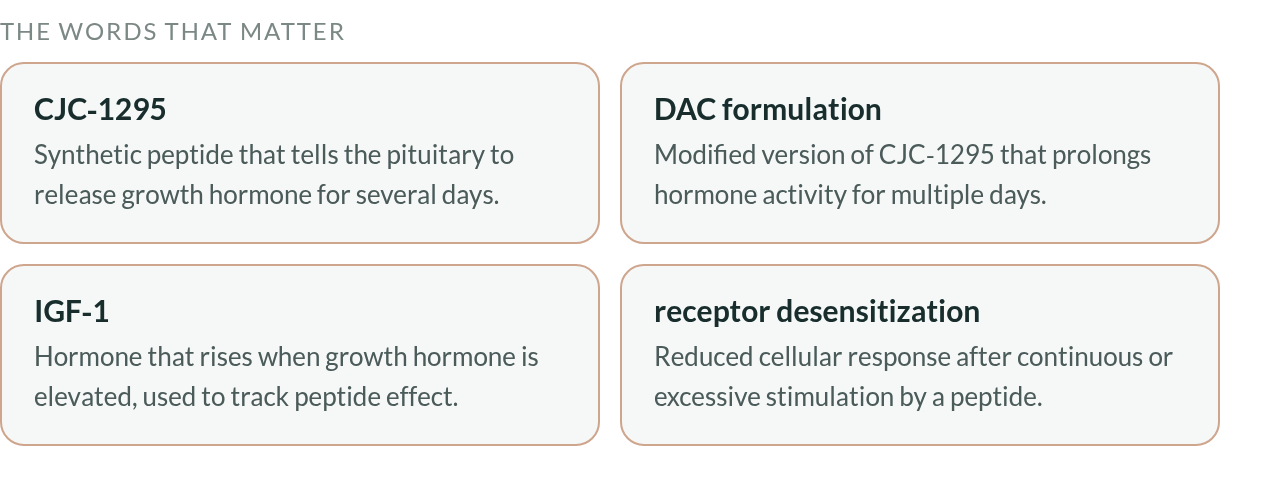
CJC-1295 is a 29-amino-acid analog built from the active portion of growth-hormone-releasing hormone. It mimics the signal that tells your pituitary to release growth hormone, but it lasts days instead of minutes. Protocols vary—some patients inject subcutaneously a few nights per week, others use the long-acting DAC form less frequently. Before any of that, you need to understand the documented side effects, the dosing schedules clinicians actually use, and why medical oversight isn’t optional.
Side Effects: What the Published Trials Show
Injection-site reactions—redness, tenderness, swelling—top the list. Trials have documented dose-dependent local reactions and brief flushing that resolves within minutes. Headaches, nausea, and heart-rate increases at higher doses appear in the literature. Some participants reported drowsiness, dizziness, water retention, or a slight rise in body temperature.
Published research shows more adverse events in CJC-1295 groups than placebo, yet most were mild rather than serious. That distinction matters. Most effects are manageable, but vague terms like “presence of side effects” don’t help a telehealth provider decide whether to adjust your dose. We need severity, timing, duration, and whether the reaction returns after the next injection.
| Side Effect | Typical Onset |
|---|---|
| Injection-site reaction | Immediately after dose |
| Flushing | Minutes post-injection |
| Headache | Hours after dose |
| Nausea | Variable |
| Increased heart rate | Variable |
Storage, Purity, and Why Supervision Isn’t Theater
Reconstituted peptide vials need refrigeration, and the usable shelf life is short—ask the pharmacy for the exact expiration. Most CJC-1295 available today is compounded rather than FDA-approved, so purity and concentration vary between suppliers. We review your full medical history and watch for signals like heart-rate shifts before starting any protocol. The evidence supporting widespread use is thin.
Why Side-Effect Awareness Comes First
CJC-1295 tells your pituitary to release growth hormone for several days at a time. Your body’s natural growth-hormone-releasing hormone breaks down in minutes. That extended window is why patients ask about it when they notice muscle loss, persistent fat, or energy that never quite recovers. But the same mechanism that makes it attractive also makes side-effect tracking non-negotiable.
The human data is narrow. A 2006 trial in healthy adults measured sustained increases in growth hormone and IGF-1 after subcutaneous injection. Even at conservative doses, mild discomfort showed up. Online communities tend to downplay these effects, so patients are often unprepared when their first dose leaves a tender welt or their face flushes for a few minutes.
Why Symptom Logs Become Clinical Data
Your symptom record becomes useful when a provider tracks hormone responses over weeks. CJC-1295 with DAC can keep IGF-1 elevated for days after repeated doses, so a mild headache on day three might signal a cumulative shift by week two. Recording injection-site reactions, heart-rate changes, or new puffiness gives us a timeline we can compare against baseline IGF-1 and fasting glucose. When a pattern appears—persistent nausea after dose two, blood-sugar swings in someone with prediabetes—we adjust or stop before the side effect escalates.

Red Flags You Should Know Before Dose One
Proactive planning means agreeing on warning signs before the first injection. Heart-rate spikes matter more if you have cardiovascular history. Water retention becomes a concern if you’re already managing blood pressure. We walk through these scenarios during intake so you know when to message immediately versus when to track and report at the next check-in. The goal isn’t to scare you away from peptide therapy—it’s to replace guesswork with a response plan that fits your medical context.
The Common Side-Effect Pattern
The most useful way to think about side effects is by pattern. A brief local reaction after an injection is different from swelling that gets worse with each dose. A one-time headache is different from a recurring symptom that shows up on dosing days.
Local skin responses range from tenderness to a raised, firm area—called induration. Most resolve without intervention, but they still belong in your log because they can reveal whether your injection technique, site rotation, or timing needs adjustment.
Headaches and Heart-Rate Changes
Headaches appear in published reports and patient accounts. Cardiovascular responses warrant more caution because CJC-1295 acts through growth-hormone signaling, not as a simple recovery aid. If you have a history of palpitations, blood-pressure concerns, chest symptoms, or cardiovascular disease, those details should come up before treatment—not after your first dose.
Some patients report nausea or puffiness in the hands or feet. The available evidence doesn’t establish how long these symptoms usually last or identify a dose threshold where they become more likely. That uncertainty is why we ask you to report symptoms as they occur instead of trying to decide on your own what’s “normal.”
What the Evidence Doesn’t Tell Us
Published trials enrolled narrow populations and followed them for short periods. That leaves gaps in understanding long-term safety. Early research recorded a high rate of adverse events in treated groups versus placebo, yet classified none as serious. This contrast highlights the difference between common mild reactions—temporary redness, brief flushing—and rare events that require immediate medical attention.
The supplied materials don’t provide validated protocols for managing injection-site pain, flushing, or headache. Some compounding pharmacies suggest rotating injection sites and staying hydrated, but these recommendations lack formal study backing. We guide patients to report any persistent or worsening symptoms rather than self-managing with untested remedies.
Rare Complications and Who Shouldn’t Use CJC-1295
Controlled research captured short-term tolerability signals, not a full map of uncommon complications. The absence of documented serious reactions in early studies should not be mistaken for proof that every patient is low-risk.
Early studies measured growth hormone and IGF-1 responses but didn’t establish biomarker panels for detecting serious complications or define lab thresholds that signal danger. We emphasize regular check-ins and symptom tracking rather than waiting for a red-flag lab value to surface, though published research hasn’t validated a standardized monitoring schedule for peptide therapy.
Cancer Risk and Blood-Sugar Effects
Elevated IGF-1 drives cell-growth signaling. That makes CJC-1295 a theoretical concern for anyone with active cancer or cancer history, though no human trial has documented a direct oncologic event. The same growth-promoting pathway can interfere with glucose metabolism. Some users report fasting glucose changes or worsening insulin sensitivity, but available research measured hormone levels—not metabolic outcomes. Anyone with uncontrolled diabetes or prediabetes should complete glucose screening before starting.
Where the Evidence Stops
Available research doesn’t provide validated drug-interaction warnings or emergency-response recommendations. That absence matters. Without large outcome trials, providers rely on careful intake, conservative decision-making, documentation, and follow-up rather than a universally accepted contraindication checklist. We review your health history and medication list before you start—then monitor symptoms as you go.
Setting Up Your Protocol
In physician-supervised peptide therapy, the documented protocol signals from human research give us starting points—not prescriptions. Early human studies of CJC-1295 with DAC measured sustained increases in growth hormone and IGF-1 after subcutaneous injection in healthy adults, with effects persisting for multiple days. Your protocol should be adjusted to your response, not copied from a generic dosing template.
We offer both CJC-1295 (no-DAC / Mod GRF 1-29) and the long-acting CJC-1295 with DAC formulation. Dosing and frequency are individualized based on your history, goals, and response. Because available evidence doesn’t establish how often follow-up labs should be drawn or define standard pre-treatment panels, our team tracks symptom patterns and hormone responses case by case.
Storage and Injection Technique
Store reconstituted vials in the refrigerator, away from light. Don’t freeze. Rotate injection sites—abdomen, thigh, upper arm—with each dose to reduce local irritation. Your provider will give you specific guidance on vial expiration, missed doses, and timing between injections during your consultation.
Prolonged or excessive stimulation may reduce receptor response, especially with longer-acting forms. That’s why we build recovery intervals into protocols and adjust dosing based on your individual response rather than a fixed schedule. High doses can waste money if the response fades. If your response fades, intensifies, or becomes unpredictable, the answer is reassessment—not simply adding more peptide.
Finding Real Medical Supervision
When you’re weighing peptide therapy, the first question isn’t “where can I buy CJC-1295?” It’s “who will supervise what I’m injecting?” CJC-1295’s FDA compounding status is not a single fixed list. Current guidance places it among bulk drug substances that cannot be used in compounded medications, while a later April 2026 Section 503A Category 2 update assigns a different category. Before assuming a platform is operating illegally—or safely—confirm which rule applies to your specific formulation. That regulatory gap creates real risk.
Licensed Oversight: The Non-Negotiable Baseline
Telehealth supervision can review your health data and spot patterns, but it cannot physically examine you or see an injection-site reaction in person. CJC-1295’s published research documents dose-dependent heart-rate increases and injection-site reactions. A provider who can interpret those symptoms against your cardiovascular history, cancer risk, and glucose control is essential—but the monitoring plan has to be specific enough to match that risk.
The compounding concern adds another layer. Quality and purity vary significantly between sources. Before starting any peptide protocol, ask your provider: where is this compounded, what testing confirms purity, and can you show me the certificate of analysis? A U.S.-licensed compounding pharmacy following USP standards is the baseline.
Questions That Separate Real Supervision from a Prescription Mill
Before you commit, ask three things.
First: will you order baseline labs—IGF-1, fasting glucose, and a lipid panel—before I start, and will you retest at defined intervals? Growth-hormone signaling affects insulin resistance, so tracking those markers matters.
Second: what happens if I develop symptoms that persist, worsen, or feel out of proportion to what you told me to expect? A provider should explain how they decide whether to pause, reduce, reassess, or discontinue.
Third: how do you handle the fact that current human evidence is limited, and outcome data for body composition and recovery remain largely theoretical? Providers should tell you up front when the evidence is narrow and adjust protocols based on what you report rather than promising results the literature hasn’t validated.
Real supervision should feel specific, cautious, and responsive—not like an automatic refill process.
FAQ
Can I use CJC-1295 if I have prediabetes or a family history of cancer?
Possibly, but it requires individualized medical screening. Those histories change the risk conversation because CJC-1295 works through growth-hormone and IGF-1 signaling rather than through a pathway isolated from metabolism or cell-growth activity. Bring your personal and family history, medications, and recent labs to a licensed provider before considering treatment.
How long does flushing or injection-site redness typically last after a CJC-1295 dose?
Your provider should define what they expect for your protocol before you begin. If a skin reaction, warmth, facial flushing, discomfort, or swelling becomes stronger than expected, keeps recurring, or does not follow the pattern you were told to monitor, contact your provider instead of waiting for the next scheduled check-in.
Why does the DAC version of CJC-1295 require more careful symptom tracking than the no-DAC form?
The DAC version is designed for longer activity, while the no-DAC version has a shorter response window. That difference changes how follow-up is handled: with a longer-acting formulation, your provider needs to know whether subtle symptoms are accumulating across the protocol rather than appearing as isolated one-day events.
What should I ask a provider before starting CJC-1295 to confirm they’re offering real supervision?
Ask how they screen candidates, what labs they use, how they handle side effects, where the peptide comes from, and what documentation supports product quality. The strongest providers can explain both the clinical rationale and the limits of the evidence without making the process sound risk-free.
Ready to see which protocol fits your goals? Our team will review your history and biomarkers with you before you start anything new. Book your consultation with BiohackNow
Free 15-Minute Discovery Call
Ready to take the guesswork out of your health?
Book a free 15-minute call with Monika to talk through your goals, what testing makes sense for you, and the right next step. No pressure, just clarity.
Book Your Free CallFor educational purposes only. Not medical advice.
