
Quick Comparison Summary
Search “peptide therapy near me” and the results split into a few clear buckets that are not interchangeable. Three lines do most of the sorting: FDA status, how the peptide was sourced and tested, and whether anyone watches you after the first injection. Get those straight and the rest falls into place.
Most people compare clinics on price. That skips the part that actually protects you: what happens between doses. A program built around at-home dosing with wearable data and adjusted protocols is a different product from a one-and-done prescription, even when the peptide in the vial is identical.
How the Main Peptide Options Stack Up
Quick read: FDA-approved peptides carry the strongest safety data and the narrowest menu. Compounded peptides may give you personalization with variable testing and oversight behind it. Research-grade material is the cheapest and the riskiest, because it often ships with no medical oversight.
| Factor | FDA-Approved Rx | Compounded (Licensed Pharmacy) | Research-Grade (Educational) | At-Home Monitored Program |
|---|---|---|---|---|
| FDA status | Fully approved | Prepared in a licensed pharmacy; facility oversight varies | Not for human use | Depends on peptide sourced |
| Purity testing | Full clinical trials | Certificate of Analysis (COA) often provided; testing varies | Third-party COA varies | COA required per protocol |
| Medical supervision | Yes | May be dispensed under a prescription | None | Ongoing clinical oversight |
| Dosage adjustment | Fixed labeling | Practitioner-set | Self-directed | Data-driven, adjusted over time |
| Best for | Approved indications | Personalized longevity stacks | Informed self-experimenters | Optimization with feedback loops |
Approved peptides come with regulatory review and therefore more predictable dosing. Compounded peptides sit in a supervised middle lane, though that supervision can vary. Research-grade peptides sit outside that oversight entirely.
The Cost You See vs. the Cost That Matters
The gap is in monitoring, not the vial. A raw research-grade peptide looks cheap online. That price ignores lab work, a clinical consultation, and follow-up. A supervised program folds those in, and that’s where the value sits.
Expect a consultation fee to anchor any legitimate program. Our peptide consultation runs $275 and covers a full review of your blood work, health history, and goals before a single protocol gets written. That fee buys the thing research-grade shopping skips: someone accountable for your dosing.
Skip the research-grade route if you have no way to verify purity or run baseline labs. Buying vials without a feedback loop is shopping, not treatment.
Why the Monitoring Is the Actual Product
Continuous data beats a static prescription. A fixed protocol assumes your biology stays put. It doesn’t. Sleep, recovery, and metabolic markers shift week to week, and wearable data lets a practitioner adjust dosing to what your body is actually doing.
That’s what the cheapest options can’t replicate. Pairing biomarker updates with flagged trends turns a one-time script into a protocol that evolves with you. For anyone chasing longevity or performance, that adjustment loop is the difference between guessing and steering.
Key Takeaways
- FDA-approved peptides carry the strongest safety data from full clinical trials but offer the narrowest menu of approved indications.
- Compounded peptides may be supplied through licensed pharmacies that offer a Certificate of Analysis and may require a prescription; testing and oversight can vary.
- A legitimate peptide consultation anchors around $275, covering blood work review, health history, and goals before any protocol gets written.
- For non-FDA-approved peptides, oversight may be uneven; some experts say it can fall largely to states rather than a federal safety system.
Why Consider These Options
People land on a search for peptide therapy near me from very different starting points, and the reason you’re searching changes which option fits. A recovering athlete wants tissue repair. A busy professional wants steadier energy and sleep. Someone building a longevity plan wants to move a biomarker and watch it respond over months. Three different jobs. Pretending one clinic model serves all of them is how people end up disappointed.
So the first factor isn’t the peptide. It’s what you need done and how closely it has to be watched.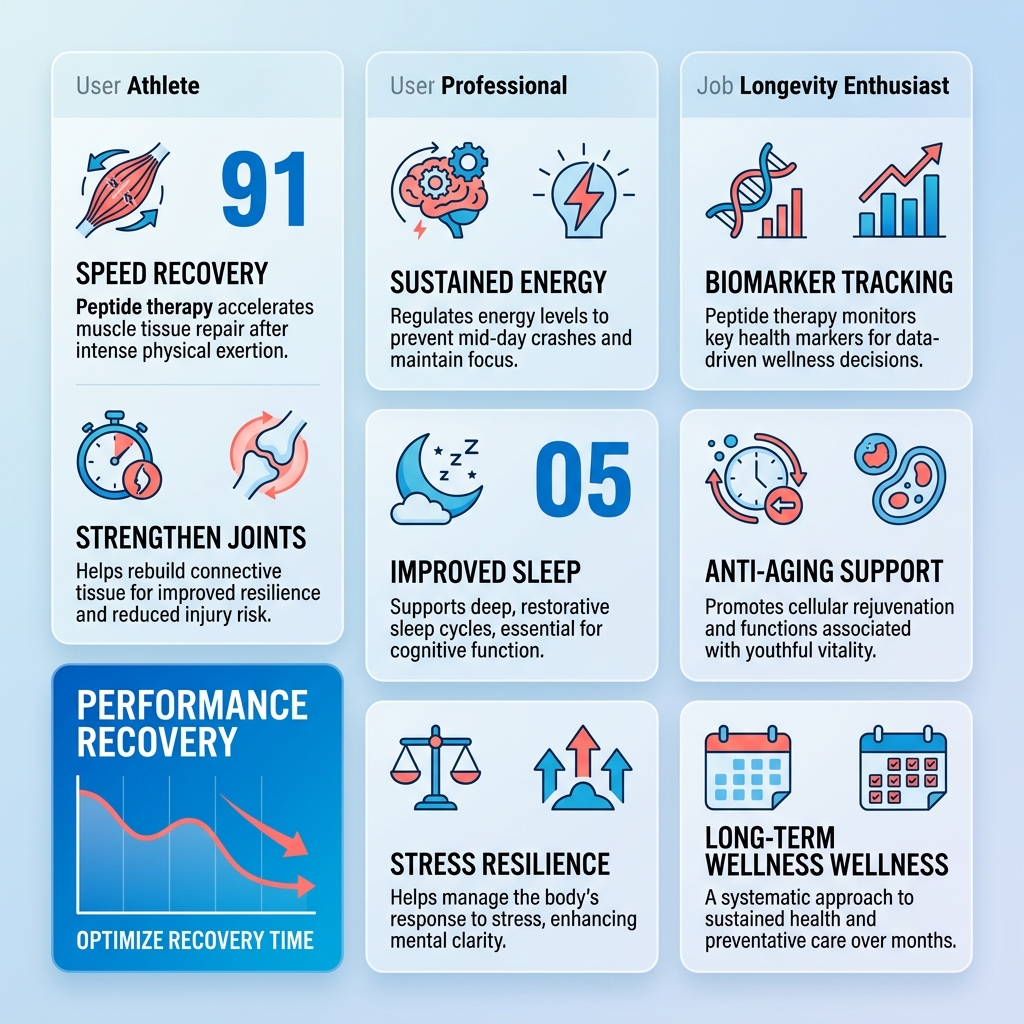
Who Is Peptide Therapy Near Me Actually For?
The best fit is people who want an ongoing, measured program rather than a single script. If your goal is a defined outcome you can track, a clinically supervised protocol with biomarker tracking gives you feedback most walk-in clinics never collect. Telomere length, hormones, toxins, gut health. Those measures are what let a protocol get tuned to you instead of to an average.
Skip the heavily monitored route if you only need a short, FDA-approved course for a clear medical indication. There the strongest safety data lives with the approved product, and a straightforward prescription is enough. Bolting biomarker-driven adjustment onto a two-week approved regimen is effort without payoff.
Why Does Monitoring Weigh So Heavily Here?
Now the uncomfortable part that shapes the whole comparison. For many peptides that aren’t FDA-approved, the federal safety net is less clear; oversight may fall to states. Some public-health experts have argued that this makes oversight uneven at best.
That reframes what ongoing biomarker tracking and protocol adjustment are doing. For non-approved peptides, continuous monitoring isn’t a luxury feature. It’s replacing a safety net that regulation never built. When we run a supervised protocol, that clinical oversight and biomarker review is the mechanism catching trouble early, because nothing upstream will catch it for you.
How Do The Main Models Compare?
| Selection factor | Approved-only clinic | Walk-in compounded clinic | Clinically supervised program with biomarker tracking (our model) |
|---|---|---|---|
| Best for | Short defined medical course | One-off compounded script | Ongoing longevity + performance tracking |
| Post-dose oversight | Standard follow-up | Often minimal | Ongoing, clinically supervised |
| Dose personalization | Fixed to label | Practitioner’s call | Adjusted to your biomarker updates |
| Where the safety net lives | FDA + follow-up | Largely the state | Ongoing clinical oversight |
Read the table by your actual need, not by price. If you want a program that responds to how your body reacts over time, the clinically supervised, biomarker-tracked route is built for that job.
One honest caveat from the field: critics point out the peptide space can run ahead of its evidence, with hype outpacing what studies show. That critique lands when monitoring is decoration. It stops applying when the data genuinely drives the dosing. For the reasoning behind that distinction, our clinic blog goes deeper.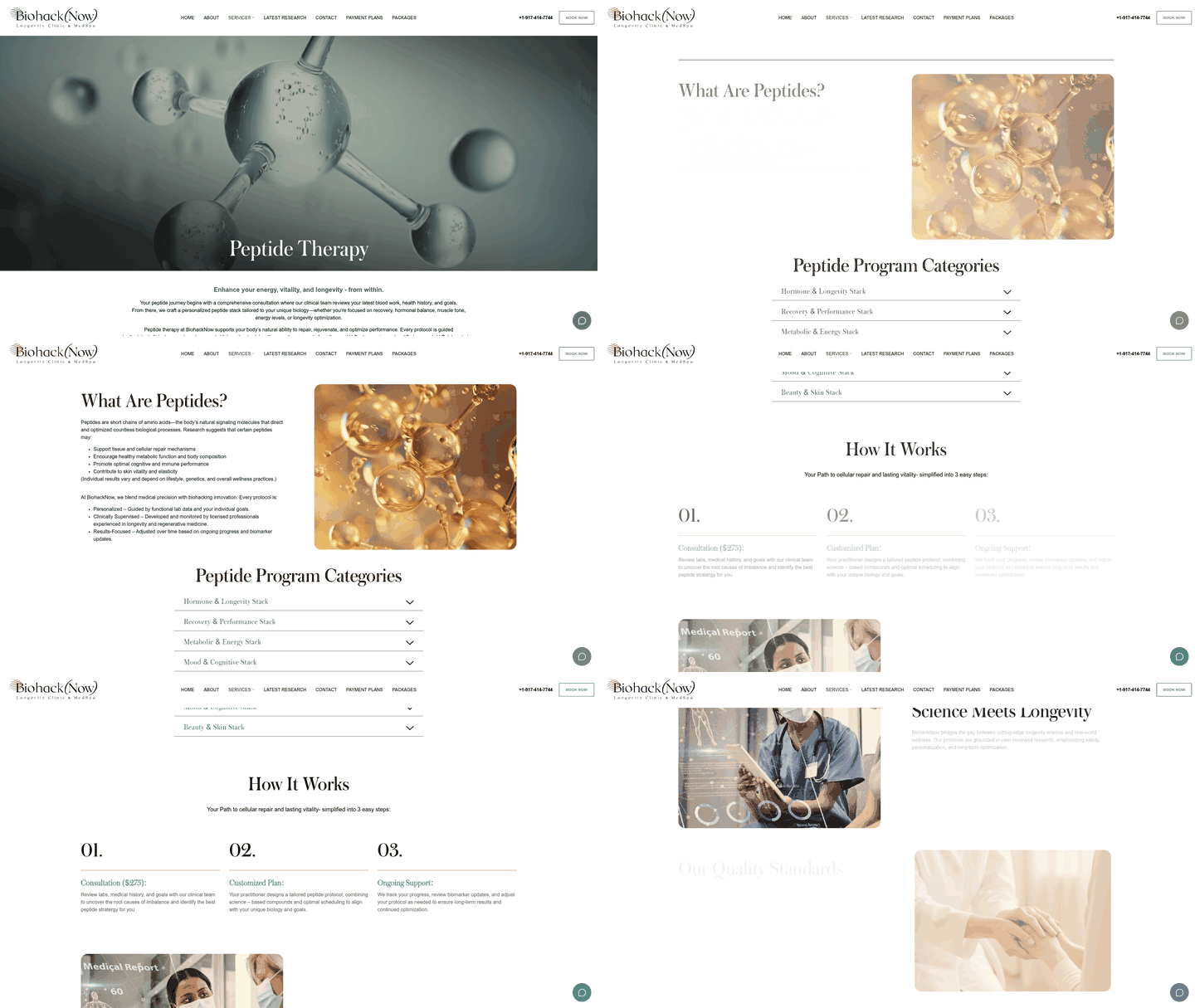
Feature Comparison
Most comparison pages stop at the vial. They tell you which peptide, at what price, and call it done. But the feature that actually changes your outcome sits outside the vial: what gets measured after you dose, and whether anyone acts on it. That’s where these options separate.
We built our program around that gap. So let’s compare feature by feature and show where clinical supervision with biomarker tracking and adjustable protocols earns its keep. If you’re weighing peptide therapy near me options on capability rather than convenience, this is the table that matters.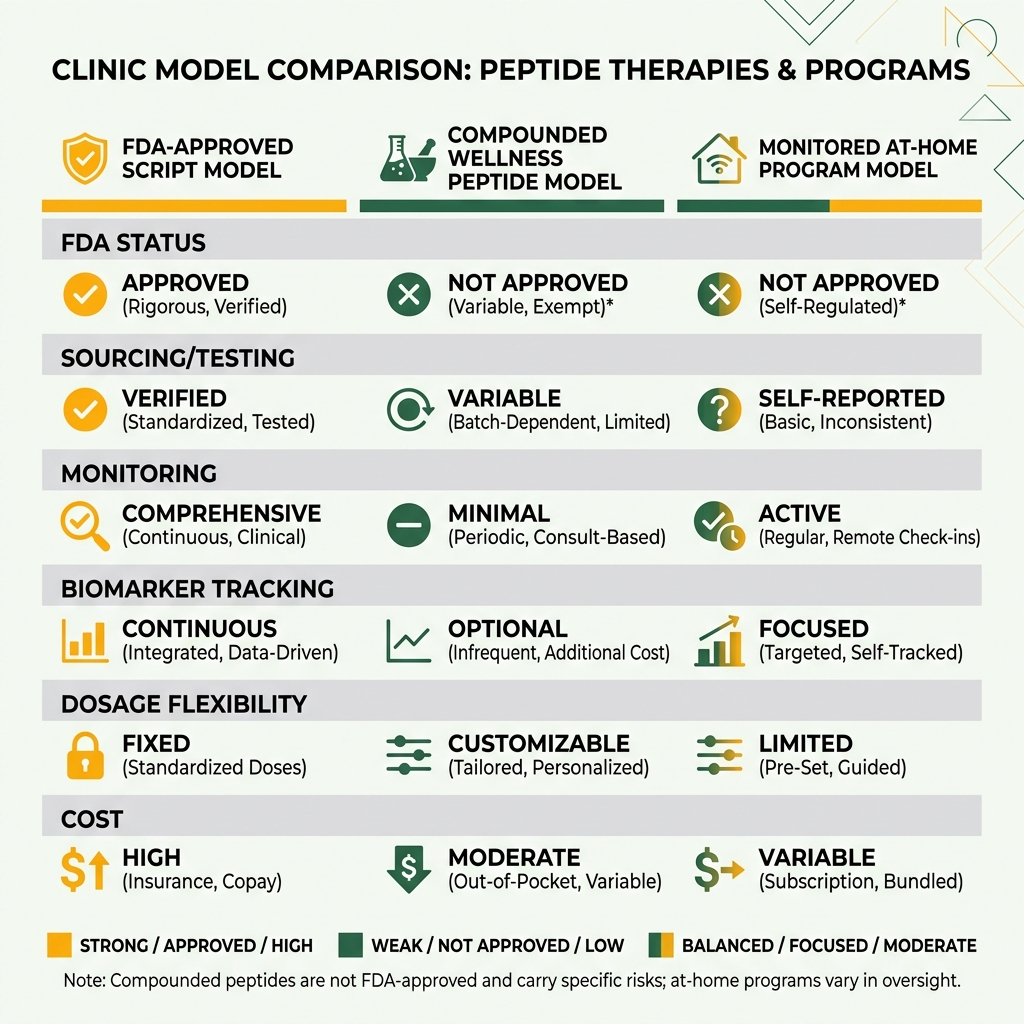
What Features Actually Separate These Options?
| Feature | FDA-approved (in-clinic script) | Compounded / wellness peptide | Clinically supervised program with biomarker tracking |
|---|---|---|---|
| Characterized pharmacokinetics | Yes | Often no established PK | Yes (built on approved-peptide PK) |
| Post-dose monitoring | Usually none between visits | None | Ongoing biomarker review + clinical oversight |
| Dosage adjustment | Fixed script | Fixed or self-guided | Data-driven, adjusted over time |
| Safety-signal tracking | Periodic labs | None | Biomarker updates + periodic labs |
| Best for | Single defined indication | Experimentation | Ongoing, measured longevity work |
The pattern is clear. The first two columns hand you a dose and send you home. The third watches what the dose does and responds.
Why Does Monitoring Only Work With Known Peptides?
This part gets glossed over. Some peptide drugs have drawn regulatory attention for safety concerns such as QTc prolongation and immunogenicity. Lab review and biomarker tracking can be useful against exactly those signals, when they apply. That’s a strong argument for ongoing clinical monitoring.
But monitoring is only actionable when the peptide has characterized pharmacokinetics. You need to know how the compound behaves in the body before a data point means anything. With an approved peptide, that baseline exists. You can see a QTc drift, if that concern applies, and adjust with confidence.
Many compounded and wellness peptides lack established PK and safety profiles. So adjusting your dose there is optimizing against an unknown. Fancy data on top of an uncharacterized molecule is still guesswork with a nicer dashboard. We won’t pretend otherwise, and neither should any clinic selling it.
Where Does Each Option Fall Short?
Approved in-clinic scripts are the safest starting point, but the menu is narrow and the monitoring stops at the door. You get a proven compound and very little feedback between appointments.
Compounded peptides open the menu wide. The trade-off is trusting sourcing and testing that vary enormously, with often no PK or safety data to anchor a dose. Without a measurement loop closing the circle, the endless stacking that follows starts to look more like shopping than science. That critique only lands when there’s no ongoing biomarker review holding a protocol accountable.
A clinically supervised program with biomarker tracking fixes the monitoring gap, and it’s the one category where ongoing adjustment makes clinical sense. Its limit is honesty about inputs: it should run on peptides with real PK, or the tracking is decorating noise. Used that way, it’s the strongest fit for people who want a tracked, adjustable longevity protocol rather than a one-time script.
Performance Comparison
The real performance question isn’t how fast a peptide acts in your bloodstream. It’s how fast the whole program gets you to a dose that works, and how well it holds up when life gets busy. Compare peptide therapy near me options on that basis and the gap between a one-time script and a monitored program widens fast.
A single in-clinic script performs well on day one, then goes quiet. You feel something or you don’t, and the next data point is your memory at a follow-up weeks later. That’s slow feedback. Our model closes the loop by tracking biomarkers over time and adjusting the protocol as your numbers move, so changes follow data rather than guesswork.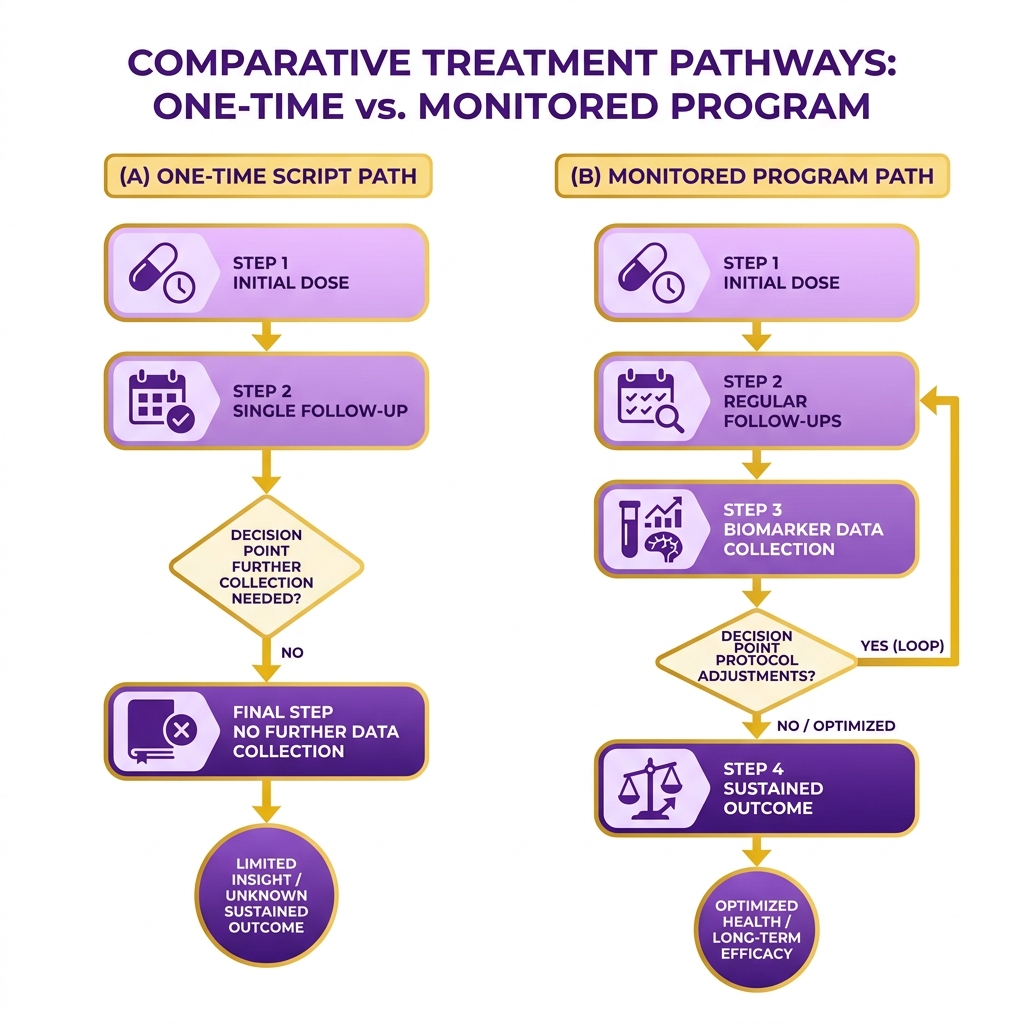
How Fast Do You Reach a Working Dose?
Speed here means time-to-titration, not injection kinetics. Most programs start conservative and wait for a scheduled visit to change anything. Safe, but sluggish.
When your protocol is built on functional lab data and ongoing biomarker updates, the signal to adjust is clearer. We use those reads to refine dosing over time, which narrows the trial-and-error window most people spend guessing.
The tradeoff is honest: this only helps if you follow through with the lab work and check-ins. Skip it for a peptide you’re trialing casually for two weeks. The monitoring overhead isn’t worth it for a short experiment.
| Performance factor | In-clinic script | Compounded / mail-order | Monitored program |
|---|---|---|---|
| Time to a working dose | Slow (visit-gated) | Variable (self-guided) | Fast (data-guided) |
| Feedback loop | Weeks to months | None built in | Ongoing biomarker updates |
| Scales across your busy weeks | Poor | Good but unsupervised | Good and supervised |
| Monitoring burden on you | Low | Low | Moderate (labs + check-ins) |
| Clinician effort per adjustment | High (in-person) | None | Low (data-driven) |
Does It Scale Without Adding Clinic Visits?
Scalability cuts two ways: your side and ours. On your side, the question is whether the program survives travel, deadlines, and missed appointments. A visit-dependent model breaks the moment your calendar does.
A protocol built on lab data and biomarker tracking scales because the plan is anchored to your biology, not a single appointment slot. Ongoing review means your practitioner can adjust as your numbers change.
On our side, clinical oversight goes where it matters, because biomarker updates surface which protocols need attention. A licensed practitioner reviews progress and adjusts as needed rather than spreading effort evenly across a schedule.
What About Resource Usage?
Resource usage is where the mail-order route looks cheapest and performs worst. It uses almost no clinical resources, which is exactly the problem: nobody catches a trend going the wrong way.
We spend more up front on a comprehensive initial consultation, blood work, and baseline lab reads. That investment pays back by catching issues early and avoiding wasted months on a dose that was never going to work.
If you want the lightest-touch option and accept flying blind, a plain script wins on resource economy. If you want measured progress you can see, the monitored path earns its extra inputs. You can see how we think about that balance on our clinic blog.
Pros and Cons
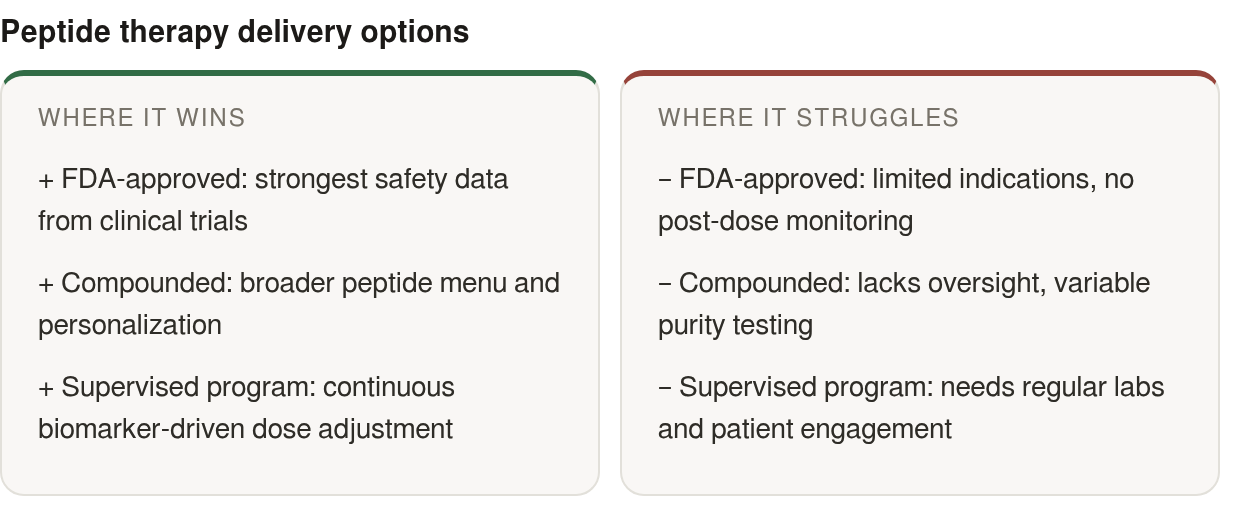
Every option in a peptide therapy near me search buys you something and costs you something else. The trick is knowing which trade-off you can live with. An FDA-approved script buys certainty and gives up flexibility. A compounded wellness peptide buys a wider menu and gives up oversight. A monitored at-home program buys ongoing correction and asks you to store and handle product yourself.
None is strictly better. They solve different problems, and the honest read is that the right pick depends on how much guidance you want between doses. The strengths and weaknesses line up like this.
Where Each Option Wins and Loses
| Option | Biggest strength | Biggest weakness |
|---|---|---|
| FDA-approved (in-clinic) | Strongest safety data, clear dosing | Narrow menu, no ongoing adjustment |
| Compounded / wellness peptide | Wide selection, easy access | No monitoring, variable sourcing and testing |
| Clinically supervised program (BiohackNow) | Biomarker-guided protocol adjustment over time | Requires ongoing consultation and engagement |
The FDA-approved route is the one I’d point most first-timers to when a peptide with real approval fits their goal. You get dosing backed by regulatory review and the fewest unknowns. The catch is the short list. If your target isn’t on it, this lane simply doesn’t carry the product.
Compounded and wellness peptides open the menu wide. That’s the appeal and the risk in one breath. Sourcing and testing vary between suppliers, and once the vial is in your hands, nobody’s checking whether the dose still fits you.
The Storage Blind Spot Nobody Puts on the Label
This is the trade-off that gets glossed over in at-home programs, even well-run ones. Many peptides can be unstable in liquid form. During preparation and storage the product can degrade, and that degradation is invisible to you and to your wearable.
Think about what that means for AI-driven dosing. Your wrist tracks heart rate variability, sleep, and recovery. It reads your physiology beautifully. It cannot read the vial. So if a peptide has partially broken down in your fridge, the algorithm sees a weaker response and may nudge the dose up, quietly compensating for decay it has no way to detect.
This is where clinical oversight matters. Protocols are developed and monitored by licensed professionals, and quality is controlled at the source. Many compounded peptides come from licensed pharmacies that may provide Certificates of Analysis for purity and potency; facility oversight varies. The monitoring loop is only as good as the product feeding it.
Who Should Skip the At-Home Model
Be honest about engagement. If you won’t follow the protocol consistently or keep up with consultations and lab reviews, a supervised program loses its whole advantage. You’re better off with a single supervised in-clinic script.
Skip at-home dosing entirely if you’re chasing a peptide with thin evidence behind it. Plenty of compounds have hype running well ahead of the data, and no amount of wearable tracking makes an unproven peptide work. Match the model to a goal you can measure, and the trade-offs start paying off.
Use Cases and Ideal Users
Start with the most honest thing we can tell anyone typing peptide therapy near me into a search bar: the monitoring you’re paying for only matters for some peptides. That single fact sorts buyers faster than any feature list.
If your peptide is a long-acting, FDA-approved drug like weekly semaglutide, the chemistry already does the work between doses. The molecule was engineered to hold steady for days, so intensive monitoring and frequent dose tweaks add little. You’re paying for smoothing on a curve that’s already smooth. We say that plainly because pretending otherwise would sell you a service you don’t need.
The monitoring model earns its place with short-acting, non-approved peptides where levels swing and response varies person to person. That’s also, honestly, where the clinical evidence is thinnest. So the ideal user isn’t chasing a miracle. They want tight observation precisely because the ground is less certain.
Who Is Clinically Monitored Peptide Therapy Right For?
The strongest fit is people running a longer protocol with a measurable target and real day-to-day variability. Recovery load that shifts with training, say, or sleep and glucose patterns worth tracking over time. If your numbers move week to week, ongoing biomarker review and protocol adjustment give you something a single script can’t.
It also fits people who want structure and accountability rather than a one-and-done script. A personalized protocol with scheduled progress tracking and biomarker updates keeps oversight intact as your needs change.
Skip it if you’re on a stable approved peptide and feeling fine. Skip it too if, as some online commenters put it, this looks like “consumerism for health freaks.” More sensors won’t fix an unclear goal.
Which Option Fits Which Person?
| Buyer profile | Best-fit option | Why |
|---|---|---|
| Stable dose, approved drug, low variability | FDA-approved in-clinic script | Engineered half-life already holds steady; monitoring adds little |
| Wide peptide menu, comfortable self-managing | Compounded / wellness peptide | Broadest access, accepts less oversight |
| Longer protocol, variable biomarkers, wants correction | BiohackNow clinically supervised protocol | Ongoing biomarker tracking and protocol adjustment over time |
One caution on that last row, and it applies to us too. Protocol adjustment is only as good as the evidence under the peptide it’s tuning. For short-acting compounds, ongoing biomarker review and dose refinement are real and useful for staying inside a safe, effective range. They are not a substitute for approval-grade safety data that doesn’t yet exist for many of these molecules. We’d rather you hear that from us than find it later.
What Decision Factors Actually Matter?
Three questions settle most choices. Does your peptide’s half-life make between-dose tuning meaningful, or is it already stable? Do your biomarkers vary enough that fresh data changes the dose? And will you realistically show up for supervision any other way?
Answer those honestly and the right option is usually obvious. Our program is built for the person who answered yes to all three, not the one who just wants another gadget in the routine.
How to Pick Your Peptide Lane
After all that comparison, the honest read is simple: the peptide inside the vial matters less than the system around it. When you search peptide therapy near me, you’re really choosing how much oversight you want between doses, and that choice should follow your goal, not the marketing.
We built our program around the gap a one-time script leaves open. If you want a defined outcome you can watch move over months, a clinically supervised model with biomarker tracking and adjustable protocols keeps correcting as your numbers change. If you just need a stable, FDA-approved drug, you don’t need us for that, and we’ll say so.
Which Option Should You Actually Pick?
| Your situation | Best fit |
|---|---|
| Long-acting FDA-approved drug (weekly dosing) | In-clinic script. The chemistry holds steady on its own |
| Wide peptide menu, comfortable self-managing | Compounded / wellness peptide, eyes open on oversight |
| Trackable longevity goal, short-acting peptide | BiohackNow. Clinical supervision, biomarker tracking, protocols adjusted over time |
Notice we win exactly one row. That’s deliberate. Stacking the deck would be dishonest, and the supervised model only earns its cost when levels swing and response varies person to person. For a smooth, engineered molecule, intensive tracking is smoothing a curve that’s already flat.
The Risk That Doesn’t Fit in a Comparison Table
A tension worth sitting with. Many early-stage peptide candidates never clear the bar in people, and the hype tends to outrun the evidence. Some observers might argue that if compounding stays permissive, there may be less incentive to run the confirmatory human trials that would settle the question.
That leaves a strange gap. The data a supervised program generates could become one of the few real human signals ever collected on some of these peptides. That’s no substitute for the clinical trials that may never happen. We take it seriously, which is why our protocols lean toward peptides with the strongest safety data and why every client journey includes a comprehensive lab review and ongoing clinical oversight, not a private experiment run on you.
Biohacking has its own well-known trap: chasing novelty for its own sake instead of what actually moves the needle. Monitoring exists to stop that drift. If the biomarker data says a peptide isn’t working, we change it or stop it. That’s the point.
Your Next Step
Pick the FDA script for certainty on an approved drug. Pick a compounded peptide if you want range and can manage yourself. Pick a supervised, data-guided program if your goal is measurable and you want someone acting on the numbers between doses.
We’re confident in that third lane because it’s the one we run. For deeper reads on protocols and biomarkers, our clinic blog goes further. Match the model to the job, and the search stops feeling like a gamble.
Quick Questions, Straight Answers
1. Can a smartwatch or AI algorithm tell if my peptide has gone bad in the fridge?
Wearables cannot read the vial. They track heart rate variability, sleep, and recovery, but if a peptide degrades in liquid storage, the algorithm sees a weaker response and may push the dose up, quietly compensating for decay it can’t detect. That’s why quality control at the source and clinical oversight matter.
2. I’m already on weekly semaglutide and feeling fine. Should I add biomarker monitoring?
Skip it. Long-acting FDA-approved peptides like weekly semaglutide were engineered to hold steady for days, so the chemistry does the work between doses. Intensive monitoring adds little value on a curve that’s already smooth. Save the tracking for short-acting peptides where levels swing and response varies.
3. If a peptide isn’t FDA-approved, who catches a safety problem?
Oversight may fall largely to individual states, which can be uneven. Many non-approved peptides do not have the same federal adverse-event reporting or facility inspection framework as approved drugs. For these, ongoing biomarker review and clinical monitoring aren’t luxuries. They replace a safety net that regulation never built, catching trouble early since nothing upstream will.
4. What is a Certificate of Analysis and why should it factor into my decision?
A Certificate of Analysis (COA) is a document some suppliers use to describe a peptide’s purity and potency. Some compounded peptides are supplied with a COA, and some providers say they use FDA-inspected or licensed pharmacies. Research-grade material’s third-party COA varies or may be absent, which is why buying vials without verified testing is shopping, not treatment.
Free 15-Minute Discovery Call
Ready to take the guesswork out of your health?
Book a free 15-minute call with Monika to talk through your goals, what testing makes sense for you, and the right next step. No pressure, just clarity.
Book Your Free CallFor educational purposes only. Not medical advice.