
Key Takeaways
- TB-500 and BPC-157, sold together as the „Wolverine Stack,“ get marketed for tendons, ligaments, and connective tissue.
- Almost all the promising data comes from animals and lab dishes, not large controlled human trials.
- A controlled rat Achilles study found TB-500 raised maximum load to failure versus controls (p < 0.05).
- That same study showed lower total Bonar scores (p = 0.016), meaning better-organized collagen.
- Adding BPC-157 to TB-500 produced no measurable extra benefit, which points to overlapping biology.
- Stacking both because a label told you to may just mean paying for redundancy.
- The single-peptide TB-500 case for tendon healing is stronger than the case for the combined stack.
Why athletes keep asking about the Wolverine Stack
For an aging endurance athlete, the pitch comes down to one question: can you shorten the gap between the finish line and your next real training block? That’s where TB-500 capsules and BPC-157 entered the conversation, bundled as the „Wolverine Stack“ and aimed at tendons, ligaments, and connective tissue. The athletes we see want faster return-to-play, less downtime, and tissue that holds up as recovery slows with age.
The honest starting point: marketing has outpaced the science. Almost all the promising data comes from animal and lab models, not large human trials. Our job is to build a recovery protocol around your goals without pretending the evidence is stronger than it is.
What the tendon research actually shows
The strongest single-peptide signal points to TB-500 for structural tendon integrity. When researchers looked at tendon repairs under the microscope, they checked how well the new collagen fibers lined up. Treated tissue showed better architecture and could take more mechanical tension before rupturing than untreated controls. So the peptide seems to support the physical rebuilding phase, not just mask symptoms.
That same finding exposes the weak point in the popular two-peptide approach. When both compounds went in together, the combined group didn’t beat the single-agent protocol. No synergy. The likeliest read is that the cellular machinery doing the remodeling gets saturated, so piling on a second peptide adds nothing.
If you’re stacking purely because a supplement label told you to, you may be paying for redundancy. For tendon healing specifically, the single-peptide TB-500 case is stronger than the combined-stack case, at least in the one controlled comparison that exists.
Why the protocol has to be personalized
Because response varies, and the pharmacokinetics are unforgiving. BPC-157 clears quickly through the kidneys. TB-500 is a large molecule with poor oral absorption. How you clear peptides, rebuild collagen, and resolve inflammation differs person to person. That’s why our consultations start with your individual health picture before anyone recommends a protocol, rather than handing every athlete the same capsule schedule.
One tension worth naming out loud. Human clinical evidence for BPC-157 is limited, and regulators stay cautious. The reason is the lack of large-scale data and unregulated manufacturing, not any documented harm. „No evidence of harm“ is not the same as „evidence of safety.“
When to skip this stack entirely
Skip it if you compete under WADA. Both peptides are prohibited in sport. Using them puts your eligibility on the line, full stop.
What the available evidence actually supports:
- Structural tissue remodeling with TB-500 in controlled animal repair models
- Better fiber alignment shown by lower Bonar and Movin scores
- Angiogenesis and localized inflammatory modulation attributed to BPC-157
- Single-peptide efficiency from skipping redundant combinations
Complexity rating: advanced. This is not a beginner supplement. Between banned status, oral bioavailability limits, and grey-market purity risks, the protocol built around it matters more than the peptides themselves.
TB-500: what it is, how it’s built, and where it might help

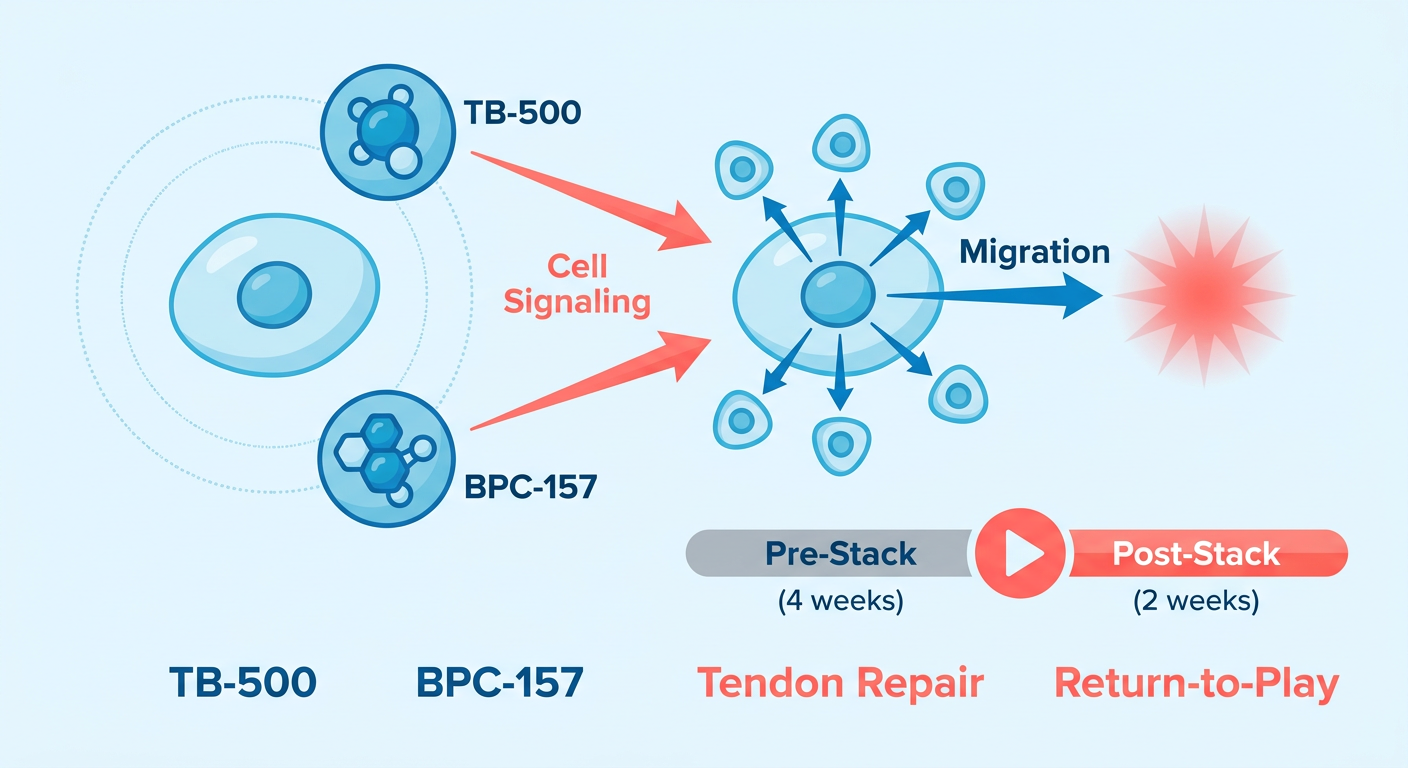
TB-500 is a synthetic version of thymosin beta-4, a peptide that regulates actin. Its job in the body is to regulate actin, the protein that lets cells crawl, migrate to injury sites, and rebuild tissue. That mechanism is why TB-500 capsules get marketed to endurance athletes chasing faster connective-tissue repair.
The catch: nearly all the efficacy data comes from injection or topical routes. For an aging athlete trying to personalize a recovery stack, delivery method matters as much as the peptide.
How TB-500 actually repairs tissue
The mechanics center on actin regulation, which helps healing cells migrate to the injury site. In the landmark animal model of tendon transection and surgical repair, researchers gave 60 µg/kg/day over several weeks. The tissue analysis showed improved fiber alignment plus significantly reduced degenerative changes, reflected in lower total Movin scores. That points to more organized, functional scar tissue forming during the early phases of recovery.
The practical read: the benefit showed up in tendon tissue, not muscle soreness. If your post-competition problem is a strained tendon or ligament, the mechanism at least points the right way. For ordinary DOMS, there’s no tissue-repair rationale here.
Do oral TB-500 capsules actually reach your tendons?
Probably not systemically. Most therapeutic peptides have very low oral bioavailability, and no published human data establishes reliable systemic absorption for oral TB-500. Every preclinical result we trust used injection.
This is the collision at the center of the capsule format. The rat tendon data and the venous-ulcer healing (~25% complete healing with 0.03% topical TB-500 in a European study) both came from routes that bypass your gut. Swallow the same peptide and digestion likely degrades most of it.
Our take: oral TB-500 capsules may act locally in the gut lining, but expecting them to rebuild a distant Achilles is optimistic. Systemic effects from a capsule deserve skepticism until pharmacokinetic data exist. We treat the capsule as a low-confidence delivery route, not the headline tool.
Does stacking with BPC-157 add anything?
Biochemically, the missing synergy points to a receptor or downstream bottleneck. If both molecules trigger overlapping cascades, say, upregulating the same growth factors or pushing endothelial cell migration, they end up competing for the same cellular machinery. Running both at once doesn’t speed up the rate-limiting steps of tissue synthesis, which makes a sequential or single-peptide approach the more logical play.
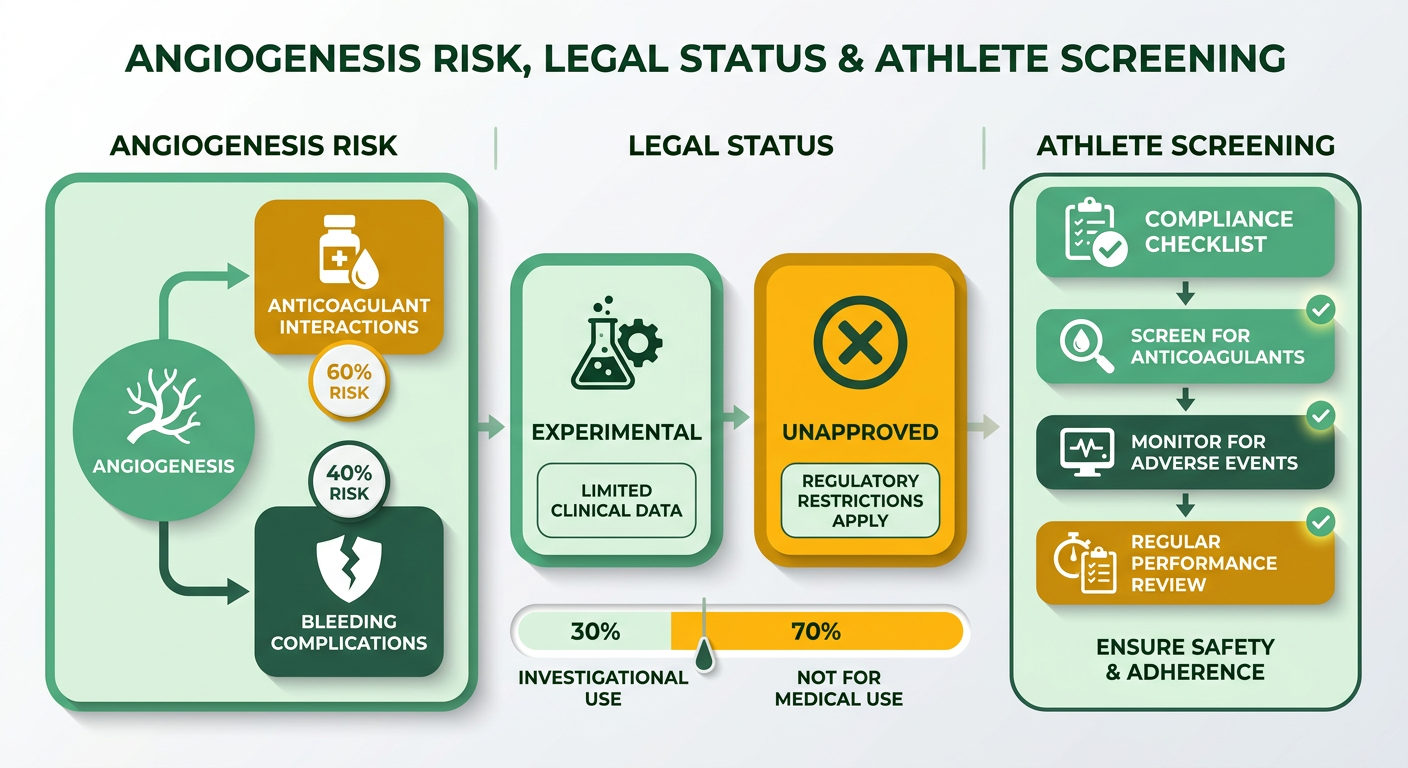
For anyone subject to drug testing, the regulatory reality is absolute. WADA classifies both compounds as prohibited. Enforcement is strict: a Canadian athlete drew a four-year ban after testing positive for TB-500. Neither has FDA approval for human use, so competitive athletes need to avoid them entirely.
BPC-157: a different lane than the marketing suggests

BPC-157 is a synthetic peptide marketed alongside TB-500 for tissue repair. It gets marketed alongside TB-500 for tissue repair, but its best-documented strengths sit elsewhere: gut protection and localized healing. That distinction matters when you’re building a recovery protocol for an aging endurance athlete.
It may support angiogenesis through nitric oxide pathways. Both pathways drive angiogenesis, the growth of new blood vessels that feed damaged tissue. For an athlete managing a chronic rotator cuff strain, improving localized microcirculation is the main reason BPC-157 enters the picture.
How BPC-157 actually repairs tissue
It’s a gastric-derived peptide that switches on angiogenic pathways to support collagen synthesis and fibroblast activity in tendon and muscle. Preclinical work links it to reduced inflammation and improved healing across muscle, tendon, ligament, and bone injuries.
There’s a real weakness you should know about. Most BPC-157 research traces back to a single Croatian research group. That’s a narrow foundation for a peptide sold as broadly proven, and it’s why we treat the mechanism as promising rather than settled. Independent replication is still thin, and validating these regenerative claims will take multi-center, double-blind human trials before anyone should call them clinically established.
Do BPC-157 capsules survive the gut?
BPC-157 is unusually stable in gastric juice, which is the strongest formulation argument for oral capsules. That stability is exactly why it gets discussed as an oral candidate when most peptides get wrecked by stomach acid.
Here’s the honest limit. Gastric stability isn’t the same as high bioavailability, and the human efficacy signals we have came from injections. So the capsule format aging athletes prefer for convenience is the one least backed by outcome data. We flag that gap rather than paper over it.
Why stack BPC-157 with TB-500 at all?
Given the missing synergy, monotherapy is the smarter starting point. Introduce one peptide first and you get a clean baseline of response. That keeps you from paying for redundant pathways and lets you adjust based on actual physiological feedback instead of marketing assumptions.
Sourcing is the other hurdle. Because these compounds aren’t approved for human consumption, the market is flooded with research-grade chemicals lacking real quality control. Impurities, heavy metals, and inaccurate dosing show up in unregulated batches. Staying safe means sticking to verified, pharmaceutical-grade pathways under professional supervision, not self-sourcing from online vendors you can’t vet.
Dosage, timing, and how it fits with training and rehab
Here’s the uncomfortable part about building a dosing protocol around TB-500 capsules: the most convenient format has the least evidence behind it. The oral route faces steep absorption hurdles, and every efficacy signal we have comes from injection or topical delivery in animals. That gap defines everything downstream.
So our starting point is honest sequencing, not a dosage calculator pretending to be precise. We build the recovery plan around your training and rehab first, then decide whether a peptide adds anything the physiotherapy isn’t already doing.

How to think about dose and delivery
Skip the microgram-to-capsule conversion tables online. They imply a systemic precision oral delivery can’t support. The peptide’s large molecular size makes it highly vulnerable to enzymatic cleavage in the gut. Oral TB-500’s systemic effects should be treated with skepticism unless pharmacokinetic data support them. If an oral capsule does anything at all, it’s far more likely to touch the local gut mucosa than to survive digestion and reach a distant, poorly vascularized joint.
For aging athletes, that reframes the whole personalization conversation. Before we talk dose adjustments based on your recovery profile, we have to confirm the molecule is even reaching the tissue you care about. With oral capsules, that assumption is shaky.
Does stacking both peptides actually help?
Running a single agent simplifies the feedback loop. Introduce one variable at a time and you can tie changes in joint stiffness or recovery rate directly to that compound. Stack multiple unproven substances at once and you confound your own data, so you can’t tell which agent is driving the response, or whether one is causing a quiet side effect.
Timing it with training and rehab
Timing peptides pre- versus post-exercise is speculative with oral delivery, so we anchor the schedule to the work that has real evidence: progressive eccentric loading. That’s the tissue-remodeling driver we can actually measure and adjust.
Our practical workflow for a post-competition recovery block:
- Phase one (recovery week): Prioritize load management and eccentric rehab. Log subjective recovery scores daily.
- Phase two (rebuild): Progress eccentric volume based on those scores, not a fixed calendar.
- Taper: Pull back if pain or stiffness scores climb two days running.
We adjust against your recovery data, not a peptide half-life we can’t verify orally. Mechanical tension is the true driver of tenocyte activation, so any supportive therapy is an adjunct to proven physical rehab, never a replacement for it.
Safety, legal, and compliance for competitive athletes
Nobody has run the long-term human safety studies to map the risks fully. TB-500 remains experimental and unapproved, with no large-scale or long-term human safety data available. That gap is the risk, not any single documented adverse event.
Both peptides drive angiogenesis, the growth of new blood vessels. That mechanism is exactly why you should flag any athlete on anticoagulants or immunosuppressants before considering a stack. New vessel formation and altered clotting or immune signaling can pull in opposite directions, and no human data tells you how that plays out at scale.
BPC-157’s pharmacokinetics add a second wrinkle. Most of what we know comes from preclinical work in cells and animals, not large human trials. For an aging athlete with reduced renal or hepatic reserve, an unknown clearance profile deserves genuine screening, not a boilerplate consent checkbox.
What pre-season clearance and documentation should look like
Start with a comprehensive medical evaluation, not a supplement list. The sensible order of operations is to establish a clear clinical diagnosis through imaging before discussing experimental protocols. For our clients, a structured orthopedic assessment always comes first.
Practical pre-season steps for clinical intake:
- Review athletic eligibility: Confirm whether your sport’s governing body enforces drug testing, since these compounds don’t qualify for medical exemptions.
- Comprehensive health history: Document every active prescription, especially anything affecting vascular tone, clotting, or immune function, to catch contraindications.
- Metabolic profiling: Establish baseline blood panels to monitor organ function, so any experimental protocol can be judged against stable markers.
- Structured physical therapy: Make sure a progressive loading program is fully active, because passive recovery can’t replace mechanical tissue remodeling.
For non-competitive clients, we build personalized recovery plans that treat these compounds as experimental, documented honestly on our consent forms.
Tracking outcomes: biomarkers, imaging, and performance
No validated human blood biomarker confirms peptide-driven tendon repair. The animal evidence relied on histopathology, not serum markers. So collagen-turnover panels and inflammatory readouts give you trend data, not proof the peptide is working.

For a tendon, imaging beats bloodwork. Diagnostic ultrasound shows fiber alignment and neovascularization in real time and costs little to repeat. MRI captures deeper structural change but is expensive to run monthly.
Our take: use ultrasound as your workhorse, because you can scan the same tendon every few weeks and compare directly. Reserve MRI for a baseline and a single follow-up if the ultrasound picture stays ambiguous. Chasing monthly MRIs burns money without adding signal.
What performance metrics show real recovery
Performance data gives endurance athletes the cleanest read, because it measures function, not molecules. Track sport-specific outputs you already log: time-to-fatigue, VO₂ max, tempo-run pace at a fixed heart rate, and tendon-loaded outputs like single-leg hop distance if a lower-limb tendon is the target.
Trend matters more than any single test. Weekly performance logging catches direction; monthly imaging confirms structure. Anything more frequent just adds noise. And isolate your variables. Introduce multiple recovery interventions at once and you can’t attribute any gains to a specific compound. To get a clean cause-and-effect read, run functional metrics under a single-agent protocol before adding anything else.
How often to reassess
Set a rhythm and stick to it, because inconsistent timing wrecks trend analysis. A sensible cadence for post-competition recovery:
- Weekly: performance metrics (pace, hop distance, time-to-fatigue) logged in the same conditions
- Every 3-4 weeks: diagnostic ultrasound on the target tendon
- Baseline and one follow-up: MRI, plus any collagen-turnover or inflammatory panel you choose to run
We keep every protocol data-driven and personalized, so the exact monitoring plan gets tailored to your goals during a consultation.
One caveat worth naming: read every flat result against your training load, not the peptide in isolation. A tendon under a heavy tempo block may show static ultrasound findings simply because remodeling lags mechanical stress by several weeks. Log your weekly training volume next to each scan so you can separate a genuine plateau from normal adaptation delay. If your numbers stall while volume climbs, that mismatch is the story worth chasing, not the raw biomarker.
Frequently Asked Questions
1. Can I get a Therapeutic Use Exemption (TUE) to use these peptides in competition?
No. Under the World Anti-Doping Code, a Therapeutic Use Exemption (TUE) requires demonstrating that the prohibited substance is necessary to treat an acute or chronic medical condition, and that no reasonable, non-prohibited therapeutic alternative exists. Because standard physical therapy, approved medical devices, and established pharmaceuticals are available for tissue repair, these experimental peptides do not meet the criteria for a TUE. Consequently, any sanctioned athlete testing positive faces severe multi-year suspensions.
2. Are these peptides useful for ordinary post-workout muscle soreness?
No. Delayed onset muscle soreness (DOMS) involves transient inflammatory responses and micro-tears within skeletal muscle fibers, which naturally resolve through standard rest and nutrition. The regenerative mechanisms of these peptides—specifically actin regulation and localized angiogenesis—are studied for dense, poorly vascularized connective tissues like tendons and ligaments. Applying them to routine muscle soreness misaligns the physiological target and introduces unnecessary risks for a self-limiting condition.
3. Should I tell my doctor about medications before trying these peptides?
Yes, absolutely. It is critical to disclose all experimental substances to your healthcare provider, particularly if you are managing cardiovascular or autoimmune conditions. Because these compounds influence vascular endothelial growth factors, they can theoretically alter the efficacy of therapies designed to manage blood viscosity or immune activity. A physician can help monitor your systemic health markers and ensure your recovery plan does not interfere with prescribed medical treatments.
4. Why run single-peptide phases instead of starting with the full stack?
Isolating variables is the cornerstone of any rigorous self-experimentation protocol. By introducing only one compound at a time, you can establish a clear cause-and-effect relationship with your recovery metrics. If you start with a multi-peptide stack, you cannot determine which substance is driving your progress or if one is entirely redundant, leading to unnecessary long-term expenses and a more complex protocol than required.
5. How do I know if a tendon plateau means the peptide failed or normal adaptation?
Tendon tissue adapts much slower than muscle due to its limited blood supply, with collagen synthesis and structural remodeling taking several weeks to manifest on imaging. If your functional performance and pain scores remain stable while your training load increases, your tissue is successfully adapting to the stress. A true plateau is indicated only when your functional capacity decreases or pain escalates under a constant, non-increasing physical workload.
6. Why is ultrasound preferred over MRI for tracking tendon recovery?
High-frequency diagnostic ultrasound allows for dynamic, real-time imaging where a clinician can move the joint and observe fiber tension and blood flow under active movement. It is highly accessible and cost-effective for frequent monitoring. Magnetic resonance imaging, while highly detailed for deep intra-articular structures, represents a static snapshot and is generally cost-prohibitive for routine, short-term progress tracking.
7. Is BPC-157’s gastric stability the same as it being well absorbed orally?
No. Gastric stability simply means the peptide survives the highly acidic environment of the stomach without being immediately denatured. However, to exert systemic effects on distant tissues, the molecule must still cross the intestinal epithelial barrier and enter portal circulation. Because large peptide chains face significant absorption barriers in the gut, surviving stomach acid does not guarantee that a therapeutically active concentration reaches your bloodstream.
Free 15-Minute Discovery Call
Ready to take the guesswork out of your health?
Book a free 15-minute call with Monika to talk through your goals, what testing makes sense for you, and the right next step. No pressure, just clarity.
Book Your Free CallFor educational purposes only. Not medical advice.