
What makes a peptide a polypeptide
If you’re trying to understand why insulin is called a polypeptide while BPC-157 stays a peptide, the answer starts with amino acids. Peptides are short chains of amino acids linked by peptide bonds—the same covalent bonds that hold proteins together. Most peptides run 2 to 50 amino acids. A polypeptide is just a longer peptide chain. The term covers any amino-acid chain, including the ones that fold into functional proteins. All proteins are polypeptides. Not all polypeptides are proteins. Sequencing is the process of determining a molecule’s amino-acid sequence, and it tells you which side of the boundary a molecule occupies.
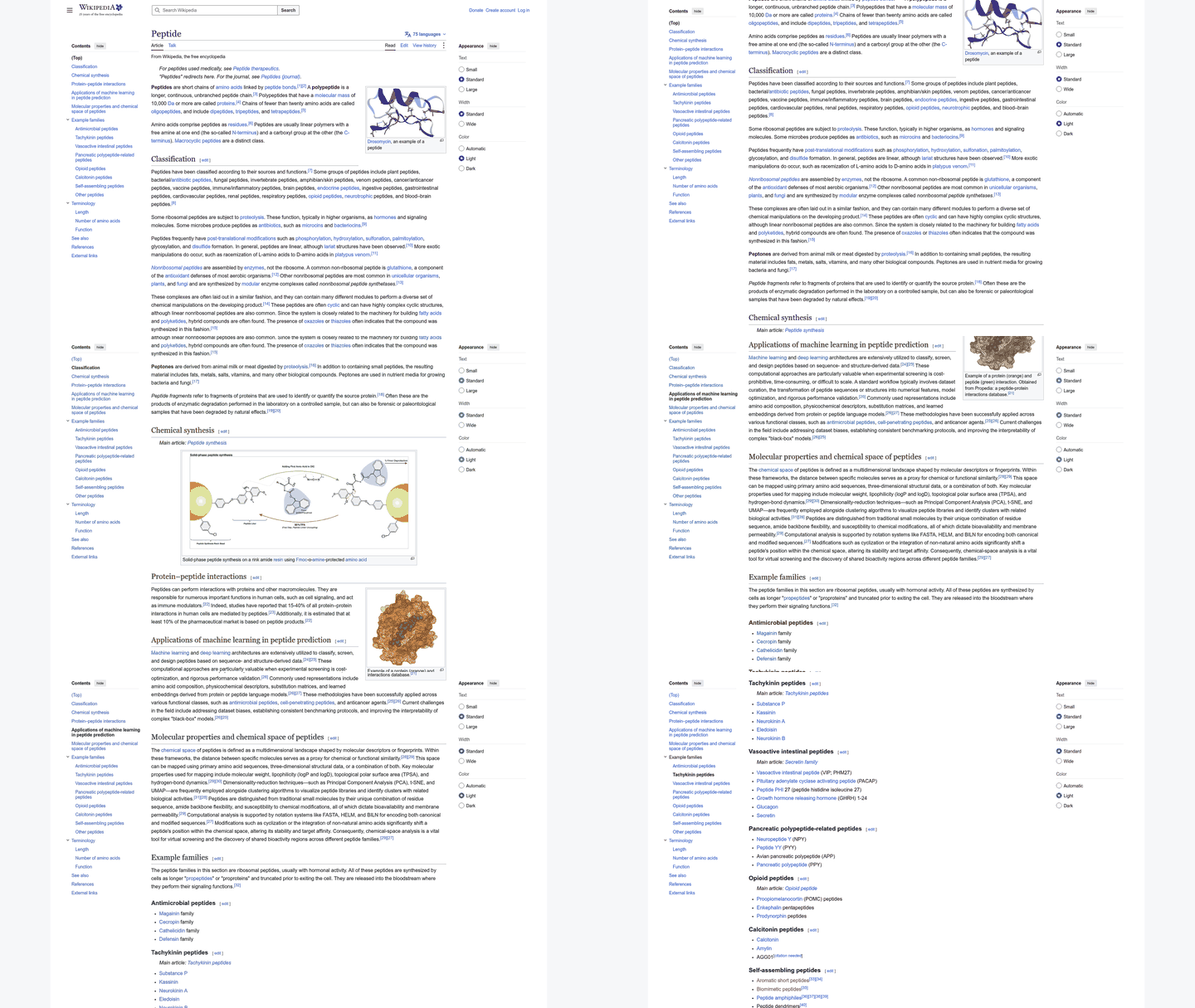
There’s no regulatory body that decides where peptide ends and polypeptide begins. StatPearls defines peptides as short strings of 2 to 50 amino acids joined by peptide bonds, distinguishing them from proteins by length and the absence of folded structure. Chains above roughly 50 amino acids gain enough length to fold into stable secondary and tertiary structures—alpha helices and beta sheets—that let proteins perform enzymatic and structural work. Below that length, most chains stay unstructured in solution.
Insulin sits on the line
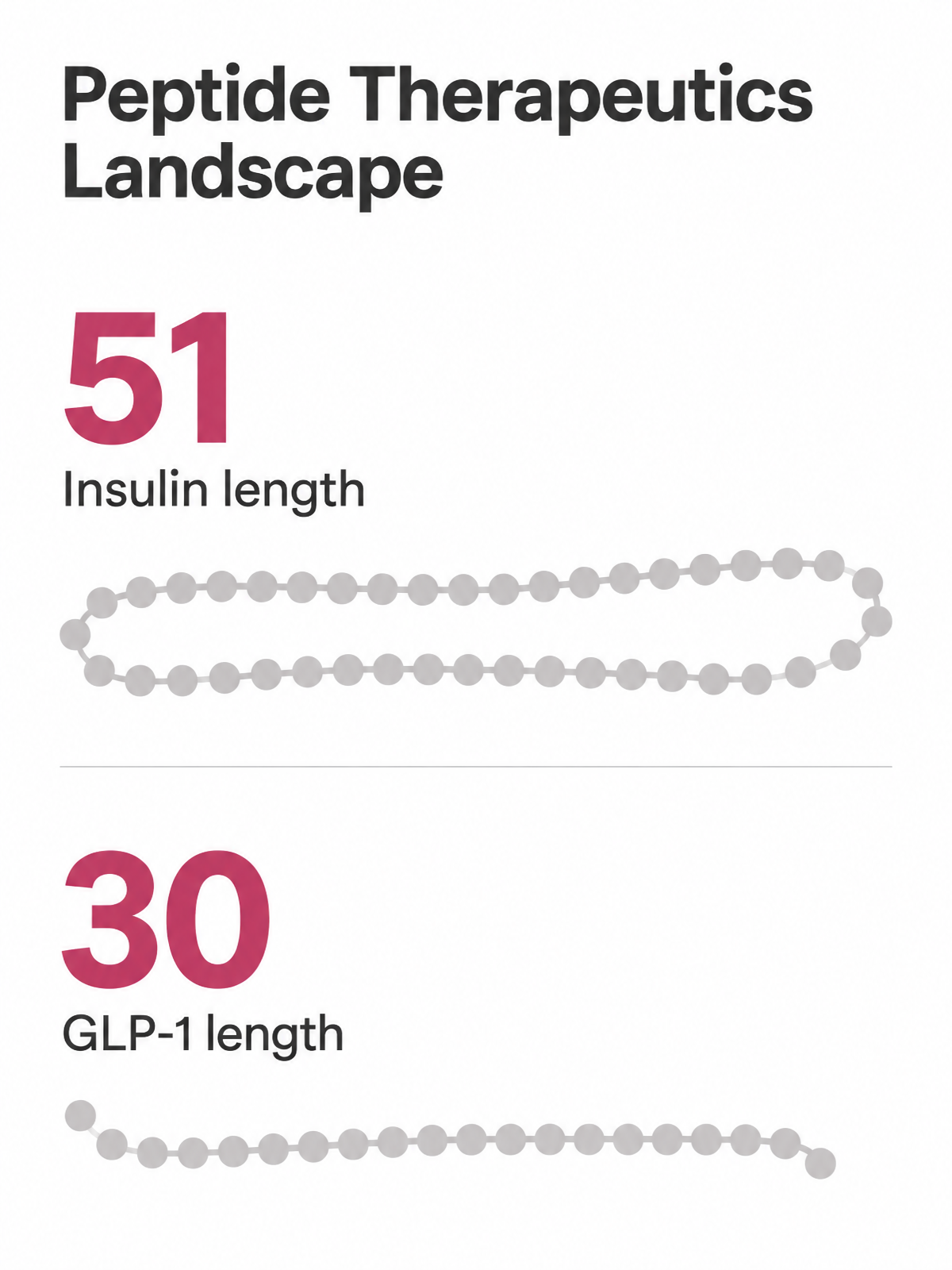
Insulin is the borderline case. At 51 amino acids, insulin crosses the conventional peptide upper limit. Insulin is often discussed as sitting between small-molecule drugs and protein biologics, a framing that captures its structural and pharmacological identity. Insulin is usually called a protein hormone because it folds. GLP-1, at 30 amino acids, stays unambiguously a peptide.
Sequencing determines where a molecule lands
Determining a molecule’s amino-acid sequence tells you which side of the boundary it occupies. Longer polypeptides require recombinant cell expression. Sequence also drives immunogenicity risk, which shifts regulatory scrutiny depending on chain length.
Quick reference
- Insulin sits at the naming boundary where peptide, polypeptide, and protein-hormone language overlap.
- Peptides are generally shorter amino-acid chains; polypeptides are long enough to support stable folding.
- Insulin’s activity depends on its linked-chain architecture and the bonds that preserve its active shape.
- Manufacturing strategy changes as chains become longer and harder to assemble by stepwise chemical synthesis.
- GLP-1 shows that a molecule can be short and still biologically potent.
- Insulin’s structural complexity puts it in a biologic-style regulatory conversation rather than a simple small-molecule framework.
Insulin—the benchmark polypeptide hormone
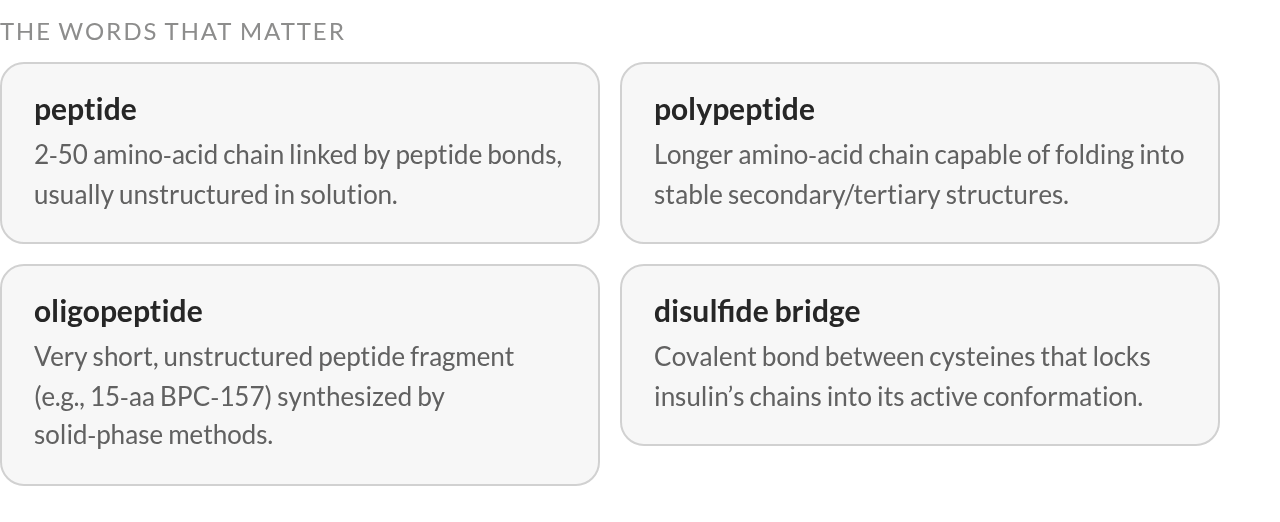
Insulin is the benchmark polypeptide hormone: a 51-amino-acid molecule split into two chains that sits exactly at the boundary between peptide and protein. The A chain carries 21 residues; the B chain carries 30. News-Medical reports that two disulfide bridges link the chains at residues A7–B7 and A20–B19, while a third bridge forms internally within the A chain between A6 and A11. Those three bridges lock the molecule into its active shape. Sequencing insulin’s structure reveals why it became the reference case for polypeptide classification: long enough to fold, yet short enough that chemists initially debated whether to call it a protein or an oversized peptide.
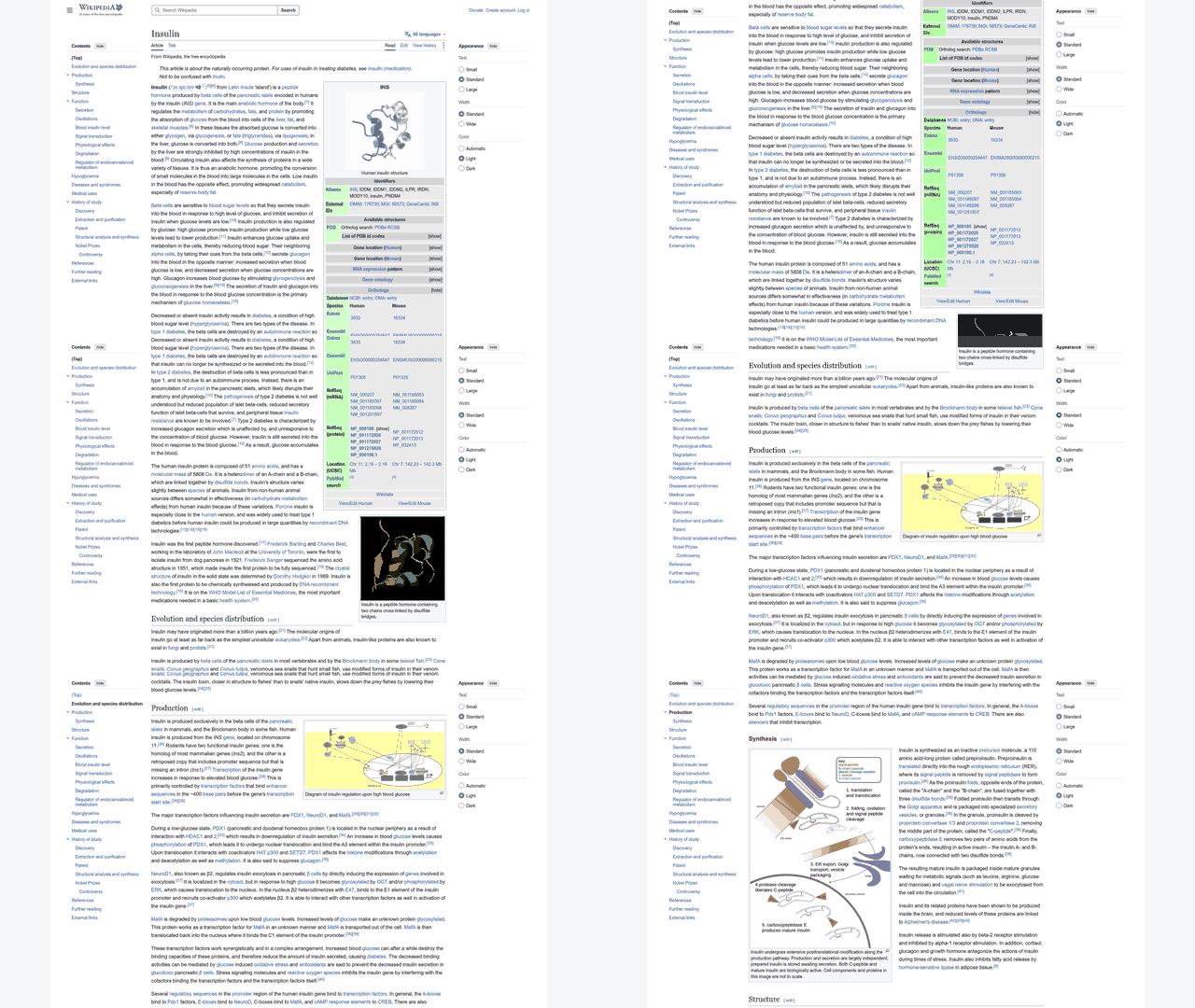
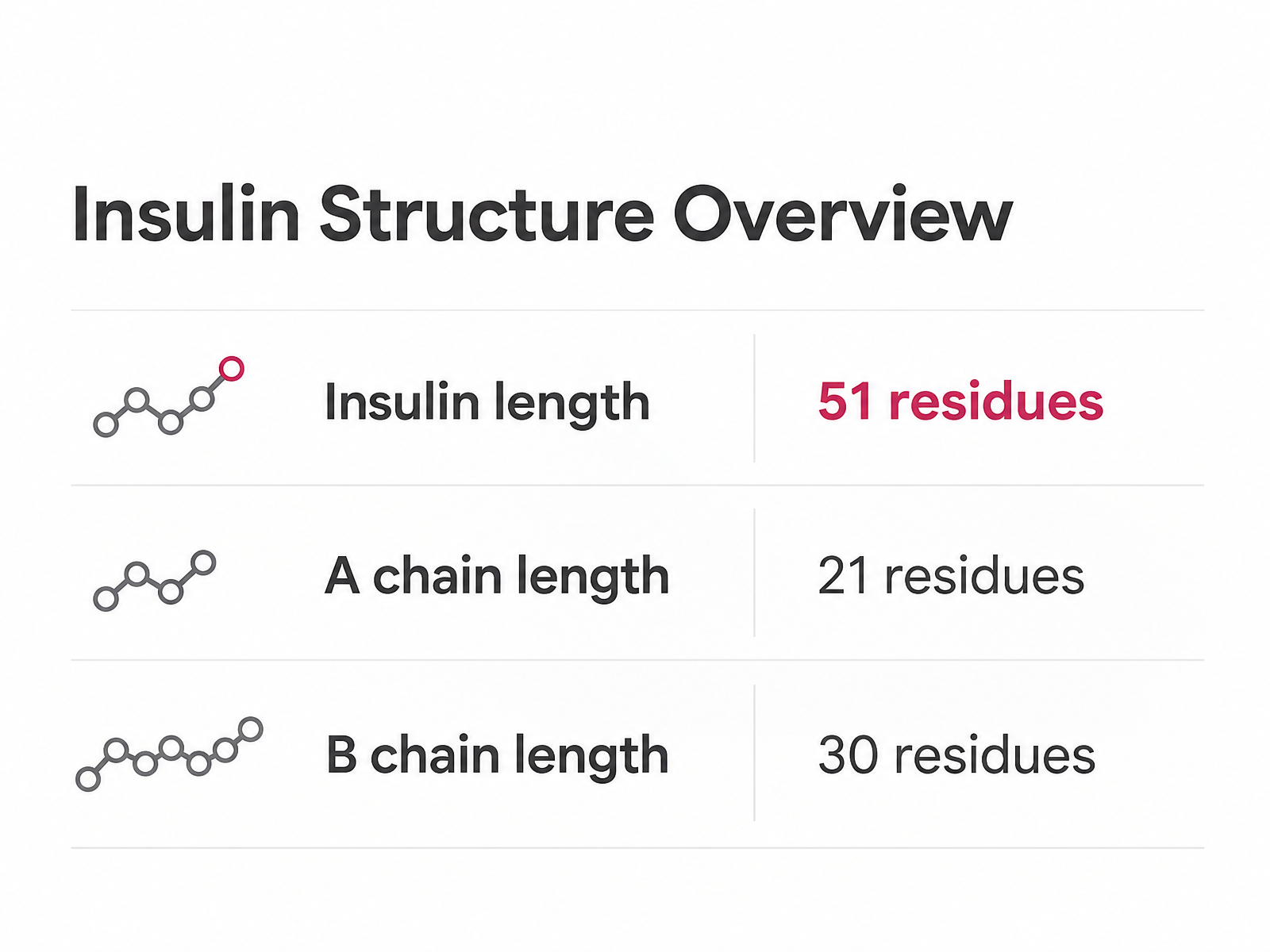
The molecule you inject as recombinant human insulin began as a longer precursor called preproinsulin. During biosynthesis in pancreatic beta cells, signal peptides and connecting sequences are cleaved by prohormone convertase enzymes and carboxypeptidase E. What remains is the mature hormone.
Why insulin straddles the peptide-protein line
Insulin is usually called a protein hormone in endocrinology textbooks, yet you’ll find it sold commercially under “peptide” or “polypeptide” labels depending on vendor context. Superpower’s clinical review frames insulin as a protein hormone while comparing it with shorter incretin peptides, illustrating how the boundary shifts with functional role rather than strict chemistry. Insulin lands at the conventional lower edge often cited for proteins.
The distinction matters for synthesis and regulation. Insulin is typically produced via recombinant expression in yeast or bacteria rather than direct chemical synthesis, because longer chains push solid-phase peptide synthesis toward impracticality. The FDA uses both size and structural complexity to decide regulatory pathway: insulin’s folded, biologically active tertiary structure places it firmly in the biologic category requiring a BLA approval route, not the small-molecule NDA path.
Insulin’s structure is highly conserved across mammalian species, which is why animal-sourced insulin was clinically useful before recombinant production became standard.
BPC‑157—why it’s not classified as a polypeptide
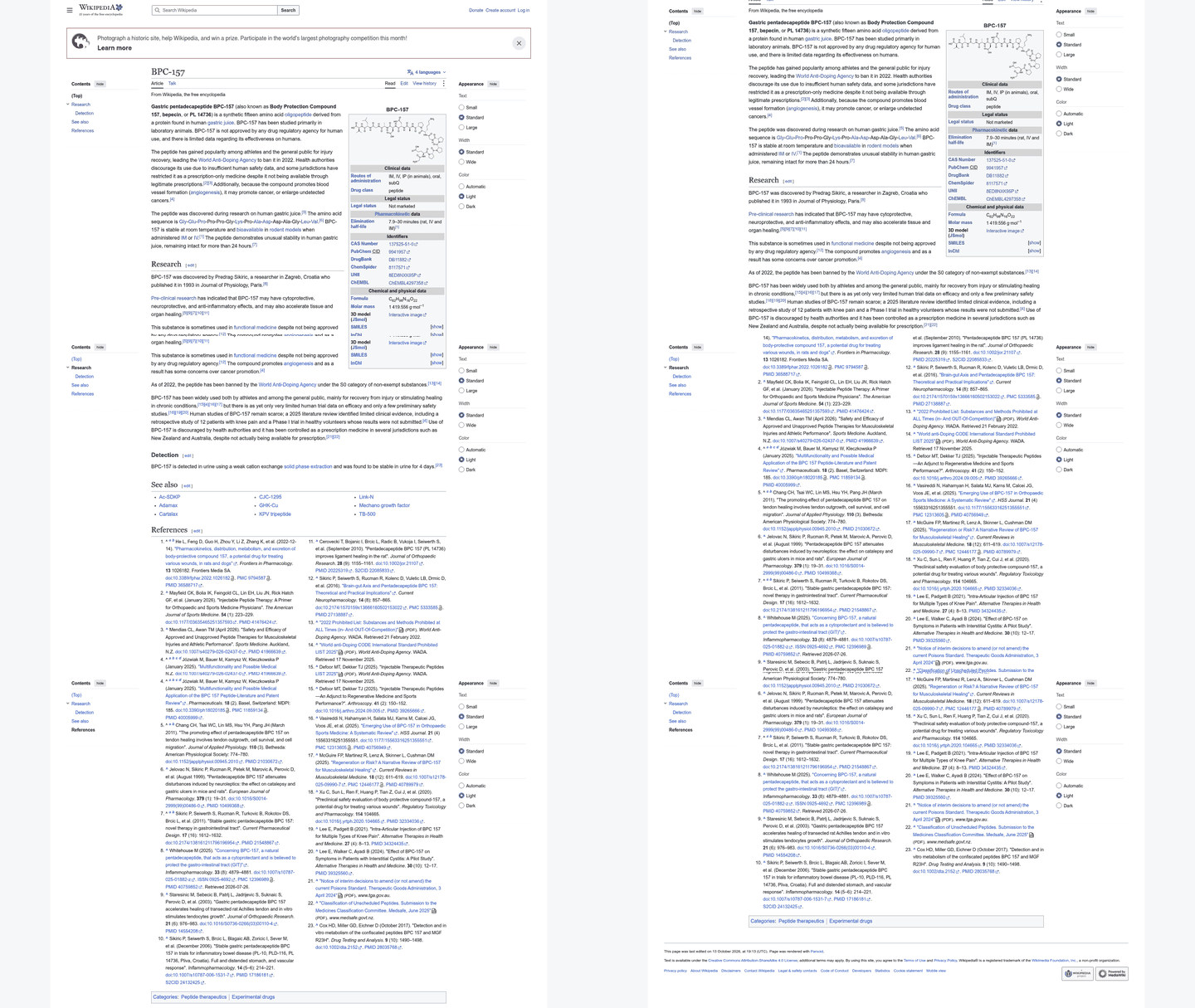
Sequencing assigns every amino acid its place in the chain, and that sequence determines whether you’re looking at a peptide or a polypeptide. BPC-157 falls on the short-chain side of the classification system. Shorter chains fall into the oligopeptide category—short, unstructured, and synthesizable by standard solid-phase methods. Chains that become long enough to fold can begin taking on the catalytic, structural, or complex receptor-binding behavior associated with proteins.
Insulin sits at the threshold; shorter chains stay safely below it
BPC-157 is often discussed alongside insulin because both are amino-acid chains, but their structures do not occupy the same category. Insulin has enough length and cross-linking to hold a compact conformation, while BPC-157 sits far below the roughly 50-residue line where chains begin to fold. That is the central classification difference: one behaves as a folded polypeptide hormone, while the other remains a short synthetic peptide fragment.
Shorter chains remain largely unstructured in solution, which limits them to signaling roles rather than enzymatic ones. BPC-157’s 15 amino acids stay well within the reach of solid-phase peptide synthesis. As chain length increases toward insulin’s 51 residues, coupling efficiency compounds across every added residue, and synthesis yield eventually drops enough to make recombinant cell expression the more practical manufacturing route.
Regulatory guidance also treats shorter chains differently from larger folded proteins.
What we actually use in longevity protocols
We don’t integrate insulin therapy or BPC-157 into standardized protocols, and we want to be direct about why. Insulin administration outside of diabetes management carries serious hypoglycemia risk. The sequencing data that makes insulin a well-characterized polypeptide hormone also means its receptor activity is tightly mapped—dosing errors have fast, measurable consequences. Athletes sometimes ask about insulin for nutrient partitioning, but the risk-to-benefit ratio doesn’t justify it in a longevity-focused practice where safer anabolic pathways exist.
BPC-157 sits on the other end of the spectrum. It’s a 15-amino-acid synthetic fragment, which keeps it outside polypeptide territory. Its shorter chain length means it doesn’t fold into the stable secondary structures insulin relies on, and it also means the regulatory pathway is murkier. With this murkier regulatory standing, sourcing consistent, verifiable product can be difficult.
What longevity-focused practices may prioritize instead
Many longevity-focused practices center on compounds with clearer regulatory standing and reproducible clinical outcomes: thymosin beta-4 derivatives for tissue repair, GHK-Cu for skin and collagen integrity, and select GLP-1 analogs under physician supervision. Protocols in precision medicine often start with a baseline metabolic panel and biomarker review—fasting glucose, IGF-1, inflammatory markers—so dosing can be adjusted against measurable endpoints, not anecdotal recovery timelines. Skip peptides entirely if you’re not willing to commit to quarterly labs. Without biomarker tracking, you’re guessing.
Why classification boundaries remain blurred
The peptide therapeutics market shows sustained momentum rather than a sudden breakthrough wave. Peptide-based drugs occupy a distinct space in pharmaceutical development, between small molecules and larger protein biologics in both structure and function. That middle ground reflects a pipeline that moves steadily but carefully. Sequencing precision matters more at regulatory milestones than it does for small molecules, because a single misfolded residue can trigger immunogenicity or lose receptor selectivity entirely.
Insulin’s structure sits exactly where definition and function diverge. By convention, insulin is called a protein hormone despite falling near the boundary that separates peptides from proteins—a boundary that shifts depending on which threshold you examine. Chain length, folded structure, molecular weight, immune recognition, and renal filtration cutoff all land in slightly different ranges, and insulin crosses several of them at once.
The distinction matters in practice because it shapes how a molecule behaves in the body. Short incretin peptides act primarily as targeted signals, while insulin adopts secondary and tertiary structure that enables more complex receptor activation. Even then, insulin remains far smaller than many biologics, which is why its synthesis, clearance, and classification history have always required careful wording.
We’ve watched regulatory frameworks adapt in real time. The boundary isn’t blurred because scientists lack precision—it’s blurred because the chemistry is continuous and the relevant thresholds don’t align neatly. Insulin became the reference case precisely because it forced a choice: call it a small protein or an oversized peptide, and either label leaves edge cases unresolved. What matters clinically is how the molecule folds, how the body clears it, and whether it triggers an immune response—questions that length alone cannot answer.
What this means when you’re choosing a protocol

Insulin’s linked-chain structure places it exactly at the boundary where peptide, polypeptide, and protein-hormone labels all converge. BPC-157, by contrast, carries a shorter chain that places it unambiguously in peptide territory. The distinction matters for synthesis feasibility, immunogenicity risk, and regulatory pathways—not just for naming.
We apply this understanding when evaluating which compounds can be safely integrated into wellness protocols and which require more specialized medical oversight. Insulin’s polypeptide structure gives it tightly mapped receptor activity and fast, measurable consequences, which is why it remains a pharmacological agent for metabolic conditions rather than a general wellness intervention. BPC-157’s shorter chain keeps it chemically simpler, but that simplicity doesn’t guarantee the joint-health, exact-sequence, research-grade, or pricing claims we see marketed around it. Those claims need batch-level documentation, not assumed peptide-class behavior.
What current evidence actually supports
Insulin’s structure is exhaustively characterized; every residue position, disulfide bridge, and folding pathway has been mapped. The molecule’s receptor-binding activity depends entirely on maintaining its precise tertiary fold, which is why even single amino acid substitutions in therapeutic analogs require full clinical trials. We have not seen the same level of structural validation for BPC-157. Its exact sequence and attributed bioactivity need primary-source validation before we can write about them with the same confidence we apply to insulin’s mapped structure. That is the difference between knowing how every bond and turn behaves under physiological conditions and relying on preliminary models that may shift as better data arrives.
Quick Questions, Straight Answers
1. Can I use insulin for muscle growth if I don’t have diabetes?
Not as a wellness or performance shortcut. Insulin is a powerful metabolic drug, not a general anabolic supplement, and any use outside appropriate medical care requires physician supervision.
2. Why is BPC-157 hard to source from compounding pharmacies right now?
The practical issue is documentation. Without dependable purity data, batch records, and compliant sourcing, clinics cannot treat BPC-157 like an approved peptide therapy with predictable quality controls.
3. Does a peptide need to fold into a structure to work in the body?
No. Folding changes the type of activity a molecule can support, but short peptides can still communicate with receptors. Insulin shows why folded structure matters for some hormones; shorter signaling peptides show that a stable protein-like shape is not always required.
4. What makes insulin production require yeast or bacteria instead of chemical synthesis?
Insulin is difficult to assemble as a simple step-by-step chemical chain because its final therapeutic form depends on correct chain pairing and structural integrity. Recombinant systems are better suited to producing a consistent molecule with the required biological shape.
Ready to see which protocol fits your goals? Our team will review your history and biomarkers with you before you start anything new. Book your consultation with BiohackNow
Free 15-Minute Discovery Call
Ready to take the guesswork out of your health?
Book a free 15-minute call with Monika to talk through your goals, what testing makes sense for you, and the right next step. No pressure, just clarity.
Book Your Free CallFor educational purposes only. Not medical advice.
