
Before we get into it, the short version:
- Neither BPC-157 nor TB-500 is FDA or TGA approved for therapeutic use, and both are widely reported to be prohibited under WADA anti-doping rules for competitive athletes; athletes should confirm the current list directly.
- The four-peptide version adds CJC-1295 and Ipamorelin, which some providers describe as a growth-hormone/IGF-1 support strategy for age-related muscle loss in older adults.
- Professor Gordon Slater warns that „the hype is running well ahead of the human evidence“ for these peptide stacks in clinical practice.
- The two-peptide stack is often described as a tissue-repair approach focused on inflammation control and blood vessel growth, not sarcopenia or lean-mass preservation.
- Baseline biomarker testing may help determine whether adding the growth-hormone layer addresses a genuine deficit or simply increases risk without measurable benefit.
Quick Summary
If you’re over 55 and weighing peptides for joint repair or holding onto muscle, the real question isn’t „which peptides“ but „which version of the stack, and how will you know it’s working in your body?“ That’s where the two builds of the wolverine stack protocol diverge. One format is described as targeting healing alone. The other is described as adding a growth-hormone layer aimed at age-related muscle loss.
The two-peptide version pairs BPC-157 and TB-500 for tissue repair. The four-peptide build adds CJC-1295 and Ipamorelin, which are often described as supporting the GH-IGF-1 axis, the hormonal pathway tied to how well you preserve lean mass as you age. For older adults, that second layer is the whole debate. We read it through the biomarkers we track and your lab work rather than guessing from how you feel.
| Dimension | Two-Peptide (BPC-157 + TB-500) | Four-Peptide (+ CJC-1295 + Ipamorelin) | How We Run It |
|---|---|---|---|
| Primary mechanism | Proposed tissue repair, inflammation control, blood vessel growth | Proposed repair plus GH-IGF-1 support | Match proposed mechanism to your measured gaps |
| Dosage pattern | No fixed regimen; anecdotal protocols vary | No fixed regimen; GH peptides often described as evening dosing; no standardized human protocol exists | Dosing tied to baseline labs, not a fixed template |
| Frequency | Often described as cyclical | Often described as cyclical | Reassessed at each biomarker checkpoint |
| Main focus | Soft-tissue, tendon, ligament recovery | Recovery plus sarcopenia and lean-mass support | Resilience over raw healing speed |
| Safety & regulatory | Not FDA or TGA approved; quality and contamination concerns reported; verify prohibited status | Same, plus GH-axis monitoring needs | Guided by your lab results |
| Cost tier | Lower | Higher (two more peptides) | Scoped to what your data justifies |
The Two-Peptide Stack Is a Repair Tool, Not a Longevity Plan
BPC-157 and TB-500 are often positioned as soft-tissue recovery support. The early animal data on tendon healing, wound repair, and inflammation has drawn attention, which is why the pairing gets so much interest. But human evidence remains thin.
That uncertainty changes how we frame the stack. It may be a repair adjunct in carefully selected cases, but it should not become a standalone answer for an acute injury that needs diagnosis, physiotherapy, progressive loading, or imaging.
Biomarkers Decide Whether the GH Layer Earns Its Place
The four-peptide build only makes sense if your numbers say it does. CJC-1295 and Ipamorelin are intended to support the GH-IGF-1 axis, which matters for older adults losing muscle, but adding them blind is reckless.
We test first. If your lab work shows low markers and lean mass is slipping, the GH layer has a rationale worth tracking. If it’s already in range, you’re paying for two extra peptides and more risk with no measurable upside.
Where We Stand on Both Versions
For routine soreness or a healthy 40-year-old chasing faster recovery, neither build is worth the cost or the anti-doping exposure. For an older adult with documented sarcopenia and sluggish repair markers, the four-peptide version has a defensible case, provided every dose answers to a lab result rather than a protocol screenshot.
Why the Wolverine Stack Matters
The regulatory market tells you where the field actually stands. These are not mainstream, approved recovery drugs; they sit in an investigational space where quality control, supervision, and athlete eligibility all matter. For tested competitors, the compliance issue is not a nuance. It comes before any discussion of potential benefit.
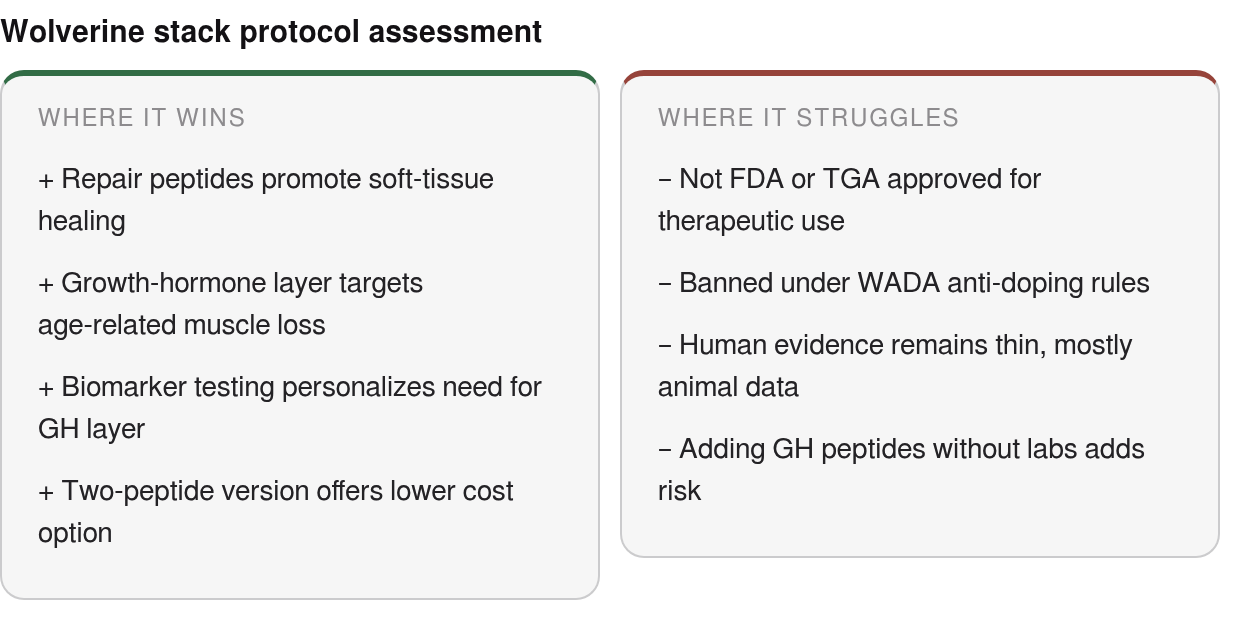
Slater’s broader concern matters for the people we see: a compound can sound promising in a lab and still fail to deliver reliable benefit for a real patient in everyday practice. That gap between mechanism and outcome is exactly why we do not treat the stack as a shortcut.
Match the Protocol to the Person, Not the Hype
Who actually benefits splits along clear lines. We map the driver to a personalized protocol before anyone touches a vial.
| Reader type | Main driver | What the protocol targets | Our starting read |
|---|---|---|---|
| Masters athlete | Stubborn tendon or soft-tissue injury | Repair layer (BPC-157, TB-500) | Rehab first, peptides as adjunct |
| Aging professional | Strength and lean-mass decline | Personalized peptide protocol | Only after baseline biomarkers |
| Post-surgical adult | Recovery timeline | Tissue healing | Coordinate with surgical team |
The protocol should never replace the basics that actually rebuild capacity. For most tendon, ligament, and joint problems, assessment, graded loading, and the right rehab plan still do the heavy lifting.
Why Biomarkers Decide the Dose
This is where a precision approach separates from the shopping-cart version of biohacking. It’s easy to drift from the things that genuinely move the needle toward doing more simply for the sake of trying something new.
We’d rather do less, measured. Age-related biomarker testing, including markers tied to the GH-IGF-1 axis, helps us judge whether a growth-hormone layer is addressing a genuine deficit or just adding risk. That lab-first logic is the thread running through this whole comparison, and it’s what the next sections build on. You can read more of our thinking on the BiohackNow blog.

Core Components & Mechanistic Overview
Holding two vials and a recent blood panel. One pair of peptides is often described as patching tissue. The other pair is described as nudging a hormone axis that fades with age. Knowing which molecule is proposed to do what is the difference between dosing on hope and dosing on data. That is the practical heart of any wolverine stack protocol for older adults, and it starts with knowing what a peptide actually is.

A peptide is a short chain of amino acids, the same building blocks that make proteins, just smaller. Think of them as signaling notes your body already uses to tell cells when to repair, grow, or calm down. The four peptides in these stacks fall into two camps. We read each camp against your own lab work rather than treating the whole stack as one undifferentiated dose.
How BPC-157 and TB-500 Drive Repair
BPC-157 is tied in early research to proposed effects on blood vessel growth, inflammation, and the migration of fibroblasts, the cells that lay down new collagen. More blood supply plus more collagen-building traffic is the mechanistic case often made for faster soft-tissue recovery.
TB-500 is described as a fragment related to thymosin beta-4, a protein involved in regulating actin, the scaffolding that lets cells move and reorganize. That proposed actin role is why it shows up in discussions of cell migration, tissue remodeling, and wound repair. Put simply, the proposed rationale is that BPC-157 may support blood flow and collagen-building traffic at a repair site while TB-500 may help cells move and reorganize.
Most of this mechanism work sits in animal and lab models, not large human trials. We treat these pathways as plausible targets to monitor, not proven outcomes to promise.
What the Growth-Hormone Layer Adds
CJC-1295 is commonly described as a long-acting analog of growth-hormone-releasing hormone (GHRH), the natural signal that tells your pituitary to release growth hormone. The intended effect is to extend and amplify your own GH pulses rather than override them.
Ipamorelin is described as a selective ghrelin-receptor agonist that triggers a sharper GH signal. Claims about avoiding hunger or cortisol bumps are common, but they are not well-established in large human data. Paired together, these two peptides are intended to support the GH-IGF-1 signaling your body loses with age, which is the whole reason this layer interests us for muscle preservation.
Which Biomarkers Tell the Two Stacks Apart
This is where precision matters for anyone over 55. The repair peptides and the GH peptides are proposed to act on different pathways, and early research points to different markers for each.
| Peptide | Proposed pathway in early research | Marker discussed in early research |
|---|---|---|
| BPC-157 | Proposed blood vessel growth, fibroblast migration | Inflammatory markers, collagen-turnover markers |
| TB-500 | Proposed actin regulation, cell migration | Soft-tissue recovery markers |
| CJC-1295 | Described as long-acting GHRH analog | IGF-1 (GH-IGF-1 axis) |
| Ipamorelin | Described as selective ghrelin-receptor agonist | IGF-1, body composition |
Across these pathways, the markers above are commonly discussed in early research, not established clinical endpoints. We don’t promise a fixed protocol built around any single one. Instead, every plan starts with your own blood work, and the core biomarkers we track—from hormones to toxins and gut health—guide what we recommend rather than a generic chart.
Clinical Applications & Target Populations
Two readers over 55. One has a stubborn Achilles tendon that never fully settled after a hike last spring. The other sleeps fine and trains hard but watches lean mass slip year over year. Same age bracket, different problems, and the right wolverine stack protocol looks different for each.

That split is the whole point of mapping peptides to people rather than handing everyone the four-peptide build. We start from what you’re actually trying to fix, then check it against the biomarkers we track before anyone draws up a dose.
Where the Two-Peptide Build Earns Its Place
The repair pair is intended for localized soft-tissue problems. Some animal work suggests better tendon healing, blood vessel growth, and tissue remodeling, which is why the combination is sometimes considered after a soft-tissue injury that won’t resolve.
For a localized problem, that’s often enough. If your goal is a cranky rotator cuff or a ligament that’s lagging, adding a growth-hormone layer doesn’t address the thing in front of you. More molecules isn’t more healing.
Our caution is practical rather than dramatic: if a tendon or joint problem has not been properly assessed, peptides can become an expensive distraction from the intervention that would actually restore function. The repair peptides belong downstream of diagnosis and rehab planning, not ahead of them.
A recreational runner with plantar fasciitis that didn’t respond to rest and stretching, or a gym-goer with elbow tendinopathy that’s been dragging on for months—these are the scenarios where controlled tissue-repair support may make practical sense.
Matching the Four-Peptide Protocol to Somatopause
The full build addresses a hormonal target, not just tissue damage. This is where biomarker testing stops being optional. Our protocols are data-driven and personalized, so we lean on the markers we track to judge whether the extra layer is justified for you.
If your hormonal markers read low for your age and you’re losing muscle despite training, the growth-hormone layer has a rationale worth testing. If those markers sit mid-range and your complaint is purely a sore knee, you’re paying for two peptides you don’t need.
The evidence gap matters most when expectations get too specific. We may have a biologically coherent reason to test a growth-hormone layer, but that is different from guaranteeing strength, body-composition, or recovery outcomes in everyday use. Your numbers decide whether the trial continues.
For example, an older adult with confirmed low IGF-1, declining strength metrics despite consistent training, and a clear slowdown in recovery may be a better candidate for the hormonal support layer than a person with an isolated joint complaint and normal markers.
Who Should Skip These Peptides Entirely
Athletes under formal testing should step away before weighing protocol details. The competition-risk issue may already be established for many tested sports, and a wellness goal is not worth jeopardizing eligibility.
| Scenario | Two-Peptide Build | Four-Peptide Build | Our biomarker-led approach |
|---|---|---|---|
| Localized tendon/ligament injury | Best fit | Overkill | Biomarker data still informs the plan |
| Age-related muscle loss + low hormonal markers | Partial | Stronger rationale | Data-tailored protocol |
| Competing athlete under a prohibited list | Not advised | Not advised | We flag current anti-doping status first |
| Aesthetic/skin goals | Unproven | Unproven | Honest gap, no overclaim |
The aesthetic claims around skin collagen deserve the same skepticism. We don’t have solid human outcome data to stand behind, so we won’t sell it as settled. If skin elasticity is your only goal, this isn’t the tool to reach for yet. We’d rather tell you that than market a promise the evidence can’t carry.
Protocol Design: Dosage, Timing, and Administration
You’ve got the vials, the alcohol swabs, and a schedule you’re not sure you trust. The questions that trip up most older adults aren’t about whether to inject. They’re about when, where in the body, and how to tell a working dose from a wasted one. That’s the real work of building a wolverine stack protocol around your biology instead of a generic chart.
A wolverine stack generally works in two moving parts: a repair layer and, when the labs justify it, a growth-hormone layer. Each part has its own rhythm. Treating them as one undifferentiated dose is where people stall. Our starting point is always your baseline bloodwork, not a dose someone posted online.
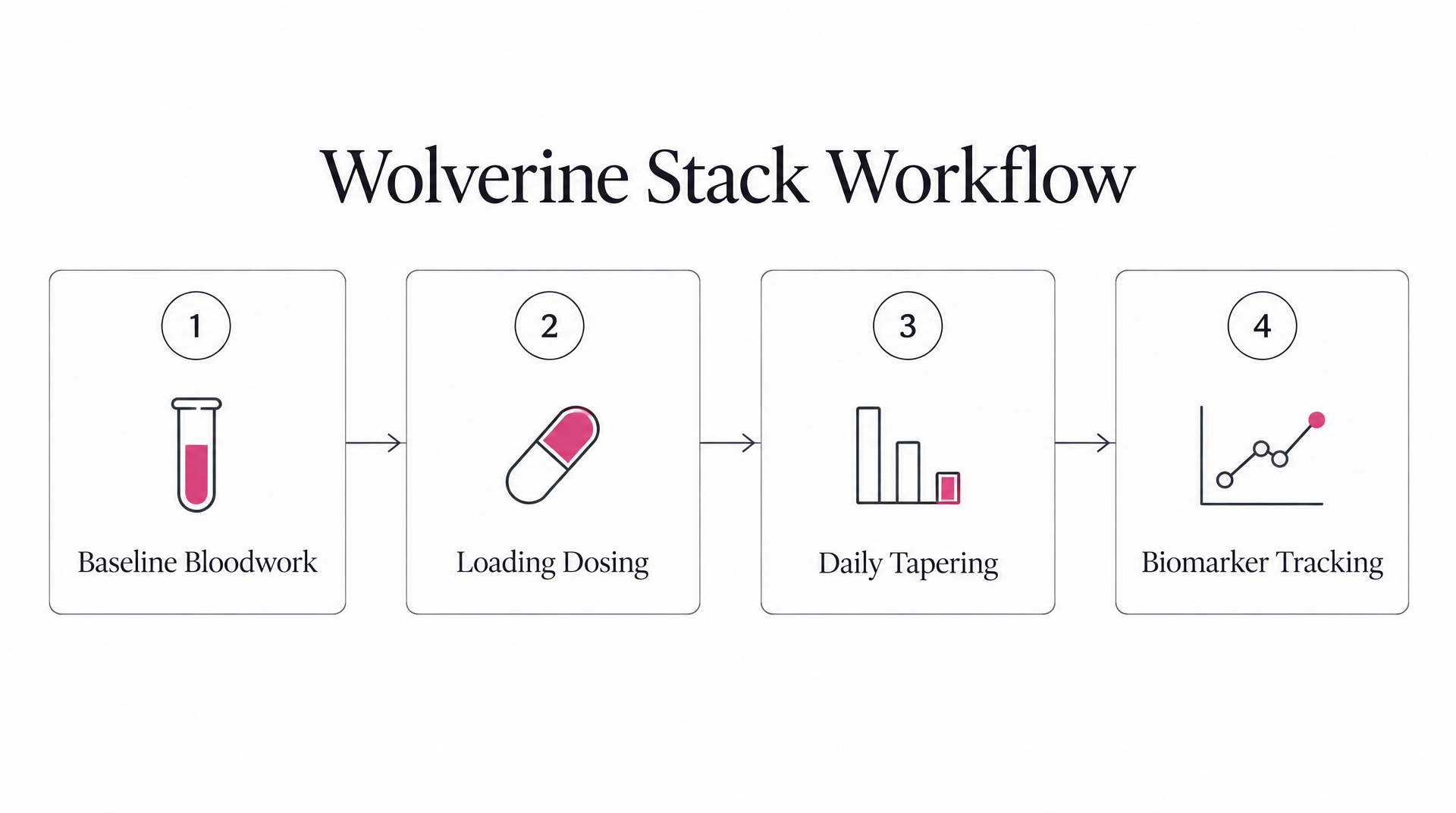
How We Phase a Wolverine Stack Protocol
Many protocols are described in terms of two stages: a loading phase and a maintenance phase. The loading stage uses more frequent dosing early, when tissue is actively remodeling or when you’re trying to establish a signal. Maintenance pulls back to a lighter, steadier cadence once your markers move in the right direction.
For the repair pair, that means more attention during the active healing window, then tapering as inflammation markers and function settle. The GH-axis peptides follow a different clock. These are generally held steadier and judged against IGF-1 trends—a blood marker of growth-hormone activity—rather than how your joints feel on a given morning.
For example, a clinician might design a starting plan around a short loading interval and then reduce frequency only if repeat labs remain within expected range and symptoms improve. Actual dosing and cycle length should follow practitioner judgment and the patient’s biomarker response, not a standard social-media schedule.
Sub-Q Is the Default; IM Earns Its Exceptions
Most of these peptides are commonly used by sub-cutaneous injection, meaning into the fat layer just under the skin. It’s simpler, less painful, and often used for systemic signaling. For most people managing this at home, sub-Q is the format reached for first.
Intramuscular delivery is sometimes considered when the aim is to concentrate a signal near a specific injured muscle or tendon. It’s not inherently better. It’s a targeting choice, and it carries a steeper learning curve for self-injection.
Timing That Respects Your Growth-Hormone Clock
Peptide timing isn’t arbitrary. Some compounds are often scheduled around meals, while GH secretagogues are often timed to natural hormonal pulses. Many protocols propose bedtime or fasted dosing to align with lower insulin levels and the night’s natural GH surge.
Meanwhile, injury-focused peptides may tolerate more flexible scheduling. Some protocols dose them around workout windows or injury flare-ups without losing systemic effect.
| Protocol Element | Two-Peptide Repair Build | Four-Peptide Build |
|---|---|---|
| Primary route | Sub-Q; IM sometimes considered near injury | Sub-Q |
| Dosing cadence | Often described as loading, then taper | Often described as steady maintenance |
| Timing anchor | Flexible, around training | Often bedtime or fasted |
| Phase logic | Heal then back off | Hold and monitor |
| Marker to track | Function, inflammation | IGF-1 trend |
No chart can replace a protocol built around your biology. Every plan here starts from your baseline bloodwork and the core biomarkers we track—from hormones to toxins and gut health—so your regimen reflects what your data actually shows rather than a generic schedule. If you want deeper reading between visits, our clinic blog shares more of our approach.
One honest limit: skip the GH layer entirely if your IGF-1 already sits high for your age. Pushing that axis when it doesn’t need pushing adds risk without a payoff worth tracking.
Safety, Side Effects, and Contraindications
You’ve matched your doses to your labs. Now the harder question lands: what could go wrong, and how would you catch it early? That’s the part of any wolverine stack protocol most online guides skip, and it’s the part we won’t.
The long-term safety data on these peptides doesn’t exist yet. We’re working from short-term use, mechanism, and the lab markers we can actually watch. That’s why we lean on monitoring instead of reassurance.
The Mild Stuff Is Common, the Serious Stuff Is Mechanistic
Some users report local and minor reactions: redness, a small welt, or soreness at the injection site. Rotating sites and clean technique handle the bulk of it.
The reactions worth real attention stem from how these compounds may interact with your endocrine system over time. Some users report joint stiffness, dull headache, or fluid retention that tracks with injection days. For someone over fifty with borderline kidney function or a history of edema, those fluid shifts deserve close attention, though they are not well characterized in clinical trials.
One risk sits outside dosing entirely: product quality. Slater has pointed to contamination and inconsistent manufacturing as open safety questions for these investigational compounds. A clean protocol run on a dirty vial is still a dirty protocol. Source verification isn’t optional at this age.

Some conditions make the four-peptide build the wrong call, full stop. We don’t tiptoe around these.
- Active or recent cancer: anything that amplifies growth signaling can, in theory, feed tissue that’s already proliferating. Skip the GH layer here. This isn’t a hedge; it’s a hard line until you’re well clear.
- Uncontrolled diabetes: a protocol that alters glucose regulation on a system already struggling to manage it is working against you.
- Pregnancy or breastfeeding: no safety data, no reason to gamble.
- Severe sleep apnea: growth hormone secretagogues may worsen airway collapse in susceptible individuals. Get the apnea treated first.
The two-peptide repair build carries a lighter theoretical load than the growth-hormone version, but the cancer caution still applies given the same theoretical growth-signaling concerns.
| Risk area | Who may need caution | Monitoring signals to consider |
|---|---|---|
| Growth-signal history | Active or recent cancer | Clinical oncology status; avoid GH layer unless specialist clears |
| Glucose control | Diabetes or metabolic syndrome | Blood glucose trends if GH layer considered |
| Airway status | Sleep apnea | Symptom review; sleep study if indicated |
| Pregnancy/breastfeeding | Pregnancy or breastfeeding | Avoid |
We use a monitoring schedule rather than a one-time clearance. Baseline labs help establish where your GH-IGF-1 axis, inflammatory markers, and metabolic markers sit before any peptide is introduced. Follow-up testing is then timed to the practitioner’s judgment and the patient’s response. If repeat labs trend unfavorably, or if symptoms such as fluid retention, joint stiffness, or disrupted glucose control appear, the dose is reduced or the protocol is stopped. That stop-or-adjust threshold is clinical judgment tied to your data, not a fixed rule someone posted online.
Common Questions
Can I use the two-peptide stack if I’m already taking prescription medications for inflammation or blood pressure?
That depends on your specific medications and baseline biomarkers. BPC-157 and TB-500 are proposed to influence inflammation pathways and blood vessel growth, so they may theoretically interact with anticoagulants, NSAIDs, or blood-pressure drugs. Start with lab work and coordinate with your prescribing physician before combining these peptides with existing medications.
How long does it typically take to see measurable changes in IGF-1 after starting the four-peptide protocol?
IGF-1 is not a next-morning feedback marker. We treat it as a trend that needs enough time, consistent dosing, and repeat testing to interpret. That is why the four-peptide build requires scheduled bloodwork and clear stop-or-adjust criteria rather than relying on how recovery feels after the first few weeks.
If I stop the wolverine stack mid-cycle due to side effects, will my body rebound or lose the gains I made?
That depends on which layer you stop and why. Tissue gains from a completed repair phase are more likely to persist if rehab, loading, sleep, and nutrition are still in place. The hormonal layer is less durable if training and diet are not supporting lean mass, so we reassess labs and symptoms before deciding whether to pause, taper, or discontinue.
Are these peptides legal to purchase and use in Australia, or do I need a prescription?
The regulatory picture in Australia is not a clean consumer-health category, and access may depend on prescribing pathways and personal-use rules. We do not provide legal advice. The bigger practical issue is not just access; it is whether the product source is verified, whether the protocol is supervised, and whether you understand the regulatory limits already discussed above before purchasing anything.
What happens if my baseline IGF-1 is already high for my age—should I skip the growth-hormone peptides entirely?
Yes. If the marker the growth layer is meant to influence is already elevated, adding CJC-1295 and Ipamorelin is difficult to justify. In that situation, we would look at the specific repair goal, injury history, and safety markers before considering a narrower two-peptide approach.
Can I dose BPC-157 and TB-500 on opposite days to reduce injection frequency, or do they need to overlap daily?
Scheduling can be staggered when the protocol is designed that way. The repair layer does not need to be treated as a single all-at-once event, and spacing injections may make adherence easier. We still base the cadence on the injury target, phase of healing, tolerance, and the biomarkers we are following rather than convenience alone.
Free 15-Minute Discovery Call
Ready to take the guesswork out of your health?
Book a free 15-minute call with Monika to talk through your goals, what testing makes sense for you, and the right next step. No pressure, just clarity.
Book Your Free CallFor educational purposes only. Not medical advice.